
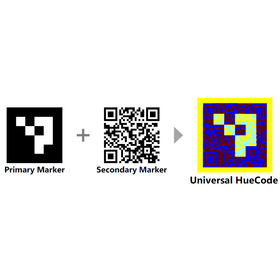
Multiple markers superimposed on a single sheet. Recognizable under a variety of lighting conditions, no learning required, general-purpose code.
2D codes are used in various situations such as information transmission, tickets such as airline tickets, product management in stores, and robot control. However, only one information is usually obtained from 2D codes. Therefore, composite markers are developed by superimposing multiple markers. In the conventional hue specific superimposed marker “HueCode ” devised by the inventors, different markers are superimposed on the area of one marker, and two pieces of information can be acquired simultaneously. However, HueCode can only read markers with a reader that implements a special algorithm. In order to read markers under various lighting conditions, prior learning is required, and HueCode may not be recognized in unknown environments. The present invention is a “Universal HueCode” that solves the above problem by superimposing two or more markers and adopting a color scheme that appears to be the first marker when converted to greyscale, even though the distance between the colors of each marker = RGB u-grid distance is maximally separated. By replacing commonly used QR codes and AR markers with Universal HueCode, it is possible to embed additional information into the marker while continuing to use it for its current purpose. Furthermore, by improving the recognition algorithm, recognition under various lighting conditions is possible without prior learning.
Inquire About This Product
basic information
For details, please contact us or refer to the PDF.
Price range
Delivery Time
Applications/Examples of results
For details, please contact us or refer to the PDF.
catalog(1)
Download All Catalogs
Company information
The revenue generated from technology transfer is reinvested as new research funding for universities and researchers, and is utilized to create further research outcomes. To ensure the smooth operation of this cycle, known as the "Intellectual Creation Cycle," we will vigorously promote technology transfer. The types of seeds we handle include patents, know-how, databases, and programs. We have established a collaborative framework by signing basic technology transfer agreements with the following universities (as of June 1, 2025): Tohoku University, Hirosaki University, Iwate University, Akita University, Fukushima University, Yamagata University, Tohoku Gakuin University, Iwate Medical University, Fukushima Medical University, Aizu University, Miyagi University, Hokkaido University, Muroran Institute of Technology, and Showa Medical University.




![[Example] Line Marker](https://image.mono.ipros.com/public/product/image/209/2000633324/IPROS61714413319042800198.png?w=280&h=280)


