Tohoku Univ. Technology :PPARα agonists that improve cognitive function: T22-091

New drug discovery seeds for psychiatric disorders such as schizophrenia
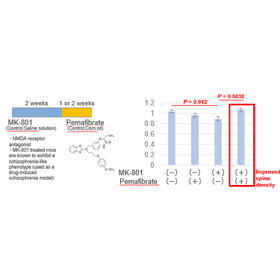
Recent large-scale genomic and postmortem brain analyses have indicated that synaptic dysgenesis may be involved in the pathogenesis of schizophrenia, but the detailed mechanisms remain unclear. Drugs mainly blocking dopamine D2 receptors have been used for the treatment of schizophrenia, but they are mainly used for symptomatic treatment and have insufficient effects on negative symptoms and cognitive dysfunction. Therefore, it is desirable to develop new drugs based on new molecular mechanisms. The inventors have discovered that the decreased function of the PPARA gene, which encodes the nuclear receptor PPARα, is involved in the pathogenesis of schizophrenia [1]. Since PPARα is a transcription factor that can be activated by its ligand, they considered the possibility that activation of PPARA might lead to the improvement of schizophrenia, and found that fenofibrate, a PPARa agonist, is actually effective in improving synaptic function [2]. In this study, they found that pemafibrate, a PPARa agonist, helps to improve cognitive function at the same time as restoring spine density in mice. The invention could lead to the discovery of novel mechanisms for schizophrenia. Furthermore, since decreased spine density and cognitive decline are similar symptoms in other psychiatric disorders such as Alzheimer's, it could also be a therapeutic agent for these disorders.
Inquire About This Product
basic information
For details, please contact us or refer to the PDF.
Price range
Delivery Time
Applications/Examples of results
For details, please contact us or refer to the PDF.
catalog(1)
Download All Catalogs
Company information

The revenue generated from technology transfer is reinvested as new research funding for universities and researchers, and is utilized to create further research outcomes. To ensure the smooth operation of this cycle, known as the "Intellectual Creation Cycle," we will vigorously promote technology transfer. The types of seeds we handle include patents, know-how, databases, and programs. We have established a collaborative framework by signing basic technology transfer agreements with the following universities (as of June 1, 2025): Tohoku University, Hirosaki University, Iwate University, Akita University, Fukushima University, Yamagata University, Tohoku Gakuin University, Iwate Medical University, Fukushima Medical University, Aizu University, Miyagi University, Hokkaido University, Muroran Institute of Technology, and Showa Medical University.

![[Research Material] Global Market for Rare Disease Therapeutics](https://image.mono.ipros.com/public/product/image/7ed/2001463555/IPROS27833049956181521407.jpeg?w=280&h=280)
![[Market Report] Global Inflammatory Bowel Disease Treatment Market](https://image.mono.ipros.com/public/product/image/a4b/2001106888/IPROS31487049118012998584.jpeg?w=280&h=280)
![[Research Material] The Global Market for Alcoholic Liver Disease Treatment](https://image.mono.ipros.com/public/product/image/3a3/2001481232/IPROS08321310365042854705.jpeg?w=280&h=280)
![[Research Material] Global Market for Rheumatic Disease Therapeutics](https://image.mono.ipros.com/public/product/image/4f1/2001460119/IPROS37766465377223263356.jpeg?w=280&h=280)