Tohoku Univ. Technology:Enhanced CO₂ Geological Storage and Mineralization Using Rock Dissolution by Biodegradable Chelating Agents:T22-272

Safe, Secure, and Efficient CCS: A Key to Decarbonization
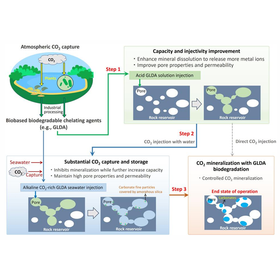
In recent years, CO₂ geological storage using mafic and ultramafic rocks—such as basalt and peridotite, which are rich in calcium and other metal elements that react with CO₂ to form carbonate minerals—has garnered global attention as a means of reducing atmospheric CO₂, a major contributor to global warming. However, subsurface environments for CO₂ storage are typically low in temperature and therefore have limited reactivity. Additionally, the amount and connectivity of pores as well as permeability of the subsurface rocks are not always sufficient, presenting significant challenges that require innovative technological solutions. In storage methods that involve dissolving CO₂ in water, the use of seawater is preferable. However, during the storage process, it is also necessary to temporarily suppress the reaction between metal ions in seawater and CO₂ until the CO₂ is securely stored. This invention promotes CO₂ geological storage and mineralization by using biobased, biodegradable chelating agents that enhance mineral dissolution and capture metal ions. By dissolving minerals in subsurface rocks using the chelating agents, the amount and connectivity of pores (CO₂ storage capacity) increase, and the permeability (CO₂ injectivity) is also improved. Furthermore, when CO₂-charged seawater containing the chelating agents is injected into subsurface rocks, it becomes possible to simultaneously store both CO₂ and the metal ions required for carbonate mineral formation with creating additional rock porosity.
Inquire About This Product
basic information
For details, please contact us or refer to the PDF.
Price range
Delivery Time
Applications/Examples of results
For details, please contact us or refer to the PDF.
catalog(1)
Download All Catalogs
Company information
The revenue generated from technology transfer is reinvested as new research funding for universities and researchers, and is utilized to create further research outcomes. To ensure the smooth operation of this cycle, known as the "Intellectual Creation Cycle," we will vigorously promote technology transfer. The types of seeds we handle include patents, know-how, databases, and programs. We have established a collaborative framework by signing basic technology transfer agreements with the following universities (as of June 1, 2025): Tohoku University, Hirosaki University, Iwate University, Akita University, Fukushima University, Yamagata University, Tohoku Gakuin University, Iwate Medical University, Fukushima Medical University, Aizu University, Miyagi University, Hokkaido University, Muroran Institute of Technology, and Showa Medical University.


![Amenities Meter: Creating a Comfortable Working Space with IoT [Work Style Reform]](https://image.mono.ipros.com/public/product/image/6fb/2001027009/IPROS12754886358639934309.png?w=280&h=280)