Tohoku Univ. Technology : Safe, Efficient, and Eco-Friendly Subsurface Rock Fracturing:T25-004

Fracturing with biobased reactive fluid
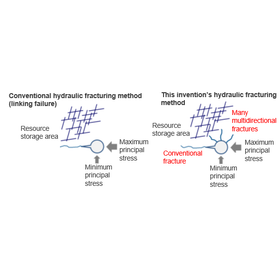
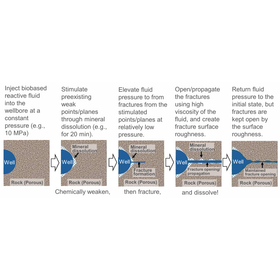
In the development of subsurface energy infrastructures—such as geothermal power generation, geological storages of carbon dioxide (CCS) and renewable- energy-based hydrogen—it is essential to artificially create highly permeable fractures in rocks at depths of 1,000 to 5,000 meters and temperatures ranging from approximately 30°C to 300°C, in order to secure fluid pathways. In recent years, there has been a growing demand for the development of safer, more efficient, and environmentally friendlier technologies. Conventional hydraulic fracturing is a purely mechanical technique that fractures rock by injecting high-pressure fluid through a wellbore. However, this method faces several technical and environmental limitations, including concerns over induced seismicity from high-pressure injections, and difficulty in maintaining fracture openings and fluid loss especially in moderately permeable rocks. These challenges have highlighted the need for innovative chemical-based approaches—particularly those grounded in green chemistry principles. This invention introduces an innovative fracturing technique that utilizes biobased reactive fluid having high viscosity. This method chemically weakens the rock while forming and propagating fractures at relatively low pressures. Furthermore, by dissolving and roughened the fracture surfaces, the method helps maintain fracture openings and improves permeability over time.
Inquire About This Product
basic information
For details, please contact us or refer to the PDF.
Price range
Delivery Time
Applications/Examples of results
For details, please contact us or refer to the PDF.
catalog(1)
Download All Catalogs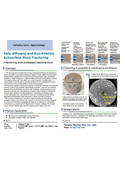
Company information
The revenue generated from technology transfer is reinvested as new research funding for universities and researchers, and is utilized to create further research outcomes. To ensure the smooth operation of this cycle, known as the "Intellectual Creation Cycle," we will vigorously promote technology transfer. The types of seeds we handle include patents, know-how, databases, and programs. We have established a collaborative framework by signing basic technology transfer agreements with the following universities (as of June 1, 2025): Tohoku University, Hirosaki University, Iwate University, Akita University, Fukushima University, Yamagata University, Tohoku Gakuin University, Iwate Medical University, Fukushima Medical University, Aizu University, Miyagi University, Hokkaido University, Muroran Institute of Technology, and Showa Medical University.