
Presentation of joining technology data: Ultra-thin bonding layers enable dissimilar material bonding and laminated bonding!

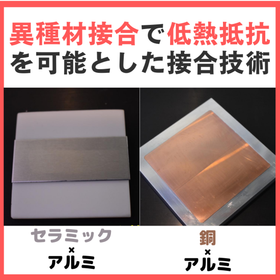
Semicon Japan 2025: Achieving over 10 MPa in shear tensile strength! Enables the joining of dissimilar materials such as metals, resins, and ceramics necessary for improving heat dissipation characteristics!
【Exhibition Information】 We will be showcasing "CAM bonding capable of joining dissimilar materials" at SEMICON Japan 2025. ■ Dates: December 17-19, 2025 ■ Booth: Chubu Pavilion / E4141 Our company conducts trial processing, develops specialized CAM agents, and engages in process development using CAM bonding technology. This bonding technology combines chemical bonding and fusion. It is environmentally friendly, easy to apply, and cost-effective. A CAM agent is applied and dried on the metal surface to form an organic film, and the workpieces are bonded together through thermal pressing. You can read detailed technical documents that describe the specific features and functions. 【Examples of Bondable Materials】 ■ Metals: Aluminum, Copper, Steel, Titanium ■ Resins: Nylon, PBT, CFRP ■ Ceramics: Alumina, Glass ■ Zero thermal resistance is also possible.
Inquire About This Product
basic information
【Features of Low Thermal Resistance CAM Agents】 ■M8.xx: Water-soluble, conductive ■G4.xx: Non-water-soluble, insulating, transparent ■Q1.xx: Non-water-soluble, conductive ■Q3.xx: Non-water-soluble, insulating ■Q5.xx: Non-water-soluble, insulating, inexpensive *For more details, please feel free to contact us.
Price range
Delivery Time
Applications/Examples of results
For more details, please feel free to contact us.
catalog(5)
Download All Catalogs


Company information

Our company is engaged in the development of joining technologies. The newly developed CAM joining can handle a range of applications, starting from the joining of dissimilar materials such as metal and resin, to metal-metal joining that includes dissimilar metals. CAM joining can achieve zero thermal resistance and is also applicable to the laminated joining of multilayer thin plates.

![[Presentation of Materials] Layered Joining of Metals Using CAM Joining](https://image.mono.ipros.com/public/product/image/9e4/2001109438/IPROS14342783631787409537.PNG?w=280&h=280)


![Non-melting joining technology 'Friction Stir Welding' [Joining prototype in progress!]](https://image.mono.ipros.com/public/product/image/b1d/2000722273/IPROS97878006696714956384.png?w=280&h=280)


![[Free Offer] Prevent Blade Troubles in Production Equipment! Non-Stick Thin Film Coating](https://image.mono.ipros.com/public/product/image/fde/2000612726/IPROS23915370847246220159.jpeg?w=280&h=280)
![[Free Giveaway] Non-Stick Coating | Prevent Blade Troubles in Production Equipment!](https://image.mono.ipros.com/public/product/image/a78/2000619955/IPROS37607432622075090550.jpeg?w=280&h=280)

![[Surface Treatment Case] Surface treatment that streamlines the manufacturing process of lithium-ion batteries.](https://image.mono.ipros.com/public/product/image/604/2000700111/IPROS81671406460541521470.jpeg?w=280&h=280)
![[Surface Treatment Case] Improving Production Equipment for Lithium-Ion Batteries!](https://image.mono.ipros.com/public/product/image/5b1/2000703368/IPROS15171996575415638336.jpeg?w=280&h=280)