
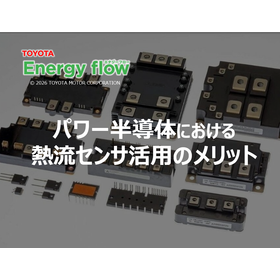
Next-generation power semiconductors achieve breakthroughs through the use of thermal flow sensors.

From margin design that protects by looking at temperature to confident design that attacks by looking at heat flow.
Next-generation power semiconductors (SiC and GaN) have high energy density, and to address the following challenges, a breakthrough in thermal design thinking is essential! 1. Occurrence of localized thermal concentration 2. Black box nature of thermal design 3. Impact of time-dependent thermal resistance By utilizing thermal flow sensors, the perspective on design changes, leading to a reduction in development lead time and an improvement in product competitiveness.
Inquire About This Product
basic information
For more details, please refer to the technical documents and product catalogs that can be downloaded from below.
Price range
Delivery Time
Applications/Examples of results
- Predictive control that detects signs of thermal runaway through abnormal heat spikes and reduces output. - Real-time monitoring of contact thermal resistance to detect signs of TIM degradation and perform maintenance before failure. - Shortening development lead time by improving the accuracy of thermal fluid analysis.
catalog(1)
Download All Catalogs![[Use Case] Next-Generation Power Semiconductors](https://image.mono.ipros.com/public/catalog/image/2115964/IPROS8059636701977932245.jpeg?w=120&h=170)
Company information

In the business development area of Toyota Motor Corporation, we are developing technology solution businesses that leverage the technologies and know-how cultivated over many years of car manufacturing. The heat flow sensor "Energy flow," which can measure "heat flux" essential for elucidating the mechanisms of temperature changes with high sensitivity and simplicity, is an in-house sensor utilized in Toyota's vehicle development field. It has become an indispensable item for the development of high-efficiency thermal energy management systems/components aimed at a decarbonized society, and it is being used by customers in various industries, including the automotive sector. Please feel free to contact us when you need assistance.


