

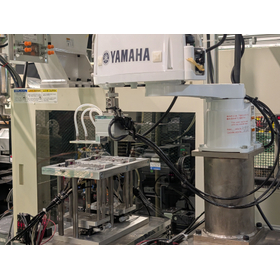
Elimination of misinsertion completely with an in-house automated transport robot utilizing magnetic polarity. Zero mass production troubles.
In the molding of magnetic inserts for heating devices, the risk of incorrect insertion of the magnets' front and back sides and polarity, as well as the magnetic influence on the molds, had been a cause of mass production troubles. We developed an in-house automatic transport robot that utilizes the polarity of the magnets to prevent incorrect insertion, and we adopted special mold steel that is not affected by magnetism for the product components (cavity cores). We have achieved the elimination of mass production troubles related to magnetic inserts and zero defects from incorrect insertion. By in-house development of the automatic transport robot, we can flexibly build an automated line optimized for the customer's specific molding process.
Inquire About This Product
basic information
【Main Technologies and Manufacturing Methods】 - Automatic transport robot with magnetic polarity detection mechanism (in-house production) - Selection of mold steel materials that eliminate magnetic influence - Mold structure design specifically for magnetic inserts
Price range
Delivery Time
Applications/Examples of results
【Target Industries】 Heating devices (e-cigarettes, etc.), electronic equipment 【Examples of Target Applications】 - Electronic components that require magnetic inserts 【Achievements】 Elimination of mass production troubles with magnetic inserts. Achieved zero defective insertions.
catalog(2)
Download All Catalogs

Company information

**About Yoshida Techno Works** We are the world's first manufacturer to commercialize in-mold transfer molding, which utilizes plastic molding and decoration technology cultivated through cosmetic container manufacturing, allowing for simultaneous molding and transfer decoration. **Key Technologies** - Double in-mold molding that performs simultaneous decoration on both sides of the product - Hybrid molding that combines sheet inserts with in-mold techniques - Glass insert in-mold (GIM) molding that inserts reinforced glass into the mold, allowing for integrated molding of resin frames and decoration - Two-color in-mold molding that combines rotational two-color molding with in-mold transfer - Composite technology that integrates metal (such as SUS sheet metal and nuts) with in-mold molding - Real material (natural wood, fabric, synthetic leather, etc.) insert molding - Out-mold deep drawing decoration method (VSS) compatible with metal, glass, and resin