Tohoku Univ. and Tokyo Univ.Technology:Scanning control technology for designing desired laser intensity distributions:T24-044

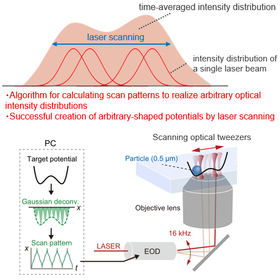
Precise design of scanning speeds and trajectories, contributing to enhanced microparticle control and improved fabrication accuracy
In conventional laser scanning control, it is difficult to accurately match an arbitrary target intensity distribution even when optimizing the temporal change of irradiation positions. This has imposed limits on the precision of microparticle control using optical tweezers and the resolution of drawing and fabrication. This invention overcomes these constraints by reverse-calculating and optimizing scan patterns from target distribution data. By precisely managing irradiation timing and intensity balance, it aligns actual laser intensities with ideal profiles, enabling high-precision microparticle manipulation, maskless lithography, and optical 3D printing. Leveraging this technology, inventors achieved the world’s first experimental demonstration of particle transport with minimal thermodynamic dissipation, as predicted by mathematical "optimal transport theory". This breakthrough provides a foundation for next-generation ultra-low-power information processing and the design of precision nanomachines
Inquire About This Product
basic information
please contact us or refer to the PDF for more details.
Price range
Delivery Time
Applications/Examples of results
please contact us or refer to the PDF for more details.
catalog(1)
Download All Catalogs
Company information
The revenue generated from technology transfer is reinvested into universities and researchers as new research funding, which is used to create further research outcomes. To ensure the smooth operation of this cycle, known as the "Intellectual Creation Cycle," we will actively promote technology transfer. The types of seeds we handle include patents, know-how, databases, and programs. We have established a collaborative framework by concluding basic technology transfer agreements with the following universities (as of April 1, 2026): - Tohoku University - Hirosaki University - Iwate University - Akita University - Fukushima University - Yamagata University - Tohoku Gakuin University - Iwate Medical University - Fukushima Medical University - Aizu University - Miyagi University - Hokkaido University - Muroran Institute of Technology - Showa Medical University - Asahikawa Medical University