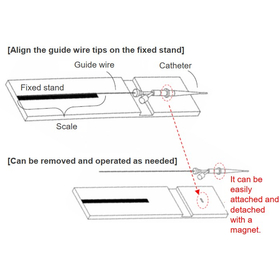
Adjuster for easily grasping positional relation between catheter and guide wire and providing safe operation
In endovascular therapy, it is necessary to advance the distal tip of a catheter through the body to reach a lesion. When guiding the catheter internally, a guidewire is passed through the catheter and used for navigation. The positions of the catheter and guidewire are continuously monitored using X-ray fluoroscopy. While modern catheters have pursued extreme thinness and flexibility to enable highly precise treatments, they have become less visible under X-ray, often making it difficult to ascertain the exact location of the catheter tip. Consequently, the catheter may reach unintended locations, or inappropriate force may be applied to the guidewire. This can damage cerebral blood vessels and even lead to extremely severe complications. To prevent such adverse events, operators must maintain constant vigilance, which leads to prolonged procedure times and increased operator fatigue. The present invention is based on the concept of equipping the proximal catheter control section with a graduated adjuster. This clarifies the positional relationship between the catheter and the guidewire, enabling accurate identification of the catheter tip's location. The adjuster can be easily attached to and detached from the catheter, and is designed to secure to the exact same position on the catheter every time.
Inquire About This Product
basic information
please contact us or refer to the PDF for more details.
Price range
Delivery Time
Applications/Examples of results
please contact us or refer to the PDF for more details.
catalog(1)
Download All Catalogs
Company information
The revenue generated from technology transfer is reinvested into universities and researchers as new research funding, which is used to create further research outcomes. To ensure the smooth operation of this cycle, known as the "Intellectual Creation Cycle," we will actively promote technology transfer. The types of seeds we handle include patents, know-how, databases, and programs. We have established a collaborative framework by concluding basic technology transfer agreements with the following universities (as of April 1, 2026): - Tohoku University - Hirosaki University - Iwate University - Akita University - Fukushima University - Yamagata University - Tohoku Gakuin University - Iwate Medical University - Fukushima Medical University - Aizu University - Miyagi University - Hokkaido University - Muroran Institute of Technology - Showa Medical University - Asahikawa Medical University