
List of Manufacturing and processing machinery products
- classification:Manufacturing and processing machinery
271~315 item / All 102080 items


It won't break even after 1 million repetitions! A mat switch with reliable operation, high durability, and low price. Suitable for options in machine tools as well. Please consult us about delivery t...
- Sensors


We can accommodate high resistance over 10,000 ohms, with diameters ranging from approximately 30 mm to 8 inches, and we also offer thinning and chip processing arrangements!
- Other semiconductors
- Processing Contract
- Wafer

Heat-resistant ceramic coating at 800℃.
- Contract manufacturing
- Processing Contract
- Surface treatment contract service

It repels dirt and oil due to its super hydrophobic properties.
- Contract manufacturing
- Processing Contract
- Surface treatment contract service


It excels in high sensitivity detection, quantification, and portability, making it suitable for quality inspection and research and development settings. It contributes to the detection of minute for...
- Semiconductor inspection/test equipment
- Other Sanitation Inspections
- Other appearance and image inspection equipment

17th High-Performance Materials WEEK [Tokyo] We will be exhibiting a fine particle visualization system at the 17th High-Performance Film Exhibition. (September 30, 2026 (Wed) - October 2, 2026 (Fri) / Makuhari Messe, Hall 2)
The particle visualization technology developed under our brand "ViEST" has a very high level of detection sensitivity that allows for real-time visualization of the suspended and adhered states of micro and nano-sized particles. We are expanding our sales of visualization systems and providing evaluation services (such as investigating particles and airflow in production processes, manufacturing equipment, and factory environments, evaluating the performance of cleaning products, and proposing yield improvement measures) both domestically and internationally. We consistently support the identification of causes and the formulation of countermeasures by visualizing fine foreign substances, particle adhesion due to static electricity, and variations in cleanliness that are problematic in the film manufacturing process. The following are some examples of applications, but by utilizing our technology, we can strongly promote the resolution of various issues such as the deterioration of defect rates caused by fine foreign substances, visualization of clean airflow, and concerns regarding site cleanliness. - Visualization of foreign matter contamination and adhesion mechanisms in the coating and drying processes - Visualization of dust generation and re-adhesion during roll transportation and consideration of countermeasures - Evaluation of airflow and cleanliness within clean booths/clean rooms - Identification of dust sources within manufacturing equipment and promotion of cleanliness - Reduction of foreign matter adhesion risk on film surfaces and improvement of yield
PTFE coating that provides slip to rubber.
- Contract manufacturing
- Processing Contract
- Surface treatment contract service
Resistant to oil, solvents, and heat. Maximizes the potential of sliding parts with a low-friction coating.
- Contract manufacturing
- Processing Contract
- Surface treatment contract service
Heat-resistant and insulating coating film.
- Processing Contract
- Surface treatment contract service
- Coating Agent


Shaping soft materials like rubber. Capable of handling complex shapes and prototypes as well as mass production. Processing examples are currently available!
- Processing Contract
We will exhibit at the Mechanical Components Technology Exhibition [Tokyo] from July 1 (Wednesday) to July 3 (Friday), 2026.
Our company is a manufacturer of processing materials such as rubber, plastic, and sponge, which are softer than metal. In particular, our rubber cutting processing that does not require molds is a rare technology even in Japan, and the samples of this processing are a must-see! Please take a look at the precision, appearance, and finish that can be achieved through cutting processing.
Cost reduction! Introducing a method to create rubber parts without the need for molds!
- Processing Contract
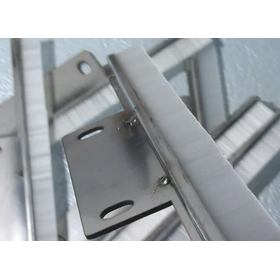

Custom-made solutions utilizing the workability of channel brushes for guide rails of curved conveyors.
- Conveyor
- Conveyor Components
- Food Conveyor Equipment
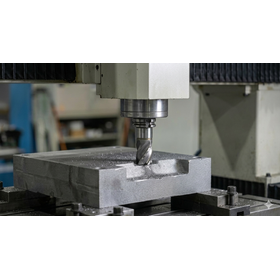

We confirmed double the lifespan with FC250 processing. Would you like to try its effects at your site as well?
- Processing Contract
- Other contract services
- Surface treatment contract service
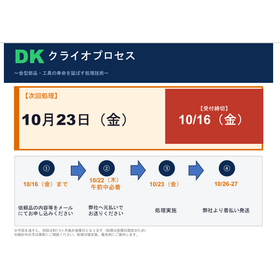
[DK Cryo Process Next Processing Date Notification] Next processing on 10/23
【DK Cryo Process Next Processing Date Notification】 Thank you for your continued support. The next processing date for the DK Cryo Process is Friday, October 23. The application deadline is Friday, October 16. If you have mold parts or cutting tools that are suffering from chipping or wear, please consider this opportunity. ✔ We can accommodate from just one piece ✔ Coated and in-use parts can also be consulted ✔ Proven lifespan increase of 2 to 7 times (depending on usage conditions) Feel free to contact us with inquiries such as, "Can this part be processed?" "I would like to know the estimated cost." We are also offering a free collection of DK Cryo Process case studies. For applications and inquiries: https://dksmmp.com/dkcryo.php dfujita@dksmmp.com


Of course, short delivery times in manufacturing quickly resolve evaluation-related issues.
- Contract manufacturing


Ideal for transporting drums. Easy to move with large wheels!


- Trolley

Announcement of the publication of Aqua System "Product Catalog vol. 23" (2023-2024 edition)
Aqua System has published the "Product Catalog vol. 23" (2023-2024 edition). The shipping of the new catalog itself is scheduled to begin sequentially from April 1. Customers who wish to receive the catalog by mail are kindly requested to place their orders through the contact section of our company website. The product catalog has been designed to be more understandable and convenient for everyone as a pump manufacturer. We will continue to strive to be a pump manufacturer that is loved and helpful to everyone. We appreciate your continued support for Aqua System this year. <Contents> Product catalog of Aqua System Co., Ltd. Featured products: Over 400 types Improvement examples from issues: Over 40 cases - Product usage examples by industry - Special features 1. Introduction of new products scheduled for release in 2023-2024: "Connecting people and products with unique ideas for on-site improvements" 2. "Sustainable" services that are close to our customers "Creating things" to shape the future! - Table of contents / Index - Information on each product - Chemical resistance table - Viscosity compatibility table - Corporate philosophy / History - Product inquiry form

A grease injector convenient for the maintenance of air equipment; simply insert it into the intake part and rotate to improve product durability and maintain performance.


- Filling and bottling machines

Notice of advertisement publication in the June 22, 2023 issue of the Nikkan Kogyo Shimbun.
We have an advertisement published in the June 22, 2023 issue of the Nikkan Kogyo Shimbun. The article titled "Non-electric air motor factory fans, blowers & Cool Mister (Mist Fan ACM) for ventilation, blowing, exhaust, and heat stroke prevention in flammable areas!!" features our products. We introduce a mist fan (Cool Mister) that can be installed on factory fans, providing a refreshing mist that doesn't feel sticky, and can be used for heat stroke and static electricity countermeasures, as well as a grease suction device for air motors and grease-up (GRU) that helps reduce maintenance labor hours.

Solve the problems of tank cleaning for work machines and the recovery of cutting fluids and chips! A document summarizing product features is available.
- Other machine tools
Announcement of the publication of Aqua System "Product Catalog vol. 23" (2023-2024 edition)
Aqua System has published the "Product Catalog vol. 23" (2023-2024 edition). The shipping of the new catalog itself is scheduled to begin sequentially from April 1. Customers who wish to receive the catalog by mail are kindly requested to place their orders through the contact section of our company website. The product catalog has been designed to be more understandable and convenient for everyone as a pump manufacturer. We will continue to strive to be a pump manufacturer that is loved and helpful to everyone. We appreciate your continued support for Aqua System this year. <Contents> Product catalog of Aqua System Co., Ltd. Featured products: Over 400 types Improvement examples from issues: Over 40 cases - Product usage examples by industry - Special features 1. Introduction of new products scheduled for release in 2023-2024: "Connecting people and products with unique ideas for on-site improvements" 2. "Sustainable" services that are close to our customers "Creating things" to shape the future! - Table of contents / Index - Information on each product - Chemical resistance table - Viscosity compatibility table - Corporate philosophy / History - Product inquiry form

Solve the problems of tank cleaning for machine tools and the recovery of cutting fluids and chips! A document summarizing product features is available.
- Other machine tools
Announcement of the publication of Aqua System "Product Catalog vol. 23" (2023-2024 edition)
Aqua System has published the "Product Catalog vol. 23" (2023-2024 edition). The shipping of the new catalog itself is scheduled to begin sequentially from April 1. Customers who wish to receive the catalog by mail are kindly requested to place their orders through the contact section of our company website. The product catalog has been designed to be more understandable and convenient for everyone as a pump manufacturer. We will continue to strive to be a pump manufacturer that is loved and helpful to everyone. We appreciate your continued support for Aqua System this year. <Contents> Product catalog of Aqua System Co., Ltd. Featured products: Over 400 types Improvement examples from issues: Over 40 cases - Product usage examples by industry - Special features 1. Introduction of new products scheduled for release in 2023-2024: "Connecting people and products with unique ideas for on-site improvements" 2. "Sustainable" services that are close to our customers "Creating things" to shape the future! - Table of contents / Index - Information on each product - Chemical resistance table - Viscosity compatibility table - Corporate philosophy / History - Product inquiry form

Solve the problems of tank cleaning for machine tools and the recovery of cutting fluids and chips! A document summarizing product features is available.
- Other machine tools
Announcement of the publication of Aqua System "Product Catalog vol. 23" (2023-2024 edition)
Aqua System has published the "Product Catalog vol. 23" (2023-2024 edition). The shipping of the new catalog itself is scheduled to begin sequentially from April 1. Customers who wish to receive the catalog by mail are kindly requested to place their orders through the contact section of our company website. The product catalog has been designed to be more understandable and convenient for everyone as a pump manufacturer. We will continue to strive to be a pump manufacturer that is loved and helpful to everyone. We appreciate your continued support for Aqua System this year. <Contents> Product catalog of Aqua System Co., Ltd. Featured products: Over 400 types Improvement examples from issues: Over 40 cases - Product usage examples by industry - Special features 1. Introduction of new products scheduled for release in 2023-2024: "Connecting people and products with unique ideas for on-site improvements" 2. "Sustainable" services that are close to our customers "Creating things" to shape the future! - Table of contents / Index - Information on each product - Chemical resistance table - Viscosity compatibility table - Corporate philosophy / History - Product inquiry form
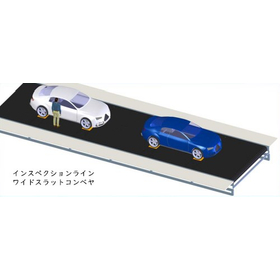

Utilizing the existing line, we simplify and improve the tire locking process! This achieves minimal burden without the need for large-scale renovations.
- Conveyor
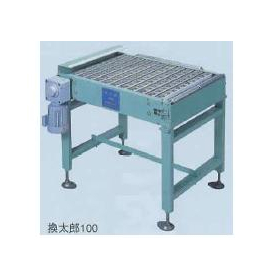

Compatible with light to medium weight transport items. It can change direction on the same plane.
- Conveyor
One machine for lifting and transporting. Smooth flow of harvested goods.
- lift
- Other conveying machines
![[For Pharmaceutical Manufacturing] ...](https://image.mono.ipros.com/public/product/image/332144/IPROS638448330467928377.JPG?w=280&h=280)
Ideal for sterile transport! Small workpieces can be turned at right angles without changing height. Simple design helps reduce after-costs.
- Conveyor

Automatic deployment in sites where hoists cannot be used. A lineup according to the deployment capacity.
- Conveyor
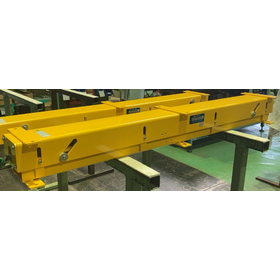
Achieving stable and precise transfer and elevation for component installation in the aerospace field.
- Other conveying machines
- Conveyor

A conveyor that satisfies your desires! It transports more, faster, and more reliably.
- Conveyor
- Other conveying machines
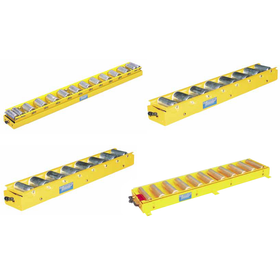
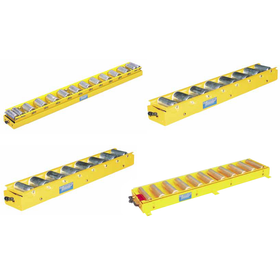
Equipped with a free roller, it can be easily introduced as a switch.
- lift
- Other conveying machines

Compatible with pallet and heavy cargo transport. Can change direction on the same plane.
- Conveyor

Equipped with a parallel link mechanism! This power base allows for hose replacement without disassembly.
- lift
- Other conveying machines


Leave the sintering and pre-sintering of industrial chemical raw materials such as functional materials, electronic materials, and powder mixed materials to us.
- Contract manufacturing
- Processing Contract
- Industrial Furnace

High-precision positioning machining achieving μm accuracy.
- Processing Contract
- Plastic Mould
- Mold
Achieving a maximum cooling time reduction of 50%: Introducing examples of mold performance improvement through diffusion bonding.
- Plastic Mould
- Injection Molding Machine
- Mold
From small precision items to large 2-meter pieces, we guarantee the final finishing accuracy.
- Grinding Machine
- Contract manufacturing
- Processing Contract
Are you having trouble with deep hole machining and your suppliers?
- Contract manufacturing
- Processing Contract
- Plastic Mould
Ultra-precision machining technology that supports μm accuracy
- Plastic Mould
- Processing Contract
- Mold
Joining different materials without melting: A joining technology that balances precision and strength.
- Welding Machine
- Oxidation/Diffusion Device
- Processing Contract
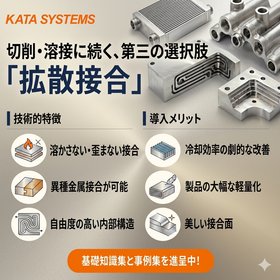
Please use it for demonstration tests and research and development.
- Processing Contract
- Contract manufacturing
- Semiconductor inspection/test equipment
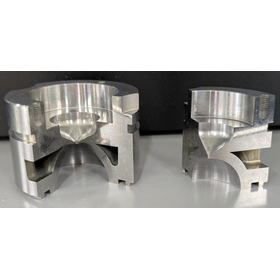
Microfabrication and diffusion bonding
- Special Processing Machinery
- Other machine elements
- Other purification and extraction
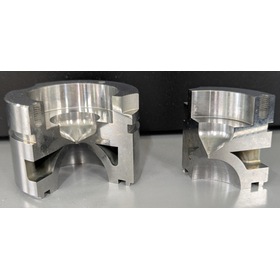
We meet the high precision needs of semiconductor manufacturing with microfabrication and diffusion bonding.
- Special Processing Machinery
- Heat exchanger
- Oxidation/Diffusion Device
Lightweighting of metal products using diffusion bonding.
- Other conveying machines
- Press Dies
- Auto Parts

Genuinely facing technology and delivering that technical expertise to our customers.
- Plastic Mould
- Mold
- Food Packaging Machinery
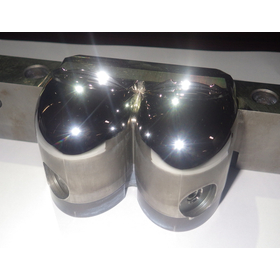
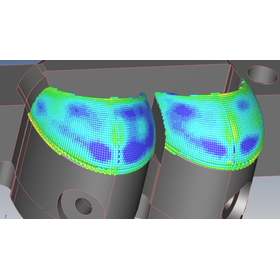
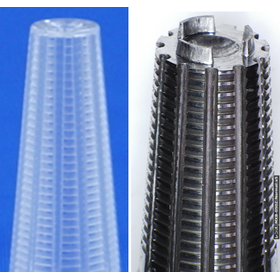
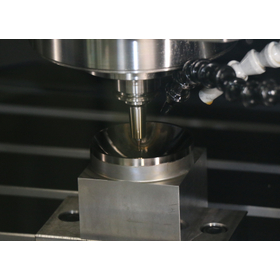
Processing accuracy in the 1000 range.
- Processing Contract
- Contract manufacturing
- Special Processing Machinery