We have compiled a list of manufacturers, distributors, product information, reference prices, and rankings for Spectrometer.
ipros is IPROS GMS IPROS One of the largest technical database sites in Japan that collects information on.

Spectrometer Product List and Ranking from 77 Manufacturers, Suppliers and Companies | IPROS GMS

Last Updated: Aggregation Period:Jan 14, 2026~Feb 10, 2026
This ranking is based on the number of page views on our site.

Spectrometer Manufacturer, Suppliers and Company Rankings

Last Updated: Aggregation Period:Jan 14, 2026~Feb 10, 2026
This ranking is based on the number of page views on our site.

  1. 一般財団法人材料科学技術振興財団 MST Tokyo//Testing, Analysis and Measurement
  2. サーモフィッシャーサイエンティフィック株式会社/Thermo Fisher Scientific K.K. Tokyo//Testing, Analysis and Measurement
  3. オプトシリウス Tokyo//others
  4. 4 null/null
  5. 5 テックアナリシス Osaka//Testing, Analysis and Measurement

Spectrometer Product ranking

Last Updated: Aggregation Period:Jan 14, 2026~Feb 10, 2026
This ranking is based on the number of page views on our site.

  1. Fully Automated X-ray Photoelectron Spectroscopy Device 'K-Alpha' サーモフィッシャーサイエンティフィック株式会社/Thermo Fisher Scientific K.K.
  2. Low price! Ultra-compact near-infrared spectrometer FLAME-NIR+ オプトシリウス
  3. HORIBA Compact Raman テックアナリシス
  4. 4 Near Infrared Spectrometer STD Series 900–1700nm ナノシード 本社
  5. 5 X-ray photoelectron spectroscopy device 'Nexsa' サーモフィッシャーサイエンティフィック株式会社/Thermo Fisher Scientific K.K.

Spectrometer Product List

151~180 item / All 236 items

Displayed results

3D Micro Laser Raman Spectroscopy Device Nanofinder30A

Pursuing sensitivity and spatial resolution approaching the limits, a hybrid system combining "Raman spectroscopy + α" with other systems, achieving diversification of Raman spectroscopy measurements.

Nanofinder - High-quality Raman spectral analysis and evaluation with a spatial resolution of 200 nanometers. Tokyo Instruments pioneered the industry's first "Raman imaging with a spatial resolution of 200 nanometers" 20 years ago and continues to challenge itself with "cutting-edge analysis and evaluation technologies."

  • Spectroscopic Analysis Equipment
  • Analytical Equipment and Devices
  • Laser microscope
  • Spectrometer

Added to bookmarks

Bookmarks list

Bookmark has been removed

Bookmarks list

You can't add any more bookmarks

By registering as a member, you can increase the number of bookmarks you can save and organize them with labels.

Free membership registration

Multi-Focus Raman Microscope Phalanx-R

Raman imaging captures the state of chemical reactions and the distribution of molecules inside cells in an "instant," like taking a photograph.

The multi-focal Raman microscope Phalanx-R is the world's first Raman microscope that can capture 2D Raman images "in an instant," just like taking a photograph. It enables real-time imaging of dynamic chemical reactions, which was previously impossible, and allows for high-speed observation of molecular distribution and changes within cells while minimizing light damage to the samples.

  • Spectroscopic Analysis Equipment
  • Laser microscope
  • Analytical Equipment and Devices
  • Spectrometer

Added to bookmarks

Bookmarks list

Bookmark has been removed

Bookmarks list

You can't add any more bookmarks

By registering as a member, you can increase the number of bookmarks you can save and organize them with labels.

Free membership registration

Microscopic Raman Spectroscopy Device 'Nanofinder FLEX'

Shape observation of transparent samples (resin, film, organic EL) using Raman and fluorescence measurement!

The "Nanofinder FLEX" is a versatile device equipped with the basic performance of the 3D micro laser Raman spectrometer "Nanofinder30," featuring modularized units. It maintains high spatial resolution and sensitivity while pursuing thorough miniaturization and achieving low cost. The software is the well-established dedicated Nanofinder software, which is rich in content and excels in image representation (visualization). 【Features】 ■ High performance, compact size, low cost ■ Raman spectroscopic imaging with spatial resolution below 300nm ■ High sensitivity (detecting the fourth harmonic of Si within one minute) with low illumination laser of 4mW ■ Adoption of confocal laser microscopy ■ Raman optical unit reduced to A4 size *For more details, please refer to the PDF document or feel free to contact us.

  • Spectroscopic Analysis Equipment
  • Analytical Equipment and Devices
  • Laser microscope
  • Spectrometer

Added to bookmarks

Bookmarks list

Bookmark has been removed

Bookmarks list

You can't add any more bookmarks

By registering as a member, you can increase the number of bookmarks you can save and organize them with labels.

Free membership registration

Raman spectrometer "Peakseeker"

The definitive version of a high-performance compact Raman system!

"Peakseeker" is a groundbreaking Raman spectroscopy system that includes a laser, spectrometer, probe, and computer (with software). It allows for easy Raman spectroscopic measurements simply by placing the probe on solids, powders, or liquids. Compared to traditional expensive and cumbersome large devices, it is compact, user-friendly, and enables Raman measurements without complicated setups. Additionally, the higher-end model, Pro, features a cooled back-illuminated CCD, allowing for high sensitivity and high S/N (1,000:1) measurements. 【Features】 ■ One-touch Raman spectroscopy measurement, easy, compact, and affordable ■ Easy measurements with the included PC (with software) ■ Capable of measuring solids, powders, and liquids (penetration) ■ High sensitivity and high S/N type (1,000:1) release *For more details, please download the PDF or feel free to contact us.

  • Other measurement, recording and measuring instruments
  • Spectrometer

Added to bookmarks

Bookmarks list

Bookmark has been removed

Bookmarks list

You can't add any more bookmarks

By registering as a member, you can increase the number of bookmarks you can save and organize them with labels.

Free membership registration

Ion Energy Spectroscopy (IES)

It is possible to obtain information about high-quality thin films and interfaces! A diagnostic tool for process monitoring.

"Ion Energy Spectroscopy (IES)" is an ion energy spectroscopic method. It provides a diagnostic tool for in-situ real-time process monitoring for PLD/PED systems. High-quality thin film and interface information can be obtained from the energy theory of lasers using a plasma plume. 【Features】 ■ It is possible to obtain high-quality thin film and interface information from the energy theory of lasers using a plasma plume. *For more details, please refer to the PDF document or feel free to contact us.

  • Spectroscopic Analysis Equipment
  • Spectrometer

Added to bookmarks

Bookmarks list

Bookmark has been removed

Bookmarks list

You can't add any more bookmarks

By registering as a member, you can increase the number of bookmarks you can save and organize them with labels.

Free membership registration

Reflective spectroscopic film thickness gauge rental

You can try out the new model! Welcome to the era of rental reflectance spectroscopic film thickness gauges.

At Asumi Giken, instead of introducing expensive equipment, we propose usage that fits your needs and allow customers to select devices without the risk of failure by offering rental of reflective spectroscopic film thickness gauges. Even without a substantial budget, you can use it immediately at a reduced cost, and temporary use is possible for short-term research or in case of equipment failure. The dedicated software is already installed, and you can start using it right away with just a USB cable connection. If you have any questions about usage, our operators will assist you over the phone. 【Benefits of Rental】 ■ Available for trial use ■ You can thoroughly evaluate operability and functionality before purchasing ■ Unlike purchasing, internal approval processes are relatively easy ■ No need for payment of fixed asset tax or handling of depreciation paperwork ■ No hassle of calibration, management of accompanying PC software, updates, or OS management *For more details, please refer to the PDF document or feel free to contact us.

  • Coating thickness gauge
  • Rental/lease
  • Spectrometer

Added to bookmarks

Bookmarks list

Bookmark has been removed

Bookmarks list

You can't add any more bookmarks

By registering as a member, you can increase the number of bookmarks you can save and organize them with labels.

Free membership registration

Imaging Spectrometer "MK-300"

Significantly reduced non-point aberrations to the limit, greatly improving the resolution degradation that occurred at both ends of the wavelength!

The "MK-300" is a polychromator that excels in spatial resolution across the entire CCD detection surface, thanks to its newly designed aberration-correcting optical system. By attaching a CCD detector (sold separately), it is suitable for multi-point simultaneous spectral measurements using branched bundle optical fibers, as well as spectral measurements connected to a microscope. It can accommodate up to three diffraction gratings and is equipped with an electronic controller, allowing connection to a PC via USB cable to perform wavelength shifting and diffraction grating switching using the included dedicated software. 【Features】 ■ Imaging spectrometer with a newly designed optical system ■ Can accommodate up to three diffraction gratings ■ Suitable for multi-point simultaneous spectral measurements ■ Ideal for spectral measurements of observed images ■ Also available in a dual detector switching type *For more details, please refer to the PDF document or feel free to contact us.

  • Optical Measuring Instruments
  • Spectroscopic Analysis Equipment
  • Spectrometer

Added to bookmarks

Bookmarks list

Bookmark has been removed

Bookmarks list

You can't add any more bookmarks

By registering as a member, you can increase the number of bookmarks you can save and organize them with labels.

Free membership registration

[Data] Application Note: Life Sciences Edition

Consolidated on page 24! Introducing solutions related to pharmaceuticals, cosmetics, and bioimaging.

In this document, we will introduce how it contributes to advanced research and development, such as the visualization of biological structures and the development and manufacturing of pharmaceuticals and cosmetics. [Contents (Excerpt)] ■ Introduction ■ Evaluation of the chemical properties of pharmaceuticals and correlation techniques using confocal Raman microscopy ■ Analysis examples in the cosmetics field using AFM ■ Measurement of fluoride content in toothpaste ■ Bioimaging *Application note: Life Sciences edition available for free! Please download the PDF to view it. Feel free to contact us.

  • Other microscopes
  • Spectrometer

Added to bookmarks

Bookmarks list

Bookmark has been removed

Bookmarks list

You can't add any more bookmarks

By registering as a member, you can increase the number of bookmarks you can save and organize them with labels.

Free membership registration

Request Analysis "NanoSIMS50"

High-resolution secondary ion mass spectrometer

NanoSIMS 50 is a SIMS developed for ultra-trace analysis and isotope analysis of micro-regions. 【Features】 ○ Ultra-high sensitivity allows for analysis of small areas ○ Simultaneous analysis of 5 elements (5 types of ions) enables perfect isotope ratio and imaging analysis of the same analysis area For more details, please contact us or download the catalog.

  • Contract measurement
  • Spectrometer

Added to bookmarks

Bookmarks list

Bookmark has been removed

Bookmarks list

You can't add any more bookmarks

By registering as a member, you can increase the number of bookmarks you can save and organize them with labels.

Free membership registration

[Data] Expert Insights: IR Biotyper

We were able to improve the efficiency of contract analysis services! Introducing IR BioTyper.

This document explains how to save time with rapid and easy microbial strain typing using the IR BioTyper at Technosuruga Lab (Shizuoka Prefecture). The IR BioTyper has the significant advantage of not being limited to specific types of microorganisms, allowing for the identification of a wide variety of microbial strains. Images and diagrams are included for a detailed explanation. We encourage you to read it. 【Contents】 - Saving time with rapid and easy microbial strain typing using the IR BioTyper - Advanced infrared spectroscopy - Looking towards the future *For more details, please refer to the PDF document or feel free to contact us. *This product is for research purposes only and cannot be used for clinical diagnostic purposes.

Added to bookmarks

Bookmarks list

Bookmark has been removed

Bookmarks list

You can't add any more bookmarks

By registering as a member, you can increase the number of bookmarks you can save and organize them with labels.

Free membership registration

[Book] Raman Spectroscopy Spectrum Data Analysis (No. 2143BOD)

Technical Specialized Books: Polymer, Batteries, Electronic Devices, Carbon Materials, Glass, Pharmaceuticals, Food, Cells and Tissues.

Book Title: Collection of Case Studies on Raman Spectroscopy Data Analysis --------------------- ★ "Abundant" spectral and mapping data serve as references for analysis! --------------------- ■ Key Points of This Book ● What information can be obtained from Raman spectra? ● Data preprocessing and analysis methods for effectively interpreting spectra ● How to obtain good Raman spectra through sample preparation and measurement techniques? ● Numerous analysis case studies on polymers, electronic devices, batteries, inorganic materials, pharmaceuticals, food, and cells! -------------------------- ● Published: February 28, 2022 ● Authors: 63 ● Format: A4 size, 405 pages Hardcover Edition: Price: 88,000 yen (tax included) ISBN: 978-4-86104-872-2   ↓↓ The hardcover edition is out of print ↓↓ On-Demand Edition Available       Price: 44,000 yen (tax included) ISBN: 978-4-86798-076-7       After receiving your order, we will perform simple printing and binding. --------------------------

  • IPROS3391385136135994447_220x220.png
  • others
  • Technical and Reference Books
  • Technical and Reference Books
  • Spectrometer

Added to bookmarks

Bookmarks list

Bookmark has been removed

Bookmarks list

You can't add any more bookmarks

By registering as a member, you can increase the number of bookmarks you can save and organize them with labels.

Free membership registration

Raman analysis of carbon materials

Measure the Raman spectrum! It is possible to obtain information about the structure and crystallinity of carbon materials.

Carbon materials include various types such as graphite, activated carbon, and carbon fibers, and are widely used in applications such as the active material for the negative electrode of lithium-ion batteries, additives for conductive plastics, inks, and CFRP. Our company evaluates the structural differences of carbon materials through Raman analysis. In the case of carbon black (CB) and activated carbon, the G-band peak becomes broader compared to graphite, and the full width at half maximum increases. This indicates that the crystallite size differs, with graphite having a larger crystallite size than CB and activated carbon. **Differences in Raman spectra due to carbon materials:** - Graphite shows a strong and sharp G-band around 1580 cm-1. - It indicates the disorder in the hexagonal structure, which is the unit cell of graphite, and the stacking of layers is more disordered. - In CB and activated carbon, the G-band peak is broader compared to graphite, and the full width at half maximum is larger. - Graphite has a larger crystallite size than CB and activated carbon. *For more details, please refer to the PDF document or feel free to contact us.*

  • Analytical Equipment and Devices
  • Contract Analysis
  • Spectrometer

Added to bookmarks

Bookmarks list

Bookmark has been removed

Bookmarks list

You can't add any more bookmarks

By registering as a member, you can increase the number of bookmarks you can save and organize them with labels.

Free membership registration

Comparison of Infrared Spectroscopy and Raman Spectroscopy

By conducting two analyses, it is possible to obtain more detailed and accurate results!

This document introduces the characteristics of each spectroscopy method and the spectra obtained when comparing infrared spectroscopy and Raman spectroscopy. Both infrared spectroscopy and Raman spectroscopy are vibrational spectroscopies that investigate the vibrational energy of molecules, but the shapes of the spectra obtained from each method differ even when measuring the same substance. Infrared spectroscopy and Raman spectroscopy are complementary; information that cannot be obtained through a single analysis can be acquired more detailed and accurately by conducting both analyses. For more details, please refer to the catalog provided. 【Characteristics of Infrared Spectroscopy】 ■ Infrared absorption occurs when the dipole moment changes with vibration (infrared active). ■ Vibrations that cause a distortion in the symmetry of the molecule (leading to an electronic dipole) are highly infrared active. *For more information, please refer to the PDF materials or feel free to contact us.

  • Vibration Testing
  • Spectrometer

Added to bookmarks

Bookmarks list

Bookmark has been removed

Bookmarks list

You can't add any more bookmarks

By registering as a member, you can increase the number of bookmarks you can save and organize them with labels.

Free membership registration

[AES] Auger Electron Spectroscopy

By measuring the kinetic energy distribution of Auger electrons emitted by electron beam irradiation, insights can be gained regarding the types and quantities of elements present on the sample surface.

- Qualitative and quantitative analysis of solid material surfaces (depth of several nm) is possible. - Qualitative and quantitative analysis of micro-regions (approximately tens of nm to sub-micron) is possible. - Depth profile analysis, line analysis, and area analysis of major component elements can be measured. - For several elements such as Si and Al, evaluation in both oxide and metallic states is possible. - Identification of specific areas of interest using SEM images is possible.

  • 打ち合わせ.jpg
  • セミナー.jpg
  • Contract Analysis
  • Contract measurement
  • Contract Inspection
  • Spectrometer

Added to bookmarks

Bookmarks list

Bookmark has been removed

Bookmarks list

You can't add any more bookmarks

By registering as a member, you can increase the number of bookmarks you can save and organize them with labels.

Free membership registration

Fourier Transform Infrared Spectroscopy (FT-IR)

Measurement of areas on the order of several tens of micrometers is possible.

Infrared spectroscopy is a method for obtaining information about molecular structure by measuring infrared absorption due to molecular vibrations. - Non-destructive measurement is possible. - Measurement under vacuum allows for the removal of the effects of atmospheric components such as CO2 and H2O. - Microscopic measurements enable the analysis of areas approximately several tens of micrometers in size. - By using methods such as transmission, reflection, and ATR, it is possible to measure samples of various shapes and states.

  • 打ち合わせ.jpg
  • セミナー.jpg
  • Contract Analysis
  • Contract measurement
  • Contract Inspection
  • Spectrometer

Added to bookmarks

Bookmarks list

Bookmark has been removed

Bookmarks list

You can't add any more bookmarks

By registering as a member, you can increase the number of bookmarks you can save and organize them with labels.

Free membership registration

[SEM-EDX] Energy Dispersive X-ray Spectroscopy (SEM)

It is a method for conducting elemental analysis and compositional analysis by detecting characteristic X-rays generated by electron beam irradiation and spectrally analyzing them by energy.

EDX is a method for performing elemental and compositional analysis by detecting characteristic X-rays generated by electron beam irradiation and spectrally analyzing them by energy. It is also referred to as EDS: Energy Dispersive X-ray Spectroscopy. In many cases, it is attached to SEM or TEM, and this document will explain EDX attached to SEM. - The entire energy measurement range (from B to U) can be measured simultaneously in a short time. - It has excellent detection efficiency, allowing measurements with a low probe current. - Analysis can be easily performed without the need for pretreatment, except for special samples. - It is suitable for the analysis of unknown samples. - Measurements can be conducted in a frozen or cooled state using a cryo holder.

  • 打ち合わせ.jpg
  • セミナー.jpg
  • Contract Analysis
  • Contract measurement
  • Contract Inspection
  • Spectrometer

Added to bookmarks

Bookmarks list

Bookmark has been removed

Bookmarks list

You can't add any more bookmarks

By registering as a member, you can increase the number of bookmarks you can save and organize them with labels.

Free membership registration

[TEM-EELS] Electron Energy Loss Spectroscopy

By measuring the energy lost due to interactions with atoms as electrons pass through thin film samples, the constituent elements and electronic structure of the material can be analyzed.

EELS analysis is a method that measures the energy lost by electrons as they pass through thin samples due to interactions with atoms. It can analyze the constituent elements and electronic structure of materials. Compared to the elemental analysis device (EDX) attached to a TEM, it has the following features: - Better sensitivity for light elements compared to EDX - Higher energy resolution compared to EDX - Higher spatial resolution compared to EDX, making it difficult to detect surrounding information - Chemical state analysis is possible for certain elements

  • 打ち合わせ.jpg
  • セミナー.jpg
  • Contract Analysis
  • Contract measurement
  • Contract Inspection
  • Spectrometer

Added to bookmarks

Bookmarks list

Bookmark has been removed

Bookmarks list

You can't add any more bookmarks

By registering as a member, you can increase the number of bookmarks you can save and organize them with labels.

Free membership registration

[Analysis Case] Evaluation of Bone Condition Before and After HF Treatment

Evaluation of the state before and after drug solution treatment using Raman analysis.

HF (hydrofluoric acid) is widely used in processes such as wet etching of SiO2 and plays a very important role in semiconductor manufacturing. However, it is also a very dangerous chemical that can penetrate the skin and damage bones, so care must be taken when handling it. The bone erosion caused by HF occurs because Ca, which exists in the bone as apatite, reacts with HF to produce CaF2. This document presents a case study evaluating the changes in this reaction using Raman analysis.

Added to bookmarks

Bookmarks list

Bookmark has been removed

Bookmarks list

You can't add any more bookmarks

By registering as a member, you can increase the number of bookmarks you can save and organize them with labels.

Free membership registration

[Analysis Case] Band Gap Evaluation of Oxidized and Nitrided Thin Films

High-precision band gap evaluation is possible through combined analysis of XAFS and XPS.

The band gap of thin film samples has been measured using analytical methods such as UV-Vis, PL, and XPS, but the cases that could be evaluated were limited due to constraints related to the sample structure, such as materials, film thickness, and substrates. This time, through the combined analysis of XAFS and XPS, it has become possible to reduce the constraints of the sample structure and achieve a higher precision band gap evaluation than before. This method is particularly effective for the evaluation of various oxide and nitride films. This document presents a case study on the band gap evaluation of silicon nitride (SiN) films. Measurement methods: XAFS, XPS. Product fields: solar cells, lighting, oxide semiconductors, power devices. Analysis purpose: evaluation of electronic states. For more details, please download the document or contact us.

Added to bookmarks

Bookmarks list

Bookmark has been removed

Bookmarks list

You can't add any more bookmarks

By registering as a member, you can increase the number of bookmarks you can save and organize them with labels.

Free membership registration

The influence of adsorbed oxygen in XPS.

XPS: X-ray Photoelectron Spectroscopy

XPS is a method for obtaining information about the composition and bonding state of the sample surface (to a depth of about several nanometers), but by combining it with ion irradiation for sputter etching, it is also possible to evaluate the internal structure of the sample and depth distribution. However, in evaluations involving sputter etching, due to the principles and measurement mechanisms of XPS, the amount of oxygen may be overestimated due to the influence of adsorbed oxygen, so caution is required. In the case of evaluating samples that easily adsorb oxygen (such as Ti, TiN, AlN, etc.) or focusing on trace amounts of oxygen, the influence of adsorbed oxygen becomes significant, so comparisons between samples and analyses using SIMS are recommended.

Added to bookmarks

Bookmarks list

Bookmark has been removed

Bookmarks list

You can't add any more bookmarks

By registering as a member, you can increase the number of bookmarks you can save and organize them with labels.

Free membership registration

[Analysis Case] Evaluation of the Skin Permeability of Melbromin

Information about valence bands and intra-gap levels can be obtained by element.

Soft X-ray emission spectroscopy (SXES) using synchrotron radiation is widely used as a method to evaluate the electronic states of materials because it allows for the direct acquisition of the partial density of states (pDOS) near the Fermi level for each element constituting the material. Furthermore, the characteristics of this method include: 1. Information from the bulk can be obtained, 2. It can be evaluated without being affected by charging effects even for insulators, and 3. It has a low detection limit (less than 1 atomic %), making it particularly effective for evaluating materials containing light elements (such as B, C, N, O). In this document, we will introduce the SXES spectrum of a GaN substrate as a measurement example.

Added to bookmarks

Bookmarks list

Bookmark has been removed

Bookmarks list

You can't add any more bookmarks

By registering as a member, you can increase the number of bookmarks you can save and organize them with labels.

Free membership registration

[Analysis Case] Foreign Substance Analysis on Metal Components by Raman

Measurement targeting microdomains is possible.

Foreign substances attached to manufacturing equipment or parts can affect product defects and equipment operation issues. By appropriately analyzing and evaluating these foreign substances, it is possible to investigate the causes of their occurrence and improve the defects. This document presents the results of evaluating the components of foreign substances attached to metal materials using Raman analysis. Raman can measure micro-regions of about 1μm, allowing for the acquisition of information regarding the molecular or crystal structure of targeted areas, making it effective for qualitative analysis of sparsely present foreign substances.

Added to bookmarks

Bookmarks list

Bookmark has been removed

Bookmarks list

You can't add any more bookmarks

By registering as a member, you can increase the number of bookmarks you can save and organize them with labels.

Free membership registration

[Analysis Case] Verification of Reduction Treatment for Sn Oxide

Comparison of XPS and computational simulations: Analysis of electronic states from the valence band spectrum.

XPS is a method for evaluating the composition and bonding state of a material based on the photoelectron spectrum from inner shell levels. On the other hand, the valence band spectrum, which reflects the states of the outer shell electrons, appears near the Fermi level. This document presents a case study that verifies the reduction treatment of Sn oxides by comparing and discussing the density of states calculated through first-principles calculations with the valence band spectrum obtained by XPS. Utilizing computational simulations allows for a deeper understanding of the XPS spectrum obtained.

Added to bookmarks

Bookmarks list

Bookmark has been removed

Bookmarks list

You can't add any more bookmarks

By registering as a member, you can increase the number of bookmarks you can save and organize them with labels.

Free membership registration

Hard X-ray Photoelectron Spectroscopy

HAXPES is an analytical method that uses hard X-rays as the excitation light for XPS (X-ray photoelectron spectroscopy).

It is also referred to as HX-PES or HXPES. Due to high-energy X-ray excitation, it allows for bulk state evaluation up to approximately 50 nm deep, which is several to about 10 times deeper than conventional XPS, as well as damage-free evaluation of bonding states at interfaces. This device is a laboratory instrument equipped with a GaKα source (9.25 keV), which enables a reduction in the time lag from sample preparation to measurement. - Bulk-sensitive state evaluation (approximately up to 50 nm) - Non-destructive evaluation of buried interface bonding states - Evaluation using deep inner shell orbitals (avoiding overlapping Auger peaks in XPS, analysis using the non-split 1s orbital) It also includes options for measurements combined with sputtering using GCIB (Gas Cluster Ion Beam), angle-resolved measurements, Al source (1.49 keV), neutralization guns, and measurements under non-exposure to the atmosphere. - Damage-free sputter cleaning using GCIB (depth profiling is generally not possible) - Depth-direction comparison of bonding states using Al source and angle-resolved measurements - Evaluation under non-exposure to the atmosphere

  • Contract measurement
  • Spectrometer

Added to bookmarks

Bookmarks list

Bookmark has been removed

Bookmarks list

You can't add any more bookmarks

By registering as a member, you can increase the number of bookmarks you can save and organize them with labels.

Free membership registration

[Analysis Case] Measurement of Partial Density of States of GaN

Information about valence bands and gap states can be obtained by element.

Soft X-ray emission spectroscopy (SXES) using synchrotron radiation is widely used as a method to evaluate the electronic states of materials, as it allows for the direct acquisition of the partial density of states (pDOS) near the Fermi level for each element constituting the material. Furthermore, the characteristics of this method include: 1. Information from the bulk can be obtained. 2. It can be evaluated without being affected by charging effects, even for insulators. 3. The detection limit is low (<1 atomic%). These features make it particularly effective for evaluating materials containing light elements (such as B, C, N, O). In this document, we will introduce the SXES spectrum of a GaN substrate as a measurement example.

  • c0511-2.jpg
  • Contract Analysis
  • Contract measurement
  • Spectrometer

Added to bookmarks

Bookmarks list

Bookmark has been removed

Bookmarks list

You can't add any more bookmarks

By registering as a member, you can increase the number of bookmarks you can save and organize them with labels.

Free membership registration

[Analysis Case] Evaluation of Composition Distribution of Organic Films by Raman Mapping

It is possible to visualize the in-plane distribution of organic components (inorganic components can also be included)!

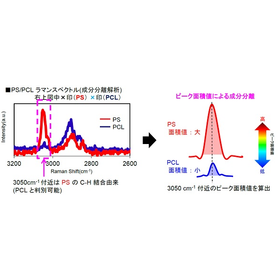
Our organization offers composition distribution evaluation of organic films using Raman mapping. The properties such as mechanical characteristics, thermal resistance, and durability change by mixing materials. It is important to link material properties with mixing conditions in material development, and using dispersion as an indicator is effective. This document presents a case study of mapping the distribution of PS (polystyrene) and PCL (polycaprolactone) using Raman. By comparing the characteristic Raman peaks of each material, it is possible to separate the components of the mixture. Component separation from PCL was performed through spectral analysis around the PS-specific peak at approximately 3050 cm-1. [Measurement Method / Processing Method] ■ [Raman] Raman Spectroscopy *For more details, please download the PDF or feel free to contact us.

Added to bookmarks

Bookmarks list

Bookmark has been removed

Bookmarks list

You can't add any more bookmarks

By registering as a member, you can increase the number of bookmarks you can save and organize them with labels.

Free membership registration

Technical Data: High-Speed Imaging Compatible Confocal Microscopic Laser Raman

Introducing a high-performance micro-Raman system! Free materials available!

This document contains technical information about Bruker's high-performance system "SENTERRA II," which caters to routine analyses in quality control and advanced research fields. It provides detailed information about the product features and main specifications. [Contents] ■ Next-generation compact micro-Raman ■ Compatible with various applications ■ Complies with various standards ■ Main specifications *For more details, please refer to the PDF document or feel free to contact us.

  • Analytical Equipment and Devices
  • Spectrometer

Added to bookmarks

Bookmarks list

Bookmark has been removed

Bookmarks list

You can't add any more bookmarks

By registering as a member, you can increase the number of bookmarks you can save and organize them with labels.

Free membership registration

Technical Data: Application of Micro-Raman Spectroscopy in Pharmaceuticals

Introducing the application of the Microscopic Raman SENTERRA II to pharmaceuticals! Free materials available!

This document is a technical material that outlines the advantages of utilizing the confocal micro-Raman spectroscopy system "SENTERRA II" in the pharmaceutical field. [Contents] ■ Overview of the features of the micro-Raman spectroscopy system SENTERRA II ■ Feature 1: Excellent user convenience ■ Feature 2: Support for validation needs ■ Feature 3: Powerful spectroscopic performance ■ Data security, integrity, and traceability *For more details, please refer to the PDF document or feel free to contact us.

Added to bookmarks

Bookmarks list

Bookmark has been removed

Bookmarks list

You can't add any more bookmarks

By registering as a member, you can increase the number of bookmarks you can save and organize them with labels.

Free membership registration

High-throughput screening of pharmaceuticals using FT-Raman.

[Free Gift] Technical document introducing examples of applications for qualitative and quantitative analysis of pharmaceuticals.

In recent years, the pharmaceutical industry has placed significant importance on high-throughput screening technologies in the formulation development process, similar to the drug discovery process. In particular, high levels of automation are simultaneously required for the identification and classification of solid forms. Here, we introduce examples of applications for qualitative and quantitative analysis of pharmaceuticals using our "FT-Raman spectrometer" and "high-throughput screening (HTS) accessories." [Contents] ■ Introduction ■ FT-Raman System / FT-Raman Spectrometer ■ HTS-Raman Accessories ■ Discriminant Analysis ■ Quantitative Analysis ■ Conclusion *For more details, please refer to the PDF document or feel free to contact us.

  • Analytical Equipment and Devices
  • Spectrometer

Added to bookmarks

Bookmarks list

Bookmark has been removed

Bookmarks list

You can't add any more bookmarks

By registering as a member, you can increase the number of bookmarks you can save and organize them with labels.

Free membership registration

Technical Data: Microplastic Analysis Solution

Providing a new analysis method based on high-speed imaging and machine learning!

Bruker Japan can provide spectroscopic analysis solutions specialized in microplastics due to many years of experience. Our FT-IR and Raman microscopes are used daily by leading microplastic scientists around the world. This document clearly explains: ▶ The effectiveness of micro-infrared and Raman spectroscopy ▶ Why Bruker products are suitable for microplastic analysis *For more details, please refer to the PDF document or feel free to contact us. ◆Exhibiting at JASIS2023◆ Please check the basic information below for details about the exhibition.

  • Other environmental analysis equipment
  • Spectrometer

Added to bookmarks

Bookmarks list

Bookmark has been removed

Bookmarks list

You can't add any more bookmarks

By registering as a member, you can increase the number of bookmarks you can save and organize them with labels.

Free membership registration