The Klinger spiral wound gasket "Maxiflex" compensates for the effects of load variations such as fluid pressure and temperature fluctuations, as well as bolt stress relaxation.
Features of the Spiral Wound Gasket 'Maxiflex'
The spiral wound gasket can compensate for load fluctuations caused by variations in fluid pressure and temperature, temperature differences on flange surfaces, flange rotation, bolt stress relaxation, and permanent deformation.
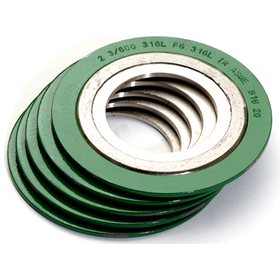
The sealing part of the spiral wound gasket consists of a layer of metal foil called a hoop and a layer of soft, highly compressible sealing material known as filler, wound in a spiral shape. When compressed during installation, the sealing material fills the irregularities of the flange surface. The metal foil supports the filler while providing the gasket with mechanical strength and flexibility. The Maxiflex spiral wound gasket allows for the selection of filler material based on usage conditions.
Design Guidelines for Klinger Spiral Wound Gaskets
In the sealing part of the spiral wound gasket, a V-shaped cross-section hoop material is wound together with a soft filler in a spiral manner. To enhance mechanical strength and sealing performance, the beginning and end of the winding consist only of hoop material, and the entire circumference is spot-welded. By maintaining consistent tension during the winding process, a uniform thickness is achieved. As a result, the gasket has a high recovery rate, allowing for reliable surface pressure even under varying operating conditions.

![[Youngil Silicone] Gasket for Semiconductor Equipment](https://image.mono.ipros.com/public/product/image/fe7/2001332273/IPROS18089356669852928427.jpg?w=280&h=280)
![[Youngil Silicone] Gasket for Batteries](https://image.mono.ipros.com/public/product/image/669/2001332274/IPROS7571044411826257014.jpg?w=280&h=280)






![Case Studies for Solving High-Temperature Gasket Issues [With Performance Data]](https://image.mono.ipros.com/public/product/image/9b7/2000607268/IPROS27619334366283689827.jpeg?w=280&h=280)


