We have compiled a list of manufacturers, distributors, product information, reference prices, and rankings for Analysis Software.
ipros is IPROS GMS IPROS One of the largest technical database sites in Japan that collects information on.

Analysis Software Product List and Ranking from 296 Manufacturers, Suppliers and Companies

Last Updated: Aggregation Period:Dec 17, 2025~Jan 13, 2026
This ranking is based on the number of page views on our site.

Analysis Software Manufacturer, Suppliers and Company Rankings

Last Updated: Aggregation Period:Dec 17, 2025~Jan 13, 2026
This ranking is based on the number of page views on our site.

  1. null/null
  2. ミューテック Tokyo//software
  3. ウェーブフロント 本社 Kanagawa//software
  4. 4 インフォコム サイエンスグループ Tokyo//software
  5. 5 日本イーエスアイ Tokyo//software

Analysis Software Product ranking

Last Updated: Aggregation Period:Dec 17, 2025~Jan 13, 2026
This ranking is based on the number of page views on our site.

  1. Multivariate analysis software "SIMCA" インフォコム サイエンスグループ
  2. Lighting and optical analysis software "Lighting Simulator CAD" Camerium
  3. Utilizing borehole data with Surfer ヒューリンクス
  4. 4 Integrated proteomics analysis software "PEAKS" インフォコム サイエンスグループ
  5. 5 High-frequency three-dimensional electromagnetic field analysis software Ansys HFSS

Analysis Software Product List

766~780 item / All 1302 items

Displayed results

[Analysis Case] Analysis of PTC Resin Heater

Analyzing the property that electrical resistance increases as temperature rises.

PTC resin has the property of increasing electrical resistance as the temperature rises (temperature dependence). We conducted an analysis of a heater that utilizes this property. This heater has the characteristic that as the temperature rises, the inherent resistance of the PTC resin increases, limiting the current, so it does not exceed a certain temperature. We will perform a current distribution analysis when a voltage of 100[V] is applied to the electrode terminals of the heater. For more details, please download the catalog.

  • Magnetic field analysis/electromagnetic wave analysis
  • Analysis Services
  • Contract Analysis

Added to bookmarks

Bookmarks list

Bookmark has been removed

Bookmarks list

You can't add any more bookmarks

By registering as a member, you can increase the number of bookmarks you can save and organize them with labels.

Free membership registration

[Analysis Case] Induction Heating Analysis of Steel Plates (Coupled Analysis of Magnetic Field and Heat)

The target of the analysis is a steel plate penetrated by three-phase alternating current lines.

The analysis of induction heating of a steel plate (coupled analysis of magnetic field and heat) determines the distribution of heat generation due to eddy currents flowing in the steel plate created by a three-phase current magnetic field. Next, thermal conduction is analyzed based on the calculated heat generation. For more details, please download the catalog.

  • Magnetic field analysis/electromagnetic wave analysis
  • Analysis Services
  • Contract Analysis

Added to bookmarks

Bookmarks list

Bookmark has been removed

Bookmarks list

You can't add any more bookmarks

By registering as a member, you can increase the number of bookmarks you can save and organize them with labels.

Free membership registration

[Analysis Case] Stress Analysis of Elastic Bodies (Frequency Response)

As an example of stress analysis, we present a stress analysis of an elastic body with a bell shape.

The number of nodes for the stress analysis of the elastic body is 2271, and the number of elements is 1400. For more details, please download the catalog.

  • Stress Analysis
  • Analysis Services
  • Contract Analysis

Added to bookmarks

Bookmarks list

Bookmark has been removed

Bookmarks list

You can't add any more bookmarks

By registering as a member, you can increase the number of bookmarks you can save and organize them with labels.

Free membership registration

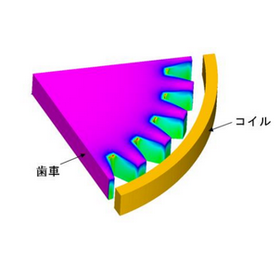
[Case Study] Induction Heating for Gear Hardening

We will apply a time-varying current and determine the heat generation density distribution and temperature distribution of the gear.

The induction heating of gears for hardening was analyzed for cases where the relative permeability depends on temperature (strong coupling) and where it does not depend on temperature (weak coupling). For more details, please download the catalog.

  • Magnetic field analysis/electromagnetic wave analysis
  • Analysis Services
  • Contract Analysis

Added to bookmarks

Bookmarks list

Bookmark has been removed

Bookmarks list

You can't add any more bookmarks

By registering as a member, you can increase the number of bookmarks you can save and organize them with labels.

Free membership registration

Case distribution! Software for strong coupled analysis of dynamic magnetic fields and heat conduction that can be used by beginners.

Case study collection now available! Analysis software that can automatically perform strong coupling analysis (bidirectional).

The magnetic field and thermal coupled analysis system "PHOTO-Series" is a dedicated module for magnetic field-thermal coupled analysis that combines dynamic magnetic field analysis and thermal conduction analysis. Since the transfer of heat generation density is automatically performed without the need for files, even beginners can confidently conduct strong coupled analysis (bidirectional). 【Examples of Applications】 ◆ Quenching of gears by induction heating ◆ Induction heating analysis of steel plates (coupled analysis of magnetic field and heat) ◆ Analysis of induction heating, etc. 【For more details, please download the catalog or feel free to contact us】      ↓ ↓ ↓            ↓ ↓ ↓

  • Magnetic field analysis/electromagnetic wave analysis
  • Analysis Services
  • Contract Analysis

Added to bookmarks

Bookmarks list

Bookmark has been removed

Bookmarks list

You can't add any more bookmarks

By registering as a member, you can increase the number of bookmarks you can save and organize them with labels.

Free membership registration

Thermal Conductivity Analysis Software THERMO

Finite Element Method Thermal Conduction Analysis Software (Simulator)

2D Axisymmetric and 3D Heat Conduction Analysis Simulator using Finite Element Method ■□■Features■□■ ■ Since it is an integrated pre-post tool dedicated to the PHOTO series, data creation, analysis, and result processing can be performed as a series of operations. ■ It is integrated with other PHOTO series modules, allowing for easy coupled analysis, such as obtaining temperature distribution from heat generation calculated by electromagnetic field analysis. ■ It uses the ICCG method, making calculations fast and enabling analysis on a personal computer. ■ Since it employs the finite element method, the solutions are stable, making it user-friendly even for beginners. ■ Coupled calculations with stress analysis and fluid analysis are easy to perform.

  • Magnetic field analysis/electromagnetic wave analysis
  • Analysis Services
  • Contract Analysis

Added to bookmarks

Bookmarks list

Bookmark has been removed

Bookmarks list

You can't add any more bookmarks

By registering as a member, you can increase the number of bookmarks you can save and organize them with labels.

Free membership registration

■Electric Field Analysis Software (Boundary Element Method) VOLTBM

3D electric field analysis software (electric field simulator) using the boundary element method *No air mesh required.

Three-dimensional electric field (electric field) analysis software using boundary element method for static analysis (electric field simulator) ■□■Features■□■ ■You can create an analysis model without creating an air region. ■Since it is integrated with the PHOTO series dedicated pre/post, data creation, analysis, and result processing can be performed as a series of operations. ■You can create display elements to evaluate the analysis values in the space.

  • Magnetic field analysis/electromagnetic wave analysis
  • Analysis Services
  • Contract Analysis

Added to bookmarks

Bookmarks list

Bookmark has been removed

Bookmarks list

You can't add any more bookmarks

By registering as a member, you can increase the number of bookmarks you can save and organize them with labels.

Free membership registration

■ Magnetic field analysis software (combined method, frequency response) EDDYTMjω

3D magnetic field analysis software (magnetic field simulator) using a combination of finite element method and H-method *No air mesh required.

■ Magnetic field/magnetic field analysis software (magnetic field simulator) using a combination of the finite element method and H-method, capable of performing static analysis and frequency response analysis. ■ Can handle three-dimensional problems. ■□■ Features ■□■ ■ Can create analysis models without creating air regions. ■ Integrated with the PHOTO series dedicated pre- and post-processing, allowing data creation, analysis, and result processing to be performed as a single operation. ■ Achieves revolutionary speedup through the combination of edge element method and ICCG method (dozens of times faster than conventional finite element methods). ■ Provides stable solutions using the finite element method, making it safe for beginners to use.

  • Magnetic field analysis/electromagnetic wave analysis
  • Analysis Services
  • Contract Analysis

Added to bookmarks

Bookmarks list

Bookmark has been removed

Bookmarks list

You can't add any more bookmarks

By registering as a member, you can increase the number of bookmarks you can save and organize them with labels.

Free membership registration

■Electric field analysis software (frequency response) VOLTjω

Frequency response electric field analysis software using the finite element method.

Perform static analysis and frequency response analysis Electric field analysis software using the finite element method (Electric field simulator) ■□■Features■□■ ■Since it is integrated with the PHOTO series dedicated pre- and post-processing, data creation, analysis, and result processing can be performed as a continuous operation. ■It is integrated with other PHOTO series modules, allowing for easy coupled analysis, such as obtaining temperature distribution from heat generation determined by electromagnetic field analysis. ■Using the ICCG method, calculations are fast, enabling analysis on a personal computer. ■Since it uses the finite element method, the solutions are stable, making it safe for beginners to use.

  • Magnetic field analysis/electromagnetic wave analysis
  • Analysis Services
  • Contract Analysis

Added to bookmarks

Bookmarks list

Bookmark has been removed

Bookmarks list

You can't add any more bookmarks

By registering as a member, you can increase the number of bookmarks you can save and organize them with labels.

Free membership registration

[Analysis Case] Electromagnetic Field Analysis of Polyethylene-Filled Waveguides

Here is an example of a comparison between the obtained reflection coefficient from the analysis results and the theoretical values!

When a dielectric such as polyethylene is filled in a rectangular waveguide, reflections of electromagnetic waves occur at the air interface. Considering a system where polyethylene is filled in part of a rectangular waveguide of standard WRJ-5, the distribution of electromagnetic waves was analyzed using the finite element method. As a result, it was found that the absolute value of the electric field on the polyethylene side is constant, indicating that no reflection occurs at the output surface (the impedance boundary is correctly set). [Case Summary] ■ Analysis Module: PHOTO-WAVEjω ■ Analysis Results - It is evident that no reflection occurs at the output surface since the absolute value of the electric field on the polyethylene side is constant (the impedance boundary is correctly set). - In the calculation of the scattering matrix, the characteristic impedances of air and polyethylene were set as ZAir = 279.052Ω and ZPE = 156.987Ω. *For more details, please refer to the related links or feel free to contact us.

  • Magnetic field analysis/electromagnetic wave analysis
  • Analysis Services
  • Contract Analysis

Added to bookmarks

Bookmarks list

Bookmark has been removed

Bookmarks list

You can't add any more bookmarks

By registering as a member, you can increase the number of bookmarks you can save and organize them with labels.

Free membership registration

[Analysis Case] Input Impedance Analysis of a Dipole Antenna

Set impedance boundaries at the model boundary! Here are examples compared with the results of the moment method.

We will introduce a case study analyzing the input impedance of a dipole antenna using the electromagnetic wave analysis software "PHOTO-WAVEjω." The antenna has a diameter of 1mm, a length of 60.5mm, and a gap of 0.5mm. An impedance boundary was set at the model boundary. The antenna was treated as a perfect conductor. 【Case Overview】 ■ Software Used: PHOTO-WAVEjω ■ Analysis Conditions - An impedance boundary was set at the model boundary - The antenna was treated as a perfect conductor *For more details, please refer to the related links or feel free to contact us.

  • Magnetic field analysis/electromagnetic wave analysis
  • Analysis Services
  • Contract Analysis

Added to bookmarks

Bookmarks list

Bookmark has been removed

Bookmarks list

You can't add any more bookmarks

By registering as a member, you can increase the number of bookmarks you can save and organize them with labels.

Free membership registration

[Case Study] Photonic Crystal Optical Waveguide (Electromagnetic Field Analysis)

Conducting electromagnetic wave analysis using the finite element method! Introducing a case study of an L-shaped optical waveguide.

Photonic crystals are structures that can control light by periodically arranging multiple dielectrics and other materials. Electromagnetic wave analysis was conducted using the finite element method. The optical waveguide consists of periodically arranged dielectric rods, and light passes through areas where there are no dielectric rods. The radius of the rods, r, and the period of the rods, a, are set as r = 0.18a, and the electric field component parallel to the dielectric rods was input. 【Case Overview】 ■ Software Used: PHOTO-WAVEjω ■ Analysis Conditions - The radius of the rods, r, and the period of the rods, a, are set as r = 0.18a (Wavelength λ: 1.55μm, Refractive index n: 3.4) - Impedance boundary conditions are set on the sides - The electric field component parallel to the dielectric rods was input *For more details, please refer to the related links or feel free to contact us.

  • Magnetic field analysis/electromagnetic wave analysis
  • Analysis Services
  • Contract Analysis

Added to bookmarks

Bookmarks list

Bookmark has been removed

Bookmarks list

You can't add any more bookmarks

By registering as a member, you can increase the number of bookmarks you can save and organize them with labels.

Free membership registration

[Analysis Case] Analysis using automatic load condition setting function (TE wave, TM wave)

Specify a set of nodes that are on the same plane! Calculate the electric field at each node and set it as the loading condition.

In versions prior to Ver8.0 of "PHOTO-WAVEjω," it was necessary to set the electric field (3 components) at nodes or the current density (3 components) at elements as load conditions. Since Ver8.2, a feature has been added to automatically set these load conditions. Users can specify a set of nodes that are on the same plane, and by simply inputting a few parameters, the program calculates the electric field at each node and sets it as the load condition. [Issues] ■ In versions prior to Ver8.0 of "PHOTO-WAVEjω," it was necessary to set the electric field at nodes or the current density at elements as load conditions. ■ When setting the electric field in a rectangular waveguide, it was necessary to set each electric field component from the coordinates of each node, which was a cumbersome task for users. *For more details, please refer to the related links or feel free to contact us.

  • Magnetic field analysis/electromagnetic wave analysis
  • Analysis Services
  • Contract Analysis

Added to bookmarks

Bookmarks list

Bookmark has been removed

Bookmarks list

You can't add any more bookmarks

By registering as a member, you can increase the number of bookmarks you can save and organize them with labels.

Free membership registration

[Analysis Case] Magnetic Field Analysis of Gear Sensors

Check how the magnetic field distribution changes when the electrical conductivity, rotation speed, and position of the gears are altered!

When a magnet is brought close to a gear made of a magnetic material, the distribution of the surrounding magnetic field changes depending on the position and rotation speed of the gear. A permanent magnet was placed near the rotating gear, and the changes in the surrounding magnetic field were analyzed. As a result, in the comparison of magnetic flux density due to rotation speed, the gear rotating at high speed exhibited a larger magnetic field along the edge of the gear, and a magnetic field due to eddy currents remained even when it was away from the magnet. 【Case Summary】 ■ Analysis Type: 3D Nonlinear Transient Magnetic Field Analysis ■ Analysis Module: PHOTO-EDDY *For more details, please refer to the related links or feel free to contact us.

  • Magnetic field analysis/electromagnetic wave analysis
  • Analysis Services
  • Contract Analysis

Added to bookmarks

Bookmarks list

Bookmark has been removed

Bookmarks list

You can't add any more bookmarks

By registering as a member, you can increase the number of bookmarks you can save and organize them with labels.

Free membership registration

[Analysis Case] Magnetic Field Analysis of a Transformer

Finite element division of the iron core and primary/secondary windings! A node current of 1A at 1000Hz was applied.

This is an introduction to a case study analyzing the magnetic flux density distribution, self-inductance, and mutual inductance of a transformer composed of primary and secondary windings and a magnetic circuit (iron core) when excited. The software "PHOTO-EDDYTMjω" was used. A current of 1A at a frequency of 1000Hz was applied to the primary and secondary windings. Additionally, the number of nodes was 18,118, and the number of elements was 13,648, with the shape modeled in three dimensions as a full model. [Case Overview] ■ Software Used: PHOTO-EDDYTMjω ■ Analysis Conditions - Model using iron core and primary/secondary windings - Applied a node current of 1A at 1000Hz to the primary and secondary windings *For more details, please refer to the related links or feel free to contact us.

  • Magnetic field analysis/electromagnetic wave analysis
  • Analysis Services
  • Contract Analysis

Added to bookmarks

Bookmarks list

Bookmark has been removed

Bookmarks list

You can't add any more bookmarks

By registering as a member, you can increase the number of bookmarks you can save and organize them with labels.

Free membership registration