We have compiled a list of manufacturers, distributors, product information, reference prices, and rankings for Fluorine resin coating.
ipros is IPROS GMS IPROS One of the largest technical database sites in Japan that collects information on.

Fluorine resin coating Product List and Ranking from 77 Manufacturers, Suppliers and Companies | IPROS GMS

Last Updated: Aggregation Period:May 06, 2026~Jun 02, 2026
This ranking is based on the number of page views on our site.

Fluorine resin coating Manufacturer, Suppliers and Company Rankings

Last Updated: Aggregation Period:May 06, 2026~Jun 02, 2026
This ranking is based on the number of page views on our site.

  1. 吉田SKT Aichi//Manufacturing and processing contract
  2. フロロコート Saitama//others
  3. 日建塗装工業 Tokyo//Manufacturing and processing contract
  4. 4 NIPPON FUSSO CO.,LTD. Osaka//Electronic Components and Semiconductors
  5. 5 YMM コーティング事業部 Osaka//others

Fluorine resin coating Product ranking

Last Updated: Aggregation Period:May 06, 2026~Jun 02, 2026
This ranking is based on the number of page views on our site.

  1. Causes of Teflon coating peeling and how to address them. 吉田SKT
  2. Advantages and disadvantages of re-coating a non-stick frying pan. 吉田SKT
  3. A detailed explanation about Teflon lining. 吉田SKT
  4. 4 Fluororesin Coating: "Differences in Color and Selection Method" 吉田SKT
  5. 5 What is the semiconductor manufacturing process? An introduction to surface treatment that supports semiconductor manufacturing. 吉田SKT

Fluorine resin coating Product List

211~240 item / All 591 items

Displayed results

[Experimental footage] Excellent coating properties with non-stick, slip resistance, and corrosion resistance.

We will introduce the surface treatment functions provided by Yoshida SKT in an experimental video. The video explains the non-stick, slip, and corrosion resistance features in about 7 minutes.

Yoshida SKT responds to customer needs by providing surface treatment functions. - Non-stick (function to reduce sticking) Video playback: 0:00 - (For those in a hurry, please start playback from this time) - Low friction (function to enhance slipperiness) Video playback: 2:33 - (For those in a hurry, please start playback from this time) - Corrosion resistance (function to reduce corrosion) Video playback: 4:42 - (For those in a hurry, please start playback from this time) These are introduced through easy-to-understand experimental videos. With Yoshida SKT, we can accommodate a wide variety of substrates and offer suggestions from hundreds of types of coating materials. This broadens the range of coatings that customers can choose from. In addition to functions such as "reducing adhesion of sticky substances" and "improving slipperiness," we also respond meticulously to the varying needs and environments of each customer, such as "requiring precision" or "requiring heat resistance," to achieve reliable effects.

  • Surface treatment contract service
  • Fluorine resin coating

Added to bookmarks

Bookmarks list

Bookmark has been removed

Bookmarks list

You can't add any more bookmarks

By registering as a member, you can increase the number of bookmarks you can save and organize them with labels.

Free membership registration

[Automotive Industry Case Study] Release Properties + Wear Resistance + Image Recognition Properties 'Bicoat'

Improving production efficiency on the electronic components production line! We will introduce a case where the adoption of surface treatment has achieved prevention of adhesion to the suction fixtures.

We will introduce a case study of trouble resolution on the transport line for electronic components sealed with resin. ■Issue The electronic components sealed with resin are suctioned by a jig and transported and placed on the substrate. However, there were instances where the slightly adhesive sealing resin would stick to the jig, negatively affecting the yield. ■Request Since the suction jig performs suction, transport, and placement operations tens of thousands of times per hour, high wear resistance was required. Additionally, an image recognition camera is used to confirm the position of the components on this line, so it was necessary to use a color that minimizes reflection to prevent whiteout in the images. ■Adopted Surface Treatment - Bycoat® NYK-01BK ■Background and Effects of Adoption 'Bycoat' was considered for preventing the sticking of the sealing resin and for its wear resistance. After evaluation on actual equipment, it was found to have good wear resistance as well as excellent release properties for the resin. 【Resolved Issues】 - Reduced sticking issues with the resin - Decreased cleaning costs - Improved productivity *For more details, please download the PDF or contact us.

  • Surface treatment contract service
  • Fluorine resin coating

Added to bookmarks

Bookmarks list

Bookmark has been removed

Bookmarks list

You can't add any more bookmarks

By registering as a member, you can increase the number of bookmarks you can save and organize them with labels.

Free membership registration

[Automotive Industry Case] Non-stick coating to prevent label adhesion

A must-see for those struggling with sticking! Silicone-free, with a convex coating that peels off easily. We will introduce a case study on the product label application process.

We would like to introduce an improvement case of an automatic label application device using robots. ■Issues In the label application process using robots, the labels peeled off from the release paper are placed adhesive side down on a platform, from which the robot picks them up and applies them to the products. However, there were frequent troubles where the robot could not smoothly peel the labels from the platform, causing work stoppages. ■Requests Initially, we tried a silicone coating with excellent release properties, but the silicone transferred to the labels, reducing their adhesive strength, which led to the labels peeling off after being applied to the products. Additionally, the conventional Teflon™ coating did not sufficiently prevent the labels from sticking. To solve this, it was necessary to achieve both excellent release properties and silicone-free performance. 【Issues to be resolved】 - Label peeling due to silicone transfer - Cleaning time for label adhesive - Line stoppage troubles due to sticking ■Adopted Coating 'Super TP 250 UNDER' *For more details, please download the PDF or contact us.

  • Surface treatment contract service
  • Fluorine resin coating

Added to bookmarks

Bookmarks list

Bookmark has been removed

Bookmarks list

You can't add any more bookmarks

By registering as a member, you can increase the number of bookmarks you can save and organize them with labels.

Free membership registration

[Data Download] Surface Treatment "By Application" Chosen in the Semiconductor and Electronics Field

Coatings with anti-static properties, heat resistance, chemical resistance, and chemical inertness are widely used in semiconductor manufacturing equipment and electronic component manufacturing equipment.

■Applications such as plating jigs, soldering jigs, and semiconductor manufacturing lines - Selected surface treatment 'TEFLON (TM) fluororesin coating' ■Applications such as precision molds - Selected surface treatment 'Bicoat (R)' 'Nanoprocess (R)' ■Applications such as wafer and glass handling - Selected surface treatment 'Saflon (R)' 'PBI, PI coating' ■Applications such as precision nozzles, MEMS components, and optical lenses - Selected surface treatment 'Nanoprocess (R)' ■Applications such as chemical supply tanks - Selected surface treatment 'TEFLON (TM) fluororesin coating' 'Saflon (R) AP+' 'MY Lining (R)' ■Applications such as clean room walls, experimental equipment, and various tools - Selected surface treatment 'SeraShield F' ■Applications such as high-temperature equipment parts (rolls, heater covers) - Selected surface treatment 'SGN coating' *You can download the PDF of the surface treatment products introduced. For detailed product information, please visit the "Yoshida SKT Official Website."

  • Surface treatment contract service
  • Fluorine resin coating

Added to bookmarks

Bookmarks list

Bookmark has been removed

Bookmarks list

You can't add any more bookmarks

By registering as a member, you can increase the number of bookmarks you can save and organize them with labels.

Free membership registration

Surface treatments chosen for corrosion-resistant applications in the chemical industry *Product documentation available

In fields where chemical substances are used, surface treatments aimed at enhancing corrosion resistance are required. We introduce thick film coatings made from high-performance resins.

Typical corrosion-resistant materials include rubber, glass, and graphite products, but each has its drawbacks. ■ Disadvantages and Concerns - Rubber → Weak against heat and solvent-based substances - Glass lining → Weak against alkaline chemicals, thermal shock, and mechanical shock - Graphite products → Excellent acid resistance but weak against strong oxidizing acids (such as fuming sulfuric acid) ■ Materials that Address Disadvantages and Concerns From the above perspective, perfluoro-based fluoropolymers have few drawbacks, and in terms of chemical resistance, fluoropolymer coatings and linings can be used in a versatile manner. Applications such as tanks, piping, valves, and pumps ■ Selected Surface Treatments - Teflon(TM) Coating - Fluoropolymer Coating - SafeFlon(R) - SafeFlon(R) AP+ - MY Lining(R) Applications such as reaction vessels and acid storage tanks ■ Selected Surface Treatments - MY Lining(R) Applications such as dryers and centrifuges ■ Selected Surface Treatments - SafeFlon(R) - SafeFlon(R) AP+ *You can download the PDF introducing the surface treatment products.

  • Surface treatment contract service
  • Fluorine resin coating

Added to bookmarks

Bookmarks list

Bookmark has been removed

Bookmarks list

You can't add any more bookmarks

By registering as a member, you can increase the number of bookmarks you can save and organize them with labels.

Free membership registration

Presentation of Materials: Selection of Surface Treatments Chosen in the Medical and Pharmaceutical Fields

Non-stick, sliding, and wear-resistant surface treatments for chutes, guides, and sealers are effective for speeding up pharmaceutical packaging machines and making them maintenance-free.

The production sites for medical and pharmaceutical products require not only high productivity but also very strict cleanliness standards. In pharmaceutical packaging machines, there is a demand for speed-up for efficiency and maintenance-free operation, leading to the adoption of Bicoat® and fluoropolymer coatings to improve non-stick properties, slip resistance, and wear resistance for guides and sealers. In tablet production lines, Bicoat® is used on tablet presses, hoppers, and guides to enhance the slip properties of tablets, contributing to quality improvement. Additionally, fluoropolymer coatings are used on stages, hot plates, and parts that come into contact with paraffin in pathology testing equipment. ■ Applications for medical drip fusion sealers, pathology testing equipment, etc. - Selected surface treatments: 'Fluoropolymer coating', 'Bicoat®' ■ Applications for tanks, material supply machines, chutes, etc. - Selected surface treatments: 'Urethane coating', 'Saflon® AP+' ■ Applications for centrifuges, etc. - Selected surface treatments: 'Saflon® AP+' ■ Applications for adhesive drugs and tape transport fixtures, etc. - Selected surface treatments: 'TP series, CTT series, Super Alloy, CAT, CMT'

  • s-シーラー.jpg
  • Surface treatment contract service
  • Fluorine resin coating

Added to bookmarks

Bookmarks list

Bookmark has been removed

Bookmarks list

You can't add any more bookmarks

By registering as a member, you can increase the number of bookmarks you can save and organize them with labels.

Free membership registration

Fluororesin Coating: "What is the relationship between non-stick properties and water repellency?"

[Function Explanation] Understanding the mechanism of adhesion reveals the best release and surface treatment! Surface energy and water repellency | What is the relationship between non-stickiness and water repellency?

Why does fluoropolymer coating repel water? We will introduce the relationship between surface energy, non-stick properties, and water repellency. ■ The relationship between water droplets and surface energy The reason the surface of fluoropolymer coating repels water is that the surface tension of water acts strongly. The same principle applies to sticky substances. In other words, "difficult to wet = difficult to stick." The action of liquid surface tension is strongly related to the surface free energy of solids. Surface free energy is the force that tries to attract the molecules of the contacting counterpart. Water is a substance with higher surface tension compared to oil. When in contact with a solid that has the same surface free energy, oil tends to spread and wet more easily, while water tends to bead up and is harder to wet. The smaller the surface free energy of the solid compared to the liquid it contacts, and the greater the difference, the more difficult it becomes for the liquid to wet (stick). The surface of fluoropolymer coating has very low surface free energy, which allows it to repel not only water but also oil, making it an effective surface treatment for release purposes due to its low tendency to stick. For more details, please check the official Yoshida SKT website from the link below.

  • s-ガラス親水2.jpg
  • s-表面エネルギーの差2.jpg
  • Surface treatment contract service
  • Fluorine resin coating

Added to bookmarks

Bookmarks list

Bookmark has been removed

Bookmarks list

You can't add any more bookmarks

By registering as a member, you can increase the number of bookmarks you can save and organize them with labels.

Free membership registration

[Presentation of Materials] List of Surface Treatments Selected for Food Factories by Application

Surface treatment that enables automation, labor-saving, and robotization of food factory lines. Contributes to speed-up and maintenance-free operation!

■Applications for automatic rice cooking lines, kneaders, rolls, baking molds, etc. - Selected surface treatments 'Teflon(TM) coating (fluororesin coating)' 'MRS coating (silicone-based coating)' ■Applications for packaging machine blades, tape feeding rolls, etc. - Selected surface treatments 'MRS coating (silicone-based coating)' 'Bicoat(R)' ■Applications for packaging machine guides, buckets, sealers, etc. - Selected surface treatments 'Bicoat(R)' 'Bicoat(R) Exceed' ■Applications for cutters, arms, claws, etc. - Selected surface treatments 'Nanoprocess(R)' ■Applications for confectionery molding molds, rice serving machines, food transport sections, lightweight cups, etc. - Selected surface treatments 'TP coating, Super TP coating' 'MRS coating' ■Applications for baking molds, baking sheets (to prevent sticking during food baking), etc. - Selected surface treatments 'Teflon fluororesin coating' ■Applications for rice shutters, etc. - Selected surface treatments 'CTT fabric sheet' *You can download the above surface treatment products in PDF format.

  • Surface treatment contract service
  • Fluorine resin coating

Added to bookmarks

Bookmarks list

Bookmark has been removed

Bookmarks list

You can't add any more bookmarks

By registering as a member, you can increase the number of bookmarks you can save and organize them with labels.

Free membership registration

Fluororesin Coating "Functional Property Data"

Here is some reference data on the non-stick, water-repellent, heat-resistant, and slippery (low friction) properties of fluororesin.

■Non-stickiness: It refers to the property of being easily released from strongly adhesive substances, either not adhering at all or having a tendency to adhere less. ■Water repellency: It refers to the property of repelling liquids and not getting wet when they come into contact with the surface. 【Reference data for non-stickiness and water repellency】 ■Contact angle of water (°) PTFE ... 114 PFA ... 105-110 FEP ... 115 ETFE ... 96 ■Contact angle of n-HD (°) PTFE ... 34-45 PFA ... >45 FEP ... 41-45 ETFE ... 28 ■Surface free energy of solids (dyne/cm) PTFE ... 18.5 PFA ... 17.8 FEP ... 17.8 ETFE ... 22.1 ■Low friction: It has a slippery feel and a low coefficient of friction, providing excellent lubricity. 【Reference data for low friction】 ■Static friction coefficient (μ) PTFE ... 0.02-0.04 PFA ... 0.04-0.05 FEP ... 0.05-0.06 ETFE ... 0.07-0.08 *The values are general characteristics and are not guaranteed. *For more details, please contact us.

  • Surface treatment contract service
  • Fluorine resin coating

Added to bookmarks

Bookmarks list

Bookmark has been removed

Bookmarks list

You can't add any more bookmarks

By registering as a member, you can increase the number of bookmarks you can save and organize them with labels.

Free membership registration

[Electronics Industry Improvement Case] Enabling Continuous Cutting of Adhesive Packages!

Achieve continuous cutting of adhesive-backed packages with thin film coating! The excellent non-adhesiveness of the thin film coating maintains the sharpness of the blades.

We would like to introduce a case where we achieved prevention of adhesive residue on cutting blades when disposing of adhesive-laden packages. ■ Background of Surface Treatment Consideration In the device that removes products from the package, a mechanism was needed to automatically cut and dispose of adhesive-laden packages into smaller pieces. ■ What We Wanted to Achieve The device operates unmanned, with human intervention only required when the finely cut packages fill the dust box. Therefore, it was essential to prevent the adhesive from sticking to the cutting blades, allowing for maintenance-free operation. ■ Conditions for Selecting Treatment Initially, a fluororesin coating, effective in preventing adhesive residue, was selected and tested. However, the thickness of the fluororesin coating, approximately 30μm, caused a decrease in the sharpness of the blades. As a solution, we polished the coating only on the cutting edge and conducted retesting, but this resulted in the cutting edge being uncoated, leading to adhesive sticking. Continuous cutting of packages became impossible. ■ Adopted Coating 'MRS Coating' ▼ We are currently offering a free collection of improvement case studies and a coating trial set! ▼

  • 550x550期間限定なし.jpg
  • IMG_1881_edited.jpg
  • Other packaging machines
  • Fluorine resin coating

Added to bookmarks

Bookmarks list

Bookmark has been removed

Bookmarks list

You can't add any more bookmarks

By registering as a member, you can increase the number of bookmarks you can save and organize them with labels.

Free membership registration

[Case Study on Surface Treatment] Non-Stick Coating for Rubber Punching Blades *Materials Available

Prevent line stoppage of cutting tools for urethane rubber products. Improve production efficiency by solving adhesion issues with a thin film coating on the cutting blades.

■Concern We received a consultation regarding a problem where a blade used to punch out polyurethane rubber shapes causes the device to stop due to fragments of polyurethane rubber sticking to the blade. Upon checking, we found that the device sometimes stops on the first shot, significantly reducing the production efficiency of the product. ■Background In the case of punching blades, both release properties to prevent polyurethane rubber from sticking to the blade and slip properties to cut through the rubber without resistance when the blade is pressed into the rubber are necessary. The customer considered a fluororesin coating that excels in both release and slip properties and contacted us. ■Conditions for Choosing Treatment During the hearing, we understood that maintaining the sharpness of the blade edge is necessary for the punching blade to maintain the product shape, and that this is difficult to achieve with a fluororesin coating. We also learned that the customer has been achieving results with silicone release agents as an improvement measure. ■Adopted Coating 'MRS-014' ▼ We are currently offering a free collection of case studies on blade improvements in cutting processes and a trial set! ▼

  • 550x550期間限定なし.jpg
  • IMG_1884_edited.jpg
  • Other packaging machines
  • Fluorine resin coating

Added to bookmarks

Bookmarks list

Bookmark has been removed

Bookmarks list

You can't add any more bookmarks

By registering as a member, you can increase the number of bookmarks you can save and organize them with labels.

Free membership registration

[Pharmaceutical Industry Case] Solving Infusion Pack Transportation Issues with Fluorine Coating

Transport troubles with infusion packs. Solved with superior slip properties over fluororesin coatings! Improving the slip properties of resin containers such as drip packs.

■Concern This was a consultation regarding the transportation line where liquid-filled packs are conveyed by sliding them down a stainless steel chute. The issue was that the stainless steel chute and the liquid packs had poor sliding properties, causing the packs to stop midway and leading to line stoppages. Although a pusher was installed on the transport line to address this, it was inefficient, and improving the sliding properties of the chute remained a challenge. ■Background As a countermeasure, the customer polished the surface of the stainless steel chute with a buff and applied a fluororesin coating. While some improvement was observed, the process using the pusher did not change. Co-deposited fluororesin plating was also attempted, but it did not lead to any significant improvement. ■Adopted Coating "Super TP HL" ■Achieved Effect At Yoshida SKT, we proposed "Super TP HL," which can control surface shape using only fluororesin. After processing one of the actual chutes for testing, it began to slide without the use of a pusher. Currently, it has been adopted across all lines, and it is being used without any issues. *Product information PDF is available for download.

  • 調整00000013_edited.jpg
  • 調整00000012_edited.jpg
  • Surface treatment contract service
  • Fluorine resin coating

Added to bookmarks

Bookmarks list

Bookmark has been removed

Bookmarks list

You can't add any more bookmarks

By registering as a member, you can increase the number of bookmarks you can save and organize them with labels.

Free membership registration

Prevention of adhesive adhesion on laminated processing paper for transport shoots! *Surface treatment example

[Surface Treatment Solution Case] Preventing adhesive adhesion on polyethylene laminated paper. We improve transport equipment with our unique convex fluorine coating.

■Concern The paper used for packaging liquids such as milk cartons is laminated with resin such as polyethylene on its surface. The adhesive used for the lamination process was causing issues by oozing out from the processed paper and sticking to the transport chute, leading to foreign substances adhering to the product (processed paper) and resulting in product defects. ■Background The customer we consulted was using an overseas-made device, which had surface treatment on the transport section since its introduction. Upon inspection, it was found that a fluororesin coating had been applied, but adhesive residue that oozed out from the paper was sticking and hardening, worsening the product's slip characteristics, necessitating frequent cleaning. ■Adopted Coating 'Super TP Hemispherical Graphic HL' ■Effects of Adoption The reduction in contact area of the 'Super TP Coating' and the excellent slip properties of the fluororesin successfully prevented the adhesion of adhesive residue. The smooth convex surface allowed for smooth transport without scratching the laminated paper. As a result, the need for regular cleaning has been eliminated, achieving both a reduction in product defects and an increase in production efficiency.

  • IMG_9908_edited.jpg
  • IMG_9907_edited.jpg
  • Surface treatment contract service
  • Fluorine resin coating

Added to bookmarks

Bookmarks list

Bookmark has been removed

Bookmarks list

You can't add any more bookmarks

By registering as a member, you can increase the number of bookmarks you can save and organize them with labels.

Free membership registration

Examples of preventing adhesion of ion exchange resins! Special fluoropolymer coating.

We will smoothly transport ion exchange resins that are prone to sticking. Here, we present a case study of a solution using convex fluororesin coating to reduce contact area.

■Concern We were using equipment to transport ion exchange resin, including hoppers, screws, and casings. Since the ion exchange resin is transported in a wet state, it tends to stick to the equipment due to moisture. Additionally, the resin that sticks gradually loses moisture and changes its properties, so measures to prevent sticking in the transport equipment were necessary. ■Background Initially, fluoropolymer coatings were considered for preventing the sticking of ion exchange resin. Fluoropolymers such as PTFE and PFA are known for their excellent non-stick properties and are used for releasing various materials. In this case, when we tested samples with ion exchange resin, we found that it stuck just like it did to metal and could not be removed. ■Adopted Coating TP Coating TP-431 ■Adoption Process and Effect In experiments, it was found that the ion exchange resin, being in small bead form and wet, stuck to the flat surface of the fluoropolymer due to moisture. To reduce the impact of moisture, we tested the TP coating, which forms fine convex surfaces on the surface. After several tests, TP-431, which showed the least sticking, was adopted. *For more details, please visit the official Yoshida SKT website or contact us.*

  • Other conveying machines
  • Fluorine resin coating

Added to bookmarks

Bookmarks list

Bookmark has been removed

Bookmarks list

You can't add any more bookmarks

By registering as a member, you can increase the number of bookmarks you can save and organize them with labels.

Free membership registration

Fluororesin Coating: "What is a Coating with Excellent Corrosion Resistance?"

Fluororesin has excellent chemical resistance and is suitable for applications that require corrosion resistance and purity. The coating protects metals and prevents the leaching of metal ions.

◆Features of Fluororesin Coating with Excellent Corrosion Resistance◆ ■Chemical Resistance of Fluororesin Fluororesin is chemically stable, so it is not affected by most acids, alkalis, or other chemical agents, and ions do not dissolve and leak out. ■Pinhole-Free Coating Technology By applying a fluororesin coating without electrical pinholes to substrates with shapes that cannot be lined with sheets or rotationally molded, we protect against highly corrosive liquids and gases such as acids and alkalis, and prevent the leaching of metal ions from the substrate. ■Prevention of Liquid Penetration and Excellent Blister Resistance Compared to standard fluororesin coatings, our MY lining significantly reduces blister formation and offers a lifespan over ten times longer, with a maximum film thickness of up to 2000μm possible due to our unique processing technology (depending on substrate conditions). With this technology, we provide fluororesin coatings with excellent corrosion resistance. *For more details, please refer to the catalog or contact us directly.

  • 2021-06-02 (40).png
  • 2021-06-02 (37).png
  • s-0078ZL_edited.jpg
  • Processing Contract
  • Fluorine resin coating

Added to bookmarks

Bookmarks list

Bookmark has been removed

Bookmarks list

You can't add any more bookmarks

By registering as a member, you can increase the number of bookmarks you can save and organize them with labels.

Free membership registration

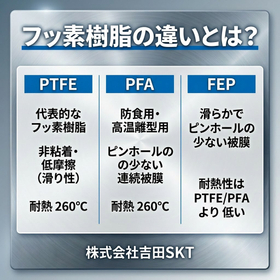
Fluororesin Coating: "What is the difference in fluororesin?"

I will explain the differences between the representative fluororesins "PTFE," "PFA," and "FEP."

Types and Characteristics of Representative Resins for Teflon Coating and Fluororesin Coating ■ Resin Name PTFE (Polytetrafluoroethylene) ■ Characteristics It has the highest continuous use temperature of 260°C, and in addition to heat resistance, it also excels in non-stick properties and low friction characteristics. ■ Alternative Name Tetrafluoroethylene, 4F ■ Resin Name PFA (Perfluoroalkoxyalkane Polymer) ■ Characteristics An improved resin of PTFE, it has the same continuous use temperature of 260°C as PTFE. It has a low thermal melt viscosity, allowing for a continuous coating with fewer pinholes that could not be achieved with PTFE, making it the best-performing fluororesin for corrosion-resistant coatings. Additionally, PFA is superior in non-stick properties compared to PTFE for certain applications, making it suitable for high-temperature release coatings. ■ Resin Name FEP (Perfluoroethylene Propylene Copolymer) ■ Characteristics An improved resin of PTFE, but with lower heat resistance than PTFE. It can achieve a smooth coating with fewer pinholes through sintering. ■ Alternative Name 4F6F, Tetrafluoro-hexafluoropropylene

  • 0217VD.png
  • Secondary Cells/Batteries
  • Fluorine resin coating

Added to bookmarks

Bookmarks list

Bookmark has been removed

Bookmarks list

You can't add any more bookmarks

By registering as a member, you can increase the number of bookmarks you can save and organize them with labels.

Free membership registration

The lifespan of fluorine coating improved up to four times: Case study on the improvement of resin thermal fusion process.

Solving the issue of fluororesin coating peeling in the polypropylene container welding process! Achieving four times the maximum usage count, resulting in increased productivity and reduced costs.

■Concern For customers manufacturing resin containers made of PP (polypropylene), there was a process of adjusting the size and welding them in the middle for containers that are split vertically into two parts. ■Background To prevent adhesion of PP on the heat welding plates (heater plates) used for welding PP resin, PTFE coating (fluororesin coating) was adopted. The heater temperature is high, reaching up to 250°C, and since it is pressed against the PP resin during use, the PTFE coating would get scratched, leading to delamination at the interface between the heat welding plate and the coating, necessitating immediate replacement. ■Adopted Coating "CHC-1111CR" ■Adoption Background and Effects While PTFE has high heat resistance and is less likely to soften when heated, we proposed "CHC-1111CR," which has even higher film hardness during heating. In actual machine tests, where PTFE could no longer be used after one cycle, it was found that it could now be used for four cycles, leading to its adoption. The adhesion prevention performance for PP remains unchanged compared to PTFE. *For more details, please download the PDF or contact us.*

  • 800808.jpg
  • 1718928.jpg
  • Other Auto Parts
  • Fluorine resin coating

Added to bookmarks

Bookmarks list

Bookmark has been removed

Bookmarks list

You can't add any more bookmarks

By registering as a member, you can increase the number of bookmarks you can save and organize them with labels.

Free membership registration

[Surface Treatment Example] Improved Release Properties of Heat Plates for Tray Sealers!

[Food Industry Case Study] Improved Non-Stick Properties of Welded Plates with Special Fluoropolymer Coating! Measures to Prevent Adhesion of Films that Stick Even with Fluoropolymer Coatings.

We would like to introduce a case of a coating that resolved the sticking issues of melt film that could not be solved with fluororesin coatings. ■ Background of the Consultation A certain customer was handling a tray sealer that covers plastic trays with film. In the process of covering plastic containers with film, the film is melted and thermally bonded to the plastic container. The thermal bonding plate is heated to over 100°C, causing the film surface to melt. To prevent the film from sticking to the heating plate, a fluororesin coating was applied. ■ Background of Coating Selection Fluororesin coatings are often used for their excellent non-stick properties, but depending on the material of the film and the melting temperature, they were causing product defects by sticking to the heating plate. Additionally, the heating plate had small holes for vacuuming the film, which limited the options available. ■ Coating Adopted 'TP Coating' *Please scroll down for more details. *For more information, please refer to the materials or contact us directly.

  • 722013_edited.jpg
  • 1262386.jpg
  • Food Packaging Machinery
  • Fluorine resin coating

Added to bookmarks

Bookmarks list

Bookmark has been removed

Bookmarks list

You can't add any more bookmarks

By registering as a member, you can increase the number of bookmarks you can save and organize them with labels.

Free membership registration

Explaining the non-stick properties of Teflon and fluoropolymer resins! "Why don't they stick?"

What is non-stickiness? Why do ingredients not stick to Teflon-coated frying pans? We present an explanatory document that answers such questions about non-stickiness!

Teflon fluoropolymer, known for its Teflon coating and fluorine coating. What kind of mechanism enables its characteristic of being difficult for things to stick? By understanding the non-stick mechanism of fluoropolymer, you will be able to use it appropriately. We present the following three-part document explaining non-stick properties. ■□■□■□■□■□■□■□■□■□■□■□■□■□■□■□■□ INDEX 1. The property of non-stickiness 2. Reasons why Teflon fluoropolymer excels in non-stickiness 2-1. High repellency 2-2. Low affinity 2-3. Chemically stable molecular structure 3. Examples of solutions utilizing non-stick properties - Case studies introduction - ■□■□■□■□■□■□■□■□■□■□■□■□■□■□■□■□ For more details, please download the document or check the link below. ▼ "Why doesn't it stick?!" Explanation of the non-stick properties of Teflon fluoropolymer ▼

  • Surface treatment contract service
  • Fluorine resin coating

Added to bookmarks

Bookmarks list

Bookmark has been removed

Bookmarks list

You can't add any more bookmarks

By registering as a member, you can increase the number of bookmarks you can save and organize them with labels.

Free membership registration

Explaining the chemical resistance of Teflon and fluoropolymer! "Why doesn't it dissolve in chemicals?"

Teflon resin, or fluoropolymer, has excellent chemical resistance. This explains the chemical resistance of fluoropolymers compared to the typical plastic polyethylene.

■What is the "Chemical Resistance" of Fluororesin? "Chemical resistance" refers to durability against various chemicals. The types of chemicals include acids, alkalis, and organic solvents, and it is said to have "chemical resistance" when it does not dissolve (dissolve), swell (swell), or react to them. Fluororesin is not affected by almost all chemicals. You can check the detailed explanation in the PDF document. ■INDEX 1. What is chemical resistance? 2. Effects of chemicals on resin 3. Reasons why Teflon fluororesin excels in chemical resistance 4. What can be done using chemical resistance *For more details, please download the document or contact us.

  • Surface treatment contract service
  • Fluorine resin coating

Added to bookmarks

Bookmarks list

Bookmark has been removed

Bookmarks list

You can't add any more bookmarks

By registering as a member, you can increase the number of bookmarks you can save and organize them with labels.

Free membership registration

Fluororesin coating: What is "corrosion resistance of thick film coating"?

Teflon fluoropolymer, used for corrosion-resistant lining to protect substrates from chemicals. This explains the corrosion resistance of thick fluoropolymer coatings.

■ What is "corrosion resistance"? "Corrosion resistance" refers to the property of being less prone to corrosion reactions and oxidation. In the field of corrosion prevention, which requires corrosion (anti-corrosion) properties, terms such as "light anti-corrosion" and "heavy anti-corrosion" may be used depending on the degree of corrosiveness. You can find detailed information in the PDF document below. ーーーーーーーーーーーーーーーーーーーーーーーーーーーーーーー 1. What is corrosion resistance? 2. How to prevent corrosion 3. Corrosion resistance of Teflon fluoropolymer coatings 4. Characteristics of Teflon fluoropolymer coatings for corrosion-resistant applications 4-1. No pinholes or defects in the coating film 4-2. Thickening of the coating film 5. What can be achieved by utilizing the corrosion resistance of Teflon fluoropolymer coatings ーーーーーーーーーーーーーーーーーーーーーーーーーーーーーーー * For more details, you can download the document or view it at the link below. ▼ "Protecting the substrate from chemicals!" Explanation of the corrosion resistance of Teflon fluoropolymer coatings ▼

  • Surface treatment contract service
  • Fluorine resin coating

Added to bookmarks

Bookmarks list

Bookmark has been removed

Bookmarks list

You can't add any more bookmarks

By registering as a member, you can increase the number of bookmarks you can save and organize them with labels.

Free membership registration

Fluororesin and Surface Treatment Information "Coating MAGAZINE"

Disseminating necessary coating materials, processing methods, selection tips, effects, and technical knowledge for everyone involved in manufacturing!

"Coating MAGAZINE" is an information media related to surface treatment and coating, developed by the surface treatment technology manufacturer Yoshida SKT. Starting with "Basic Information on Fluororesin Sheet Lining," it features articles explaining topics such as "What Types of PFA Lining Are There? Differences in Processing Methods and Characteristics" and "Chemical Resistance of Teflon Fluororesin." We provide information that helps overcome challenges faced by production equipment engineers. Please take a look. 【List of Articles (Excerpt)】 ■ [Corrosion Treatment] Explanation of Basic Information on Fluororesin Sheet Lining ■ What Types of PFA Lining Are There? Explanation of Differences in Processing Methods and Characteristics ■ "Strong Against Chemicals!" Explanation of the Chemical Resistance of Teflon Fluororesin ■ "Water Beads Up!" Explanation of the Water and Oil Repellent Properties of Teflon Fluororesin ■ "Why Doesn't It Stick?" Explanation of the Non-Stick Properties of Teflon Fluororesin *For more details, please refer to the related links or feel free to contact us.

  • Surface treatment contract service
  • Fluorine resin coating

Added to bookmarks

Bookmarks list

Bookmark has been removed

Bookmarks list

You can't add any more bookmarks

By registering as a member, you can increase the number of bookmarks you can save and organize them with labels.

Free membership registration

Fluororesin and Teflon: "Explanation of Low Friction Properties" *Materials Available

This will provide a detailed explanation of the low friction properties of fluororesins used in friction reduction measures.

Fluororesin is known for its excellent sliding properties. We will explain in detail the secret behind its ability to reduce friction resistance and improve sliding performance. ■Contents of the document 1. What is friction? 2. Measures to reduce friction 3. What is the low friction property of fluororesin (PTFE)? 4. Reasons why fluororesin (PTFE) excels in low friction properties 4-1. Smoothness of the PTFE molecular surface 4-2. Strength of interatomic bonds 4-3. Lamellar structure and the deposition of PTFE 5. What can be achieved by utilizing the low friction properties of fluororesin For more details, please refer to the PDF document or feel free to contact us.

  • Surface treatment contract service
  • Fluorine resin coating

Added to bookmarks

Bookmarks list

Bookmark has been removed

Bookmarks list

You can't add any more bookmarks

By registering as a member, you can increase the number of bookmarks you can save and organize them with labels.

Free membership registration

Non-adhesive and release properties sustained even in high-temperature environments! Surface treatment technology 'CHC'

Proven to last three times longer! A new proposal featuring fluororesin and heat resistance! We are currently offering materials with case studies that showcase our unique coating technology.

CHC is Yoshida SKT's unique coating technology that uses ceramics. By combining ceramics with fluororesin, it is a new type of fluororesin coating that not only provides the usual "non-stick and release properties," but also has "less reduction in film hardness even in high-temperature environments." Currently, we are offering product materials that include a comparison table of physical properties with various coatings and case studies of companies that have solved their issues with CHC. ■Features - Non-stick properties equivalent to PTFE and PFA - High film hardness at temperatures above 200°C (compared to PTFE) *Based on internal testing *For more product details, please see the link below.

  • FireShot Capture 492 - 【新開発】表面処理CHC(セラミックハードコート)のご紹介 - コーティングマガジン - 吉田SKT - www.y-skt.co.jp.png
  • Resin mold
  • Fluorine resin coating

Added to bookmarks

Bookmarks list

Bookmark has been removed

Bookmarks list

You can't add any more bookmarks

By registering as a member, you can increase the number of bookmarks you can save and organize them with labels.

Free membership registration

Learn from the Basics! A Textbook on Fluororesin Coating

[Materials Presentation] A textbook on fluororesin coatings that covers everything from the basics to practical examples! Understanding the fundamentals will also lead to applications in practical work.

We are offering "The Textbook of Fluoropolymer Coatings," which allows you to learn about fluoropolymers from the basics, from our company, a specialized manufacturer of fluoropolymer coatings! This coating is utilized in various scenarios within the manufacturing industry, and we provide a clear explanation of fundamental topics such as material properties, processing methods, and selection criteria. With this one book, you can learn everything from the basics to applications of fluoropolymers. If you are interested, please feel free to download it. [Contents (excerpt)] ■ What are fluoropolymers? ■ Explanation of the properties of fluoropolymers ■ What are fluoropolymer coatings? ■ Processing methods for fluoropolymer coatings ■ Tips for selecting fluoropolymer coatings ■ Suitable substrates for fluoropolymer coatings ■ Case studies of fluoropolymer coatings

  • intro.jpg
  • index.jpg
  • p3.jpg
  • p5.jpg
  • Surface treatment contract service
  • Fluorine resin coating

Added to bookmarks

Bookmarks list

Bookmark has been removed

Bookmarks list

You can't add any more bookmarks

By registering as a member, you can increase the number of bookmarks you can save and organize them with labels.

Free membership registration

What is fluororesin coating (Teflon coating)?

It has the property of repelling water and oil well, even when they are on the surface! It is also resistant to cold and can withstand low temperatures of -250°C.

"Fluororesin coating (Teflon coating)" is a surface treatment that imparts various properties of fluororesin to the surface of materials, achieving prevention of sticking and adhesion, reduction of friction, and protection of the materials. It exhibits excellent release properties even against strongly adhesive substances and is rarely affected by or corroded by chemicals such as acids and alkalis. The Teflon coating on household frying pans is an example of a fluororesin coating that utilizes the non-stick and heat-resistant characteristics of Teflon fluororesin to make it difficult for food to stick to the frying pan. 【Features and Effects】 ■ Non-stick: Excellent release properties even against strongly adhesive substances ■ Water and oil repellency: Effectively repels water and oil on the surface ■ Heat and cold resistance: Withstands high temperatures (up to 260°C) and low temperatures (down to -250°C) ■ Low friction: Has a low coefficient of friction, making it slippery ■ Chemical resistance: Rarely affected by or corroded by chemicals such as acids and alkalis ■ Electrical properties: High dielectric strength (resistance to dielectric breakdown), volume resistivity, and surface resistivity *For more details, please refer to the related links or feel free to contact us.

  • image_16.png
  • image_17.png
  • image_18.png
  • image_19.png
  • image_20.png
  • Coating Agent
  • Fluorine resin coating

Added to bookmarks

Bookmarks list

Bookmark has been removed

Bookmarks list

You can't add any more bookmarks

By registering as a member, you can increase the number of bookmarks you can save and organize them with labels.

Free membership registration

Cleaning tasks become easier! "What is the non-stick property of fluoropolymer coatings?"

The non-stick property makes it difficult for substances to adhere, making cleaning tasks easier. Here, we introduce the non-stick characteristics of fluoropolymer coatings.

■The "non-stick property" of fluoropolymer… Non-stick property refers to the characteristic of being easy to release and not adhere, or to adhere less, even to strongly adhesive substances. For example, fluoropolymers have excellent water and oil repellency, a large contact angle, and due to their molecular structure, they possess a property of being difficult to wet. The measure of wettability, "critical surface tension (γc)," is extremely low for fluoropolymers, making it easy for liquids to be repelled and difficult to wet. Coatings that utilize such functions are effective for release applications, applications where adhesion needs to be minimized, and for simplifying cleaning. 【Reference data on non-stick properties】 ■Surface free energy of solids (dyn/cm) PTFE…18.5 PFA…17.8 FEP…17.8 ETFE…22.1 Fluoropolymers have low surface treatment free energy and possess properties that make them difficult to bond with various liquids and solids. By coating with fluoropolymer, dirt is less likely to stick and becomes easier to clean. *For detailed information on fluoropolymer coatings and non-stick properties, please download the PDF or contact us.

  • Resin mold
  • Fluorine resin coating

Added to bookmarks

Bookmarks list

Bookmark has been removed

Bookmarks list

You can't add any more bookmarks

By registering as a member, you can increase the number of bookmarks you can save and organize them with labels.

Free membership registration

Surface Treatment Case Studies: "Speeding Up Production Lines Using Adhesives"

Enabling the transport of products coated with hot melt adhesive! Utilizing surface treatment can solve various production challenges and troubles. Samples are currently available.

Troubles such as the following can occur at any time on the production line: ■ Line stoppage ■ Delay in takt time ■ Increase in defects etc… While prompt response and investigation of the causes are important when such issues arise, learning preventive measures in advance can help avoid emergencies. By imparting "release properties and slip properties" through surface treatment, we are currently offering free "Coating Sample Books" and "Process Improvement Case Studies" that have actually improved production processes. ■ The cleaning efficiency of adhesives that do not fully solidify is significantly enhanced by a higher level of non-stickiness. For more details on the cases, please download the "Process Improvement Case Studies" and check them out. You can apply for a free trial set of surface treatment samples from the "Related Links." We encourage you to take this opportunity to apply.

  • Other surface treatment equipment
  • Fluorine resin coating

Added to bookmarks

Bookmarks list

Bookmark has been removed

Bookmarks list

You can't add any more bookmarks

By registering as a member, you can increase the number of bookmarks you can save and organize them with labels.

Free membership registration

Surface treatment case: Coating that solved the stringing issue of polyethylene hot welding.

CHC technology has succeeded in maintaining the non-stick properties of heat plates compared to conventional fluoropolymer coatings (PTFE coatings)!

■Customer Request We want to eliminate stringing that occurs on the heating plate during the thermal welding of polyethylene containers. We aim to reduce product defects caused by stringing without changing the takt time and to decrease the frequency of heating plate replacement. ■Conditions for Process Selection As a result of considering cost-effectiveness, we require a lifespan that is double that of the current coating. ■Achieved Effects By adopting CHC technology for the coating, we have successfully balanced release effect and lifespan. *You can download a PDF summarizing the product information. For more details, please contact us.

  • FireShot Capture 492 - 【新開発】表面処理CHC(セラミックハードコート)のご紹介 - コーティングマガジン - 吉田SKT - www.y-skt.co.jp.png
  • Resin mold
  • Fluorine resin coating

Added to bookmarks

Bookmarks list

Bookmark has been removed

Bookmarks list

You can't add any more bookmarks

By registering as a member, you can increase the number of bookmarks you can save and organize them with labels.

Free membership registration

Fluororesin coating minimizes deformation of the substrate during processing.

The thin film fluoropolymer coating "10UNDER" is a revolutionary fluoropolymer coating that minimizes deformation of the substrate and can be processed.

■What is the "10under" Thin Film Fluoropolymer Coating? Conventional fluoropolymer coatings can be challenging to apply when dimensional stability of the substrate is a priority, particularly in terms of film thickness. Yoshida SKT has been working on development to meet these needs and has announced the "Thin Film Fluoropolymer Coating '10under.'" ■Features of 10under - Non-stick properties equivalent to standard fluoropolymer coatings - Capable of thin film processing of approximately 10μm, reducing dimensional changes - While being a thin film, it minimizes transparency *For more details, please download the materials or contact us.

  • 2_家比較全体.jpg
  • Surface treatment contract service
  • Fluorine resin coating

Added to bookmarks

Bookmarks list

Bookmark has been removed

Bookmarks list

You can't add any more bookmarks

By registering as a member, you can increase the number of bookmarks you can save and organize them with labels.

Free membership registration