We have compiled a list of manufacturers, distributors, product information, reference prices, and rankings for Fluorine resin coating.
ipros is IPROS GMS IPROS One of the largest technical database sites in Japan that collects information on.

Fluorine resin coating Product List and Ranking from 75 Manufacturers, Suppliers and Companies | IPROS GMS

Last Updated: Aggregation Period:Jan 28, 2026~Feb 24, 2026
This ranking is based on the number of page views on our site.

Fluorine resin coating Manufacturer, Suppliers and Company Rankings

Last Updated: Aggregation Period:Jan 28, 2026~Feb 24, 2026
This ranking is based on the number of page views on our site.

  1. 吉田SKT Aichi//Manufacturing and processing contract
  2. フロロコート Saitama//others
  3. null/null
  4. 4 シャイン工芸 Nara//Manufacturing and processing contract
  5. 5 関西ポリマー Osaka//Manufacturing and processing contract

Fluorine resin coating Product ranking

Last Updated: Aggregation Period:Jan 28, 2026~Feb 24, 2026
This ranking is based on the number of page views on our site.

  1. Advantages and disadvantages of re-coating a non-stick frying pan. 吉田SKT
  2. Causes of Teflon coating peeling and how to address them. 吉田SKT
  3. Fluororesin Coating: "Differences in Color and Selection Method" 吉田SKT
  4. 4 A detailed explanation about Teflon lining. 吉田SKT
  5. 5 What non-stick (non-stick) coating is 吉田SKT

Fluorine resin coating Product List

181~210 item / All 543 items

Displayed results

【資料進呈】摺動性・滑り性に優れたコーティングとは? 

滑り性、摺動性に優れ、耐摩耗性にも優れるコーティング。用途環境に適したコーティングを選択できます。

製造設備では、ふたつのものが接触して動く箇所の滑り性(潤滑性)を 良くすることで、稼働をスムーズにしたり、少ない力でものを動かしたり という効果が求められます。 〇フッ素樹脂、特にテフロンフッ素樹脂の代表格でもあるPTFEは  摩擦係数が低く、静摩擦係数は動摩擦係数よりも小さいため、  スティックスリップ現象を起こさず滑らかに滑ります。 〇バイコート(R)は高い硬度を備えた無機材料とフッ素樹脂を組み合わせ、  滑り性に優れる、超耐久性ふっ素系有機コーティングシステムです。 〇スーパーTPコーティングは、フラットな基材でも  オールフッ素の独自の凸面コーティングが可能。  接触面積のコントロールによるすべり性に優れたコーティングです。 【選ばれているコーティング】 ■摺動・低摩擦性  ・テフロン(TM)フッ素樹脂コーティング ■潤滑・耐摩耗性・高硬度  ・バイコート(R) ■接触面積コントロールによる 滑り性(フッ素樹脂系)  ・スーパーTP  ・スーパーTP半球グラフィック ※詳しくはPDF資料をご覧いただくか、お気軽にお問い合わせ下さい。

  • Processing Contract
  • Fluorine resin coating

Added to bookmarks

Bookmarks list

Bookmark has been removed

Bookmarks list

You can't add any more bookmarks

By registering as a member, you can increase the number of bookmarks you can save and organize them with labels.

Free membership registration

[Food Industry Case Study] Preventing Product Jamming with Conveying Guides for Automatic Packaging Machines

Case study of solving issues with automatic packaging machines for frozen foods. The adhesion caused by moisture to the transport guide has been reduced, improving the sliding performance.

We would like to introduce a case where product jams were prevented in the conveying guide of a frozen food automatic packaging machine. During the 20-hour daily operation of frozen food packaging, a phenomenon occurred where the side guide became a resistance to product conveyance, causing the line to jam. This resulted in the equipment stopping and the line halting, which was a significant issue. Additionally, there was a problem where the products were being scraped due to friction with the guide. By adopting the "Super TP Hemisphere HL," a large convex surface created a gap between the product and the guide, reducing sticking due to moisture and improving sliding. The situation where products jammed and the equipment stopped has been improved. [Key Points] - Purpose of surface treatment: Reduce work loss, stabilize quality and operation - Required functions: Non-stick and release properties, sliding and gliding, wear resistance - Adopted treatment: "Super TP Hemisphere HL" *For more details, please refer to the PDF materials or feel free to contact us.

  • Processing Contract
  • Fluorine resin coating

Added to bookmarks

Bookmarks list

Bookmark has been removed

Bookmarks list

You can't add any more bookmarks

By registering as a member, you can increase the number of bookmarks you can save and organize them with labels.

Free membership registration

[Case Study in the Hygiene Products Industry] Improved Cleanability of Adhesive on Rolls!

Shortening cleaning time! A case study on solving coating challenges that improved productivity.

We would like to introduce a case study on surface treatment in the lamination process using hot melt adhesives for diapers and sanitary products. In the lamination process, if the applied adhesive adheres to the transport rolls, there is a risk of it transferring to the product or contaminating it, resulting in defective products. Therefore, it was necessary to regularly remove the adhesive. We adopted our "Super CTT" for this purpose. Thanks to its release effect, the semi-cured hot melt adhesive is transported without adhering, which reduces the frequency of cleaning, shortens cleaning time, and ultimately improves productivity. 【Key Points】 ■ Purpose of surface treatment: Speeding up, stabilizing quality and operation, reducing work loss ■ Required functions: Non-stick, release properties, wear resistance ■ Treatment adopted: Super CTT *For more details, please refer to the PDF document or feel free to contact us.

  • Processing Contract
  • Fluorine resin coating

Added to bookmarks

Bookmarks list

Bookmark has been removed

Bookmarks list

You can't add any more bookmarks

By registering as a member, you can increase the number of bookmarks you can save and organize them with labels.

Free membership registration

[Case Study] Coating to Eliminate Sheet Adhesion to Molds

Almost zero adhesion! Case study of coating used during decorative sheet transfer.

We will introduce a case that resolved the sticking of decorative sheets to molds during transfer. ■Background Decorative sheets with adhesive are set onto parts using molds and are transferred via vacuum. During this process, it was observed that excess sheets, other than those on the parts, would stick to certain parts of the mold. To prevent the sticking caused by the adhesive on the decorative sheets, surface treatment of the molds was being explored. ■Adoption of Coating and Effects By adopting our "Bicoat," significant improvements in preventing sticking were achieved. The sticking of decorative sheets was reduced to almost zero, resulting in a level of satisfaction from our customers. 【Key Points of the Case】 ■Purpose of Surface Treatment: Quality and operational stability, realization of development needs, reduction of replacement and material costs ■Required Functions: Non-stick and release properties, long lifespan ■Adopted Treatment: Bicoat *For more details, please refer to the PDF document or feel free to contact us.

  • Processing Contract
  • Fluorine resin coating

Added to bookmarks

Bookmarks list

Bookmark has been removed

Bookmarks list

You can't add any more bookmarks

By registering as a member, you can increase the number of bookmarks you can save and organize them with labels.

Free membership registration

[Case Study on Problem Solving through Surface Treatment] Prevention of Adhesion to Conveying Rolls of Uncured Rubber

The effect of preventing sticking lasts a long time! It has become possible to reduce costs and working time.

■Concern The manufacturing process of weatherstrips involved transporting extruded rubber on rolls while heating and drying it in a furnace. Due to changes in the rubber material formulation for environmental measures and durability, it became necessary to process the rubber at higher temperatures than before, resulting in the rubber becoming sticky immediately after entering the furnace. ■Issues It was confirmed that when a common fluoropolymer coating was applied to the transport rolls, the rubber would stick to them like a suction cup. ■Effect of Surface Treatment By adopting our "Super TP Coating," we significantly reduced the rubber's stickiness and achieved a relatively soft contact surface. 【Key Points】 ■Purpose of Surface Treatment: Quality and operational stability, reduction of work loss, compliance with safety and environmental requirements ■Required Functions: Non-stick and release properties, long lifespan ■Adopted Treatment: Super TP Coating *For more details, please refer to the PDF document or feel free to contact us.

  • Processing Contract
  • Fluorine resin coating

Added to bookmarks

Bookmarks list

Bookmark has been removed

Bookmarks list

You can't add any more bookmarks

By registering as a member, you can increase the number of bookmarks you can save and organize them with labels.

Free membership registration

Electrostatic Prevention Fluororesin Coating 'Safron(R) AP+'

Thick film processing that can be used for applications requiring corrosion resistance is possible. It also accommodates cases where static electricity is a concern and fluororesin coatings cannot be used.

■What is SafeLon(R) AP+? SafeLon(R) AP+ is an anti-static fluoropolymer coating that further enhances the functions of Yoshida SKT's anti-static fluoropolymer coating, "SafeLon(R)." ■Features of SafeLon AP+ By enhancing three functions: "release performance," "anti-static performance," and "blister resistance," improvements in corrosion resistance, non-stick properties, and coating lifespan can be expected. 【Upgraded Functions from SafeLon】 - Release Performance Improved release performance by creating a smoother surface. - Anti-Static Performance Achieves a leakage resistance value of 10^4-5Ω by directly dissipating generated charges to the substrate (metal). - Blister Resistance Reduces blister formation to about half that of conventional fluoropolymer coatings. *For more details, please refer to the PDF document or feel free to contact us.

  • 2021-06-02 (27).png
  • 2021-06-02 (33)-1.png
  • Surface treatment contract service
  • Fluorine resin coating

Added to bookmarks

Bookmarks list

Bookmark has been removed

Bookmarks list

You can't add any more bookmarks

By registering as a member, you can increase the number of bookmarks you can save and organize them with labels.

Free membership registration

[Coating Example] Non-stick Performance Scissors

The special coated blade repels sticky substances!

The scissors coated by Yoshida SKT do not attract adhesive materials. The film thickness is 1 to 3 microns. The precision of the blade tip is maintained even after coating. Since the coating extends to the blade tip, it has a high level of non-stickiness all the way to the tip of the blade. They can be used for cutting various adhesive materials such as vinyl tape, double-sided tape, and cloth tape. Our company is capable of applying a coating that prevents adhesive materials from sticking to scissors. As a specialized manufacturer of surface treatment and industrial Teflon fluororesin coating, we provide problem-solving solutions that enhance customer satisfaction. 【Features】 ■ Film thickness: 1 to 3 microns ■ Maintains blade tip precision even after coating ■ High non-stickiness all the way to the tip of the blade *For more details, please refer to the PDF document or feel free to contact us.

  • IMG_1901_edited.jpg
  • Processing Contract
  • Fluorine resin coating

Added to bookmarks

Bookmarks list

Bookmark has been removed

Bookmarks list

You can't add any more bookmarks

By registering as a member, you can increase the number of bookmarks you can save and organize them with labels.

Free membership registration

Presentation of materials: A coating that surpasses fluorine and silicone in anti-adhesion properties.

For applications that cannot be satisfied with Teflon or silicone coatings! You can experience excellent release properties.

To prevent sticking of adhesive materials, fluororesin coatings (Teflon™ coatings) and silicone coatings are commonly used, but the following challenges may arise: [Challenge 1] Even with surface treatments claiming to prevent sticking, there was not much change. [Challenge 2] It started sticking unexpectedly quickly during use. [Challenge 3] Silicone coating transfers and causes defects in the bonding process (fluororesin did not provide sufficient effectiveness, leading to the choice of silicone). Recently, there has been an increase in customers needing solutions for more adhesive materials, such as wanting to release molten resins that do not fully solidify to shorten process time. Yoshida SKT has coatings that can improve such situations. In general fluororesin coatings, adhesive materials can stick due to various factors. In contrast, treatments that create a rough surface to reduce the contact area with adhesive materials are known. Our company has a unique technology to create convex surfaces using fluororesin and other materials, and we are now offering a kit to experience its effectiveness for free! ▼ You can apply from the "Yoshida SKT Official Site" below.

  • ip4.jpg
  • ip5.jpg
  • ip6.jpg
  • ip2.jpg
  • ip3.jpg
  • ip1.gif
  • Other Auto Parts
  • Fluorine resin coating

Added to bookmarks

Bookmarks list

Bookmark has been removed

Bookmarks list

You can't add any more bookmarks

By registering as a member, you can increase the number of bookmarks you can save and organize them with labels.

Free membership registration

"Bi-Coat" with durability that surpasses fluororesin coatings.

For those troubled by peeling and wear of fluororesin coatings, we are currently offering free samples of 'Bicoat(R)', which excels in high hardness, wear resistance, release properties, and slip characteristics.

Do you have any concerns or requests regarding coatings for "preventing sticking" and "improving sliding"? - "Worried about coating deterioration or peeling" - "Want to extend the period until reprocessing" In production environments, there is always a demand for "damage-free" coatings. Bycoat® is a coating that pursues a balance of [durability and strength] and [anti-sticking and sliding effects]. [Purpose] To reduce the possibility of troubles such as "function degradation, foreign matter contamination, and defects caused by coating scratches and peeling," which can lead to decreased production efficiency. [Examples of Use] - Conveyance guides Provides sliding properties to prevent clogging of conveyed items. Reduces the risk of coating peeling and foreign matter contamination. - Heat seal type (sealer) Prevents sticking of the sealing member that presses the film with heat and coating peeling. - Molding type Contributes to improved release properties of resin product molds. Maintains dimensional accuracy, allows for low-temperature processing, and preserves mold quality. We are currently offering a free "Bycoat® Experience Kit." Please try the anti-sticking and sliding properties with actual materials. ▼ You can apply for the "Experience Kit" from the official Yoshida SKT website below.

  • damageless11.jpg
  • s-IMG_8528_edited.jpg
  • s-IMG_8557_edited.jpg
  • s-NYF-11-S.jpg
  • s-NYF-11-S (2).jpg
  • s-NYK-01 (3)1.jpg
  • s-NYK-01 (4).jpg
  • Other Auto Parts
  • Fluorine resin coating

Added to bookmarks

Bookmarks list

Bookmark has been removed

Bookmarks list

You can't add any more bookmarks

By registering as a member, you can increase the number of bookmarks you can save and organize them with labels.

Free membership registration

Presentation of Case Studies: Improve Conveying Equipment with Anti-Sticking Coating!

Waste hidden in conveying devices and processes. With convex coating, why not start improvements now for "profit enhancement" and "productivity increase"?

The unique convex coating technology of Yoshida SKT, which excels in "anti-sticking and slip resistance," will improve your transportation processes and contribute to increased profitability. OLD NORMAL - Current Production Site - - It's just how things are - It's working without issues - Someone can handle it each time This common sense has taken root and is often overlooked. If we don't change this situation to a "New Normal," profitability will not improve! NEW NORMAL - Correct Approach - - Prepare and consider measures before problems arise - Promote labor-saving, cleanliness, and automation through robotics - Reduce indirect work and allow workers to focus on their core tasks Yoshida SKT's convex coating will assist in transitioning to the New Normal in transportation! 1. What Makes Yoshida SKT's Convex Coating Different It can control a rich variety of convex formations according to conditions, ensuring a high level of improvement. 2. We Have Improvement Case Studies We have a proven track record with various transportation materials, improving diverse transportation troubles such as adhesives and rubber products. [We offer a collection of case studies on process improvements through coating] If you are interested, please request the "trial set" through the related link!

  • s-IMG_0164_edited_edited.jpg
  • s-IMG_9503_edited_edited.jpg
  • s-IMG_9517_edited_edited.jpg
  • s-IMG_9422_edited.jpg
  • s-IMG_9476_edited_edited.jpg
  • s-IMG_9448_edited.jpg
  • Conveyor
  • Fluorine resin coating

Added to bookmarks

Bookmarks list

Bookmark has been removed

Bookmarks list

You can't add any more bookmarks

By registering as a member, you can increase the number of bookmarks you can save and organize them with labels.

Free membership registration

Proposal for Coating Selection: "Coating Performance Measurement Service" *Materials Available

To meet the need of wanting to confirm the effectiveness before coating, Yoshida SKT measures the coating surface with its unique know-how.

"I want to test the effectiveness of coatings using materials produced in-house in advance." "I am considering introducing coatings but am struggling with how to select them." To address these concerns, we propose measuring coating performance using our unique know-how, allowing for a comparative review before introducing coatings. Please feel free to consult us about preparing sample pieces. - Do you have any of these issues? During resin molding, resin sticks to molds or extruders, causing problems. After researching, I found that surface treatment is an effective measure to prevent sticking, but there are various types of resins and additives depending on the product, and I don't know which surface treatment to choose. - With our coating performance measurement service, you can use the materials you are currently using to check the adhesion with the coating, facilitating smooth real machine testing. ■ Measurement of Release Force of Melted Resin Pellets We measure the release force between melted resin pellets and the coated surface, allowing you to confirm the degree of peeling from the coating numerically. *For applications and to download materials, please visit the official Yoshida SKT website below.

  • テープ離型力測定4.png
  • コーティング性能測定イラスト 溶融樹脂6.png
  • 溶融樹脂シート離型力測定1.png
  • 液体の接触角測定1.png
  • Contract measurement
  • Fluorine resin coating

Added to bookmarks

Bookmarks list

Bookmark has been removed

Bookmarks list

You can't add any more bookmarks

By registering as a member, you can increase the number of bookmarks you can save and organize them with labels.

Free membership registration

What are the differences between fluoropolymer coatings: PTFE, PFA, and FEP?

We will introduce the differences between fluoropolymer PTFE, PFA, and FEP.

Differences in Types and Characteristics of Representative Resins for Teflon Coating and Fluororesin Coating ■ Resin Name PTFE (Polytetrafluoroethylene) ■ Characteristics It has the highest continuous use temperature of 260°C, and in addition to heat resistance, it excels in non-stick and low friction properties. ■ Alternative Name Tetrafluoroethylene, 4F ■ Resin Name PFA (Perfluoroalkoxyalkane Polymer) ■ Characteristics An improved resin of PTFE, it has the same continuous use temperature of 260°C as PTFE. It has a low thermal melt viscosity, allowing for a continuous coating with fewer pinholes that could not be achieved with PTFE, making it the best-performing fluororesin for corrosion-resistant coatings. Additionally, PFA is superior in non-stick properties compared to PTFE for certain applications, making it suitable for high-temperature release coatings. ■ Resin Name FEP (Perfluoroethylene Propylene Copolymer) ■ Characteristics An improved resin of PTFE, but with lower heat resistance than PTFE. It can achieve a smooth coating with fewer pinholes through firing. ■ Alternative Name 4F6F, Tetra-hexafluoride

  • 0217VD.png
  • Secondary Cells/Batteries
  • Fluorine resin coating

Added to bookmarks

Bookmarks list

Bookmark has been removed

Bookmarks list

You can't add any more bookmarks

By registering as a member, you can increase the number of bookmarks you can save and organize them with labels.

Free membership registration

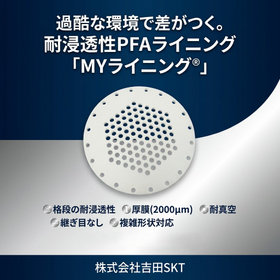
Blister resistance increased by 10 times - Fluororesin lining 'MY Lining'

Achieves penetration resistance performance that greatly exceeds that of standard fluoropolymer lining. It demonstrates ten times the blister resistance compared to our standard PFA lining.

"MY Lining(R)" is a corrosion-resistant lining that significantly improves permeation resistance compared to standard PFA. It offers a lifespan that is expected to be several dozen times longer than that of conventional products (according to our coatings). It is suitable for environments that could not be used before and for places where the previous lifespan was unsatisfactory. It can also be lined in complex shapes such as eye plates and stirrers. 【Features】 ■ Dramatic improvement in permeation resistance performance (compared to our products) ■ Thick film processing is possible (MAX 2000μm) ■ Strong adhesion (vacuum resistance) ■ Seamless integrated processing ■ Can be lined in complex shapes such as eye plates and search machines *For more details, please refer to the PDF document or feel free to contact us.

  • 2021-06-02 (38).png
  • 2021-06-02 (37).png
  • 2021-06-02 (39).png
  • 2021-06-02 (40).png
  • Surface treatment contract service
  • Fluorine resin coating

Added to bookmarks

Bookmarks list

Bookmark has been removed

Bookmarks list

You can't add any more bookmarks

By registering as a member, you can increase the number of bookmarks you can save and organize them with labels.

Free membership registration

For those unsure about choosing surface treatment: Release and non-stick coatings *Materials available

Release properties are necessary. I want to reduce adhesion. I want to save on cleaning effort. It effectively meets all your requests! We introduce a surface treatment that excels in release and non-stick properties.

"Non-stick" refers to a property that makes it easy to release from strongly adhesive materials, meaning it either does not adhere or adheres with difficulty. Utilizing non-stick properties, we introduce surface treatments (coatings) that are effective for release applications, applications where adhesion needs to be minimized, and for simplifying cleaning. [Surface treatments chosen for non-stick and release purposes (partial list)] ■ Non-stick, lubricity, heat and cold resistance, chemical resistance, water and oil repellency, electrical properties 'Teflon (TM) fluoropolymer coating' ■ Release properties, high hardness, dimensional stability, lubricity, wear resistance 'Bicoat (R)' ■ Prevention of adhesion of highly adhesive materials 'Adhesive release coating series' 'MRS coating' (silicone-based coating) ■ Release of molten resin at high temperatures 'FSR coating' *For more details, please click to download the PDF or feel free to contact us.

  • s-シーラー.jpg
  • ホットメルト_edited.jpg
  • IMG_9472_edited2.jpg
  • s-ロール.jpg
  • IMG_9363_edited.jpg
  • s-0197UJedit.jpg
  • DSC04626_edited.jpg
  • Processing Contract
  • Fluorine resin coating

Added to bookmarks

Bookmarks list

Bookmark has been removed

Bookmarks list

You can't add any more bookmarks

By registering as a member, you can increase the number of bookmarks you can save and organize them with labels.

Free membership registration

Fluororesin coating "Types suitable for applications"

What types of fluororesins are suitable for applications such as non-adhesiveness, slip properties, and corrosion resistance? It is necessary to consider the characteristics and properties of the resin, as well as the selection of processing methods.

**Representative Types** ■ PTFE (Polytetrafluoroethylene) It has the highest continuous use temperature of 260°C and excels in non-stick and low friction properties. ■ PFA (Perfluoroalkoxyalkane Polymer) It has a low melt viscosity and can achieve a continuous coating with fewer pinholes than PTFE. It is the best-performing fluororesin for high-temperature corrosion resistance. ■ FEP (Perfluoroethylene Propylene Copolymer) An improved resin of PTFE, it has a lower continuous use temperature than PTFE but can achieve a smooth coating with fewer pinholes through sintering. ■ ETFE (Ethylene-Tetrafluoroethylene Copolymer) Due to its excellent mechanical properties, it is highly resistant to wear and is often used for anti-corrosion applications. ■ Modified Types ◎ High-temperature modified type ◎ Low-temperature modified type **Representative Processing Methods** ○ The enamel of fluororesin is applied using a painting machine or manually. ○ Fluororesin powder is applied using electrostatic or special painting machines. Coating processing is easily adaptable to complex shapes and is used in numerous industries. *For more details, please download the PDF and take a look.*

  • 製品 かずかず3.png
  • 2021-06-02 (3).png
  • 2021-06-02 (23).png
  • s-00718Nedit.gif
  • s-0078ZLedit.gif
  • s-すべり用.jpg
  • Surface treatment contract service
  • Fluorine resin coating

Added to bookmarks

Bookmarks list

Bookmark has been removed

Bookmarks list

You can't add any more bookmarks

By registering as a member, you can increase the number of bookmarks you can save and organize them with labels.

Free membership registration

[Surface Treatment Case] Protecting Robots from Corrosion with Fluorine-based Corrosion-resistant Coating

What are the methods to enable robots to exist in harsh environments? We will introduce surface treatments (coatings) that implement corrosion prevention measures such as robot covers.

■Sites Requiring Surface Treatment - Environments where corrosion of robot arm covers is a concern - Sterilization environments using UV - Environments requiring cleanability ■Points of Innovation - By applying a corrosion-resistant coating to robot arm covers, we protect the metal from many acids, alkalis, solvents, and other chemicals. - The surface is resistant to degradation even in special environments such as UV, making it suitable for protecting robots. - It offers superior cleanability compared to metal, allowing for safe use even in conditions where food may adhere and create a breeding ground for bacteria. - It enhances efficiency in sites where "environment" and "atmosphere" have been bottlenecks, raising concerns about equipment deterioration. ■Examples of Coatings for Improving Robot Transport Adhesion Issues - Teflon Coating (Fluororesin Coating) - Antistatic Fluororesin Coating "Safron" - Antistatic Fluororesin Coating "Safron AP+" - Organic-Inorganic Composite Coating "Cerashield" - Fluorine-based Room Temperature Coating "Cerashield F" *For more details, please download the PDF or feel free to contact us.*

  • ロボットカバー腐食.jpg
  • DSC_4981_edited.jpg
  • IMG_1856_edited.jpg
  • IMG_1850_edited.jpg
  • IMG_1860_edited.jpg
  • IMG_1848_edited.jpg
  • Surface treatment contract service
  • Fluorine resin coating

Added to bookmarks

Bookmarks list

Bookmark has been removed

Bookmarks list

You can't add any more bookmarks

By registering as a member, you can increase the number of bookmarks you can save and organize them with labels.

Free membership registration

[Data Presentation] Super Engineering Plastics Property List

Presentation of a list of characteristics for PTFE, PFA, FEP, PCTFE, ETFE, ECTFE, PVDF, PBI, PEEK, PAI, PES, and PPS.

【Super Engineering Plastic Properties Documentation】 ■PTFE (Polytetrafluoroethylene) ■PFA (Tetrafluoroethylene-Perfluorovinyl Ether Copolymer) ■FEP (Tetrafluoroethylene-Hexafluoropropylene Copolymer) ■PCTFE (Chlorotrifluoroethylene Homopolymer) ■ETFE (Tetrafluoroethylene-Ethylene Copolymer) ■ECTFE (Chlorotrifluoroethylene-Ethylene Copolymer) ■PVDF (Polyvinylidene Fluoride Homopolymer) ■PBI (Polybenzimidazole) ■PEEK (Polyether Ether Ketone) ■PI (Polyimide) ■PAI (Polyamide Imide) ■PES (Polyether Sulfone) ■PPS (Polyphenylene Sulfide) *For more details, please download the PDF and refer to it. The property tables are for general characteristics and do not guarantee the physical properties by our company. Thank you for your understanding in advance.*

  • Surface treatment contract service
  • Fluorine resin coating

Added to bookmarks

Bookmarks list

Bookmark has been removed

Bookmarks list

You can't add any more bookmarks

By registering as a member, you can increase the number of bookmarks you can save and organize them with labels.

Free membership registration

[Surface Treatment Solution Case] Release of UV-curable resin with a 1μm thin film surface treatment!

Achieving adhesion prevention for UV-curable resin used in display panel sealing! Ultra-thin film surface treatment 'Nano Process(R)'

■Concerns In the process of manufacturing display panels for TVs and other devices, sealing is done using UV-curable resin. However, the adhesive resin tends to stick to the jigs, leading to an increased likelihood of product defects. ■Requests The standard Teflon™ anti-adhesion coating results in a film thickness of several tens of micrometers, which causes fine irregularities to be transferred to the resin, raising concerns about the impact on products requiring precision. Additionally, the 400°C heat treatment during coating can cause warping of the jigs, and the UV light necessary for curing the sealing resin can compromise the adhesion of the coating, making it unusable. ■Solution Coating NanoProcess® TLS-200 ■Problem Resolution - Significant reduction in product defects due to prevention of resin adhesion - Improved precision leading to longer lifespan of jigs - Increased production efficiency *For details on the effects and background of the solution, please download the PDF or contact us.*

  • banner192x192_dl.jpg
  • Surface treatment contract service
  • Fluorine resin coating

Added to bookmarks

Bookmarks list

Bookmark has been removed

Bookmarks list

You can't add any more bookmarks

By registering as a member, you can increase the number of bookmarks you can save and organize them with labels.

Free membership registration

[Experimental footage] Excellent coating properties with non-stick, slip resistance, and corrosion resistance.

We will introduce the surface treatment functions provided by Yoshida SKT in an experimental video. The video explains the non-stick, slip, and corrosion resistance features in about 7 minutes.

Yoshida SKT responds to customer needs by providing surface treatment functions. - Non-stick (function to reduce sticking) Video playback: 0:00 - (For those in a hurry, please start playback from this time) - Low friction (function to enhance slipperiness) Video playback: 2:33 - (For those in a hurry, please start playback from this time) - Corrosion resistance (function to reduce corrosion) Video playback: 4:42 - (For those in a hurry, please start playback from this time) These are introduced through easy-to-understand experimental videos. With Yoshida SKT, we can accommodate a wide variety of substrates and offer suggestions from hundreds of types of coating materials. This broadens the range of coatings that customers can choose from. In addition to functions such as "reducing adhesion of sticky substances" and "improving slipperiness," we also respond meticulously to the varying needs and environments of each customer, such as "requiring precision" or "requiring heat resistance," to achieve reliable effects.

  • Surface treatment contract service
  • Fluorine resin coating

Added to bookmarks

Bookmarks list

Bookmark has been removed

Bookmarks list

You can't add any more bookmarks

By registering as a member, you can increase the number of bookmarks you can save and organize them with labels.

Free membership registration

[Automotive Industry Case Study] Release Properties + Wear Resistance + Image Recognition Properties 'Bicoat'

Improving production efficiency on the electronic components production line! We will introduce a case where the adoption of surface treatment has achieved prevention of adhesion to the suction fixtures.

We will introduce a case study of trouble resolution on the transport line for electronic components sealed with resin. ■Issue The electronic components sealed with resin are suctioned by a jig and transported and placed on the substrate. However, there were instances where the slightly adhesive sealing resin would stick to the jig, negatively affecting the yield. ■Request Since the suction jig performs suction, transport, and placement operations tens of thousands of times per hour, high wear resistance was required. Additionally, an image recognition camera is used to confirm the position of the components on this line, so it was necessary to use a color that minimizes reflection to prevent whiteout in the images. ■Adopted Surface Treatment - Bycoat® NYK-01BK ■Background and Effects of Adoption 'Bycoat' was considered for preventing the sticking of the sealing resin and for its wear resistance. After evaluation on actual equipment, it was found to have good wear resistance as well as excellent release properties for the resin. 【Resolved Issues】 - Reduced sticking issues with the resin - Decreased cleaning costs - Improved productivity *For more details, please download the PDF or contact us.

  • Surface treatment contract service
  • Fluorine resin coating

Added to bookmarks

Bookmarks list

Bookmark has been removed

Bookmarks list

You can't add any more bookmarks

By registering as a member, you can increase the number of bookmarks you can save and organize them with labels.

Free membership registration

[Automotive Industry Case] Non-stick coating to prevent label adhesion

A must-see for those struggling with sticking! Silicone-free, with a convex coating that peels off easily. We will introduce a case study on the product label application process.

We would like to introduce an improvement case of an automatic label application device using robots. ■Issues In the label application process using robots, the labels peeled off from the release paper are placed adhesive side down on a platform, from which the robot picks them up and applies them to the products. However, there were frequent troubles where the robot could not smoothly peel the labels from the platform, causing work stoppages. ■Requests Initially, we tried a silicone coating with excellent release properties, but the silicone transferred to the labels, reducing their adhesive strength, which led to the labels peeling off after being applied to the products. Additionally, the conventional Teflon™ coating did not sufficiently prevent the labels from sticking. To solve this, it was necessary to achieve both excellent release properties and silicone-free performance. 【Issues to be resolved】 - Label peeling due to silicone transfer - Cleaning time for label adhesive - Line stoppage troubles due to sticking ■Adopted Coating 'Super TP 250 UNDER' *For more details, please download the PDF or contact us.

  • Surface treatment contract service
  • Fluorine resin coating

Added to bookmarks

Bookmarks list

Bookmark has been removed

Bookmarks list

You can't add any more bookmarks

By registering as a member, you can increase the number of bookmarks you can save and organize them with labels.

Free membership registration

[Data Download] Surface Treatment "By Application" Chosen in the Semiconductor and Electronics Field

Coatings with anti-static properties, heat resistance, chemical resistance, and chemical inertness are widely used in semiconductor manufacturing equipment and electronic component manufacturing equipment.

■Applications such as plating jigs, soldering jigs, and semiconductor manufacturing lines - Selected surface treatment 'TEFLON (TM) fluororesin coating' ■Applications such as precision molds - Selected surface treatment 'Bicoat (R)' 'Nanoprocess (R)' ■Applications such as wafer and glass handling - Selected surface treatment 'Saflon (R)' 'PBI, PI coating' ■Applications such as precision nozzles, MEMS components, and optical lenses - Selected surface treatment 'Nanoprocess (R)' ■Applications such as chemical supply tanks - Selected surface treatment 'TEFLON (TM) fluororesin coating' 'Saflon (R) AP+' 'MY Lining (R)' ■Applications such as clean room walls, experimental equipment, and various tools - Selected surface treatment 'SeraShield F' ■Applications such as high-temperature equipment parts (rolls, heater covers) - Selected surface treatment 'SGN coating' *You can download the PDF of the surface treatment products introduced. For detailed product information, please visit the "Yoshida SKT Official Website."

  • Surface treatment contract service
  • Fluorine resin coating

Added to bookmarks

Bookmarks list

Bookmark has been removed

Bookmarks list

You can't add any more bookmarks

By registering as a member, you can increase the number of bookmarks you can save and organize them with labels.

Free membership registration

Surface treatments chosen for corrosion-resistant applications in the chemical industry *Product documentation available

In fields where chemical substances are used, surface treatments aimed at enhancing corrosion resistance are required. We introduce thick film coatings made from high-performance resins.

Typical corrosion-resistant materials include rubber, glass, and graphite products, but each has its drawbacks. ■ Disadvantages and Concerns - Rubber → Weak against heat and solvent-based substances - Glass lining → Weak against alkaline chemicals, thermal shock, and mechanical shock - Graphite products → Excellent acid resistance but weak against strong oxidizing acids (such as fuming sulfuric acid) ■ Materials that Address Disadvantages and Concerns From the above perspective, perfluoro-based fluoropolymers have few drawbacks, and in terms of chemical resistance, fluoropolymer coatings and linings can be used in a versatile manner. Applications such as tanks, piping, valves, and pumps ■ Selected Surface Treatments - Teflon(TM) Coating - Fluoropolymer Coating - SafeFlon(R) - SafeFlon(R) AP+ - MY Lining(R) Applications such as reaction vessels and acid storage tanks ■ Selected Surface Treatments - MY Lining(R) Applications such as dryers and centrifuges ■ Selected Surface Treatments - SafeFlon(R) - SafeFlon(R) AP+ *You can download the PDF introducing the surface treatment products.

  • Surface treatment contract service
  • Fluorine resin coating

Added to bookmarks

Bookmarks list

Bookmark has been removed

Bookmarks list

You can't add any more bookmarks

By registering as a member, you can increase the number of bookmarks you can save and organize them with labels.

Free membership registration

Presentation of Materials: Selection of Surface Treatments Chosen in the Medical and Pharmaceutical Fields

Non-stick, sliding, and wear-resistant surface treatments for chutes, guides, and sealers are effective for speeding up pharmaceutical packaging machines and making them maintenance-free.

The production sites for medical and pharmaceutical products require not only high productivity but also very strict cleanliness standards. In pharmaceutical packaging machines, there is a demand for speed-up for efficiency and maintenance-free operation, leading to the adoption of Bicoat® and fluoropolymer coatings to improve non-stick properties, slip resistance, and wear resistance for guides and sealers. In tablet production lines, Bicoat® is used on tablet presses, hoppers, and guides to enhance the slip properties of tablets, contributing to quality improvement. Additionally, fluoropolymer coatings are used on stages, hot plates, and parts that come into contact with paraffin in pathology testing equipment. ■ Applications for medical drip fusion sealers, pathology testing equipment, etc. - Selected surface treatments: 'Fluoropolymer coating', 'Bicoat®' ■ Applications for tanks, material supply machines, chutes, etc. - Selected surface treatments: 'Urethane coating', 'Saflon® AP+' ■ Applications for centrifuges, etc. - Selected surface treatments: 'Saflon® AP+' ■ Applications for adhesive drugs and tape transport fixtures, etc. - Selected surface treatments: 'TP series, CTT series, Super Alloy, CAT, CMT'

  • s-シーラー.jpg
  • Surface treatment contract service
  • Fluorine resin coating

Added to bookmarks

Bookmarks list

Bookmark has been removed

Bookmarks list

You can't add any more bookmarks

By registering as a member, you can increase the number of bookmarks you can save and organize them with labels.

Free membership registration

Fluororesin Coating: "What is the relationship between non-stick properties and water repellency?"

[Function Explanation] Understanding the mechanism of adhesion reveals the best release and surface treatment! Surface energy and water repellency | What is the relationship between non-stickiness and water repellency?

Why does fluoropolymer coating repel water? We will introduce the relationship between surface energy, non-stick properties, and water repellency. ■ The relationship between water droplets and surface energy The reason the surface of fluoropolymer coating repels water is that the surface tension of water acts strongly. The same principle applies to sticky substances. In other words, "difficult to wet = difficult to stick." The action of liquid surface tension is strongly related to the surface free energy of solids. Surface free energy is the force that tries to attract the molecules of the contacting counterpart. Water is a substance with higher surface tension compared to oil. When in contact with a solid that has the same surface free energy, oil tends to spread and wet more easily, while water tends to bead up and is harder to wet. The smaller the surface free energy of the solid compared to the liquid it contacts, and the greater the difference, the more difficult it becomes for the liquid to wet (stick). The surface of fluoropolymer coating has very low surface free energy, which allows it to repel not only water but also oil, making it an effective surface treatment for release purposes due to its low tendency to stick. For more details, please check the official Yoshida SKT website from the link below.

  • s-ガラス親水2.jpg
  • s-表面エネルギーの差2.jpg
  • Surface treatment contract service
  • Fluorine resin coating

Added to bookmarks

Bookmarks list

Bookmark has been removed

Bookmarks list

You can't add any more bookmarks

By registering as a member, you can increase the number of bookmarks you can save and organize them with labels.

Free membership registration

[Presentation of Materials] List of Surface Treatments Selected for Food Factories by Application

Surface treatment that enables automation, labor-saving, and robotization of food factory lines. Contributes to speed-up and maintenance-free operation!

■Applications for automatic rice cooking lines, kneaders, rolls, baking molds, etc. - Selected surface treatments 'Teflon(TM) coating (fluororesin coating)' 'MRS coating (silicone-based coating)' ■Applications for packaging machine blades, tape feeding rolls, etc. - Selected surface treatments 'MRS coating (silicone-based coating)' 'Bicoat(R)' ■Applications for packaging machine guides, buckets, sealers, etc. - Selected surface treatments 'Bicoat(R)' 'Bicoat(R) Exceed' ■Applications for cutters, arms, claws, etc. - Selected surface treatments 'Nanoprocess(R)' ■Applications for confectionery molding molds, rice serving machines, food transport sections, lightweight cups, etc. - Selected surface treatments 'TP coating, Super TP coating' 'MRS coating' ■Applications for baking molds, baking sheets (to prevent sticking during food baking), etc. - Selected surface treatments 'Teflon fluororesin coating' ■Applications for rice shutters, etc. - Selected surface treatments 'CTT fabric sheet' *You can download the above surface treatment products in PDF format.

  • Surface treatment contract service
  • Fluorine resin coating

Added to bookmarks

Bookmarks list

Bookmark has been removed

Bookmarks list

You can't add any more bookmarks

By registering as a member, you can increase the number of bookmarks you can save and organize them with labels.

Free membership registration

Fluororesin Coating "Functional Property Data"

Here is some reference data on the non-stick, water-repellent, heat-resistant, and slippery (low friction) properties of fluororesin.

■Non-stickiness: It refers to the property of being easily released from strongly adhesive substances, either not adhering at all or having a tendency to adhere less. ■Water repellency: It refers to the property of repelling liquids and not getting wet when they come into contact with the surface. 【Reference data for non-stickiness and water repellency】 ■Contact angle of water (°) PTFE ... 114 PFA ... 105-110 FEP ... 115 ETFE ... 96 ■Contact angle of n-HD (°) PTFE ... 34-45 PFA ... >45 FEP ... 41-45 ETFE ... 28 ■Surface free energy of solids (dyne/cm) PTFE ... 18.5 PFA ... 17.8 FEP ... 17.8 ETFE ... 22.1 ■Low friction: It has a slippery feel and a low coefficient of friction, providing excellent lubricity. 【Reference data for low friction】 ■Static friction coefficient (μ) PTFE ... 0.02-0.04 PFA ... 0.04-0.05 FEP ... 0.05-0.06 ETFE ... 0.07-0.08 *The values are general characteristics and are not guaranteed. *For more details, please contact us.

  • Surface treatment contract service
  • Fluorine resin coating

Added to bookmarks

Bookmarks list

Bookmark has been removed

Bookmarks list

You can't add any more bookmarks

By registering as a member, you can increase the number of bookmarks you can save and organize them with labels.

Free membership registration

[Electronics Industry Improvement Case] Enabling Continuous Cutting of Adhesive Packages!

Achieve continuous cutting of adhesive-backed packages with thin film coating! The excellent non-adhesiveness of the thin film coating maintains the sharpness of the blades.

We would like to introduce a case where we achieved prevention of adhesive residue on cutting blades when disposing of adhesive-laden packages. ■ Background of Surface Treatment Consideration In the device that removes products from the package, a mechanism was needed to automatically cut and dispose of adhesive-laden packages into smaller pieces. ■ What We Wanted to Achieve The device operates unmanned, with human intervention only required when the finely cut packages fill the dust box. Therefore, it was essential to prevent the adhesive from sticking to the cutting blades, allowing for maintenance-free operation. ■ Conditions for Selecting Treatment Initially, a fluororesin coating, effective in preventing adhesive residue, was selected and tested. However, the thickness of the fluororesin coating, approximately 30μm, caused a decrease in the sharpness of the blades. As a solution, we polished the coating only on the cutting edge and conducted retesting, but this resulted in the cutting edge being uncoated, leading to adhesive sticking. Continuous cutting of packages became impossible. ■ Adopted Coating 'MRS Coating' ▼ We are currently offering a free collection of improvement case studies and a coating trial set! ▼

  • 550x550期間限定なし.jpg
  • IMG_1881_edited.jpg
  • Other packaging machines
  • Fluorine resin coating

Added to bookmarks

Bookmarks list

Bookmark has been removed

Bookmarks list

You can't add any more bookmarks

By registering as a member, you can increase the number of bookmarks you can save and organize them with labels.

Free membership registration

[Case Study on Surface Treatment] Non-Stick Coating for Rubber Punching Blades *Materials Available

Prevent line stoppage of cutting tools for urethane rubber products. Improve production efficiency by solving adhesion issues with a thin film coating on the cutting blades.

■Concern We received a consultation regarding a problem where a blade used to punch out polyurethane rubber shapes causes the device to stop due to fragments of polyurethane rubber sticking to the blade. Upon checking, we found that the device sometimes stops on the first shot, significantly reducing the production efficiency of the product. ■Background In the case of punching blades, both release properties to prevent polyurethane rubber from sticking to the blade and slip properties to cut through the rubber without resistance when the blade is pressed into the rubber are necessary. The customer considered a fluororesin coating that excels in both release and slip properties and contacted us. ■Conditions for Choosing Treatment During the hearing, we understood that maintaining the sharpness of the blade edge is necessary for the punching blade to maintain the product shape, and that this is difficult to achieve with a fluororesin coating. We also learned that the customer has been achieving results with silicone release agents as an improvement measure. ■Adopted Coating 'MRS-014' ▼ We are currently offering a free collection of case studies on blade improvements in cutting processes and a trial set! ▼

  • 550x550期間限定なし.jpg
  • IMG_1884_edited.jpg
  • Other packaging machines
  • Fluorine resin coating

Added to bookmarks

Bookmarks list

Bookmark has been removed

Bookmarks list

You can't add any more bookmarks

By registering as a member, you can increase the number of bookmarks you can save and organize them with labels.

Free membership registration

[Pharmaceutical Industry Case] Solving Infusion Pack Transportation Issues with Fluorine Coating

Transport troubles with infusion packs. Solved with superior slip properties over fluororesin coatings! Improving the slip properties of resin containers such as drip packs.

■Concern This was a consultation regarding the transportation line where liquid-filled packs are conveyed by sliding them down a stainless steel chute. The issue was that the stainless steel chute and the liquid packs had poor sliding properties, causing the packs to stop midway and leading to line stoppages. Although a pusher was installed on the transport line to address this, it was inefficient, and improving the sliding properties of the chute remained a challenge. ■Background As a countermeasure, the customer polished the surface of the stainless steel chute with a buff and applied a fluororesin coating. While some improvement was observed, the process using the pusher did not change. Co-deposited fluororesin plating was also attempted, but it did not lead to any significant improvement. ■Adopted Coating "Super TP HL" ■Achieved Effect At Yoshida SKT, we proposed "Super TP HL," which can control surface shape using only fluororesin. After processing one of the actual chutes for testing, it began to slide without the use of a pusher. Currently, it has been adopted across all lines, and it is being used without any issues. *Product information PDF is available for download.

  • 調整00000013_edited.jpg
  • 調整00000012_edited.jpg
  • Surface treatment contract service
  • Fluorine resin coating

Added to bookmarks

Bookmarks list

Bookmark has been removed

Bookmarks list

You can't add any more bookmarks

By registering as a member, you can increase the number of bookmarks you can save and organize them with labels.

Free membership registration