We have compiled a list of manufacturers, distributors, product information, reference prices, and rankings for Simulation Software.
ipros is IPROS GMS IPROS One of the largest technical database sites in Japan that collects information on.

Simulation Software Product List and Ranking from 177 Manufacturers, Suppliers and Companies | IPROS GMS

Last Updated: Aggregation Period:Jun 03, 2026~Jun 30, 2026
This ranking is based on the number of page views on our site.

Simulation Software Manufacturer, Suppliers and Company Rankings

Last Updated: Aggregation Period:Jun 03, 2026~Jun 30, 2026
This ranking is based on the number of page views on our site.

  1. FsTech Kanagawa//software
  2. CGTech Tokyo//software
  3. アスペンテックジャパン/AspenTech Tokyo//software
  4. 4 シーメンス株式会社 gPROMS ポートフォリオ Kanagawa//software
  5. 5 null/null

Simulation Software Product ranking

Last Updated: Aggregation Period:Jun 03, 2026~Jun 30, 2026
This ranking is based on the number of page views on our site.

  1. CNC simulation software『Vericut 9.6』 CGTech
  2. Aspen Plus process simulation software アスペンテックジャパン/AspenTech
  3. Thermal Fluid Simulation Software 'AICFD' FsTech
  4. 4 Design and Optimization of VOITH Linear Jet FsTech
  5. 5 Engine simulation software "GT-POWER" IDAJ

Simulation Software Product List

631~660 item / All 776 items

Displayed results

Parametric modeling of turbine blade cooling structures

Introduction to CAESES parametric modeling of blades with cooling structures for optimization!

In gas turbines and steam turbines, the design and optimization of blade cooling structures is a very important issue for designers. The first stage of the turbine can achieve high thermal efficiency as it withstands high temperatures, which opens up infinite possibilities for structural design and fine-tuning to prevent turbine damage under high temperatures and high centrifugal forces. One efficient method to solve this design problem is shape optimization, which involves automatically varying the design parameters of the cooling structure. *For more detailed information, please refer to the related link. For further details, you can download the PDF or feel free to contact us.*

  • タービンブレード冷却構造のパラメトリックモデリング2.png
  • タービンブレード冷却構造のパラメトリックモデリング3.png
  • タービンブレード冷却構造のパラメトリックモデリング5.png
  • タービンブレード冷却構造のパラメトリックモデリング6.png
  • タービンブレード冷却構造のパラメトリックモデリング7.png
  • Structural Analysis
  • Turbine
  • Simulation Software

Added to bookmarks

Bookmarks list

Bookmark has been removed

Bookmarks list

You can't add any more bookmarks

By registering as a member, you can increase the number of bookmarks you can save and organize them with labels.

Free membership registration

Optimization of the turbine blade shape of the turbocharger.

Introduction to the combination of CFD and stress analysis, as well as scallop turbine wheels!

FRIENDSHIP SYSTEMS, the developer of CAESES, has collaborated with MTU and Darmstadt University of Technology to develop a robust and variable turbine wheel geometry for turbochargers. The research, called Project GAMMA ("Efficient Gas Engines for Maritime Applications of the Next Generation"), aims to develop and prepare new technologies and interactions within the system for LNG/natural gas, which serves as fuel for efficient ship propulsion systems. *For more detailed information, please refer to the related links. You can download the PDF for more details or feel free to contact us.*

  • ターボチャージャーのタービンブレード形状最適化2.png
  • ターボチャージャーのタービンブレード形状最適化3.png
  • ターボチャージャーのタービンブレード形状最適化4.png
  • ターボチャージャーのタービンブレード形状最適化5.png
  • ターボチャージャーのタービンブレード形状最適化6.png
  • ターボチャージャーのタービンブレード形状最適化7.png
  • ターボチャージャーのタービンブレード形状最適化8.png
  • Structural Analysis
  • Turbine
  • Simulation Software

Added to bookmarks

Bookmarks list

Bookmark has been removed

Bookmarks list

You can't add any more bookmarks

By registering as a member, you can increase the number of bookmarks you can save and organize them with labels.

Free membership registration

Design of a centrifugal water pump

Implementing the design process of a centrifugal water pump that maximally utilizes the capabilities of CAESES!

Centrifugal pumps are commonly used in industrial and household applications because their design, manufacturing, and maintenance are relatively simple. They also have the advantage of being efficient and easily adaptable to various sizes. Students from the Department of Transportation Systems at the Technical University of Berlin implemented the design process of a centrifugal water pump that maximizes the capabilities of CAESES as part of an internship project at FRIENDSHIP SYSTEMS, the developer of CAESES. *For more details, you can view the related links. For further information, please download the PDF or feel free to contact us.*

  • 遠心式ウォーターポンプの設計2.png
  • 遠心式ウォーターポンプの設計3.png
  • 遠心式ウォーターポンプの設計4.png
  • Structural Analysis
  • Other pumps
  • Simulation Software

Added to bookmarks

Bookmarks list

Bookmark has been removed

Bookmarks list

You can't add any more bookmarks

By registering as a member, you can increase the number of bookmarks you can save and organize them with labels.

Free membership registration

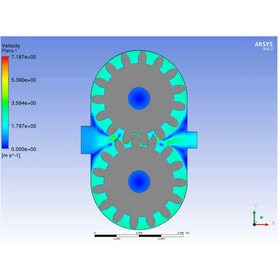
Parametric modeling of gear pumps

Introducing examples of analysis using modeled gear pumps and gear models based on involute curves!

This time, I will introduce parametric modeling, which is part of the gear pump optimization project. This project began with the customer's request to "optimize the design of the gear pump" and has progressed with a focus on gear modeling techniques, aiming to create a more functional and user-friendly model. *For detailed information, you can view it through the related links. For more details, please download the PDF or feel free to contact us.*

  • ギアポンプのパラメトリックモデリング2.png
  • ギアポンプのパラメトリックモデリング3.png
  • ギアポンプのパラメトリックモデリング4.png
  • ギアポンプのパラメトリックモデリング5.png
  • ギアポンプのパラメトリックモデリング6.png
  • Structural Analysis
  • Other pumps
  • Simulation Software

Added to bookmarks

Bookmarks list

Bookmark has been removed

Bookmarks list

You can't add any more bookmarks

By registering as a member, you can increase the number of bookmarks you can save and organize them with labels.

Free membership registration

Optimization of globe valve shape

The purpose is to improve and investigate the performance of globe valves, connecting the cloud-based CFD solver SimScale with CAESES!

CAESES has been conducting optimization calculations for various types of valves and has implemented projects in collaboration with various companies. In this context, we would like to introduce one of the newly conducted projects, "Shape Optimization of a Globe Valve." This project was carried out in cooperation with GEMÜ Gebr. Müller Apparatebau, a German valve manufacturer and a global company specializing in aseptic valves, and SimScale, a leading engineering simulation company. *For more detailed information, please refer to the related links. You can download the PDF for more details or feel free to contact us.*

  • グローブバルブの形状最適化2.png
  • グローブバルブの形状最適化3.png
  • グローブバルブの形状最適化4.png
  • グローブバルブの形状最適化5.png
  • グローブバルブの形状最適化6.png
  • グローブバルブの形状最適化7.png
  • グローブバルブの形状最適化8.png
  • Structural Analysis
  • Other CAD
  • valve
  • Simulation Software

Added to bookmarks

Bookmarks list

Bookmark has been removed

Bookmarks list

You can't add any more bookmarks

By registering as a member, you can increase the number of bookmarks you can save and organize them with labels.

Free membership registration

Optimization of drone propeller shape

Providing the right products to customers! Introducing the benefits and applications of CAESES at Parrot.

The French company Parrot, which specializes in the design and development of drones, uses CAESES for the design of drone propellers. The reason Parrot's engineers, who are experts in the drone market, adopted CAESES is to speed up the design process and provide customers with even more suitable products. Here, we will introduce the benefits and applications of CAESES at Parrot. *For detailed information, you can view the related links. For more details, please download the PDF or feel free to contact us.*

  • ドローンのプロペラ形状の最適化2.png
  • ドローンのプロペラ形状の最適化3.png
  • ドローンのプロペラ形状の最適化4.png
  • ドローンのプロペラ形状の最適化5.gif
  • Structural Analysis
  • Software (middle, driver, security, etc.)
  • Simulation Software

Added to bookmarks

Bookmarks list

Bookmark has been removed

Bookmarks list

You can't add any more bookmarks

By registering as a member, you can increase the number of bookmarks you can save and organize them with labels.

Free membership registration

Optimization design of assistive artificial hearts

Introducing the parametric model of the pump model and the evaluation of H-Q (Head-Flow) and T-Q (Torque-Flow)!

This article introduces the research and development of a ventricular assist device conducted by researchers at the Penn State College of Medicine using CAESES and CONVERGE. The goal of this research is to reduce the risk of adverse events such as hemolysis, degradation of von Willebrand factor, and thrombosis while minimizing the size of the pumps used in artificial hearts. To efficiently create a wide range of pump designs, CAESES has parameterized the flow path shape of the pump. *For more detailed information, you can view the related links. For further details, please download the PDF or feel free to contact us.*

  • 補助人工心臓の最適化設計2.png
  • 補助人工心臓の最適化設計3.png
  • 補助人工心臓の最適化設計4.png
  • Structural Analysis
  • Other analysis software
  • Other Pumps
  • Simulation Software

Added to bookmarks

Bookmarks list

Bookmark has been removed

Bookmarks list

You can't add any more bookmarks

By registering as a member, you can increase the number of bookmarks you can save and organize them with labels.

Free membership registration

Optimization of turbine blade shape

Enabling optimization calculations of parametric models through automated processes!

In this case, we will introduce the shape optimization of gas turbine fixed blades, including end wall contouring, which is a joint project with SIEMENS. An efficient workflow using CAESES can provide significant support for design development. The gas turbine, which is the application in this instance, is a type of internal combustion engine used for driving generators, among other purposes. *For more detailed information, you can view it through the related links. For more details, please download the PDF or feel free to contact us.

  • タービンブレードの形状最適化2.gif
  • Turbine
  • Simulation Software

Added to bookmarks

Bookmarks list

Bookmark has been removed

Bookmarks list

You can't add any more bookmarks

By registering as a member, you can increase the number of bookmarks you can save and organize them with labels.

Free membership registration

Aerodynamic optimization of vertical axis wind turbines

CAESES can perform optimization calculations and support users in their design tasks!

In this case, we will introduce the optimization calculations for vertical axis wind turbines. FRIENDSHIP SYSTEMS, the developer of the optimization design system CAESES, investigated the aerodynamic behavior of vertical axis wind turbines using the mesh generation software Pointwise. As a first initiative, FRIENDSHIP SYSTEMS connected the automatic mesh generation by Pointwise with CAESES and executed a method to optimize vertical axis wind turbines in 2D using various tools, including analysis software. *For more details, you can view the related links. For further information, please download the PDF or feel free to contact us.*

  • 垂直軸風力タービンの空力最適化2.png
  • 垂直軸風力タービンの空力最適化3.png
  • 垂直軸風力タービンの空力最適化4.png
  • Turbine
  • Simulation Software

Added to bookmarks

Bookmarks list

Bookmark has been removed

Bookmarks list

You can't add any more bookmarks

By registering as a member, you can increase the number of bookmarks you can save and organize them with labels.

Free membership registration

Optimization of the poppet valve

This article explains the design system based on the collaboration between the CFD solver SimericsMP and CAESES, based on actual research conducted!

The Italian company OMIQ SRL, which sells software, conducted research on an automatic design system using the poppet valve of high-pressure pumps developed by the Danish machinery manufacturer Danfoss. In this case, we will introduce the design system that integrates the CFD solver SimericsMP with CAESES based on the research that was actually conducted. The issue in this case is that the poppet valve exhibits unacceptable unstable behavior during operation. It was found that when the poppet valve attempts to open to its maximum displacement (27.5 mm), the instability of the flow increases, resulting in a decrease in pressure on the poppet valve, ultimately preventing the valve from fully opening (closing to about 6 mm remaining). This unstable phenomenon was verified through unsteady analysis using SimericsMP. *For more detailed information, please refer to the related link. For further details, you can download the PDF or feel free to contact us.*

  • ポペットバルブの最適化2.png
  • ポペットバルブの最適化3.gif
  • ポペットバルブの最適化4.gif
  • ポペットバルブの最適化5.gif
  • ポペットバルブの最適化6.gif
  • ポペットバルブの最適化7.png
  • ポペットバルブの最適化8.png
  • ポペットバルブの最適化9.png
  • ポペットバルブの最適化10.png
  • valve
  • Simulation Software

Added to bookmarks

Bookmarks list

Bookmark has been removed

Bookmarks list

You can't add any more bookmarks

By registering as a member, you can increase the number of bookmarks you can save and organize them with labels.

Free membership registration

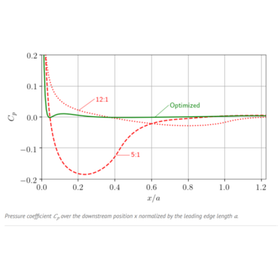
Optimization of the Leading Edge for Boundary Layer Experiments on a Flat Plate

When the minimum curvature radius is approximately 2.5mm, it is possible to prevent plastic deformation of the steel belt!

Predicting transitional boundary layers under arbitrary conditions in fluid mechanics is a very challenging task. A research group at Karlsruhe Institute of Technology conducted tests for predicting transitional boundary layers considering the effects of pressure gradients, mainstream turbulence, and surface roughness, using CAESES and the open-source OpenFOAM for suitable leading-edge shape optimization. *For more details, you can view the related links. For further information, please download the PDF or feel free to contact us.*

  • 平板境界層実験のためのリーディングエッジの最適化2.png
  • 平板境界層実験のためのリーディングエッジの最適化3.png
  • 平板境界層実験のためのリーディングエッジの最適化4.png
  • 平板境界層実験のためのリーディングエッジの最適化5.png
  • 平板境界層実験のためのリーディングエッジの最適化6.png
  • 平板境界層実験のためのリーディングエッジの最適化7.png
  • 平板境界層実験のためのリーディングエッジの最適化8.png
  • others
  • Simulation Software

Added to bookmarks

Bookmarks list

Bookmark has been removed

Bookmarks list

You can't add any more bookmarks

By registering as a member, you can increase the number of bookmarks you can save and organize them with labels.

Free membership registration

A New Approach to the Design of sCO2 Axial Flow Turbines

Introducing a design case of a supercritical carbon dioxide axial flow turbine for waste heat recovery (WHR) in a 10MW class power plant!

In conventional thermal and nuclear power plants, steam and combustion gases are used as working fluids to drive turbines and generate electricity. In this case, we will introduce a design method for axial flow turbines using supercritical carbon dioxide (sCO2) as the working fluid, which reaches a supercritical state under relatively mild conditions using CAESES. The supercritical state exhibits properties that are intermediate between gas and liquid, and due to its high density and heat capacity, it has the potential to improve cycle efficiency compared to using gases below the critical point. *For more detailed information, please refer to the related links. For further details, you can download the PDF or feel free to contact us.*

  • sCO2軸流タービン設計のための新しいアプローチ2.png
  • sCO2軸流タービン設計のための新しいアプローチ3.png
  • sCO2軸流タービン設計のための新しいアプローチ4.png
  • sCO2軸流タービン設計のための新しいアプローチ5.png
  • sCO2軸流タービン設計のための新しいアプローチ6.png
  • Turbine
  • Simulation Software

Added to bookmarks

Bookmarks list

Bookmark has been removed

Bookmarks list

You can't add any more bookmarks

By registering as a member, you can increase the number of bookmarks you can save and organize them with labels.

Free membership registration

Design and optimization of valves

The procedure explored using CAESES achieved a reduction in working time from several months to several days!

The optimization of valve design is one of many optimization targets, and by appropriately automating the design change process using CAESES and analyzing the number of implementation cases generated by the CFD solver, it is possible to significantly shorten the time to commercialization while exploring truly suitable designs under constraints. A valve is a device that opens, closes, or partially obstructs various passages to control, direct, or adjust the flow of fluid. In an open valve, fluid flows from high pressure to low pressure. Typically, the main objective of valve optimization is to adjust the flow rate passing through the valve at a specified pressure loss. This is often expressed as a flow coefficient, which serves as a relative measure of flow efficiency. *For more detailed information, please refer to the related links. For more details, you can download the PDF or feel free to contact us.*

  • バルブの設計と最適化2.jpg
  • バルブの設計と最適化3.gif
  • バルブの設計と最適化4.gif
  • バルブの設計と最適化5.gif
  • バルブの設計と最適化7.gif
  • バルブの設計と最適化8.gif
  • バルブの設計と最適化9.gif
  • バルブの設計と最適化10.gif
  • バルブの設計と最適化11.gif
  • valve
  • Simulation Software

Added to bookmarks

Bookmarks list

Bookmark has been removed

Bookmarks list

You can't add any more bookmarks

By registering as a member, you can increase the number of bookmarks you can save and organize them with labels.

Free membership registration

Optimization Case of Centrifugal Compressor Impeller Using CAESES

By constructing a parametric model, it is also possible to optimize the entire compressor model!

Centrifugal compressors are compact yet feature a high pressure ratio, and they are widely used in systems in the fields of aircraft and marine vessels. Impeller design is a crucial design aspect of centrifugal compressors and has a significant impact on compressor performance. In this case, we conducted automatic performance optimization using CAESES combined with CFD tools on an existing centrifugal compressor impeller model. *For more detailed information, please refer to the related links. For further details, you can download the PDF or feel free to contact us.*

  • CAESESによる遠心圧縮機インペラの最適化事例2.png
  • CAESESによる遠心圧縮機インペラの最適化事例3.png
  • CAESESによる遠心圧縮機インペラの最適化事例4.png
  • CAESESによる遠心圧縮機インペラの最適化事例7.gif
  • CAESESによる遠心圧縮機インペラの最適化事例8.gif
  • CAESESによる遠心圧縮機インペラの最適化事例9.gif
  • CAESESによる遠心圧縮機インペラの最適化事例10.gif
  • Centrifugal concentrator
  • Simulation Software

Added to bookmarks

Bookmarks list

Bookmark has been removed

Bookmarks list

You can't add any more bookmarks

By registering as a member, you can increase the number of bookmarks you can save and organize them with labels.

Free membership registration

Optimization of battery pack structure

The optimization calculation based on AIPOD resulted in a 4.69% reduction in mass!

In this analysis, we will build an automated simulation process for the battery pack and perform optimization with the goal of mass minimization. The software interface provided by AIPOD makes the process setup very simple. For the optimization, the thickness of 36 plates in the battery pack was given as design variables. The optimization goal is mass minimization, but the model's frequency, maximum plastic strain, and maximum RMS stress will be set as constraints. *For more detailed information, please refer to the related links. Feel free to contact us for more details.*

  • Other analysis software
  • Simulation Software

Added to bookmarks

Bookmarks list

Bookmark has been removed

Bookmarks list

You can't add any more bookmarks

By registering as a member, you can increase the number of bookmarks you can save and organize them with labels.

Free membership registration

Optimization of the rear wing shape

Utilizing CAESES for the optimization of the rear wing shape attached to racing cars!

FRIENDSHIP SYSTEMS, the developer of CAESES, has actively supported student racing teams such as FaSTTUBe and the Ryerson Formula Racing Team. Among these, CAESES was utilized for the optimization of the rear wing shape of racing cars in the Formula Student Germany (FSG) contest, which gathers students from all over Germany. This case study will introduce the optimization of the rear wing and its results. *For more detailed information, please refer to the related links. For further inquiries, feel free to download the PDF or contact us.*

  • 9-2.png
  • 9-3.gif
  • 9-4.png
  • 9-5.png
  • 9-6.png
  • 9-7.png
  • Other analysis software
  • Simulation Software

Added to bookmarks

Bookmarks list

Bookmark has been removed

Bookmarks list

You can't add any more bookmarks

By registering as a member, you can increase the number of bookmarks you can save and organize them with labels.

Free membership registration

Collaboration feature of CONVERGE and CAESES using the intake port.

Supporting development design operations! Introducing features that can be effectively utilized.

The optimization calculation software CAESES and the thermal fluid analysis software CONVERGE work together as a collaborative optimization system aimed at shape optimization and investigating the effects of design variables, providing support to engineers in the design and development field. In this article, we will introduce the functions that can be effectively utilized in CAESES when collaborating with CONVERGE, using intake port models and piston models. *For detailed content of the article, please refer to the related links. For more information, feel free to download the PDF or contact us.

  • 11-2.png
  • 11-3.png
  • 11-4.png
  • 11-5.png
  • 11-6.gif
  • Other analysis software
  • Simulation Software

Added to bookmarks

Bookmarks list

Bookmark has been removed

Bookmarks list

You can't add any more bookmarks

By registering as a member, you can increase the number of bookmarks you can save and organize them with labels.

Free membership registration

Optimization of Motor Thermal Design for Electric Vehicles

Optimization aimed at minimizing the maximum temperature based on a flexible parametric model has been implemented!

In electric vehicles, the motor is a crucial power component responsible for driving the vehicle, and appropriate thermal management is essential to maintain its performance and durability. In particular, the cooling system plays an important role in efficiently dissipating heat from inside the motor and ensuring stable operation. In optimizing the thermal design of the motor, it is necessary to study appropriate cooling effects through various design patterns to maximize cooling performance. During the optimization process, design parameters such as the number and diameter of flow paths, the inclination angle and arrangement of end windings become important factors. Furthermore, to enhance cooling efficiency, careful attention must also be paid to flow control and temperature management of the end windings. In this case study, optimization aimed at minimizing the maximum temperature was conducted based on a flexible parametric model. The motor, composed of a stator and rotor, defines design variables that allow for various shape changes, leading to the derivation of appropriate flow path patterns. *For more detailed information, please refer to the related link. For further details, you can download the PDF or feel free to contact us.*

  • 16-2.gif
  • 16-3.gif
  • 16-4.gif
  • Other analysis software
  • Simulation Software

Added to bookmarks

Bookmarks list

Bookmark has been removed

Bookmarks list

You can't add any more bookmarks

By registering as a member, you can increase the number of bookmarks you can save and organize them with labels.

Free membership registration

Dimensional reduction of hull shape using principal component analysis in CAESES.

Introducing the dimensional reduction function based on the drag optimization of KCS ships!

To optimize the hydrodynamic performance of the hull using the parametric modeling and optimization software CAESES, we first extract design variables related to the deformation of the hull's variable geometry. By increasing the number of design variables in this process, we can obtain a wider variety of deformation shapes, which in turn increases the likelihood of achieving better hull design proposals. However, the number of computational cases required for simulations (such as CFD analysis) increases exponentially (recommended number of cases S = 2^N, where N is the number of design variables), leading to significantly larger computational and time costs. To address this issue, CAESES5 offers a dimensionality reduction feature based on Principal Component Analysis (PCA) methods. *For more detailed information, please refer to the related links. For further details, feel free to download the PDF or contact us.*

  • 主成分分析による船体形状の次元圧縮2.png
  • 主成分分析による船体形状の次元圧縮3.png
  • 主成分分析による船体形状の次元圧縮4.png
  • 主成分分析による船体形状の次元圧縮5.png
  • 主成分分析による船体形状の次元圧縮6.png
  • 主成分分析による船体形状の次元圧縮7.png
  • 主成分分析による船体形状の次元圧縮8.png
  • Other analyses
  • Simulation Software

Added to bookmarks

Bookmarks list

Bookmark has been removed

Bookmarks list

You can't add any more bookmarks

By registering as a member, you can increase the number of bookmarks you can save and organize them with labels.

Free membership registration

AIPOD: Optimization of Ship Performance

The selection of a rational optimization strategy is particularly important! The model in question is the KCS hull form.

In ship shape optimization, considering the analysis time and computational resource costs for a single case, engineers need to find an optimal design solution with as few computational cases as possible. Therefore, the selection of a rational optimization strategy becomes particularly important. This article introduces ship optimization using the general-purpose optimization platform AIPOD. *For more details, you can view the related links. For further information, please download the PDF or feel free to contact us.*

  • 船舶の性能最適化3.png
  • Thermo-fluid analysis
  • 3D CAD
  • Other analyses
  • Simulation Software

Added to bookmarks

Bookmarks list

Bookmark has been removed

Bookmarks list

You can't add any more bookmarks

By registering as a member, you can increase the number of bookmarks you can save and organize them with labels.

Free membership registration

Propeller design for efoil using CAESES

Here is a brief introduction to the design of the propeller included with the foil board!

Do you all know about "efoil"? An efoil is an electric foil board that allows you to experience the sensation of flying above the water. Here, we will introduce some aspects of the propeller design that comes with the foil board, as discussed by a CAESES user with FRIENDSHIP SYSTEMS, the developer of CAESES. *You can view the detailed content of the article through the related links. For more information, please download the PDF or feel free to contact us.*

  • efoilのプロペラ設計2.png
  • Other analyses
  • 3D Printer
  • Simulation Software

Added to bookmarks

Bookmarks list

Bookmark has been removed

Bookmarks list

You can't add any more bookmarks

By registering as a member, you can increase the number of bookmarks you can save and organize them with labels.

Free membership registration

Collaboration between CAESES and OpenFOAM in Blade Shape Optimization

Introduction to parameter control of script files and optimization execution during OpenFOAM integration!

This article focuses on the software connection in the shape optimization process using OpenFOAM and CAESES. The application targeted is a propeller blade, and the connection between external software and CAESES can be established quickly, allowing for the rapid initiation of automatic optimization and design considerations for the blade. The collaboration between CAESES and OpenFOAM has been utilized in various cases, and tutorials and sample files are available within CAESES. This collaborative system using open-source software is highly efficient and can greatly benefit from optimization calculations. *For more detailed information, please refer to the related links. For further details, you can download the PDF or feel free to contact us.*

  • ブレード形状最適化におけるCAESESとOpenFOAMの連携2.png
  • ブレード形状最適化におけるCAESESとOpenFOAMの連携3.png
  • ブレード形状最適化におけるCAESESとOpenFOAMの連携4.png
  • ブレード形状最適化におけるCAESESとOpenFOAMの連携5.png
  • ブレード形状最適化におけるCAESESとOpenFOAMの連携7.png
  • Other analyses
  • Image analysis software
  • Simulation Software

Added to bookmarks

Bookmarks list

Bookmark has been removed

Bookmarks list

You can't add any more bookmarks

By registering as a member, you can increase the number of bookmarks you can save and organize them with labels.

Free membership registration

Acquisition of design parameters for geometry based on neural networks.

A method devised to understand design parameters from geometry for ship shape optimization!

In parametric modeling using CAESES, shape control is performed using the created model and the functions that serve as design parameters. However, there may be situations where the values of the design parameters are unknown, and there may be cases where one wishes to obtain design parameters from an already created model. The case introduced here is part of a project undertaken by a graduate student at Hamburg University of Technology. The method devised to determine design parameters from geometry for ship shape optimization is expected to be applicable in many other applications as well. *For more detailed information, please refer to the related links. For further details, you can download the PDF or feel free to contact us.*

  • ニューラルネットワークに基づくジオメトリの設計パラメータ取得2.gif
  • ニューラルネットワークに基づくジオメトリの設計パラメータ取得3.gif
  • ニューラルネットワークに基づくジオメトリの設計パラメータ取得4.gif
  • ニューラルネットワークに基づくジオメトリの設計パラメータ取得5.gif
  • ニューラルネットワークに基づくジオメトリの設計パラメータ取得6.png
  • ニューラルネットワークに基づくジオメトリの設計パラメータ取得7.png
  • ニューラルネットワークに基づくジオメトリの設計パラメータ取得8.png
  • ニューラルネットワークに基づくジオメトリの設計パラメータ取得9.png
  • ニューラルネットワークに基づくジオメトリの設計パラメータ取得10.png
  • Other analyses
  • Simulation Software

Added to bookmarks

Bookmarks list

Bookmark has been removed

Bookmarks list

You can't add any more bookmarks

By registering as a member, you can increase the number of bookmarks you can save and organize them with labels.

Free membership registration

Reduction of CO2 emissions through hull shape optimization.

Introducing how much the annual CO2 emissions have been reduced by utilizing CAESES!

FRIENDSHIP SYSTEMS, the developer of CAESES, has contributed to the reduction of energy consumption and CO2 emissions not only through support for the improvement of turbo machinery and engine-related parts but also for vessels. This article will introduce the experiences in design and improvement for CO2 emission reduction and how much annual CO2 emissions have been reduced by utilizing CAESES. *For detailed content of the article, please refer to the related link. For more information, feel free to download the PDF or contact us.

  • 船体形状最適化によるCO2排出量の削減2.png
  • 船体形状最適化によるCO2排出量の削減3.jpg
  • Other analyses
  • Modeler
  • Simulation Software

Added to bookmarks

Bookmarks list

Bookmark has been removed

Bookmarks list

You can't add any more bookmarks

By registering as a member, you can increase the number of bookmarks you can save and organize them with labels.

Free membership registration

Optimization of unmanned aerial vehicles

This paper introduces efforts utilizing optimization algorithms in the design of unmanned aerial vehicles (UAVs), which have seen increasing demand in recent years.

UAVs are controlled by a wireless remote control device and an embedded program control device, and they are classified into various forms such as unmanned fixed-wing aircraft, unmanned vertical take-off and landing vehicles, unmanned airships, unmanned helicopters, and unmanned multi-rotor aircraft. Their applications are wide-ranging, including aerial photography, agriculture, disaster relief, infectious disease monitoring, mapping, journalism, and film and television production. For optimization, a fully parametric blade model targeting the wing shape of unmanned aerial vehicles is created, and by integrating automated design with CFD analysis, appropriate design proposals are identified. *For more detailed information, please refer to the related links. For further inquiries, feel free to download the PDF or contact us.*

  • 6368134296768734423348389.gif
  • 6368134304120416188922970.gif
  • 6368134306668745824303331.gif
  • 6368134309159499504729036.gif
  • 6368134311032798685771560.gif
  • Other analyses
  • Simulation Software

Added to bookmarks

Bookmarks list

Bookmark has been removed

Bookmarks list

You can't add any more bookmarks

By registering as a member, you can increase the number of bookmarks you can save and organize them with labels.

Free membership registration

Shape optimization of SWATH support vessels.

In conducting shape optimization, CAESES was used for the creation of the parametric model and optimization calculations.

In the industry of operation, maintenance, and service for offshore wind power generation in Europe, which is expected to see significant growth in the future, fierce product competition is unfolding among companies. Related companies are pursuing "cost reduction of vessels," "high efficiency," and "high profitability" as much as possible to survive in the industry, advancing their design and development. The project introduced here involves the shape optimization of a SWATH vessel support ship with an innovative structure. *For detailed information, please refer to the related link. For more details, you can download the PDF or feel free to contact us.*

  • 6377991615469876016857917.png
  • 6377991633894897438080663.png
  • 6377889885001534016043736.gif
  • 6377991747754245955127008.png
  • 6377991811369977035143448.png
  • Other measurement, recording and measuring instruments
  • Other analyses
  • Simulation Software

Added to bookmarks

Bookmarks list

Bookmark has been removed

Bookmarks list

You can't add any more bookmarks

By registering as a member, you can increase the number of bookmarks you can save and organize them with labels.

Free membership registration

Shape optimization of self-propelled SEP vessels.

To avoid excessive resistance, a streamlined additional shape was designed around the sponsons and integrated as part of the overall hull shape.

In the modified design of a self-elevating platform (SEP) vessel, a method is employed to reduce the pressure on the seabed by increasing the size of the spudcan (the legs of the jacking system). Additionally, to increase cargo capacity, the draft is increased, and sponsons (protrusions on the outside of the hull for improved stability) are added along the sides of the vessel. The upgraded spudcans and hull shape have a significant impact on the hydrodynamic characteristics. It is particularly noted that spudcans that are scaled up significantly in relation to the hull tend to show more pronounced effects. *For more detailed information, please refer to the related links. For further details, you can download the PDF or feel free to contact us.*

  • 6376358753595627155359370.png
  • 6376358754468945074123618.png
  • Software (middle, driver, security, etc.)
  • Other analyses
  • Simulation Software

Added to bookmarks

Bookmarks list

Bookmark has been removed

Bookmarks list

You can't add any more bookmarks

By registering as a member, you can increase the number of bookmarks you can save and organize them with labels.

Free membership registration

VRP shape optimization system

The high efficiency of VRP achieves a reduction in fuel consumption and gas emissions during automatic vessel position keeping.

The radial propeller (hereinafter referred to as VRP) developed by the German machinery manufacturer VOITH combines a fixed-pitch azimuth thruster and a steering system into a single unit. This design principle is effective for machines that require high output and reliability, as well as precise dynamic displacement. Especially in harsh environments such as icy waters and deep seas, special vessels for assembling semi-submersible platforms, drilling ships, and wind turbines can use the VRP to arrive at their destinations quickly and safely, while ensuring they can maintain their stopping position reliably. *For more detailed information, please refer to the related link. For further details, you can download the PDF or feel free to contact us.*

  • 6375442663319839035961788.png
  • 6375442676420991601934634.png
  • 6375442739885063076649035.png
  • 6375711365037070634643436.gif
  • 6375711514091848389006534.png
  • 6375711843812140842825517.png
  • 6375711848934035223745024.png
  • Software (middle, driver, security, etc.)
  • Other analyses
  • Simulation Software

Added to bookmarks

Bookmarks list

Bookmark has been removed

Bookmarks list

You can't add any more bookmarks

By registering as a member, you can increase the number of bookmarks you can save and organize them with labels.

Free membership registration

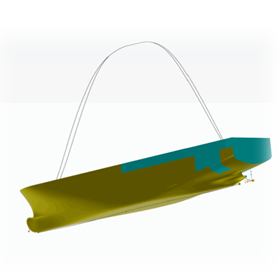
Optimization of vessels

The total hull resistance obtained after parametric modeling, CFD analysis, and optimization processing was reduced by 2 to 3%.

CAESES's hull parametric modeling, when combined with CFD software, facilitates the study of hull shapes (reducing resistance) and enables the design to optimize hull performance. The hull shape, particularly the forward shape, has a significant impact on hull resistance, making shape optimization crucial. With CAESES, hulls can be easily parameterized, allowing for straightforward adjustments to the hull shape. By generating multiple shape patterns and combining them with analysis tools, designs can be optimized according to various optimization objectives. *For more detailed information, please refer to the related links. For further details, you can download the PDF or feel free to contact us.*

  • 6370199815693877095633449.gif
  • 6370199819867683684716010.jpg
  • Software (middle, driver, security, etc.)
  • Other analyses
  • Simulation Software

Added to bookmarks

Bookmarks list

Bookmark has been removed

Bookmarks list

You can't add any more bookmarks

By registering as a member, you can increase the number of bookmarks you can save and organize them with labels.

Free membership registration

Marine platform

The final structure reduced relative motion by 4% compared to the initial structure, resulting in material savings.

The support structure of the ocean platform must withstand the effects of waves over a long period and must have sufficient strength. By using CAESES, it is possible to optimize that structure and enhance its ability to withstand waves. This time, we conducted optimization of the ocean platform using CAESES. *For more detailed information, please refer to the related link. For further details, you can download the PDF or feel free to contact us.*

  • 6368763462076739021753337.gif
  • 6368763466640089517647976.gif
  • 6368763471879947459637115.jpg
  • Software (middle, driver, security, etc.)
  • Other analyses
  • Simulation Software

Added to bookmarks

Bookmarks list

Bookmark has been removed

Bookmarks list

You can't add any more bookmarks

By registering as a member, you can increase the number of bookmarks you can save and organize them with labels.

Free membership registration