

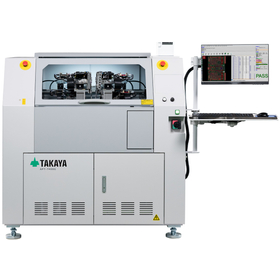
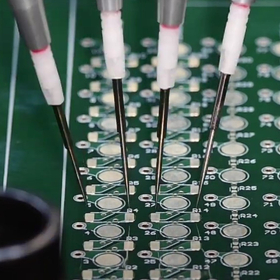
Takaya's unique 4-head & 6 flying probe system (vertical drop)
Takahashi Flying Probe Tester expands its defect detection capabilities with a unique system!!
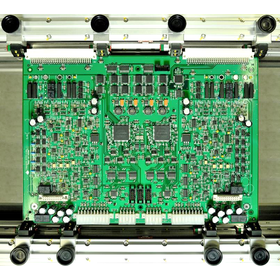
This system allows for the addition of two vertical probes to the standard four inclined probes, enabling contact with points that were previously inaccessible, such as contact points between high components, vias, through-holes, and upward connectors, thereby enhancing defect detection capabilities. To select the optimal contact method according to the shape of the object being inspected, several types of probes with different tip shapes are available. Furthermore, by adding a dual Z-axis option that automatically switches between two different vertical probes according to the inspection program, manual probe replacement becomes unnecessary, allowing for more efficient inspections.
- Company:TAKAYA Corporation
- Price:Other


![[Case Study] Initial Confirmation, Inspection Check during Line Switch](https://image.mono.ipros.com/public/product/image/e03/2000702086/IPROS56289655614275892933.jpeg?w=280&h=280)
![[Exhibition] Introduction of Exhibited Products at the 37th Nepcon Japan](https://image.mono.ipros.com/public/product/image/3e8/2000790904/IPROS2205391530225955775.jpg?w=280&h=280)


![[Case Study] High-Density Substrate Inspection in Semiconductor Manufacturing Equipment](https://image.mono.ipros.com/public/product/image/c94/2001490298/IPROS3806501845189698993.jpeg?w=280&h=280)
![[Case Study] Inspection of Large Circuit Boards for Communication Infrastructure and Servers](https://image.mono.ipros.com/public/product/image/98f/2001490301/IPROS16429395849303942383.jpeg?w=280&h=280)
![[Case Study] Board Inspection for Power Generation and Power Systems](https://image.mono.ipros.com/public/product/image/e09/2001490312/IPROS15653967981304216668.jpeg?w=280&h=280)
![[Case Study] Circuit Board Inspection for Consumer Products](https://image.mono.ipros.com/public/product/image/66d/2001490314/IPROS939823239105498352.jpeg?w=280&h=280)
![[Case Study] Defect Analysis of Automotive PCBs and In-Vehicle PCBs](https://image.mono.ipros.com/public/product/image/d59/2001490318/IPROS4209720395720705457.jpeg?w=280&h=280)
![[Case Study] Circuit Board Inspection for Aerospace and Defense Sector](https://image.mono.ipros.com/public/product/image/633/2001490332/IPROS17197433194665772389.jpeg?w=280&h=280)






![[Case Study] 100% Inspection of PCBs Requiring Higher Quality and Reliability](https://image.mono.ipros.com/public/product/image/17d/2000667102/IPROS96578941002839350961.jpeg?w=280&h=280)
![[Case Study] Electrical Testing from the PCB Prototyping Stage](https://image.mono.ipros.com/public/product/image/859/2000667112/IPROS38496786898190943621.jpeg?w=280&h=280)
![[Case Study] Immediately after mass production startup (period until jig completion)](https://image.mono.ipros.com/public/product/image/4e9/2000667118/IPROS78780680142584566514.jpeg?w=280&h=280)
![[Case Study] Analysis of defective circuit boards returned from downstream processes and the market.](https://image.mono.ipros.com/public/product/image/316/2000667169/IPROS76391750609793454966.jpeg?w=280&h=280)




![[Case Study] Electrical Testing of Inserted Implementation Boards (Discrete Components)](https://image.mono.ipros.com/public/product/image/fec/2000708036/IPROS70997628607265953707.jpeg?w=280&h=280)
