We have compiled a list of manufacturers, distributors, product information, reference prices, and rankings for Simulation Software.
ipros is IPROS GMS IPROS One of the largest technical database sites in Japan that collects information on.

Simulation Software Product List and Ranking from 22 Manufacturers, Suppliers and Companies | IPROS GMS

Last Updated: Aggregation Period:Jan 14, 2026~Feb 10, 2026
This ranking is based on the number of page views on our site.

Simulation Software Manufacturer, Suppliers and Company Rankings

Last Updated: Aggregation Period:Jan 14, 2026~Feb 10, 2026
This ranking is based on the number of page views on our site.

  1. FsTech Kanagawa//software
  2. シーメンス株式会社 gPROMS ポートフォリオ Kanagawa//software
  3. null/null
  4. 4 TCC Hiroshima//software
  5. 5 CMS Co., Ltd. Kanagawa//IT/Telecommunications

Simulation Software Product ranking

Last Updated: Aggregation Period:Jan 14, 2026~Feb 10, 2026
This ranking is based on the number of page views on our site.

  1. gPROMS simulation software シーメンス株式会社 gPROMS ポートフォリオ
  2. Web handling simulation tool *Free explanatory materials provided
  3. [Case Study] Torque Reduction of Centrifugal Fans through CFD and Automatic Optimization FsTech
  4. 4 Spray Drying Spray Dryer Model シーメンス株式会社 gPROMS ポートフォリオ
  5. 5 Simulation software 'gPROMS Process' シーメンス株式会社 gPROMS ポートフォリオ

Simulation Software Product List

31~60 item / All 102 items

Displayed results

Sensitivity approach for turbo pump inducer geometry

Equipped with a function to raise the impeller inlet head by a sufficient amount to prevent excessive cavitation generation!

The turbo pump is an important component in the design of launch rockets for space using liquid fuel. It is a component that supplies the necessary fuel flow to achieve a large thrust while maintaining a high combustion chamber pressure, and it is used in rocket engine supply systems. Due to the need for high-precision performance predictions of turbo pumps for launch rockets, as well as designs based on these predictions, resulting from the significant reduction in total rocket engine weight, the very high rotational speed of the turbo pump, and the specifications of the pump in relation to the degree of depressurization in the liquid fuel storage tank, the goal is to maximize total reliability throughout the operational lifecycle. *For more detailed information, please refer to the related links. For further details, you can download the PDF or feel free to contact us.*

  • ターボポンプインデューサージオメトリの感度アプローチ2.png
  • ターボポンプインデューサージオメトリの感度アプローチ3.png
  • ターボポンプインデューサージオメトリの感度アプローチ4.png
  • ターボポンプインデューサージオメトリの感度アプローチ5.png
  • ターボポンプインデューサージオメトリの感度アプローチ6.png
  • ターボポンプインデューサージオメトリの感度アプローチ7.png
  • Other pumps
  • Simulation Software

Added to bookmarks

Bookmarks list

Bookmark has been removed

Bookmarks list

You can't add any more bookmarks

By registering as a member, you can increase the number of bookmarks you can save and organize them with labels.

Free membership registration

Propeller design of Caterpillar Propulsion

Execute tasks such as setting up the blade model and generating individual dynamic 2D drawings!

Caterpillar Propulsion has implemented CAESES for the design of propeller blades. When we started on a project basis, the overall idea was to implement it as a workbench that integrates and controls mesh generation and simulation software. At the same time, CAESES needs to provide a fully parametric 3D blade design that allows Caterpillar Propulsion's engineers to reconstruct the definitions of existing blades and profiles, while also requiring high flexibility to try out entirely new designs. *For more details, please refer to the related link. For further information, you can download the PDF or feel free to contact us.*

  • Caterpillar Propulsionのプロペラ設計2.png
  • Mechanical Design
  • Simulation Software

Added to bookmarks

Bookmarks list

Bookmark has been removed

Bookmarks list

You can't add any more bookmarks

By registering as a member, you can increase the number of bookmarks you can save and organize them with labels.

Free membership registration

Optimization of motor electromagnetic and noise performance

Under conditions with little change in average torque, torque ripple is reduced by 10%!

This article introduces the optimization of the electromagnetic and noise performance of motors using the general-purpose optimization software AIPOD. The main source of vibration and noise in motors is the electromagnetic force that changes over time and space with the stator. To reduce the motor's vibration noise, it is key to weaken the amplitude of the corresponding order of the electromagnetic force. Through the software interface standardly equipped with AIPOD, external software's input and output variables can be seamlessly connected, allowing for rapid optimization of motor noise design. *For more detailed information, please refer to the related links. For further details, you can download the PDF or feel free to contact us.*

  • Other analysis software
  • Simulation Software

Added to bookmarks

Bookmarks list

Bookmark has been removed

Bookmarks list

You can't add any more bookmarks

By registering as a member, you can increase the number of bookmarks you can save and organize them with labels.

Free membership registration

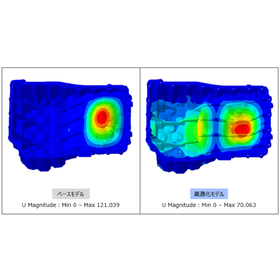
Eigenvalue optimization of automotive oil pans

Improved the first natural frequency from 701.5Hz to 1224.6Hz without breaking the outline boundary of the base model!

The base model of the oil pan, which is the subject of optimization, was considered to have a primary natural frequency lower than the initially assumed requirements, resulting in poor NVH performance. In this case, we aim to improve the primary natural frequency of the oil pan through structural optimization. Assuming that the contour boundary of the base model remains unchanged, a partial parametric model will be created using external CAD software and incorporated into the node-based optimization process constructed in AIPOD. *For more detailed information, please refer to the related links. For further details, you can download the PDF or feel free to contact us.*

  • Other analysis software
  • Simulation Software

Added to bookmarks

Bookmarks list

Bookmark has been removed

Bookmarks list

You can't add any more bookmarks

By registering as a member, you can increase the number of bookmarks you can save and organize them with labels.

Free membership registration

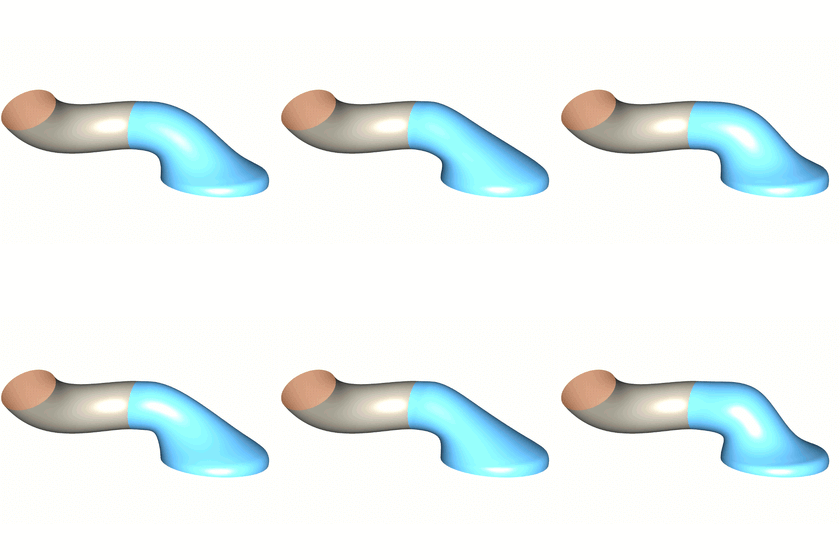
Optimization of catalytic converter performance using CAESES.

Optimization of the duct of the catalytic converter using CAESES!

Designing engine components for automobiles often involves considering many constraints, making it a challenging task within development design work. One example is the duct located just before the catalytic converter. Due to space constraints, this component is often designed to be bent quite sharply, which makes it difficult to ensure that the flow distribution is sufficiently uniform. In other words, if the flow characteristics of the catalytic converter are poor, there is a possibility that performance will decrease and emissions will increase. In this case, optimization of the duct for the catalytic converter will be performed using CAESES. *For more details, please refer to the related links. For further information, feel free to download the PDF or contact us.*

  • 6385803935833329694682380.gif
  • 9-2.png
  • 6385803976342704737924415.gif
  • 9.png
  • Other analysis software
  • Simulation Software

Added to bookmarks

Bookmarks list

Bookmark has been removed

Bookmarks list

You can't add any more bookmarks

By registering as a member, you can increase the number of bookmarks you can save and organize them with labels.

Free membership registration

Automatic Optimization using Adjoint Flow Solvers

It is possible to efficiently obtain optimal candidate geometry that can be directly supplied to the downstream CAD design process!

At FRIENDSHIP SYSTEMS, the developer of the CAD and optimization software CAESES, automatic optimization calculations were performed based on the shape sensitivity calculated by Adjoint Flow Solvers. The open-source optimization toolkit Dakota, integrated into CAESES, provides optimization methods that can directly accept gradient information obtained by combining shape sensitivity with CAD model parameters as input data. Based on this information, the algorithm selects parameters for design candidates created by CAESES, and calculations are performed using Adjoint Flow Solvers. *For more detailed information, please refer to the related links. For further details, you can download the PDF or feel free to contact us.*

  • 3-2.png
  • 3-3.png
  • 3-4.png
  • Other analysis software
  • Simulation Software

Added to bookmarks

Bookmarks list

Bookmark has been removed

Bookmarks list

You can't add any more bookmarks

By registering as a member, you can increase the number of bookmarks you can save and organize them with labels.

Free membership registration

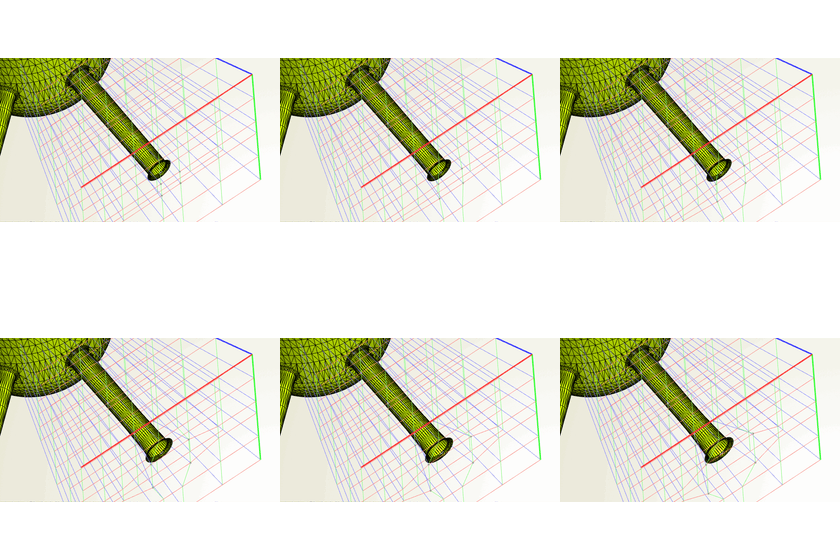
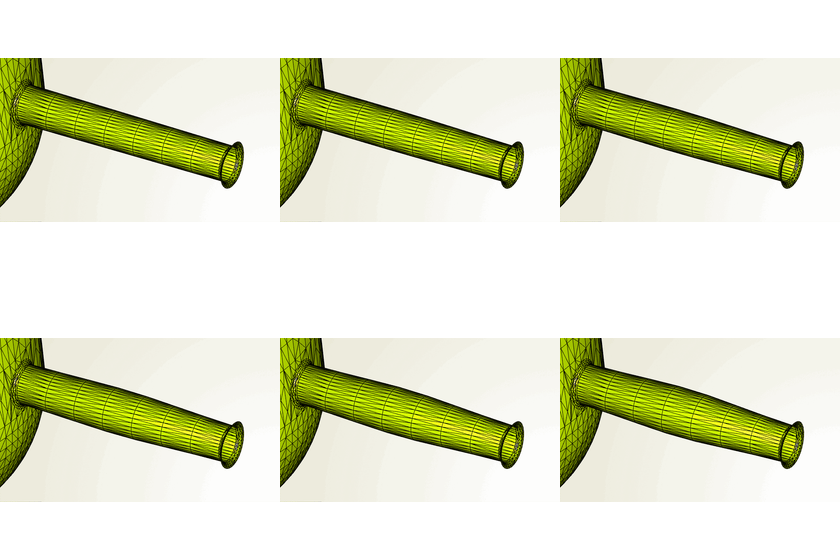
Morphing of the injector nozzle

Implement shape deformation on the injector nozzle using the morphing function!

One of the components targeted for optimization in diesel engines is the injector. This component is designed with careful consideration of its orientation and dimensions to ensure that fuel is injected appropriately into the combustion chamber, making it highly refined. In this case, we will introduce a method for rapidly deforming the existing nozzle shape of the fuel injection system. Based on the shape data imported into CAESES in STL format, we will use the morphing function to implement shape deformation on the injector nozzle. *For more detailed information, you can view the related links. For further details, please download the PDF or feel free to contact us.*

  • 7-2.png
  • 7-3.gif
  • 7-4.gif
  • 7-5.gif
  • 7-6.gif
  • Other analysis software
  • Simulation Software

Added to bookmarks

Bookmarks list

Bookmark has been removed

Bookmarks list

You can't add any more bookmarks

By registering as a member, you can increase the number of bookmarks you can save and organize them with labels.

Free membership registration

Tire tread pattern optimization

A system for automatic optimization has been built using CAESES and commercial CFD analysis tools, resulting in significant improvements to the tire tread pattern!

The development of advanced automotive systems such as electric vehicles, autonomous driving systems, and safety enhancement systems will significantly increase the number of electronic devices added to the vehicle body, including sensors, radars, and cameras. It is crucial for these devices to function reliably while minimizing exposure to water to prevent damage and corrosion. One effective approach to achieve this is to reduce water splashes on the vehicle's body and underbody. This case study introduces simulation-driven optimization to investigate the impact of tire tread patterns on water splashes. *For more detailed information, please refer to the related links. You can download the PDF for more details or feel free to contact us.*

  • 10-2.png
  • 10-3.png
  • 10-5.png
  • 10-6.png
  • 10-7.png
  • 10-8.png
  • Other analysis software
  • Simulation Software

Added to bookmarks

Bookmarks list

Bookmark has been removed

Bookmarks list

You can't add any more bookmarks

By registering as a member, you can increase the number of bookmarks you can save and organize them with labels.

Free membership registration

Torque converter shape optimization

CAESES provides beneficial results across various fields, regardless of the products in question!

A torque converter for automobiles is a type of fluid coupling used in vehicles equipped with automatic transmissions to transmit rotational force from the engine to the drive shaft. Designers of torque converters work to minimize cavitation within the device and ensure good flow behavior of the transmission oil, aiming to maximize efficiency and torque ratio at high speeds. CAESES enables the modeling of such complex shapes and can build an optimization system that incorporates shape data into analysis software. By connecting CFD analysis software and proprietary CFD codes to CAESES, it analyzes flow behavior for each designed shape during optimization calculations and provides users with the optimal shape based on constraints. *For more detailed information, please refer to the related links. For further details, feel free to download the PDF or contact us.*

  • 13-2.png
  • Other analysis software
  • Simulation Software

Added to bookmarks

Bookmarks list

Bookmark has been removed

Bookmarks list

You can't add any more bookmarks

By registering as a member, you can increase the number of bookmarks you can save and organize them with labels.

Free membership registration

Optimization of thermal design for electric vehicle battery packs

The parametric model created with CAESES can robustly output various complex shapes for use in optimization calculations!

The battery is one of the most important components in electric vehicles (EVs), and its performance and lifespan have a significant impact on the vehicle's driving range, safety, and even energy efficiency. In particular, the operating temperature of the battery is directly related to the charging and discharging efficiency and degradation rate, making proper temperature management essential. If the temperature is not adequately controlled, issues such as accelerated degradation due to overheating, reduced safety, or, conversely, decreased output and charging efficiency in low-temperature environments may arise. Therefore, the thermal design of the battery pack is a crucial factor in maximizing the performance of EVs and ensuring long-term durability. In this case study, we constructed a parametric battery model with flexible deformation and conducted optimization calculations aimed at minimizing the maximum temperature. *For more details, please refer to the related links. For further information, feel free to download the PDF or contact us.*

  • 17-2.gif
  • 17-3.gif
  • 17-4.gif
  • 17-5.gif
  • 17-6.png
  • Other analysis software
  • Simulation Software

Added to bookmarks

Bookmarks list

Bookmark has been removed

Bookmarks list

You can't add any more bookmarks

By registering as a member, you can increase the number of bookmarks you can save and organize them with labels.

Free membership registration

Propeller optimization using machine learning

The main objective of the contest was to design a propeller that could achieve maximum efficiency at a wide range of operating speeds.

In propeller design, achieving optimal efficiency and performance is extremely important. Recently, by effectively combining AI and CFD, we were able to win an online propeller design contest hosted by a popular YouTube creator. In this contest, we were able to create two high-performance propellers that demonstrated excellent efficiency using "CAESES" and "AirShaper." *For more details, you can view the related links. For more information, please download the PDF or feel free to contact us.*

  • 機械学習によるプロペラ最適化2.gif
  • 機械学習によるプロペラ最適化3.gif
  • 機械学習によるプロペラ最適化4.gif
  • 機械学習によるプロペラ最適化5.gif
  • 機械学習によるプロペラ最適化6.gif
  • 機械学習によるプロペラ最適化7.png
  • 機械学習によるプロペラ最適化8.png
  • 機械学習によるプロペラ最適化9.png
  • 機械学習によるプロペラ最適化10.png
  • Image analysis software
  • Structural Analysis
  • Simulation Software

Added to bookmarks

Bookmarks list

Bookmark has been removed

Bookmarks list

You can't add any more bookmarks

By registering as a member, you can increase the number of bookmarks you can save and organize them with labels.

Free membership registration

Optimization of Container Ship Shape

Partial parametric modeling adopted! Deformation of the hull shape is defined.

One of the representative companies in China's shipping industry, MARIC (Marine Design & Research Institute of China), first utilized CAESES for a project focused on the optimization of hull shapes for container ships. In their research, MARIC engineers selected a baseline with excellent performance and attempted to reduce hull resistance at speeds of 18 knots and 27 knots. The constraints here were the length between perpendiculars, width, and draft, which were fixed values, while the variation in displacement was limited to ±0.5%. *For more detailed information, please refer to the related links. You can download the PDF for more details or feel free to contact us.*

  • コンテナ船の形状最適化2.png
  • コンテナ船の形状最適化3.png
  • コンテナ船の形状最適化4.png
  • コンテナ船の形状最適化5.png
  • Other analyses
  • Simulation Software

Added to bookmarks

Bookmarks list

Bookmark has been removed

Bookmarks list

You can't add any more bookmarks

By registering as a member, you can increase the number of bookmarks you can save and organize them with labels.

Free membership registration

Parametric model of twin-skeg boats in CAESES

It is possible to flexibly control various parts related to hull characteristics!

We will introduce the parametric model of a twin-skeg vessel created by FRIENDSHIP SYSTEMS, the developer of the CAD + optimization software CAESES. In cases where the shape is symmetrical, only half of the hull is typically modeled. With CAESES, it is possible to robustly construct a model that incorporates the deformations anticipated by the user. *For more detailed information, please refer to the related links. For further details, you can download the PDF or feel free to contact us.

  • ツインスケグ船のパラメトリックモデル2.png
  • ツインスケグ船のパラメトリックモデル3.gif
  • Other analyses
  • Other CAD
  • Simulation Software

Added to bookmarks

Bookmarks list

Bookmark has been removed

Bookmarks list

You can't add any more bookmarks

By registering as a member, you can increase the number of bookmarks you can save and organize them with labels.

Free membership registration

Optimization of the air intake for AIPOD.

Introduction to parametric modeling using CAD and optimization software CAESES.

This article introduces the air intake optimization of ramjet engines using AIPOD, our self-developed optimization platform. Ramjet engines are designed for air intake at Mach numbers of 3 and above, where the mixture flows in and the exit becomes subsonic, making it a type of jet engine. To accommodate different flight Mach numbers, a center cone called a spike can be moved forward and backward, and when the maximum flight Mach number of 3.5 is reached, the Mach line formed at the tapered vertex intersects exactly with the lip. *For more detailed information, please refer to the related links. For further details, you can download the PDF or feel free to contact us.

  • 6381759902813614445822789.png
  • 6381759981474546185610338.png
  • 6381759992713570191512476.png
  • 6381760054527663661365892.png
  • 6381760086352692063301304.png
  • 6381760100908887057236142.png
  • 6381760116855762934017998 (1).png
  • 6381760116855762934017998.png
  • 6381760135552657312363288.png
  • Other analyses
  • Simulation Software

Added to bookmarks

Bookmarks list

Bookmark has been removed

Bookmarks list

You can't add any more bookmarks

By registering as a member, you can increase the number of bookmarks you can save and organize them with labels.

Free membership registration

Optimization of compressor blades for aircraft engines

Introduction to the optimization of axial flow compressor blades developed jointly by FRIENDSHIP Corporation and RRD Corporation.

Aircraft engine manufacturers are working daily on product development to meet the stringent demands of reducing exhaust emissions and fuel consumption. This effort requires further improvements in the design process to efficiently create aerodynamically superior compressor designs. In recent years, developing appropriate blade shapes that meet global design and performance requirements with high efficiency has necessitated numerous iterative calculations between different software tools for shape creation and fluid analysis. *For more detailed information, please refer to the related links. For further details, you can download the PDF or feel free to contact us.*

  • 6376731914747167352856152.png
  • 6376731953725303487703642.png
  • Other analyses
  • Simulation Software

Added to bookmarks

Bookmarks list

Bookmark has been removed

Bookmarks list

You can't add any more bookmarks

By registering as a member, you can increase the number of bookmarks you can save and organize them with labels.

Free membership registration

Optimization of the intake duct for propulsion systems in high Mach number regions.

Payloads, space exploration, and space travel are driving remarkable advancements in the aerospace field.

The Wright brothers first flew over a century ago, but now we live in an era where we can fly efficiently and affordably to the far corners of the world. In the future, it is expected that supersonic and hypersonic flights exceeding Mach 5 at altitudes above 90,000 feet will allow travel from the UK to Australia in just four hours, and this remarkable achievement could be realized within 20 years. Even more impressive is the development of spaceplanes that bridge the realms of air and space. *For more details, please refer to the related links. For further information, you can download the PDF or feel free to contact us.*

  • 6376057591641472687423657.jpg
  • 6376057592774466796256706.png
  • 6376057627085220006173424.png
  • 6376057885078970825455570.png
  • 6375927268481666906057103.png
  • 6376057955601159206301812 (1).png
  • Other analyses
  • Simulation Software

Added to bookmarks

Bookmarks list

Bookmark has been removed

Bookmarks list

You can't add any more bookmarks

By registering as a member, you can increase the number of bookmarks you can save and organize them with labels.

Free membership registration

Optimization of Marine Propeller Blade Shape Using OpenFOAM

The blades used for calculations can be created using the "Generic Blade" feature of CAESES.

One of the advantages of CAESES is its optimization design through an automation system connected to CFD software. This article introduces the blade shape optimization of marine propellers using OpenFOAM and CAESES, which is currently in use. In CAESES, in addition to methods for designing parametric 2D and 3D models, it is also possible to connect with various external software. *For more details, you can view the related links. For further information, please download the PDF or feel free to contact us.*

  • 6377102696005262328629436.png
  • 6377102709000600286261130.png
  • 6377102733181822253651802.png
  • 6377102792644412105023850.png
  • 6377102940461506159267580.png
  • Software (middle, driver, security, etc.)
  • Other analyses
  • Simulation Software

Added to bookmarks

Bookmarks list

Bookmark has been removed

Bookmarks list

You can't add any more bookmarks

By registering as a member, you can increase the number of bookmarks you can save and organize them with labels.

Free membership registration

Optimization of bulk carrier shape

The objective function of the first stage of optimization was set for five combinations of draft and speed regarding power consumption and hull weight at sea.

This time, we will introduce a case of optimization for bulk carriers by DNV GL, a European classification society. This case involves the optimization calculations for the hull and propeller of a bulk carrier. The hull in question is an Ultramax-sized hull called "Diamond 2." The optimization includes wave reduction, propulsion at the stern, twisting at the stern, and propeller design, with the shapes created using the CAD features of CAESES. *For more detailed information, please refer to the related links. For further details, you can download the PDF or feel free to contact us.*

  • 6376317451117000702293720.png
  • 6376317457457505981388963.png
  • 6376194216919820486447540.png
  • Software (middle, driver, security, etc.)
  • Other analyses
  • Simulation Software

Added to bookmarks

Bookmarks list

Bookmark has been removed

Bookmarks list

You can't add any more bookmarks

By registering as a member, you can increase the number of bookmarks you can save and organize them with labels.

Free membership registration

Robust-based optimization of the internal layout of an oil tanker hull.

We will carry out the optimal design of the internal layout of oil tankers, taking into account various uncertain factors.

In ships, especially large vessels, the size and position of the internal spaces of the hull are considered in the concept design phase during the early stages of design. In the case of oil tankers, the layout design of the internal hull is examined as an optimization problem to evaluate the overall performance throughout the operational period. The objective function during optimization becomes multi-faceted, including economic benefits, safety, and environmental pollution prevention, with one of the evaluation criteria being the bending moment that occurs in the hull in relation to cargo carrying capacity. *For more detailed information, please refer to the related links. For further details, you can download the PDF or feel free to contact us.*

  • スクリーンショット 2025-05-15 112548.png
  • スクリーンショット 2025-05-15 112609.png
  • スクリーンショット 2025-05-15 112621.png
  • スクリーンショット 2025-05-15 112641.png
  • スクリーンショット 2025-05-15 112658.png
  • スクリーンショット 2025-05-15 112714.png
  • スクリーンショット 2025-05-15 112731.png
  • スクリーンショット 2025-05-15 112751.png
  • スクリーンショット 2025-05-15 112806.png
  • Software (middle, driver, security, etc.)
  • Other analyses
  • Simulation Software

Added to bookmarks

Bookmarks list

Bookmark has been removed

Bookmarks list

You can't add any more bookmarks

By registering as a member, you can increase the number of bookmarks you can save and organize them with labels.

Free membership registration

[FlexSim Case Study] NEC Corporation

Research and development of simulation AI integration technology: What is the technology that enables "decision-making under unknown circumstances" using artificial intelligence (AI)?

We will introduce a research case using the discrete event simulation software "Flexsim." [Overview] The time when people had excessive expectations of AI has already passed, and we are beginning to understand what AI can and cannot do. The "Simulation AI Integration Technology" being researched by the company differs from AI analysis, which requires a large amount of data, by substituting insufficient data with simulations to support optimal decision-making. This is where our product "Flexsim" comes into play. [Case Study] ■ Introduced Product: FlexSim ■ Implementation Partner: NEC Corporation *For more details, please refer to the PDF document or feel free to contact us.

  • Image analysis software
  • simulator
  • Simulation Software

Added to bookmarks

Bookmarks list

Bookmark has been removed

Bookmarks list

You can't add any more bookmarks

By registering as a member, you can increase the number of bookmarks you can save and organize them with labels.

Free membership registration

Concept To Reality Summer 2011

We are focusing on optimization using high-performance computing.

Altea Engineering publishes the information magazine "Concept to Reality (C2R) JAPAN." "Concept to Reality (C2R) JAPAN" includes fully translated articles from the U.S. headquarters' "Concept to Reality," as well as unique information on technology, products, and events in Japan, delivered twice a year. The "Concept To Reality Summer 2011" issue features articles such as "Streamlining Aircraft Door Development with Simulation," "Analyzing Bird Strikes," "Supporting Space Payload Launches with Structural Optimization," and "Behind the Scenes at NASA's Supercomputing Center." For more details, please contact us or refer to the catalog.

  • Image analysis software
  • Simulation Software

Added to bookmarks

Bookmarks list

Bookmark has been removed

Bookmarks list

You can't add any more bookmarks

By registering as a member, you can increase the number of bookmarks you can save and organize them with labels.

Free membership registration

[Data] Conceptual Design of the Althea Vehicle Body Frame Structure

Introducing conceptual design utilizing simulation and AI technology!

This document presents the conceptual design of our vehicle body frame structure utilizing simulation and AI technology. We introduce the generative design of the body frame "C123 Process" and the high-speed calculation of vehicle characteristics using AI, "physicsAI." Additionally, we cover the designer CAE "SimSolid," which utilizes meshless analysis. [Contents] ■ Generative design of the body frame "C123 Process" ■ Semi-automatic creation of C2 models from detailed FEM models in HyperAutomation ■ High-speed calculation of vehicle characteristics using AI - physicsAI ■ Designer CAE utilizing meshless analysis - SimSolid ■ Various simulation technologies supporting the practical use of mega casting ■ Altair's AI technology adopted by automotive companies worldwide *For more details, please download the PDF or feel free to contact us.

  • Other information systems
  • Simulation Software

Added to bookmarks

Bookmarks list

Bookmark has been removed

Bookmarks list

You can't add any more bookmarks

By registering as a member, you can increase the number of bookmarks you can save and organize them with labels.

Free membership registration

[Data] Althea's Simulation/AI Technology

Adopted by EV/battery manufacturers around the world! Introducing battery performance prediction solutions and more.

This document features our simulation/AI technology adopted by EV/battery manufacturers worldwide. We introduce "design and development of EV/batteries" including thermal, vibration, fatigue, and stress analysis using a single solver and a single model. Additionally, we also cover "manufacturing simulations for all-solid-state batteries/lithium-ion batteries," such as simulations of wet mixing. [Contents] ■ Design and development of EV/batteries ■ Manufacturing simulations for all-solid-state batteries/lithium-ion batteries ■ Battery performance prediction solutions ■ Battery thermal management ■ Battery lifespan prediction model development and real-time monitoring *For more details, please download the PDF or feel free to contact us.

  • Other information systems
  • Simulation Software

Added to bookmarks

Bookmarks list

Bookmark has been removed

Bookmarks list

You can't add any more bookmarks

By registering as a member, you can increase the number of bookmarks you can save and organize them with labels.

Free membership registration

Solutions for Electrical Equipment Altair SimLab

Calculate frequency-dependent resistance, inductance, and capacitance (RLC)! Usable in various simulations.

Altair SimLab is our multiphysics analysis platform that supports simulations in various fields necessary for electrical equipment design. By using the PCB workflow of this product and conducting various simulations, it is possible to improve the reliability of printed circuit boards during the design phase. Additionally, by using the Electronics Thermal solution, circuit designers can easily perform thermal simulations. *For more details, please download the PDF or feel free to contact us.*

  • Other information systems
  • Simulation Software

Added to bookmarks

Bookmarks list

Bookmark has been removed

Bookmarks list

You can't add any more bookmarks

By registering as a member, you can increase the number of bookmarks you can save and organize them with labels.

Free membership registration

Assistance tool

Web service assistance tools for factories: "Bar Material Simulation" and "Plate Layout Simulation."

As a support tool for factories, we offer "Bar Material Simulation" and "Sheet Cutting Simulation" as web services. You can easily simulate the cutting of bar materials and sheet cutting in your browser.

  • Other production management systems
  • Simulation Software

Added to bookmarks

Bookmarks list

Bookmark has been removed

Bookmarks list

You can't add any more bookmarks

By registering as a member, you can increase the number of bookmarks you can save and organize them with labels.

Free membership registration

[Data] Optimization of streamer discharge calculations

Explanation using "VizGlow"! It includes how explanatory variables and objective variables progress, as well as optimization.

The document provides a detailed explanation of "Optimization of Streamer Discharge Calculation." It includes topics such as "Streamer Discharge Calculation," "Explanatory Variables and Objective Variables," and "How Optimization Progresses." As an example of combining optimization and simulation, we use our software "VizGlow" for the simulation of plasma devices to explore operational conditions. 【Contents (Excerpt)】 ■ Streamer Discharge Calculation ■ Explanatory Variables and Objective Variables ■ How Optimization Progresses ■ The Optimization Process (Video) ■ At what point should the values be used as the objective function? *For more details, please refer to the PDF document or feel free to contact us.

  • Contract Analysis
  • simulator
  • Other analyses
  • Simulation Software

Added to bookmarks

Bookmarks list

Bookmark has been removed

Bookmarks list

You can't add any more bookmarks

By registering as a member, you can increase the number of bookmarks you can save and organize them with labels.

Free membership registration

Simulation software VERICUT

Simulate the operation and processing of NC machine tools to prevent errors and collision risks, and improve processing efficiency.

VERICUT simulates the operation and machining of NC machine tools, preventing errors and collision risks, and improving machining efficiency. It allows for the correction of errors before running the NC program on actual machines, reducing setup time manually. Furthermore, VERICUT optimizes the feed rate of the NC program, enabling more efficient machining even on high-speed cutting machines! Additionally, VERICUT supports all types of machine tools, including 5-axis machining, lathes, multi-tasking machines, five-sided machining centers, grinders, wire EDM, and sinker EDM, and is compatible with controllers from around the world, such as FANUC, Siemens, Heidenhain, Mazatrol, and OSP, continuing to evolve into a comprehensive solution for NC environments.

  • Software (middle, driver, security, etc.)
  • Simulation Software

Added to bookmarks

Bookmarks list

Bookmark has been removed

Bookmarks list

You can't add any more bookmarks

By registering as a member, you can increase the number of bookmarks you can save and organize them with labels.

Free membership registration

Simulation software 'gPROMS Process'

For process development, optimal plant design, and operational optimization studies! Simulators for the oil, gas, and chemical industries.

In plant design, equipment sizing, process consideration, and operational optimization, PSE believes that existing process simulators still have room for improvement in terms of convergence for obtaining numerical solutions, constraints of processes they can handle, and customization of process models (model extensibility). The process simulation software developed to meet the needs for more advanced and value-added process plant design and optimization is 'gPROMS Process'. 【Features】 * Libraries for specific applications * Creation of flow sheets using Drag & Drop * High-precision custom model creation and editing functions using gPROMS language * Changes in settings within the same environment from steady-state simulation models to dynamic simulation models * Powerful optimization solution search and analysis functions * Global System Analysis (GSA) * High-Performance Computing (HPC) ★ You can view two "case study materials" available for download. These include examples of achieving high-value product offerings and cost reduction through batch process optimization, as well as successful cases of cost reduction through the optimization of entire plants.

Added to bookmarks

Bookmarks list

Bookmark has been removed

Bookmarks list

You can't add any more bookmarks

By registering as a member, you can increase the number of bookmarks you can save and organize them with labels.

Free membership registration

Spray Drying Spray Dryer Model

Pre-testing in simulations allows for risk avoidance in scaling up. We offer consulting services. Monthly contracts available.

The spray dryer allows for the consideration of product quality variation control and equipment scale-up (enlargement) by simulating factors that influence particle size control, moisture content control, and particle shape during the manufacturing process. In modeling, the particle size distribution is calculated based on the Population Balance equation, and the drying process of the particles is also taken into account. Additionally, representing adhesion to the walls is an important requirement in the simulation. With the integration of Siemens' STAR-CCM+, it is possible to analyze the actual gas flow in detail, which can be used for considerations of scale-up and operational improvements. This is an optional feature of gPROMS FormulatedProducts. *For more details, please download the catalog or contact us.

  • Contract Analysis
  • simulator
  • Analysis Services
  • Simulation Software

Added to bookmarks

Bookmarks list

Bookmark has been removed

Bookmarks list

You can't add any more bookmarks

By registering as a member, you can increase the number of bookmarks you can save and organize them with labels.

Free membership registration