46~61 item / All 61 items
Displayed results
Filter by category

Added to bookmarks
Bookmarks listBookmark has been removed
Bookmarks listYou can't add any more bookmarks
By registering as a member, you can increase the number of bookmarks you can save and organize them with labels.
Free membership registration
Contact this company
Inquiry Form46~61 item / All 61 items
Filter by category

"SUS630" is a representative steel of precipitation hardening stainless steel, combining corrosion resistance and high strength. After solution heat treatment (solid solution heat treatment) at 1020 to 1060°C, precipitation hardening heat treatment (aging heat treatment) is applied to precipitate a Cu-rich phase, resulting in high strength and high hardness. This document includes "an example of chemical composition," as well as "heat treatment standards" and "hardness conversion tables" presented in tables. Please take a moment to read it. [Contents (partial)] ■ Example of chemical composition ■ Example of physical properties ■ Heat treatment standards ■ Example of mechanical properties ■ Hardness conversion table *For more details, please refer to the PDF document or feel free to contact us.
Added to bookmarks
Bookmarks listBookmark has been removed
Bookmarks listYou can't add any more bookmarks
By registering as a member, you can increase the number of bookmarks you can save and organize them with labels.
Free membership registration
In the food processing industry, maintaining hygiene management of manufacturing equipment is crucial to ensure product safety. In particular, components that come into direct contact with food require high corrosion resistance and cleanliness. Using materials that are prone to corrosion increases the risk of rust formation and foreign matter contamination, which can lead to a decline in product quality and foodborne illnesses. Axsia is a material that possesses high corrosion resistance equivalent to austenitic stainless steel, is less prone to rust, and is easy to clean. This contributes to improved hygiene management in food processing and ensures the supply of safe products. 【Usage Scenarios】 - Parts for food manufacturing lines (nozzles, filling machines, etc.) - Tools for food processing - Kitchen equipment 【Benefits of Implementation】 - Reduced risk of foreign matter contamination - Increased efficiency in hygiene management due to improved cleanability - Enhanced product quality and safety
Added to bookmarks
Bookmarks listBookmark has been removed
Bookmarks listYou can't add any more bookmarks
By registering as a member, you can increase the number of bookmarks you can save and organize them with labels.
Free membership registration
Silicoroilab Co., Ltd. provides support and assistance for your development, helping to improve development speed, reduce development costs, and assist with promotions. This document includes topics such as "The Eternal Theme of Engineers," "Key Points in Product Development and Prototype Production," and "Company Overview." We invite you to read it. 【Contents (Partial)】 ■ The Eternal Theme of Engineers ■ Needs of Silicoroil ■ Key Points in Product Development and Prototype Production ■ Services of Silicoroilab ■ Concept ■ Company Overview *For more details, please refer to the PDF document or feel free to contact us.
Added to bookmarks
Bookmarks listBookmark has been removed
Bookmarks listYou can't add any more bookmarks
By registering as a member, you can increase the number of bookmarks you can save and organize them with labels.
Free membership registration
In the petrochemical industry, extending the lifespan of equipment in corrosive environments is a critical issue. To maintain operational efficiency and ensure safety, the selection of materials with excellent corrosion resistance is essential. Conventional stainless steel often lacks sufficient strength and hardness, leading to early corrosion and wear. Axsia achieves high hardness and high strength while possessing corrosion resistance comparable to austenitic stainless steel, making it ideal for use in harsh environments. 【Application Scenarios】 - Piping in petrochemical plants - Reaction vessels - Heat exchangers - Various valves - Pump components 【Benefits of Implementation】 - Extended equipment lifespan - Reduced maintenance costs - Stable plant operation - Improved safety
Added to bookmarks
Bookmarks listBookmark has been removed
Bookmarks listYou can't add any more bookmarks
By registering as a member, you can increase the number of bookmarks you can save and organize them with labels.
Free membership registration
In the semiconductor manufacturing industry, there is a demand for the longevity and stable performance of precision components. Particularly for parts that require high precision machining or are used in harsh environments, wear resistance, corrosion resistance, and strength are crucial. Traditional stainless steel has faced challenges in achieving a balance between hardness and corrosion resistance. Axsia addresses these issues by achieving high hardness of 56-58 HRC, high corrosion resistance equivalent to austenitic grades, and high strength of 2000 MPa class. 【Application Scenarios】 - Precision components for semiconductor manufacturing equipment - Parts requiring high precision machining - Components used in harsh environments 【Benefits of Implementation】 - Extended lifespan of components - Stable operation of equipment - Reduction of total costs
Added to bookmarks
Bookmarks listBookmark has been removed
Bookmarks listYou can't add any more bookmarks
By registering as a member, you can increase the number of bookmarks you can save and organize them with labels.
Free membership registration
In the precision machining industry of watches, maintaining the durability and accuracy of components is crucial. Especially for precision parts like movements, high resistance to wear and corrosion is required. Traditional stainless steel has faced challenges in balancing hardness and corrosion resistance. Axia contributes to extending the lifespan and improving the quality of watch components by achieving both high hardness and corrosion resistance. 【Application Scenes】 - Movement parts - Case parts - Other precision machined parts 【Effects of Introduction】 - Improved durability of components - Enhanced product quality - Overall cost reduction
Added to bookmarks
Bookmarks listBookmark has been removed
Bookmarks listYou can't add any more bookmarks
By registering as a member, you can increase the number of bookmarks you can save and organize them with labels.
Free membership registration
In marine applications, materials that are resistant to corrosion and wear, and can maintain performance over long periods, are essential. Particularly in the use of seawater, salt, and harsh environments, high durability is required. Conventional stainless steel has faced challenges in balancing strength and corrosion resistance. Axia achieves both high hardness and high corrosion resistance, contributing to the longevity of components in marine environments. 【Application Scenes】 - Marine structures - Ship parts - Undersea cables - Marine plants 【Effects of Implementation】 - Increased longevity due to high corrosion resistance - Improved reliability due to high strength - Reduction in total costs - Decreased maintenance frequency
Added to bookmarks
Bookmarks listBookmark has been removed
Bookmarks listYou can't add any more bookmarks
By registering as a member, you can increase the number of bookmarks you can save and organize them with labels.
Free membership registration
In the energy industry, the reliability of components used in environments exposed to high temperatures, such as power generation plants and heat exchangers, is crucial. High-temperature oxidation and corrosion accelerate the degradation of components, leading to increased equipment downtime and replacement costs. Axsia combines high hardness of 56-58 HRC, high corrosion resistance equivalent to austenitic grades, and high strength of 2000 MPa class, contributing to extended lifespan in high-temperature environments. 【Application Scenarios】 - Components for power generation plants - Heat exchangers - Various components used in high-temperature environments 【Benefits of Implementation】 - Improved corrosion resistance in high-temperature environments - Extended lifespan of components - Reduction in total costs
Added to bookmarks
Bookmarks listBookmark has been removed
Bookmarks listYou can't add any more bookmarks
By registering as a member, you can increase the number of bookmarks you can save and organize them with labels.
Free membership registration
In the aerospace industry, reducing the weight of aircraft is essential for improving fuel efficiency and reducing operating costs. At the same time, high safety and durability are required, and materials must possess high strength and corrosion resistance. Traditional materials have faced challenges in achieving both weight reduction and strength/corrosion resistance. Axsia addresses these challenges by achieving high hardness of 56-58 HRC, high corrosion resistance equivalent to austenitic grades, and high strength in the 2000 MPa range. 【Application Scenarios】 * Aircraft components * Space rocket components * Structural materials requiring weight reduction 【Benefits of Implementation】 * Improved fuel efficiency through weight reduction * Enhanced safety due to high strength * Increased longevity due to corrosion resistance
Added to bookmarks
Bookmarks listBookmark has been removed
Bookmarks listYou can't add any more bookmarks
By registering as a member, you can increase the number of bookmarks you can save and organize them with labels.
Free membership registration
In the electronics industry, there is a demand for both miniaturization of products and high durability and reliability. Particularly, to achieve high performance within limited space, it is essential to miniaturize components while also ensuring the strength and corrosion resistance of materials. Traditional materials have faced the challenge that increasing strength leads to decreased corrosion resistance, or vice versa. Axsia combines high hardness, high strength, and high corrosion resistance, contributing to the miniaturization and high performance of electronic devices. 【Application Scenarios】 - Miniature electronic devices - Precision instruments - Components requiring high durability 【Benefits of Implementation】 - Extended lifespan of components - Improved product reliability - Overall cost reduction
Added to bookmarks
Bookmarks listBookmark has been removed
Bookmarks listYou can't add any more bookmarks
By registering as a member, you can increase the number of bookmarks you can save and organize them with labels.
Free membership registration
In recent years, issues such as aging changes and deformation in precision parts have become a concern. This time, with the aim of understanding the various characteristics of different materials and heat treatment conditions, we investigated the amount of residual austenite and residual stress using a micro-area X-ray stress measurement device (Auto MATE, manufactured by Rigaku Corporation). For more details, please download and view the catalog. 【Classification and Materials of Test Specimens (Partial)】 ■ Tool Steel (Material: SKD11) ■ Martensitic (Material: SUS420J2) ■ Martensitic (Material: SUS440C) ■ Precipitation Hardening (Material: SUS630) ■ Precipitation Hardening (Material: SilicoLOY A2) ■ Precipitation Hardening (Material: SilicoLOY XVI) *For more details, please refer to the PDF document or feel free to contact us.
Added to bookmarks
Bookmarks listBookmark has been removed
Bookmarks listYou can't add any more bookmarks
By registering as a member, you can increase the number of bookmarks you can save and organize them with labels.
Free membership registration
This document includes various heat treatment conditions for precipitation-hardened systems in Charpy impact tests, as well as a comparison of different types of stainless steel. We present photographs of the appearance after testing, including "Silicoloy XVI" and "SUS420J2." The testing machine used was a Charpy impact testing machine (Shimadzu Corporation 300J testing machine). We encourage you to read it. 【Contents】 ■ Testing equipment ■ Shape of test specimens ■ Shape of test specimens (appearance photos) ■ Test specimens and heat treatment ■ Test results ■ Appearance after testing *For more details, please refer to the PDF document or feel free to contact us.
Added to bookmarks
Bookmarks listBookmark has been removed
Bookmarks listYou can't add any more bookmarks
By registering as a member, you can increase the number of bookmarks you can save and organize them with labels.
Free membership registration
In the mold industry, high durability and long lifespan are required. Mold damage can lead to decreased production efficiency and increased costs, making materials with excellent wear resistance and corrosion resistance essential. Axsia achieves high hardness of 56-58 HRC, high corrosion resistance equivalent to austenitic grades, and high strength of 2000 MPa, contributing to the longevity of molds. 【Application Scenarios】 - Press molds - Injection molding molds - Die-casting molds 【Benefits of Implementation】 - Reduced frequency of mold replacement - Increased productivity - Reduced total costs
Added to bookmarks
Bookmarks listBookmark has been removed
Bookmarks listYou can't add any more bookmarks
By registering as a member, you can increase the number of bookmarks you can save and organize them with labels.
Free membership registration
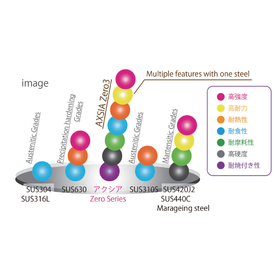
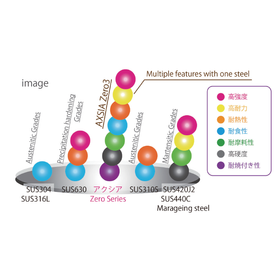
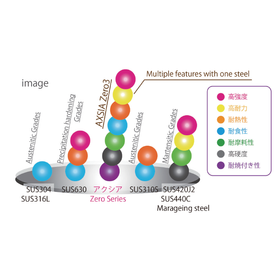
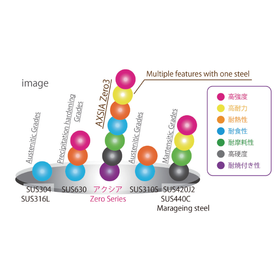
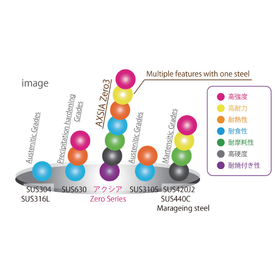
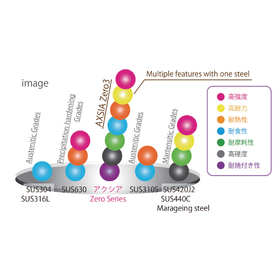
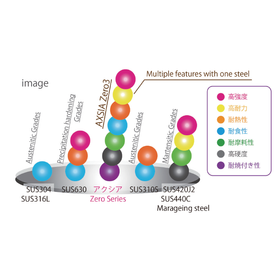
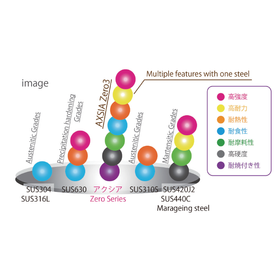
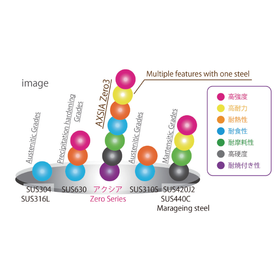
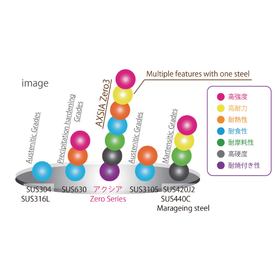
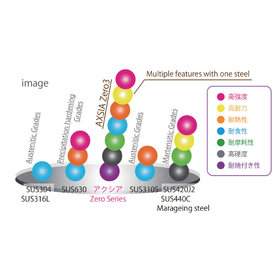
By precipitating hard metal intermetallic compounds through aging treatment, high hardness and wear resistance are improved; however, there was a challenge where the tensile strength and yield strength of our conventional steel (Silico Alloy XVI) decreased. At Silico Alloy Lab, we succeeded in fine and dispersed design of intermetallic compounds through component design! We have developed a new stainless material that adds [high strength × high yield] to [hardness × corrosion resistance]. 【Features of Axia Zero3】 ■ High hardness of 56–58 HRC ■ High corrosion resistance equivalent to austenitic phase ■ Achieves high strength of 2000 MPa class ■ High hardness can be achieved at tempering temperature equivalent (aging treatment at 480°C) ■ Minimal thermal deformation and dimensional changes It is possible to reduce total costs through new product development, problem-solving, and extending lifespan. *For details, please download the PDF or contact us directly.
Added to bookmarks
Bookmarks listBookmark has been removed
Bookmarks listYou can't add any more bookmarks
By registering as a member, you can increase the number of bookmarks you can save and organize them with labels.
Free membership registration
In the automotive industry, high-strength materials are required to achieve both safety and durability. Particularly in areas subject to high loads, such as engine components and suspensions, insufficient material strength can lead to serious accidents. Axsia achieves high hardness of 56-58 HRC and high strength of 2000 MPa class, contributing to the reliability of automotive parts. 【Application Scenarios】 - Engine components - Suspension components - Other parts requiring high strength 【Benefits of Implementation】 - Extended lifespan of parts - Improved product reliability - Overall cost reduction
Added to bookmarks
Bookmarks listBookmark has been removed
Bookmarks listYou can't add any more bookmarks
By registering as a member, you can increase the number of bookmarks you can save and organize them with labels.
Free membership registration
In the sports equipment industry, there is a constant demand for improved durability and performance of products. In particular, to withstand intense use and deliver high performance, the strength and wear resistance of materials are crucial. Traditional materials have faced challenges in achieving both strength and corrosion resistance. Axia has achieved high hardness of 56-58 HRC, high corrosion resistance equivalent to austenitic phase, and high strength of 2000 MPa class, contributing to the longevity and high performance of sports equipment. 【Application Scenarios】 - Parts of sports equipment that require high strength - Parts that require wear resistance - Parts used in harsh environments 【Benefits of Implementation】 - Improved durability of products - Enhanced performance of products - Increased longevity of products - Overall cost reduction
Added to bookmarks
Bookmarks listBookmark has been removed
Bookmarks listYou can't add any more bookmarks
By registering as a member, you can increase the number of bookmarks you can save and organize them with labels.
Free membership registration