iPROS Manufacturing
  • Search for products by classification category

    • Electronic Components and Modules
      Electronic Components and Modules
      58819items
    • Machinery Parts
      Machinery Parts
      74121items
    • Manufacturing and processing machinery
      Manufacturing and processing machinery
      98592items
    • Scientific and Physics Equipment
      Scientific and Physics Equipment
      34128items
    • Materials
      Materials
      36655items
    • Measurement and Analysis
      Measurement and Analysis
      54217items
    • Image Processing
      Image Processing
      14955items
    • Control and Electrical Equipment
      Control and Electrical Equipment
      52384items
    • Tools, consumables, and supplies
      Tools, consumables, and supplies
      64067items
    • Design and production support
      Design and production support
      12309items
    • IT/Network
      IT/Network
      42970items
    • Office
      Office
      13653items
    • Business support services
      Business support services
      33063items
    • Seminars and Skill Development
      Seminars and Skill Development
      6075items
    • Pharmaceutical and food related
      Pharmaceutical and food related
      28273items
    • others
      72640items
  • Search for companies by industry

    • Manufacturing and processing contract
      7346
    • others
      5009
    • Industrial Machinery
      4419
    • Machine elements and parts
      3280
    • Other manufacturing
      2884
    • IT/Telecommunications
      2546
    • Trading company/Wholesale
      2470
    • Industrial Electrical Equipment
      2301
    • Building materials, supplies and fixtures
      1813
    • software
      1637
    • Electronic Components and Semiconductors
      1564
    • Resin/Plastic
      1487
    • Service Industry
      1438
    • Testing, Analysis and Measurement
      1130
    • Ferrous/Non-ferrous metals
      985
    • environment
      702
    • Chemical
      629
    • Automobiles and Transportation Equipment
      560
    • Printing Industry
      509
    • Information and Communications
      452
    • Consumer Electronics
      417
    • Energy
      325
    • Rubber products
      313
    • Food Machinery
      305
    • Optical Instruments
      279
    • robot
      270
    • fiber
      250
    • Paper and pulp
      233
    • Electricity, Gas and Water Industry
      169
    • Pharmaceuticals and Biotechnology
      167
    • Warehousing and transport related industries
      146
    • Glass and clay products
      141
    • Food and Beverage
      129
    • CAD/CAM
      124
    • retail
      109
    • Educational and Research Institutions
      106
    • Medical Devices
      102
    • Ceramics
      97
    • wood
      89
    • Transportation
      83
    • Medical and Welfare
      63
    • Petroleum and coal products
      62
    • Shipbuilding and heavy machinery
      52
    • Aviation & Aerospace
      47
    • Fisheries, Agriculture and Forestry
      41
    • equipment
      30
    • Public interest/special/independent administrative agency
      29
    • self-employed
      24
    • Research and development equipment and devices
      23
    • Government
      21
    • Materials
      21
    • Mining
      17
    • Finance, securities and insurance
      13
    • Individual
      10
    • cosmetics
      10
    • Restaurants and accommodations
      9
    • Police, Fire Department, Self-Defense Forces
      7
    • Raw materials for reagents and chemicals
      3
    • Laboratory Equipment and Consumables
      3
    • Contracted research
      3
  • Special Features
  • Ranking

    • Overall Products Ranking
    • Overall Company Ranking
Search for Products
  • Search for products by classification category

  • Electronic Components and Modules
  • Machinery Parts
  • Manufacturing and processing machinery
  • Scientific and Physics Equipment
  • Materials
  • Measurement and Analysis
  • Image Processing
  • Control and Electrical Equipment
  • Tools, consumables, and supplies
  • Design and production support
  • IT/Network
  • Office
  • Business support services
  • Seminars and Skill Development
  • Pharmaceutical and food related
  • others
Search for Companies
  • Search for companies by industry

  • Manufacturing and processing contract
  • others
  • Industrial Machinery
  • Machine elements and parts
  • Other manufacturing
  • IT/Telecommunications
  • Trading company/Wholesale
  • Industrial Electrical Equipment
  • Building materials, supplies and fixtures
  • software
  • Electronic Components and Semiconductors
  • Resin/Plastic
  • Service Industry
  • Testing, Analysis and Measurement
  • Ferrous/Non-ferrous metals
  • environment
  • Chemical
  • Automobiles and Transportation Equipment
  • Printing Industry
  • Information and Communications
  • Consumer Electronics
  • Energy
  • Rubber products
  • Food Machinery
  • Optical Instruments
  • robot
  • fiber
  • Paper and pulp
  • Electricity, Gas and Water Industry
  • Pharmaceuticals and Biotechnology
  • Warehousing and transport related industries
  • Glass and clay products
  • Food and Beverage
  • CAD/CAM
  • retail
  • Educational and Research Institutions
  • Medical Devices
  • Ceramics
  • wood
  • Transportation
  • Medical and Welfare
  • Petroleum and coal products
  • Shipbuilding and heavy machinery
  • Aviation & Aerospace
  • Fisheries, Agriculture and Forestry
  • equipment
  • Public interest/special/independent administrative agency
  • self-employed
  • Research and development equipment and devices
  • Government
  • Materials
  • Mining
  • Finance, securities and insurance
  • Individual
  • cosmetics
  • Restaurants and accommodations
  • Police, Fire Department, Self-Defense Forces
  • Raw materials for reagents and chemicals
  • Laboratory Equipment and Consumables
  • Contracted research
Special Features
Ranking
  • Overall Products Ranking
  • Overall Company Ranking
  • privacy policy
  • terms of service
  • About Us
  • Careers
  • Advertising
  1. Home
  2. software
  3. ネクスタ
  4. Product/Service List
software
  • Added to bookmarks

    Bookmarks list

    Bookmark has been removed

    Bookmarks list

    You can't add any more bookmarks

    By registering as a member, you can increase the number of bookmarks you can save and organize them with labels.

    Free membership registration

ネクスタ

addressOsaka/Kita-ku, Osaka-shi/1-1-4 Shitaya, 12th Floor Hankyu Terminal Building
phone06-6136-3825
  • Special site
  • Official site
last updated:Nov 10, 2025
ネクスタlogo
  • Contact this company

    Inquiry Form
  • Company information
  • Products/Services(90)
  • catalog(22)
  • news(22)

ネクスタ Product Lineup

  • category

1~18 item / All 18 items

Displayed results

Filter by category

生産管理システム 生産管理システム
在庫管理システム 在庫管理システム
工程管理 工程管理
原価管理システム 原価管理システム
品質管理システム 品質管理システム
食品業界向け生産管理システム 食品業界向け生産管理システム
金属加工業界向け生産管理システム 金属加工業界向け生産管理システム
化粧品業界向け生産管理システム 化粧品業界向け生産管理システム
自動車部品業界向け生産管理システム 自動車部品業界向け生産管理システム
化学品業界向け生産管理システム 化学品業界向け生産管理システム
医薬品業界向け生産管理システム 医薬品業界向け生産管理システム
産業機械装置・組立品業界向け生産管理システム 産業機械装置・組立品業界向け生産管理システム
基盤実装業界向け生産管理システム 基盤実装業界向け生産管理システム
生産管理システムを活用した製造業DX事例 生産管理システムを活用した製造業DX事例
産業機械装置・組立品業界向け生産管理システム

産業機械装置・組立品業界向け生産管理システム

クラウド型生産管理システム「SmartF」は、産業機械装置・組立品製造業界の課題を解決する、生産管理システムです。図面・仕様の多様化、工程の複雑化、部品点数の多さによる進捗遅延や原価の見えにくさなど、産業機械メーカー特有の課題を、受注から生産計画・工程管理・部品在庫・原価管理まで一元化して解決します。クラウド型のため初期費用を抑えて導入可能で、スモールスタートにも対応しています。 バーコードによる作業実績登録で、工程遅延・作業抜け漏れを防止。進捗をリアルタイムに可視化し、組立工程の負荷状況も把握できます。部品在庫では、品番・ロット・引当状況を正確に管理し、欠品・過剰在庫を抑制。所要量計算から発注まで自動化し、調達業務を効率化します。 品質・原価管理では、工程別・品番別の実績を蓄積し、実際原価と標準原価の差異を可視化。個別受注が多い産業機械製造で重要な「案件別原価」も把握しやすくなります。SmartFは、紙・Excel管理から脱却し、産業機械装置・組立品製造の進捗管理・原価低減・納期遵守を支えるDX基盤を提供します。


Production management cloud system "SmartF"

Low-cost x small start production management cloud system.

"Smart F" is a production management cloud system that allows for a small start with low cost and low risk. By visualizing all aspects of the manufacturing site, it reduces waste, losses, and man-hours, achieving a compression of management costs. ◆ Effects of introducing Smart F (example) - Reduced inventory costs by 1 million yen annually - Reduced inventory counting man-hours by 560 hours annually - Eliminated annual waste losses of several million yen - Eliminated handwritten management and Excel input tasks - Eliminated 1,000 site verification tasks each month ◆ List of modules Inventory management, material management, process management/man-hour aggregation, production planning, order management, cost management, warehouse management/WMS, quality management (inspection management/defect aggregation/lot traceability) ◆ For customers facing these challenges - Want to eliminate handwritten and Excel management - Cannot eliminate the discrepancy between theoretical and actual inventory - Difficult to adjust production plans and delivery dates due to lack of process progress visibility - Unable to manage ordering and inventory of purchased parts - Want to visualize costs for each project <Understand Smart F in 3 minutes> https://youtu.be/kE2jZegz1js

Added to bookmarks

Bookmarks list

Bookmark has been removed

Bookmarks list

You can't add any more bookmarks

By registering as a member, you can increase the number of bookmarks you can save and organize them with labels.

Free membership registration

SmartF Implementation Case Studies [Assembly Industry]

Achieved a reduction of 1,000 hours in inventory work and product-specific cost management! ~Challenges in the assembly industry resolved with SmartF~

Are you struggling with complex inventory management due to a wide variety of products in small quantities and order-based production, as well as tasks that have become dependent on specific individuals? This document summarizes case studies from the assembly industry that successfully implemented SmartF to improve operational efficiency and productivity. It provides a detailed explanation in a concrete Before/After format of how various companies addressed challenges such as reducing the burden of inventory management, preventing ordering mistakes, and achieving accurate cost management! 【Case Study Highlights (Partial)】 ■ Significantly reduced the burden of monthly inventory checks conducted with paper and Excel, achieving a reduction of approximately 1,000 hours of labor over six months. This case reduced inventory discrepancies through real-time inventory updates and resolved differences in inventory recognition between the manufacturing site and the production management department. ■ Successfully systematized inventory management, compressing annual inventory costs by about 1 million yen. This case eliminated the need for on-site and purchasing teams to confirm incoming goods, resulting in a labor reduction of 72 hours per year. ■ Unified management of inventory between in-house and external warehouses, improving the dependency on specific individuals for picking operations. Inventory tasks that involved handwritten notes and Excel transcription were completed by one person in just one hour. \\ A PDF summarizing the details of these case studies is available for free! // You can view it by clicking "Download Catalog" below, so feel free to download it.

Added to bookmarks

Bookmarks list

Bookmark has been removed

Bookmarks list

You can't add any more bookmarks

By registering as a member, you can increase the number of bookmarks you can save and organize them with labels.

Free membership registration

Production Management System Selection Guide [with Checklist] Available for Free Distribution

Packed with tips to solve common challenges during implementation and find the best production management system for your company!

This is a guide on how to choose a production management system for those selecting one for the first time, aimed at ensuring a successful implementation. It includes a system selection checklist and common failure examples that we hope you will find helpful. 【This document provides insights on the following】 - What a production management system is - Feedback from companies that failed to implement a production management system - How to choose a production management system without making mistakes *This document can be downloaded from the "Catalog" section at the bottom of the page.

Added to bookmarks

Bookmarks list

Bookmark has been removed

Bookmarks list

You can't add any more bookmarks

By registering as a member, you can increase the number of bookmarks you can save and organize them with labels.

Free membership registration

[Information] How to Stop Using Paper and Excel in Production Management

How will production management operations change with systems? There are successful case studies of companies that have moved away from paper and Excel.

This document is a field improvement manual aimed at all manufacturing companies that want to solve the challenges of production management tasks that rely on paper and Excel. It introduces case studies of companies that have successfully transitioned away from paper and Excel, providing methods to eliminate inefficient management tasks. Additionally, it includes IoT tools that can be used in conjunction with production management systems, making it a valuable resource. We encourage you to read it. [Contents (partial)] ■ Introduction ■ Tasks that tend to remain reliant on paper and Excel ■ Systems that can replace paper and Excel ■ How analog tasks change with a production management system ■ IoT tools that can be used alongside production management systems *For more details, please download the PDF or feel free to contact us.

Added to bookmarks

Bookmarks list

Bookmark has been removed

Bookmarks list

You can't add any more bookmarks

By registering as a member, you can increase the number of bookmarks you can save and organize them with labels.

Free membership registration

Differences between ERP, MES, and Production Management Systems [with Diagnostic Chart]

Explaining the Differences Between ERP, MES, and Production Management Systems! - Includes a 'Diagnostic Flowchart' to Help You Choose the Best System for Your Company.

Download the guide with a "diagnostic flowchart" to help you choose the most suitable system for your company and solve the complexities of system selection! When considering digital transformation (DX) in manufacturing, do you face challenges such as "not knowing which system is best for our company" or "the distinctions between ERP, MES, and production management systems being unclear"? This guide clearly explains the roles and features of each system, helping you find the optimal options tailored to your company's challenges. 【Contents (partial)】 - Differences between ERP, MES, and production management systems (function and feature comparison table) - Key points to check when selecting a system - "Diagnostic flowchart" to find the most suitable system for your company ▶▶ You can view the materials by downloading the catalog below!

Added to bookmarks

Bookmarks list

Bookmark has been removed

Bookmarks list

You can't add any more bookmarks

By registering as a member, you can increase the number of bookmarks you can save and organize them with labels.

Free membership registration

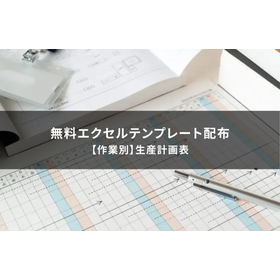
[Data] Production Schedule Template: Easily Create Work-Specific Gantt Charts

A production planning sheet by task that you can use right now! Free Excel template available.

We will provide a clear explanation, with images, of an Excel template for production planning that is easy to use even in manufacturing sites with many processes. By using this template, you can visualize the schedule of the person in charge and the production plan simply by entering the necessary items. The template we are offering is designed for those who want to start production management with Excel, allowing you to easily create production plans for each task. In sites with many work processes, you can visualize "who will do what and when" at a glance. With just a simple operation of entering minimal information such as product name, task details, and workers, you can immediately create a production plan. The input fields are limited to product name, delivery date, quantity, task name, start date, and end date. This allows for a level of detail and clarity that is difficult to achieve with paper or whiteboards. With a simple Excel format, you can easily experience an operational sense based on the template. ▶▶ Please download and use it from the link below: "Details of the template and free download here."

Added to bookmarks

Bookmarks list

Bookmark has been removed

Bookmarks list

You can't add any more bookmarks

By registering as a member, you can increase the number of bookmarks you can save and organize them with labels.

Free membership registration

Production management system 'SmartF' for the industrial machinery and assembly industry.

A cloud-based production management system that allows you to select only the necessary features. With dedicated support for peace of mind, it solves production management issues in the industrial machinery and assembly industry!

"SmartF" is a cloud-based production management system that allows for low-cost and small-scale startups. It consolidates operations such as inventory, processes, and costs into a "visualization," reducing waste, labor, and costs. ◆ What you can do with SmartF ✅ Record work effortlessly and without errors using barcodes ✅ Eliminate misuse through part number checks ✅ Achieve real-time and accurate parts inventory management by utilizing barcodes ✅ Significantly reduce ordering efforts through required quantity calculations and bulk ordering/order linkage ✅ Gate function using barcodes (checking expiration dates and inspection statuses) ✅ Trace all data related to part lots and production information ✅ Visualize actual costs from various perspectives, such as by part number or lot ✅ Manage standard costs and actual costs effectively, among other features ◆ Implementation effects (example) - Reduced inventory costs by 1 million yen annually - Reduced inventory counting labor by 560 hours annually - Reduced annual waste losses of several million yen to zero - Eliminated handwritten Excel tasks to zero ◆ Main features Inventory management / Material management / Process management / Production planning / Order management / Cost management / Warehouse management / Quality management \ Don’t fail in selecting a system! Free distribution of the 'Production Management System Selection Guide' is ongoing! / Please check it out by downloading the catalog.

Added to bookmarks

Bookmarks list

Bookmark has been removed

Bookmarks list

You can't add any more bookmarks

By registering as a member, you can increase the number of bookmarks you can save and organize them with labels.

Free membership registration

Thorough Comparison of 22 Production Management Systems! How to Choose Without Making Mistakes

Compare 22 products from the perspectives of functionality, implementation type, and cost to identify the optimal solution.

"We will answer the question, 'How should I compare the many production management systems available?' This article organizes the comparison of 22 production management systems based on four perspectives: 'functions,' 'delivery methods,' 'costs,' and 'implementation steps.' Starting with a comparison of key functions such as order management, inventory management, process progress management, and cost management, we also introduce points for distinguishing between cloud-based, on-premises, and hybrid models, as well as assessing their suitability for your company's production methods and scale. Additionally, we include hidden costs to watch out for when comparing estimates and a 90-day roadmap for successfully implementing the system. 【What you can learn from this explanatory article】 Differences in key functions revealed by comparing 22 companies How to choose a delivery method and points to consider Hidden costs that can become pitfalls during estimation How to proceed from initial implementation to establishment >> You can read more in the article linked below 【▶ Click here for the full article】! <<

Added to bookmarks

Bookmarks list

Bookmark has been removed

Bookmarks list

You can't add any more bookmarks

By registering as a member, you can increase the number of bookmarks you can save and organize them with labels.

Free membership registration

Let's grasp the key to quality risk management: the "Control Plan."

Explaining the basics of document design to prevent quality "variations" from design to mass production.

The Control Plan (CP) is one of the core tools recommended by the IATF16949 standard. It is a QMS document that outlines an appropriate risk management plan to maintain strict quality and prevent the occurrence of defective products. While the QC process chart lists management standards for specific processes, the CP is a comprehensive management method that includes characteristic management, responses to defects, inspection methods, and record-keeping. This article explains the role of the CP and its differences from the QC process chart. It provides insights into the concepts and practical points of CP that can be immediately applied to quality design. - 【What you can learn from this explanatory article】 - The basics and objectives of the Control Plan (CP) - Differences from the QC process chart - The concept of creating CP units - The flow of creating and updating CP at each stage - Key points for handling non-conformities and record management, etc. >> You can view the continuation of this article below 【▶ Click here for the full text】! <<

Added to bookmarks

Bookmarks list

Bookmark has been removed

Bookmarks list

You can't add any more bookmarks

By registering as a member, you can increase the number of bookmarks you can save and organize them with labels.

Free membership registration

What are the differences between MES and LIMS? Key selection points based on purpose.

Clarifying the differences between MES for manufacturing management and LIMS for quality management, two concepts that are often confused.

MES (Manufacturing Execution System) is a system specialized in the execution management of production sites, designed to grasp progress, achievements, and work instructions in real-time. On the other hand, LIMS (Laboratory Information Management System) plays a role in the integrated management of information related to testing, analysis, and inspection, enhancing the reliability of quality data. The decision on which system to implement depends on the management areas and challenges of the company, but recently there has been a trend towards integrating both systems. 【What you can learn from this explanatory article】 - Basic definitions and functions of MES and LIMS - Differences in their roles in manufacturing sites - Benefits gained from integration (e.g., automatic creation of EBR) - Points to consider and decision-making materials during implementation >> You can view the continuation in the article linked below! <<

Added to bookmarks

Bookmarks list

Bookmark has been removed

Bookmarks list

You can't add any more bookmarks

By registering as a member, you can increase the number of bookmarks you can save and organize them with labels.

Free membership registration

What is a production scheduler? A tool to enhance planning accuracy in the manufacturing field.

How to Choose a Production Scheduler and Organize On-Site Issues: What You Should Know Before Implementation

The production scheduler is a tool for optimally allocating resources such as people and equipment to create efficient production plans. By managing work processes along a timeline, it prevents waiting times and achieves a reduction in lead times. The standard time settings for each item allow for flexible responses to sudden changes in plans. There are two types of products: those that are independent dedicated systems and those that are offered as a function of a production management system. 【What you can learn from this explanatory article】 - Basic functions and features of the production scheduler - Differences from production management systems - Common challenges and causes in planning tasks - How the scheduler can alleviate task dependency - Key points to confirm when selecting a system >> You can read more in the article linked below【▶ Click here for the full article】! <<

Added to bookmarks

Bookmarks list

Bookmark has been removed

Bookmarks list

You can't add any more bookmarks

By registering as a member, you can increase the number of bookmarks you can save and organize them with labels.

Free membership registration

How to create an inventory management sheet in Excel! 【Free template available】

"You can do this much with Excel!" Explanation of a simple and easy-to-use inventory management sheet.

To prevent stock shortages and over-ordering, accurate inventory management is essential. In this article, we will explain the steps to create a practical and simple inventory management sheet, utilizing our company's expertise gained from years of building systems in manufacturing environments. If you feel that "I want to graduate from paper management" or "the current management sheet is difficult to use," please use this as a reference. We also provide a free template that you can use right away! ▼ Four features of this sheet: - Simple and easy to understand: A straightforward design that only requires entering the item number and product name. - Visualization of inventory value: Automatically calculates the valuation amount from the inventory quantity. - Inventory adjustment: Allows management of discrepancies between the ledger and actual inventory in a dedicated section. - Order optimization: Provides information on the quantity of each product, enabling appropriate ordering. >> The template can be downloaded from the following 【▶ Click here for the full article】! <<

Added to bookmarks

Bookmarks list

Bookmark has been removed

Bookmarks list

You can't add any more bookmarks

By registering as a member, you can increase the number of bookmarks you can save and organize them with labels.

Free membership registration

Production Management System Cost-Effectiveness Calculation Method [Including Sample Approval Document]

Production Management System "Cost-Effectiveness" Calculation and Internal Persuasion Guide [Includes Sample Approval Document]

This book summarizes specific methods for "waste reduction" and "productivity improvement" through the introduction of production management systems, set against the backdrop of the deepening labor shortage in manufacturing. It addresses concerns such as "cost" and "operational difficulties," which can be barriers to system implementation, using examples from the latest cloud-based packages. 【Main Contents】 - Labor Shortages and the Need for DX: The importance of labor-saving and efficiency from statistical perspectives, and moving away from paper and Excel management. - Cost Improvement through Waste Reduction: Visualization of "invisible costs" such as double entry and inventory checks. - Quantitative Examples of Implementation Effects: Success stories from companies that achieved a reduction of 3,000 hours of labor annually. - ROI Calculation Formula: Specific calculation methods that can be applied to your company's situation for estimation. - KPIs and Approval Documents for Internal Proposals: How to set indicators to measure effectiveness and a sample approval document that can be used as is. This practical guidebook is designed for those in charge who are struggling with "not knowing how to persuade the company" or "wanting to quantify the benefits of implementation," helping to advance on-site DX by one step. ▼▼ You can view it for free immediately by clicking the <Catalog Download> button below ▼▼

Added to bookmarks

Bookmarks list

Bookmark has been removed

Bookmarks list

You can't add any more bookmarks

By registering as a member, you can increase the number of bookmarks you can save and organize them with labels.

Free membership registration

What is "Kaizen"? How to promote improvement activities that yield results led by the workplace.

Don't struggle with improvement proposals! Knowing the approach will accelerate on-site reforms.

The essence of Kaizen is to not ignore the discomfort felt on-site, but to incorporate it into the system. This article introduces specific steps to smoothly advance "Kaizen" activities, including how to identify improvement themes, set priorities, thoroughly implement 5S, use the ECRS principles, and validate and re-execute through the PDCA cycle. It supports taking the first step from "I don't know where to start." 【What you can learn from this explanatory article】 - Selection of targets for "Kaizen" activities and considerations for prioritization - Methods for on-site analysis from the perspectives of 5S, 3M, and ECRS - How to approach generating improvement proposals - Ideas for continuous reform efforts as a team, and more >> You can view the continuation in the article linked below【▶ Click here for the full article】! <<

Added to bookmarks

Bookmarks list

Bookmark has been removed

Bookmarks list

You can't add any more bookmarks

By registering as a member, you can increase the number of bookmarks you can save and organize them with labels.

Free membership registration

What are the "3Ms" improvements that the manufacturing industry should first tackle?

Why isn't the efficiency on-site improving? The hint lies within the "3Ms."

In the manufacturing industry, reducing the 3Ms (Muda - waste, Mura - unevenness, Muri - overburden) has a positive impact on productivity, quality, and customer satisfaction. The 3Ms lurk in every process, including the effort required for each step, the load on machines and people, and uneven work distribution. By implementing specific reduction methods tailored to each issue, it becomes possible to create a competitive workplace. Improvement activities also benefit from reviewing production planning and inventory management. 【What you can learn from this explanatory article】 - Definition and importance of the 3Ms in manufacturing - Common causes of the 3Ms - Steps for reducing waste, unevenness, and overburden - Specific effects of improvements - Directions for improvement utilizing systems >> You can view the continuation in the article linked below【▶ Click here for the full text】! <<

Added to bookmarks

Bookmarks list

Bookmark has been removed

Bookmarks list

You can't add any more bookmarks

By registering as a member, you can increase the number of bookmarks you can save and organize them with labels.

Free membership registration

What is inventory days? A basic indicator to enhance the accuracy of inventory management.

Understanding the difference from inventory turnover rate, achieving optimal inventory and reducing inventory costs.

Inventory days is an indicator that represents how many days of sales the current inventory corresponds to. It is more intuitive to understand than inventory turnover rate and helps in grasping the status of inventory stagnation and appropriate levels. Calculations can be made on a monthly or weekly basis, and by having benchmarks that align with the characteristics of the products and seasonal fluctuations, the risks of excess inventory or stockouts can be mitigated. Let's utilize inventory days to visualize inventory and optimize costs. 【What you can learn from this explanatory article】 - The difference between inventory days and inventory turnover rate - The basic calculation method for inventory days - Criteria for determining optimal inventory levels - Ways to reduce inventory costs >> You can view the continuation in the article linked below【▶ Click here for the full article】! <<

Added to bookmarks

Bookmarks list

Bookmark has been removed

Bookmarks list

You can't add any more bookmarks

By registering as a member, you can increase the number of bookmarks you can save and organize them with labels.

Free membership registration

Paperless Success Cases & FAQ Volume 17 [With Readiness Checklist]

[Must-see for DX personnel] 17 paperless FAQs to resolve on-site questions. A readiness checklist clearly defines your company's current position!

This is a guidebook that condenses 17 real questions received from manufacturing sites, such as "I don't know where to start with DX" and "I'm worried about whether we can proceed with only old equipment." It presents concrete solutions to alleviate concerns about costs and effort, and to support the "first step" on-site. 【Main contents of the document】 - Introduction and Basics: Explains how to start DX, the expected effects, and the concept of a small start to minimize initial investment. - Implementation and Technology: Introduces the necessary number of tablets, metrics for measuring effectiveness (KPI), and how to proceed if there is no IT personnel. - Challenges and Responses: Covers methods for data collection with old equipment, the safety of the cloud, common failures in other companies, and points for success. - Readiness Checklist: By answering 10 questions, you can self-assess your company's readiness for DX and paperless transformation in three stages. This is a practical diagnostic tool and Q&A collection ideal for those wondering, "Is it possible to go paperless in our situation?" ▼▼ You can view it for free immediately by clicking the <Catalog Download> button below ▼▼

Added to bookmarks

Bookmarks list

Bookmark has been removed

Bookmarks list

You can't add any more bookmarks

By registering as a member, you can increase the number of bookmarks you can save and organize them with labels.

Free membership registration

Textbook on Cost Reduction: 5 Selected Ideas for Improvement Activities

[With Case Studies] Reduce Labor Costs That Squeeze Profits! "Cost Reduction Textbook" for Small and Medium Manufacturing Businesses - 5 Improvement Ideas to Drive Change on the Shop Floor.

This is a practical guide to solving the burden of labor costs and the shortage of personnel in small and medium-sized manufacturing industries. It explains specific measures for "standardization" to eliminate the "personalization" at the workplace and enhance productivity. 【Five Improvement Ideas Introduced in This Document】 ✅ Mistake Prevention: Utilize barcodes to prevent incorrect inputs and the use of expired items ✅ Elimination of Paper/Excel: Eliminate redundant data entry and search time with real-time input ✅ Elimination of Waste in Movement: Reduce round-trip time to the office by utilizing on-site terminals ✅ Standardization of Parts: Achieve cost reduction and improved accuracy through centralized inventory management ✅ Automation of Administrative Tasks: Reduce labor hours with shared delivery date responses and automatic output of invoices You can find hints for solutions from numerous success stories, including a case of reducing 2,800 hours annually. Please use this document as the first step to visualize the "invisible costs" in your workplace and transform into a profit-oriented structure! ▼▼ You can view it for free immediately by clicking the <Catalog Download> button below ▼▼

Added to bookmarks

Bookmarks list

Bookmark has been removed

Bookmarks list

You can't add any more bookmarks

By registering as a member, you can increase the number of bookmarks you can save and organize them with labels.

Free membership registration
Prev 1 Next
  • あなたの設計時間 CADに奪われていませんか? 制約から解放される新たな設計環境へ
  • 金属・化学・窯業・食品・医薬品などのほぐし・解砕・ふるい分けがこれ一台 解砕機構付き佐藤式振動ふるい機 つばさ デモ実施中!
    • Contact this company

      Inquiry Form

    Products

    • Search for Products

    Company

    • Search for Companies

    Special Features

    • Special Features

    Ranking

    • Overall Products Ranking
    • Overall Company Ranking

    support

    • site map
    IPROS
    • privacy policy Regarding external transmission of information
    • terms of service
    • About Us
    • Careers
    • Advertising
    COPYRIGHT © 2001-2026 IPROS CORPORATION ALL RIGHTS RESERVED.
    Please note that the English text on this page is automatically translated and may contain inaccuracies.