The website has been updated.
We have revamped our website and enhanced the business introduction content.

Inquiry about this news
Contact Us OnlineMore Details & Registration
Details & Registration
Added to bookmarks
Bookmarks listBookmark has been removed
Bookmarks listYou can't add any more bookmarks
By registering as a member, you can increase the number of bookmarks you can save and organize them with labels.
Free membership registration
Inquiry about this news
Contact Us OnlineMore Details & Registration
Details & RegistrationAdded to bookmarks
Bookmarks listBookmark has been removed
Bookmarks listYou can't add any more bookmarks
By registering as a member, you can increase the number of bookmarks you can save and organize them with labels.
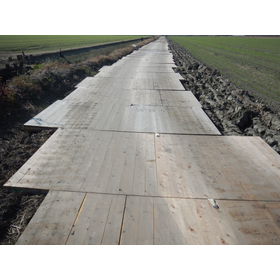
Free membership registrationIn civil engineering sites, workers walk around the site throughout the day. Moving over hard steel plates, experiencing strong glare and radiant heat during the summer, and being surrounded by the metallic sounds of vehicles can make the ground environment burdensome. The Hyper CLT board is a wooden lightweight board made from CLT (Cross-Laminated Timber) that is laminated in a perpendicular direction. The unique texture and temperature of the wood surface differ from that of steel plates, providing an opportunity to reconsider the environment of worker pathways, rest areas, and material storage. The 5×10 board weighs approximately 230 kg, and the 5×20 board weighs about 460 kg, making them relatively lightweight and easy to install, remove, or relocate depending on site conditions. The Hyper CLT board is registered as a technology with the Ministry of Land, Infrastructure, Transport and Tourism under NETIS as "TH-250021-A." It can also be utilized for proposals to improve working environments and consider environmental impact. Wooden boards, NETIS, civil engineering, CLT, wooden lightweight boards. Reevaluating the ground environment contributes to creating a more comfortable workplace.
Added to bookmarks
Bookmarks listBookmark has been removed
Bookmarks listYou can't add any more bookmarks
By registering as a member, you can increase the number of bookmarks you can save and organize them with labels.
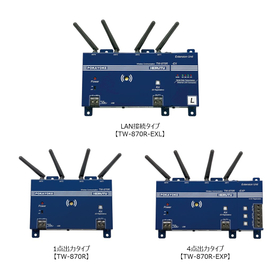
Free membership registrationHertz Electronics Co., Ltd. will update the software for its "Pokayoke Tools," a group of IoT tools that support the prevention of operator errors (Pokayoke) in production processes such as assembly and inspection, which require high quality. The update will add the "Communication Log Storage for Tool-Used Work" feature to the Pokayoke receiver TW-870R series (single output type "TW-870R," four output type "TW-870R-EXP," LAN connection type "TW-870R-EXL"). The "Communication Log Storage for Tool-Used Work" feature allows for the logging of work performed with Pokayoke-compatible tools (tools equipped with Pokayoke transmitters) each time work is done, storing logs of the work performed (transmitter serial number, work achievements, etc.) and logs of the wireless communication between the Pokayoke transmitter and the TW-870R series (communication date and time, channel, number of transmissions, etc.) as communication logs within the TW-870R series. The communication logs stored in the TW-870R series can be output in CSV format via the Windows application "Pokayoke Tools Settings," allowing for analysis of the wireless communication status in the production process and management of work history using Pokayoke-compatible tools.
Added to bookmarks
Bookmarks listBookmark has been removed
Bookmarks listYou can't add any more bookmarks
By registering as a member, you can increase the number of bookmarks you can save and organize them with labels.
Free membership registration
Metal cracks are one of the concerns in equipment maintenance operations. Conventional welding repair methods can alter the base material around the crack due to heat, leading to residual stress and deformation, which always carries the risk of "crack recurrence" or "secondary damage." Hinode Water Supply Equipment Co., Ltd.'s "Mechanical Stitching Method" is a new technique that allows for metal crack repair without the application of heat. By using special bolts and reinforcement plates, the crack is physically removed without affecting the base material at all. Repairs can be made even in environments where open flames cannot be used. Since no heat is applied, the disassembly of equipment is minimized. For more details, please contact us or download the catalog.
Added to bookmarks
Bookmarks listBookmark has been removed
Bookmarks listYou can't add any more bookmarks
By registering as a member, you can increase the number of bookmarks you can save and organize them with labels.
Free membership registration
● The production time for cast prototypes can be shortened! Since model making is not required, the production time for prototypes, which previously took about a month, can be significantly reduced. ● Model costs can be reduced! By directly producing sand molds from 3D data, there is no need for model production costs. If changes to the model are necessary, they can be addressed by modifying the 3D data. ● Similar products with different shapes and dimensions can be prototyped simultaneously! Different products, such as similar shapes or varying dimensions, can be molded at the same time in one molding process. This allows for the verification of multiple types in a short period.
Added to bookmarks
Bookmarks listBookmark has been removed
Bookmarks listYou can't add any more bookmarks
By registering as a member, you can increase the number of bookmarks you can save and organize them with labels.
Free membership registration
Metal cracks are one of the concerns in equipment maintenance operations. Conventional welding methods for repairs can change the base material around the crack due to heat, leading to residual stress and deformation, which always carries the risk of "crack recurrence" and "secondary damage." Hinode Waterworks Equipment Co., Ltd.'s "Mechanical Stitching Method" is a new technique that allows for metal crack repairs without applying heat. By using special bolts and reinforcement plates, the crack is physically removed without affecting the base material at all. Repairs can be made even in environments where open flames cannot be used. Since no heat is applied, the disassembly of equipment is minimized. For more details, please contact us or download the catalog.
Added to bookmarks
Bookmarks listBookmark has been removed
Bookmarks listYou can't add any more bookmarks
By registering as a member, you can increase the number of bookmarks you can save and organize them with labels.
Free membership registration