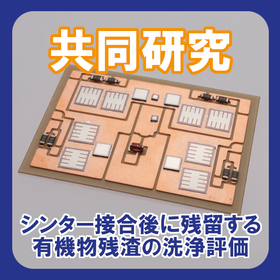
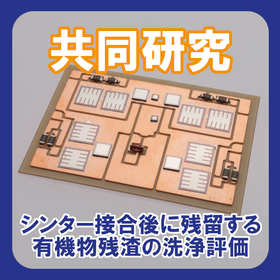
A page on "Cleaning evaluation of organic residue remaining after sintering" has been added.
 ゼストロンジャパン
In the field of power semiconductors for automotive and industrial applications, the adoption of "sintering bonding" as a joining technology that achieves high resistance and high reliability against thermal stress is expanding, replacing solder bonding.
Similar to no-clean solder bonding technology, sintering bonding is fundamentally designed to be "no-clean."
However, the currently mainstream sintering bonding methods are conducted under high temperature and high pressure conditions, which can lead to the generation and adhesion of residues during the bonding process, potentially affecting subsequent processes and long-term reliability. Cleaning is one proposed solution to this issue.
Although there is a "no-pressure" method for sintering bonding, its applications tend to be limited from the perspective of strength and reproducibility. Additionally, while it is residue-free, it is not "zero residue," so cleaning can also be a viable solution for achieving reliability.
Detailed content of the technical column can be viewed through the related link.
Inquiry about this news
Contact Us Online
Related product
Distributors