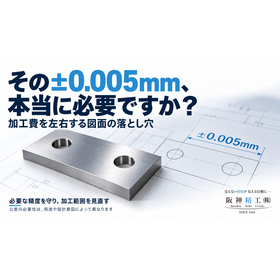
Is that ±0.005mm really necessary? Revealing points to reconsider processing costs from tolerances, C surfaces, and shapes.
阪神精工
Hanshin Seiko Co., Ltd. has published a technical article titled "Does Excessive Precision Increase Processing Costs? Key Points for Reviewing Tolerances and Processing Costs in Drawings."
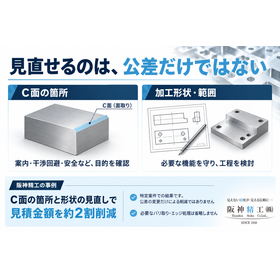
Addressing strict tolerances may require additional man-hours for finishing cycles, measurement time, and temperature considerations. The article introduces a way of thinking about reviewing tolerances, processing ranges, and shapes while maintaining the necessary precision for the functionality of parts.
It includes examples of cases where tolerances were reviewed after confirmation with customers, leading to a reduction in processes, as well as a case where changes to the C surface and shape lowered the initial estimated cost by about 20%. The approximately 20% reduction is a result of individual projects, and the effectiveness of the reduction varies depending on the drawings and processing conditions.
Excessive precision is not determined solely by the figure of ±0.005mm; the application and relationship with counterpart parts are also taken into account. Changes are considered based on the judgment of the design side.
If you are struggling to balance processing costs and required precision, please consult us with your drawings, material, quantity, plate thickness, application, and the range of possible changes.
Inquiry about this news
Contact Us OnlineMore Details & Registration
Details & Registration
Related Links
Explaining the relationship between the man-hours required for finishing and measurement and tolerances. We will introduce examples where the estimated costs were reviewed due to changes in C surfaces and shapes while maintaining the necessary precision.
Distributors