
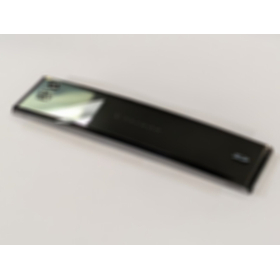
Maintains metallic luster while allowing radio waves to pass through | Tin discontinuous vapor-deposited foil

Transmits radio waves that are blocked by aluminum vapor deposition and plating. Achieves a genuine metallic appearance with nano-island tin deposition.
The issue of decreased antenna sensitivity in smartphones, Bluetooth devices, and in-vehicle devices when applying metallic decorative finishes was due to traditional plating and aluminum vapor deposition shielding the radio waves. By depositing tin (tin) in a discontinuous island-like manner at the nano level, we developed a unique deposition in-mold foil that maintains an electrically insulating state while visually emitting a uniform metallic luster. We established a new method that achieves a metallic appearance while allowing radio waves to pass through. This will be adopted in smartphone casings, Bluetooth-equipped devices, and automotive components, providing a high-transparency metallic exterior that does not interfere with radio waves in mass production.
Inquire About This Product
basic information
【Main Technologies and Manufacturing Methods】 - Optimization of film formation conditions for discontinuous tin deposition films (island deposition) - Simultaneous control of transmittance, reflectance, and insulation properties - Adaptation for in-mold transfer
Price range
Delivery Time
Applications/Examples of results
【Target Industries】 Smartphones, automotive devices, IoT devices, Bluetooth-enabled devices 【Examples of Target Applications】 - Smartphone casings - Automotive device exteriors - Wearable devices 【Achievements】 Achieved high transparency metallic exteriors that do not interfere with radio waves. Adopted for smartphone casings, Bluetooth-enabled devices, automotive components, etc.
catalog(2)
Download All Catalogs

Company information

**About Yoshida Techno Works** We are the world's first manufacturer to commercialize in-mold transfer molding, which utilizes plastic molding and decoration technology cultivated through cosmetic container manufacturing, allowing for simultaneous molding and transfer decoration. **Key Technologies** - Double in-mold molding that performs simultaneous decoration on both sides of the product - Hybrid molding that combines sheet inserts with in-mold techniques - Glass insert in-mold (GIM) molding that inserts reinforced glass into the mold, allowing for integrated molding of resin frames and decoration - Two-color in-mold molding that combines rotational two-color molding with in-mold transfer - Composite technology that integrates metal (such as SUS sheet metal and nuts) with in-mold molding - Real material (natural wood, fabric, synthetic leather, etc.) insert molding - Out-mold deep drawing decoration method (VSS) compatible with metal, glass, and resin


