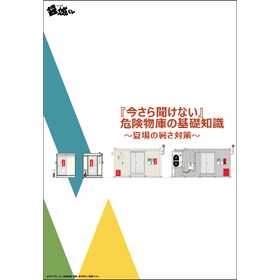
Essential Knowledge of Hazardous Material Storage You Can't Ask Now: Summer Heat Countermeasures / 2026 Latest Edition

A helpful document summarizing "Basic Knowledge of Hazardous Material Storage" and "Disaster Prevention Measures for Hazardous Materials in Summer."
This document summarizes the basic knowledge necessary for managing hazardous materials, hazardous material storage facilities, and small quantity hazardous material storage, as stipulated by the Fire Service Act and fire prevention regulations. It begins with a concise overview of what hazardous materials are, followed by examples of hazardous material disasters caused by rising temperatures in summer, and measures utilizing the "Shoki-kun" series from Arctec. [Contents] ■ Heat countermeasures using the "Shoki-kun" series (THS type COOL / FPI type) ■ Examples of hazardous material disasters due to summer heat ■ What are hazardous materials? What types are there? ■ What is a designated quantity? ■ What is a small quantity hazardous material storage? ■ What is a hazardous material storage facility? *For more details, please refer to the PDF document or feel free to contact us.
Inquire About This Product
basic information
For more details, please refer to the PDF document or feel free to contact us.
Price range
Delivery Time
Applications/Examples of results
For more details, please refer to the PDF document or feel free to contact us.
catalog(1)
Download All Catalogs
Company information

In light of the increase in accidents and disasters, in addition to strengthening fire safety guidance regarding the storage and handling of hazardous materials, the mandatory risk assessment for all chemicals that fall under GHS standards will significantly increase the number of chemical substances that must be managed. The "Shoki-kun," which is easy to install and robustly built, is suitable for the storage of toxic and hazardous substances, taking into account fire safety laws and technical standards. We recommend its introduction not only to prevent secondary disasters during emergencies and accidents but also from the perspective of compliance adherence.


![[Helpful Materials Provided] Basic Knowledge of Hazardous Material Storage That You Can't Ask Now](https://image.mono.ipros.com/public/product/image/c43/2001060834/IPROS8848834219593249481.jpg?w=280&h=280)