

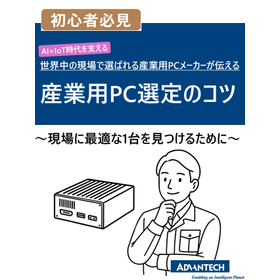
To find the optimal unit on-site.
This document provides a clear explanation of the basics of industrial PCs and the optimal selection methods considering the AI era. It introduces the differences between industrial PCs and consumer PCs, as well as features such as long-term stable operation, environmental resistance, and expandability, along with their applications in AI inference and edge computing. Additionally, it organizes selection points for CPU, memory, storage, OS, and interfaces based on four steps: "clarifying the purpose," "installation environment," "I/O requirements," and "key specifications." Furthermore, it explains points that are often overlooked during implementation, such as ECC memory, M.2 SSDs, GPUs, power supplies, Windows/Linux licenses, TPM compatibility, and environmental resistance. This is a practical guide for those looking to select the most suitable industrial PC for their applications and installation environments.
Inquire About This Product
basic information
This document is a guide that explains the points for selecting industrial PCs based on their applications and installation environments, rather than product specifications. 【Selection Criteria】 CPU: Atom / Core i3・i5・i7・Xeon・AI-oriented SoC Memory: 4GB to over 16GB (selected according to application) Storage: SATA SSD / NVMe SSD OS: Windows / Linux (Ubuntu, Yocto, etc.) Interface: LAN, USB, COM, GPIO, CAN, Display Power Supply: 12V, 24V, 9-36V DC input, redundant power supply support Chassis: Fanless, DIN rail, BOX PC, rack mount Operating Temperature: Selected according to usage environment AI Support: GPU and AI accelerator support (depending on application) Maintenance: Long-term supply and long-term support available *The optimal specifications vary depending on the application, installation environment, and whether AI is utilized.
Price range
Delivery Time
Applications/Examples of results
【Applications and Achievements】 ■ Background and Issues General PCs often fail due to dust, heat, and vibration, causing production lines to stop. Model changes occur rapidly, making it difficult to continue procurement or re-evaluation of the same model. There is a need for PCs that can withstand 24-hour continuous operation and legacy port expansion. ■ Main Applications FA and Manufacturing Lines: Production monitoring, data collection at IoT edges. Image Analysis and Inspection: Integration into AI visual inspection devices. Infrastructure and Medical: Monitoring of transportation and water treatment, integration into medical devices. ■ Implementation Results and Effects Manufacturing Industry: Introduction of fanless PCs has reduced failure rates and prevented line stoppages. Equipment Manufacturers: Adoption of long-term supply models has significantly reduced re-evaluation costs.
Company information

In 1983, Advantech (Advantech Co., Ltd.) was founded in Taiwan. For over 40 years, we have been developing high-quality and high-performance computers for industrial applications. As of 2024, we offer a lineup of over 3,000 various IoT devices. As the world's No. 1 manufacturer in the industrial computer market, with a presence in 95 cities across 26 countries, we aim to cultivate a prosperous future by solving social issues through AI × IoT platform services. *Source: OMDIA - No. 1 in global market share for industrial PCs, 42.5% (2023 edition)* In Japan, we established Advantech Co., Ltd. in 1997. In 2018, we formed a capital and business alliance with Omron Nogata Co., Ltd. to further expand sales and to quickly respond to market demands by offering design to production (DMS/ODM) services. By merging Taiwan's speed with the technological expertise we have cultivated over the years, we will establish a brand that meets the needs of our partners.