

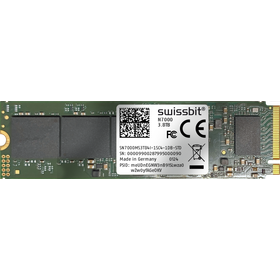
M.2 PCIe SSD
PCIe NVMe SSDs have become the standard for performance in today's systems, but requirements regarding reliability, power consumption, and lifecycle can vary significantly depending on the application. Swissbit addresses these needs with dedicated PCIe M.2 SSD products designed for long-term supply assurance, industrial-grade robustness, and application-specific optimization.
Inquire About This Product
basic information
N2000 3D NAND TLC N2600 3D NAND pSLC (2230 / 2242 / 2280) PCIe Gen3.1 / NVMe 1.3 (4 lanes) Operating temperature range: -40°C to 85°C DRAM-less / HMB (Host Memory Buffer) support AES256 encryption / TCG Opal support N7000 3D NAND TLC N7600 3D NAND pSLC (2242 / 2280) PCIe Gen4 / NVMe 2.0 / 4 lanes Robust N7001 with underfill HMB (Host Memory Buffer) support AES256 encryption / TCG Opal 2.0 Encrypted erase / Secure boot A2000 3D NAND TLC A2200 3D NAND eTLC (2280) PCIe Gen4 / NVMe 1.4 / 4 lanes Up to 3.84 TB, 0.3 DWPD Operating temperature range: -40°C to 85°C HW Powersafe power loss protection feature AES256, TCG Opal 2.0, encrypted erase, secure boot
Price range
Delivery Time
Applications/Examples of results
Medical industry / Electronics and electrical equipment industry / Aerospace industry
catalog(1)
Download All Catalogs
Company information

"To that system" "To that design." All products are manufactured at the Swissbit Germany, AG factory in Berlin, Germany. Swissbit products, equipped with safety environmental performance and high technical standards specialized for industrial applications, promise to enhance the reliability of the systems they are integrated into. Swissbit, which became independent from Siemens in Switzerland in 2001, has established itself as a global innovation leader in storage and security products, based on over 25 years of experience in the development and manufacturing of high-density, high-integration products, as well as solid engineering, circuit design, and process technology. Swissbit's flash storage products flexibly respond to the demands of high performance and multifunctionality in embedded and industrial systems for IIoT and M2M platforms. The concept of "Industry 4.0," aimed at realizing the advancement of industries centered on manufacturing, is rooted in the Japanese manufacturing spirit of "solving specific challenges/problems" and the perseverance to continuously build upon design technology. It thoroughly addresses the analysis of defects and failures, aiming for further improvements in quality standards and reliability with a global perspective and specialized technology.


