
[Issue Report] Causes and Countermeasures for Equipment Data Not Being Received Even When Connected to the Router
MI Corporation Disability Report

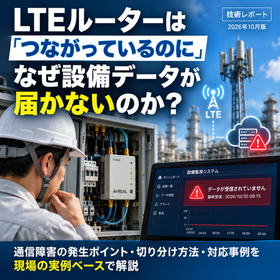
LTE connection is normal, but data is not coming through? Explanation of cause analysis and countermeasures.
"Although the LTE router is connected, the equipment data is not reaching the monitoring screen" — are you facing such troubles? In IoT remote monitoring for factories, plants, and water treatment facilities, even if the LTE line is functioning normally, monitoring data may not be updated due to issues with VPN connections, communication routes, data transmission settings, or server processing. This technical report divides the communication route from equipment and sensors to the monitoring screen into seven stages, explaining the confirmation points to identify the location of failures and the troubleshooting procedures that can be used on-site. [What you can learn from this document] * Main causes of data not being received even when connected to LTE * Confirmation points and troubleshooting procedures by symptoms * Considerations for checking logs on the VPN, device side, and server side * Design and operational measures to minimize data loss * Case studies of troubles addressed by MI Corporation Please use this for responding to equipment monitoring system failures, reviewing maintenance systems, and designing new IoT implementations. We also accept inquiries regarding remote monitoring and IoT communications.
Inquire About This Product
basic information
【Document Type】Technical Report on Industrial IoT and Remote Monitoring 【Published by】MI Corporation / October 2026 Edition 【Format】PDF 【Target Fields】Factory Equipment, Plants, Water Treatment Facilities, Infrastructure Equipment, etc. 【Target System】Equipment data collection and remote monitoring system using LTE routers 【Main Explanation Items】 - Communication paths from equipment and sensors to monitoring screens - Connection verification of LTE lines, the Internet, and VPN - Verification of data transmission applications and servers - Potential causes and troubleshooting procedures by symptoms - Preventive measures such as log acquisition, temporary data storage, and retransmission processing - Actual case studies of trouble response *This is a technical document for troubleshooting and operational improvement.
Price information
Technical Data: Free Download
Delivery Time
Applications/Examples of results
【Intended Use】 - IoT remote monitoring of factory and plant equipment - Condition monitoring of water treatment facilities and infrastructure - Investigation of communication failures in LTE routers - Troubleshooting the causes of missing monitoring data and halted updates - Investigation of VPN connection failures and poor remote access - Configuration checks during communication equipment replacement and server migration - Development of maintenance inspection procedures and monitoring/notification rules 【Examples of Corresponding Cases in the Materials】 - Investigation when VPN connection becomes unavailable and confirmation of alternative access routes - Verification of transmission settings when monitoring data cannot be obtained after communication equipment replacement Recommended for equipment maintenance personnel, electrical and control designers, information systems personnel, IoT implementation personnel, and system integrators.
Detailed information
-
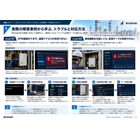
Even if the LTE router is online, it does not necessarily mean that the equipment data will reach the monitoring screen. We have organized the key points to check at each stage: equipment/sensors, LTE communication, network, VPN, data transmission, server, and monitoring screen. Please use this for initial troubleshooting and maintenance procedure considerations during incidents.
catalog(6)
Download All Catalogs

Company information

Our company handles devices and equipment centered around IoT/M2M technology. By enabling devices and equipment connected to a network to exchange information with each other through the network, it is possible to directly collect and control data from the devices and equipment without human intervention. This significantly contributes to improving operational efficiency, environmental protection, and reducing labor costs.


