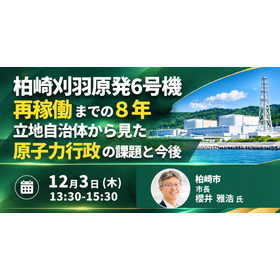
Challenges of Nuclear Administration from the Perspective of Local Governments and the Future - Between Law and "Public Opinion" in Nuclear Administration, Safety and Assurance.
Our company will hold a business seminar. 【Practical Insights Gained from the Seminar】 - The realities and challenges over the 8 years leading to the reactivation of the Kashiwazaki-Kariwa Nuclear Power Plant Unit 6 - The relationship between legal systems in nuclear administration and "public opinion" and "resident understanding" - The relationships among electric power companies, the Nuclear Regulation Authority, and national, prefectural, and local governments - The issues of "safety" in nuclear policy and "peace of mind" for local residents - Challenges and expectations for future nuclear administration and legal systems from the perspective of local governments 【Target Industries and Sectors】 - Electric power, nuclear, and energy-related businesses - Heavy electrical, plant, construction, engineering, and trading companies - Management planning, business planning, nuclear, power development, regional coexistence, and public relations departments - Energy-related sectors such as finance and consulting - National and local governments, and stakeholders in nuclear and energy policy 【Seminar Details】 ■ Date and Time: December 3 (Thursday) 13:30 - 15:30 (Doors open at 13:00) ■ Venue: JPI Conference Square ■ Address: 5-2-32 Minamiazabu, Minato-ku, Tokyo, Kowa Hiroo Building ■ Participation Method: In-person, live streaming, archived streaming ■ Speaker: Masahiro Sakurai, Mayor of Kashiwazaki City *For more details, please refer to the PDF document or feel free to contact us.
Inquire About This Product
basic information
**Lecture Overview** The Tokyo Electric Power Company's Kashiwazaki-Kariwa Nuclear Power Plant Units 6 and 7 received a change of reactor installation permit from the Nuclear Regulation Authority on December 27, 2017. It took as long as eight years until the commercial operation of Unit 6 on April 16, 2026. This delay was due to the so-called "three verifications" and the "trust issue" in Niigata Prefecture, as well as violations of nuclear material protection regulations by Tokyo Electric Power itself. The 7th Basic Energy Plan states, "The use of nuclear power in our country has been supported by the understanding and cooperation of stakeholders in the nuclear power host regions." However, the current situation goes beyond the rule of law, with residents' "understanding" regulating the development of policies. Is it acceptable to be a "neglectful legal state"? The heads of the host municipalities question this. **Lecture Topics** ■ Eight years leading to the restart of Tokyo Electric Power's Kashiwazaki-Kariwa Nuclear Power Plant Unit 6 ■ Issues that have become visible and felt ■ Future expectations and considerations of the heads of host municipalities regarding national and nuclear administration legal systems ■ Related Q&A ■ Business card exchange and networking event (limited to on-site participants)
Price information
【Participation Fee】 1 person: 37,290 yen (including tax) Special Offer: One additional participant from the same organization can attend for free (limited to in-person or live streaming) (Please register both participants simultaneously with the same participation format at the time of application. Additional registrations after applying for one person will not be eligible.) Special Offer: Individuals affiliated with local government organizations can register up to two participants for 11,000 yen each (including tax, limited to in-person or live streaming with the same participation format).
Delivery Time
Applications/Examples of results
For more details, please refer to the PDF document or feel free to contact us.
catalog(1)
Download All Catalogs
Company information

JPI Corporation (Japan Planning Institute) has been providing valuable information for executives and senior management involved in the execution of national policies and national projects, supporting the dissemination of state policies as a 'bridge of knowledge' between 'government', 'administration', and 'citizens' in the form of exclusive real seminars for participants for half a century, aiming to create national knowledge.