Practical Roadmap for Application, Market Potential, and Entry Decision - Latest Trends in High Efficiency, Printing, Large Area, Mass Production Costs, Durability, and Environmental Safety.
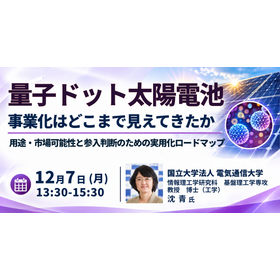
Our company will hold a business seminar. 【Practical Insights Gained from the Seminar】 - Current status of the practical application of quantum dot solar cells and future uses and market potential - Characteristics and development trends of quantum dot materials such as PbS and perovskite - Progress towards mass production through QD inks, printing, large-area scaling, and modularization - Business challenges such as durability, mass producibility, manufacturing costs, and environmental/safety concerns - Future directions to consider for entry, joint development, and application development 【Target Industries and Departments】 - New business and business development departments of renewable energy and solar cell-related companies - Companies related to chemicals, materials, semiconductors, electronic components, and printing/manufacturing equipment - Corporate planning departments considering entry, investment, and joint development in next-generation solar cells - R&D planning, technology planning, and marketing departments exploring new applications and markets - Business leaders and planners who want to understand the business viability and future potential of quantum dot technology 【Seminar Details】 ■ Date and Time: December 7 (Monday) 13:30 - 15:30 (Doors open at 13:00) ■ Venue: JPI Conference Square ■ Speaker: Professor Qing Shen, Ph.D. (Engineering), Graduate School of Information and Communication Engineering, National Institute of Technology, University of Electro-Communications
Inquire About This Product
basic information
【Lecture Overview】 Quantum dot solar cells are expected to be the next generation of solar cells due to their characteristics such as low-cost manufacturing through solution processes, broad-spectrum light absorption through size control, and multiple exciton generation. This lecture will introduce the latest trends in enhancing efficiency through the design of quantum dot materials, conduction type control, surface and interface control, and junction control with charge transport layers. Furthermore, specific research and development examples will be presented regarding the development of conductive quantum dot inks, large-area thin film formation through printing processes, and the expansion to large-area devices and modules. Finally, the lecture will discuss the technical challenges and future prospects for the practical application and social implementation of quantum dot solar cells, including long-term stability, mass production, manufacturing costs, and environmental and safety considerations. 【Lecture Topics】 ■ Characteristics and latest trends of quantum dot solar cells ■ Efficiency enhancement through material, surface, and interface control ■ Conduction type control of quantum dots and conductive quantum dot inks ■ Large-area development using stable quantum dot inks and printing processes ■ Challenges and prospects for the practical application and social implementation of quantum dot solar cells ■ Related Q&A ■ Business card exchange and networking (limited to on-site participants)
Price information
【Participation Fee】 1 person: 37,550 yen (tax included) From 2 people onwards: 32,550 yen (tax included / If multiple applications are made from the same organization, please register simultaneously. Additional registrations after applying for 1 person are not eligible for the discount.) Benefit: For those belonging to local public organizations, the fee is 11,000 yen per person (tax included / limited to in-person attendance or live streaming attendance).
Delivery Time
Applications/Examples of results
For more details, please refer to the PDF document or feel free to contact us.
catalog(1)
Download All Catalogs
Company information

JPI Corporation (Japan Planning Institute) has been providing valuable information for executives and senior management involved in the execution of national policies and national projects, supporting the dissemination of state policies as a 'bridge of knowledge' between 'government', 'administration', and 'citizens' in the form of exclusive real seminars for participants for half a century, aiming to create national knowledge.