
List of Pharmaceutical and food related products
- classification:Pharmaceutical and food related
3871~3915 item / All 32730 items


Reduce the workload from handling heavy objects! Here are five case studies that solved customer challenges! We are also accepting free consultations and tests tailored to your work!

- Other conveying machines


Strong cold wind from room temperature to -13°C! Depending on the usage environment, you can choose between the combo type or the separate type!
- Cooling system

April 10, 2024 (Wednesday) to April 12, 2024 (Friday) Notice of Participation in Nagoya Manufacturing World 2024
Sanwa Shiki Ventilator Co., Ltd. will be exhibiting at the 2024 Monozukuri World (Nagoya) held at Port Messe Nagoya. We will also be showcasing our large cooling fans and cool/warm ambient products. Date: April 10, 2024 - April 12, 2024 Opening: 10:00 AM Location: Nagoya Port Messe (Exhibition Hall 1) *Our booth: 19-1 We would be grateful if you could visit us if you have the time.
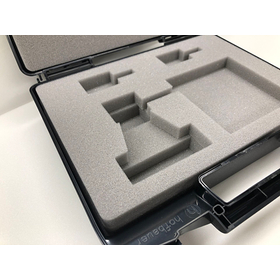

Soft sponge, internal pad cushioning material, die-cut processing and bonding processing.
- Food boxes, packaging materials, and cushioning materials
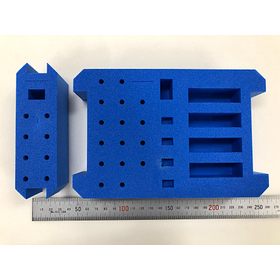
Sanpelca series case inner pads available for consultation from small quantities to mass production.
We are capable of producing case interior pads using the Sanpelka series. These materials are adopted as interior padding for cases with the purpose of protecting and securing the stored items, and we can accommodate a wide range of projects from small-scale prototypes to mass production. Case interior pads refer to the foam that is placed inside cases used for storing tools, precision instruments, measuring devices, and more. By processing the foam to match the shape of the stored items, it helps to mitigate impacts during transport and storage, and prevents the items from moving within the case. The Sanpelka series is made of relatively firm foam material and is commonly used for case interior pads. ■ Product Specifications Material: Sanpelka series Application: Case interior pads Compatible Shapes: Processed to match the shape of stored items Processing Methods: Die-cutting, bonding, shape processing Production Support: From small-scale prototypes to mass production ■ Processing Details We can accommodate everything from simple cut shapes to complex storage shapes, and we can also handle structures that combine materials of different thicknesses or bonding. We will propose appropriate processing methods based on quantity and application.


The new liposome coenzyme Q10 (ginsenoside) has demonstrated an absorption rate approximately 7 times higher than that of regular coenzyme Q10, utilizing patented technology.
- Food ingredients (powder)

It is expected that the absorption rate will improve by converting to NAD+ more quickly and effectively!
- Cosmetic materials and raw materials
Trans-type resveratrol reproduces the composition of cell membranes with a phospholipid bilayer, achieving approximately double the absorption rate!
- Food ingredients (powder)
Liposome-type Coenzyme Q10 has demonstrated an absorption rate up to about three times higher than regular Coenzyme Q10, utilizing unique patented technology!
- Food ingredients (powder)
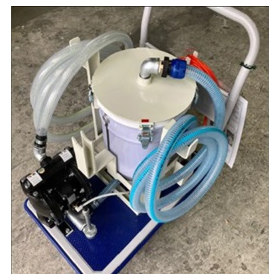

Clean and reusable without disposing of waste liquid! Contributing to the establishment of a sustainable resource recycling society.
- Waste liquid treatment equipment
Overcoming the weaknesses of vitamin C with the latest technology! The biggest appeal is that it is coated with a phospholipid bilayer, which greatly enhances its utilization efficiency in the body.
- Food ingredients (powder)

"How should I choose an RFID reader?" We will answer that question by explaining the RFID readers we handle.
- IC tag
- RFID/IC tags
- IC tag reader/writer
We are introducing basic knowledge about RFID on our company website!
- RFID related products and IC tag services
- RFID/IC tags
We are introducing the application for radio wave usage of RFID readers on our company website!
- RFID/IC tags
- RFID related products and IC tag services
Adding RFID to business devices, equipped with 1D/2D scanners as well.
- RFID/IC tags
- Handheld barcode reader
- IC tag reader/writer
All-in-one Android device with built-in 1D/2D scanner RFID reader.
- RFID/IC tags
- Handheld barcode reader
- IC tag reader/writer
You can search for products pinpointedly among a wide variety of IC tags.
- RFID/IC tags
- RFID related products and IC tag services
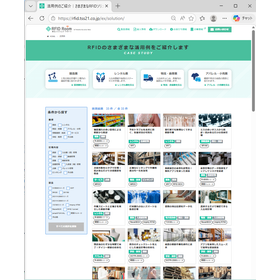
What actually changes with RFID? We are introducing examples of how other companies are utilizing it.
- RFID related products and IC tag services
- RFID/IC tags
Easy operation of the RFID reader with an easy-to-understand design.
- RFID/IC tags
- Embedded applications for mobile phones and PDAs
![[Useful Information] We are current...](https://image.mono.ipros.com/public/product/image/221588/IPROS3052852906599345194.png?w=280&h=280)
Inventory management, stock control, access management, and case studies from events!
- RFID/IC tags
- RFID related products and IC tag services


Eliminate the risk of foreign matter contamination with the disassembly and cleaning of the kettle! We accept dissolution processing and tank cleaning starting from 50L. We have thorough measures in p...
- OEM
- OEM Manufacturing Services

We support small-scale dissolution processing starting from 50L! By preventing contamination through disassembly cleaning, we provide high-quality OEM manufacturing even in small batches.
- OEM
- OEM Manufacturing Services

We accept the dilution of high-viscosity solutions starting from 50L! We prevent contamination through decomposition cleaning and can handle precise concentration adjustments and aliquoting into speci...
- OEM
- OEM Manufacturing Services

We accept dissolution in various organic solvents starting from 50L! We prevent contamination with decomposition cleaning and provide high-quality OEM manufacturing even in small batches.
- OEM
- OEM Manufacturing Services

Achieving high viscosity dissolution of up to 60,000 mPa·s! Even difficult-to-dissolve materials can be transformed into a uniform solution with powerful stirring equipment and decomposition cleaning.
- OEM
- OEM Manufacturing Services

Reduce rubber inventory with on-demand manufacturing that produces only what is necessary! We support inventory optimization and fire safety measures with small-scale melting and mixing contracts star...
- OEM
- OEM Manufacturing Services

Outsource your solvent usage processes to the professionals! We offer dissolution processing with toluene, MEK, and more starting from 50L. We provide high-quality and safe contract manufacturing thro...
- OEM
- OEM Manufacturing Services

We provide a dissolution processing that does not allow foreign matter contamination starting from 50L. Through disassembly cleaning and filtration with dedicated filters, we ensure a stable supply of...
- OEM
- OEM Manufacturing Services

Starting with a 50L prototype dissolution of new products! We maintain purity through decomposition cleaning and support from the dissolution study of difficult-to-dissolve, high-viscosity materials t...
- OEM
- OEM Manufacturing Services

We accept toluene dissolution from 50L! Prevent contamination with decomposition cleaning and dissolve rubber and resin uniformly. We can handle high viscosity and small spot requests.
- OEM
- OEM Manufacturing Services

We accept one-time spot dissolution starting from 50L! We ensure high quality through decomposition cleaning and support the resolution of excess inventory and BCP measures.
- OEM
- OEM Manufacturing Services

We accept small packaging from 50L from one-dou cans and drum cans! We guarantee safe refilling with explosion-proof equipment and quality maintenance through disassembly and cleaning.
- OEM
- OEM Manufacturing Services

Insufficient cleaning of the kettle with 'solvent cleaning' is resolved with 'decomposition cleaning'! Thoroughly prevent contamination and provide high-quality dissolution contracting starting from 5...
- OEM
- OEM Manufacturing Services

We accept solvent cuts of solid resin starting from 50L! We prevent contamination through decomposition cleaning and can flexibly process high-viscosity and difficult-to-dissolve materials. We also ac...
- OEM
- OEM Manufacturing Services

We accept orders for 50L of release and cleaning solution for molded products! We maintain quality with decomposition cleaning and can flexibly process difficult-to-dissolve items. Small lot and spot ...
- OEM
- OEM Manufacturing Services

Thoroughly eliminate contamination during the dissolution processing! With double measures of decomposition cleaning and precision filtration, we offer contract manufacturing of high-purity products s...
- OEM
- OEM Manufacturing Services
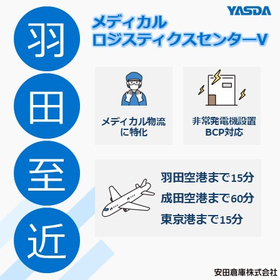

Ease of securing workers familiar with medical logistics! BCP response through the installation of emergency generators.
- Other quality control systems

Supports mixed gases! Standard features include analog output, RS-232C communication, and a backlit LCD display. Current delivery time is 8 weeks.
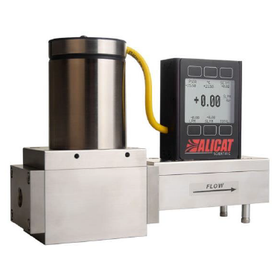
- Flow Meter
- Flow Control
- Coriolis flow meter
We have published various application examples on the official website.
Alicat's measurement devices enable technological innovation across a wide range of industrial sectors. Accurate, reproducible, and scalable flow and pressure measurement and control are essential in all fields, including industrial production, research and development, and pilot projects, and are used in applications across various industries. ◆ Differential Pressure Flow Meters: ALICAT - Aerospace and Defense - Bioreactors and Fermentation Tanks - Calibration and Measurement - Environmental and Atmospheric Monitoring - Food and Beverage - Gas Chromatography - Gas Mixing - Glass and Optical Fiber - Hydrogen - Lab-Grown Diamonds - Leak Testing - Oil and Gas - Laboratories - Thin Film Deposition ◆ Gas Mixing: Fusion Flow - MAP Packaging - Bioreactors and Biotechnology Laboratories - Gas Testing in Chambers - Research and Development - Low Methane Flare Gas - Carbon Cycle Sulfide Tracer Model - Fundamentals of Gas Sensor Calibration - Welding Shielding Gas Arc Welding ◆ Back Pressure Regulators: Equilibar + Research Applications + Industrial Applications + Pump Control + Sanitary Applications + Level Control + Vacuum
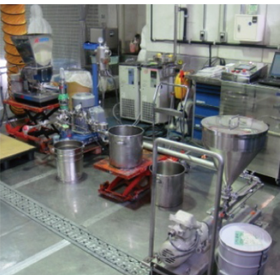

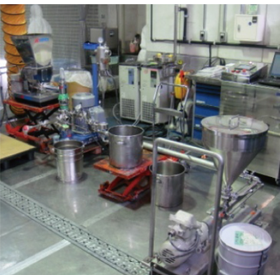
Quality changes with dispersion. Pre-validation of the reproducibility of resin materials through testing.
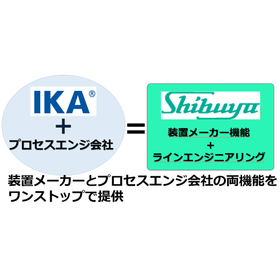
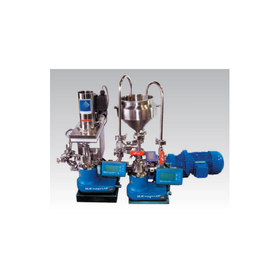
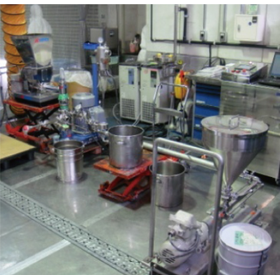
- Emulsifier/Disperser
- Vacuum degassing machine
- Dispersion/emulsification equipment/homogenizer
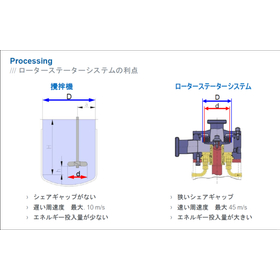
What are the reasons for changes in results from the lab to mass production? Causes and countermeasures for the deterioration of distributed quality during scale-up.
Despite obtaining good dispersion results in the lab, the challenge of unstable quality upon mass production occurs in many settings. The main cause of this is that the dispersion conditions are not replicated due to differences in scale. In lab equipment, the smaller size leads to higher energy density, making shear and flow more uniform, while in mass production equipment, the larger scale often results in insufficient dispersion energy at the same rotational speed and processing time. Additionally, differences in equipment structure and flow patterns can cause variations in the shear history and residence time experienced by particles, leading to differences in the dispersion state. Furthermore, simple scale-up does not ensure that critical parameters such as flow rate, residence time, and shear intensity match, making it difficult to reproduce the same results as in the lab. To address these challenges, it is essential to focus on process design based on dispersion energy density and flow conditions rather than merely increasing equipment size. By designing the system so that particles pass through the processing area under consistent conditions, it is possible to achieve reproducible dispersion quality even when the scale changes, as seen in inline continuous processing.
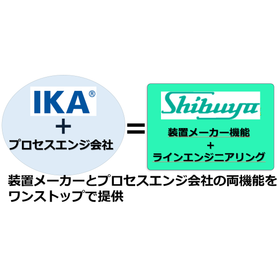
The strength is determined by the variance. Visualize quality variations through testing before mass production.
- Emulsifier/Disperser
- Vacuum degassing machine
- Dispersion/emulsification equipment/homogenizer
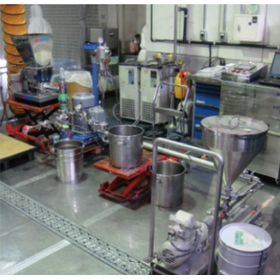
What are the reasons for changes in results from the lab to mass production? Causes and countermeasures for the deterioration of distributed quality during scale-up.
Despite obtaining good dispersion results in the lab, the challenge of unstable quality upon mass production occurs in many settings. The main cause of this is that the dispersion conditions are not replicated due to differences in scale. In lab equipment, the smaller size leads to higher energy density, making shear and flow more uniform, while in mass production equipment, the larger scale often results in insufficient dispersion energy at the same rotational speed and processing time. Additionally, differences in equipment structure and flow patterns can cause variations in the shear history and residence time experienced by particles, leading to differences in the dispersion state. Furthermore, simple scale-up does not ensure that critical parameters such as flow rate, residence time, and shear intensity match, making it difficult to reproduce the same results as in the lab. To address these challenges, it is essential to focus on process design based on dispersion energy density and flow conditions rather than merely increasing equipment size. By designing the system so that particles pass through the processing area under consistent conditions, it is possible to achieve reproducible dispersion quality even when the scale changes, as seen in inline continuous processing.
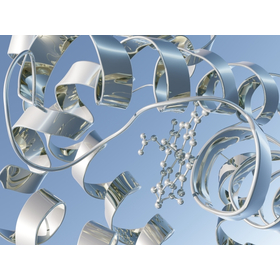
Resolve issues of not dissolving and clumping in advance. Test the dispersibility of the protein.
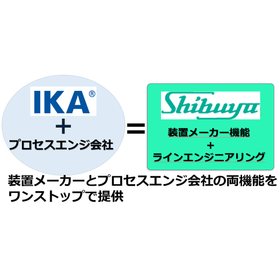
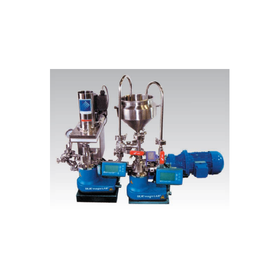
- Emulsifier/Disperser
- Vacuum degassing machine
- Dispersion/emulsification equipment/homogenizer
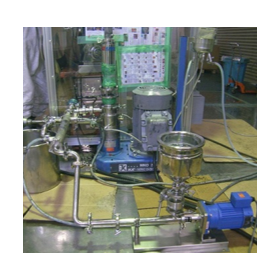
What are the reasons for changes in results from the lab to mass production? Causes and countermeasures for the deterioration of distributed quality during scale-up.
Despite obtaining good dispersion results in the lab, the challenge of unstable quality upon mass production occurs in many settings. The main cause of this is that the dispersion conditions are not replicated due to differences in scale. In lab equipment, the smaller size leads to higher energy density, making shear and flow more uniform, while in mass production equipment, the larger scale often results in insufficient dispersion energy at the same rotational speed and processing time. Additionally, differences in equipment structure and flow patterns can cause variations in the shear history and residence time experienced by particles, leading to differences in the dispersion state. Furthermore, simple scale-up does not ensure that critical parameters such as flow rate, residence time, and shear intensity match, making it difficult to reproduce the same results as in the lab. To address these challenges, it is essential to focus on process design based on dispersion energy density and flow conditions rather than merely increasing equipment size. By designing the system so that particles pass through the processing area under consistent conditions, it is possible to achieve reproducible dispersion quality even when the scale changes, as seen in inline continuous processing.

From October 29 (Tuesday) to 31 (Thursday), 2024! We will be exhibiting small ultrasonic dispersion devices and ultrasonic generators!
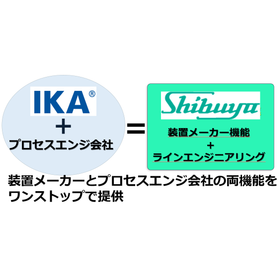


- Emulsifier/Disperser
- Powder Supply Device
- Dispersion/emulsification equipment/homogenizer
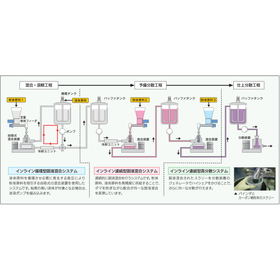
What is decentralized process design? Key points for stabilizing quality.
In dispersion engineering, stable quality cannot be achieved solely based on the performance of the equipment. What is important is the overall design of the process, taking into account material properties and process conditions. This is referred to as dispersion process design. Dispersion quality is determined not only by the strength of shear but also by multiple factors such as flow state, residence time, and method of input. If these conditions are not properly designed, localized agglomeration or variation can occur, making it difficult to maintain stable quality. For example, poor wetting during powder input or the occurrence of stagnant areas due to flow bias can lead to clumping or dispersion issues. Additionally, even if the shear energy is sufficient, if it does not act uniformly on all particles, differences in dispersion state will arise. Therefore, in dispersion processes, it is crucial to design "flow," "shear," and "processing time" as an integrated system. This allows for all particles to receive the same dispersion history, achieving uniform and highly reproducible dispersion quality. In particular, inline continuous processing has the advantage of maintaining consistent conditions within the flow, making it easier to ensure reproducibility in process design. Dispersion process design is a key concept for stabilizing quality and successfully scaling up.
![[Catalog Presentation] High-Pharmac...](https://image.mono.ipros.com/public/product/image/2080829/IPROS18174704042808786662.png?w=280&h=280)

Exhibition of local exhaust dust collection devices specialized for highly active substances, automatic dispensing systems for single-use bags, and various consultations for the construction of pharma...
- Other dust collectors and related products
Increased absorption rate with the latest liposome technology!
- Food ingredients (powder)
Liposome NMN using high-safety sunflower lecithin × plant sterols (derived from pine).
- Food ingredients (powder)
Overcoming the traditional weakness of NAD+ regarding "low absorption rate" with unique liposome technology.
- Food ingredients (powder)
Unique liposome technology that delivers NAD+ "as is."
- Food ingredients (powder)
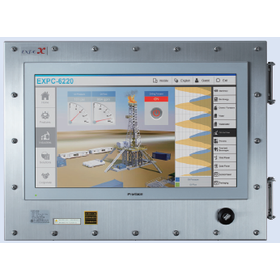
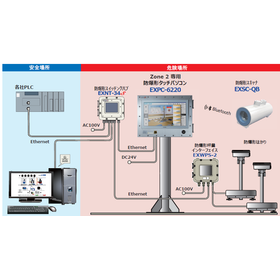
22-inch widescreen LCD touchscreen PC operable in Zone 2
- Touch Panel
- Industrial PCs
- FPD/Touch Panel