We have compiled a list of manufacturers, distributors, product information, reference prices, and rankings for Analytical Equipment.
ipros is IPROS GMS IPROS One of the largest technical database sites in Japan that collects information on.

Analytical Equipment Product List and Ranking from 260 Manufacturers, Suppliers and Companies | IPROS GMS

Last Updated: Aggregation Period:Jul 29, 2026~Aug 25, 2026
This ranking is based on the number of page views on our site.

Analytical Equipment Manufacturer, Suppliers and Company Rankings

Last Updated: Aggregation Period:Jul 29, 2026~Aug 25, 2026
This ranking is based on the number of page views on our site.

  1. FOSS JAPAN Co., Ltd. Tokyo//Testing, Analysis and Measurement
  2. ビーエルテック Tokyo//Testing, Analysis and Measurement
  3. 一般財団法人材料科学技術振興財団 MST Tokyo//Testing, Analysis and Measurement
  4. 4 日東精工アナリテック Kanagawa//Industrial Machinery
  5. 5 サーモフィッシャーサイエンティフィック株式会社/Thermo Fisher Scientific K.K. Tokyo//Testing, Analysis and Measurement

Analytical Equipment Product ranking

Last Updated: Aggregation Period:Jul 29, 2026~Aug 25, 2026
This ranking is based on the number of page views on our site.

  1. September 3, 2026 (Thursday) Free Webinar "Inline Component Analysis" FOSS JAPAN Co., Ltd.
  2. Analytical devices contributing to the automation of the water supply, environment, and food industries. ビーエルテック
  3. Automatic Sample Combustion Device 'AQF-5000H' 日東精工アナリテック
  4. 4 Combustion method protein/nitrogen analysis device Dumas Sampler Realizer
  5. 5 iCAP PRO Series ICP Emission Spectrometer サーモフィッシャーサイエンティフィック株式会社/Thermo Fisher Scientific K.K.

Analytical Equipment Product List

841~870 item / All 1239 items

Displayed results

[Analysis Case] Evaluation of Curing Degree of Epoxy Resin by FT-IR

It is possible to evaluate the degree of curing of the resin by capturing changes in functional groups.

Resins that excel in chemical resistance and electrical insulation are used as insulators, coatings, and adhesives for various electronic components. FT-IR analysis can investigate the causes of defects such as the degree of curing of resins, making it effective for product development. As an example, we will introduce a case where the degree of curing of epoxy resin was evaluated.

  • Contract Analysis
  • Other electronic parts
  • Analytical Equipment

Added to bookmarks

Bookmarks list

Bookmark has been removed

Bookmarks list

You can't add any more bookmarks

By registering as a member, you can increase the number of bookmarks you can save and organize them with labels.

Free membership registration

[Analysis Case] Evaluation of Organic Component Desorption in a Vacuum

The temperature dependence evaluation of the desorption of specific organic components is possible through composite analysis.

TDS (Thermal Desorption Gas Analysis) is a method that allows for the confirmation of desorbed components and desorption temperatures while heating a sample in a vacuum (1E-7 Pa). Furthermore, by combining the results of TDS with GC/MS (Gas Chromatography-Mass Spectrometry), which can identify organic substances, it is possible to evaluate the desorption temperatures of specific desorbed components in a vacuum. Below, we present an example of a combined analysis of TDS and GC/MS conducted on graphene.

  • Contract Analysis
  • Secondary Cells/Batteries
  • LCD display
  • Analytical Equipment

Added to bookmarks

Bookmarks list

Bookmark has been removed

Bookmarks list

You can't add any more bookmarks

By registering as a member, you can increase the number of bookmarks you can save and organize them with labels.

Free membership registration

[Analysis Case] TDS Analysis of Epoxy Resin

It is possible to investigate the degassing behavior of organic matter in a vacuum.

Epoxy resin is used as a semiconductor encapsulant, as well as an adhesive and for vacuum leak prevention both inside and outside vacuum devices. However, even after curing, heating may cause outgassing, which can negatively affect products and equipment. TDS (Thermal Desorption Gas Analysis) allows for monitoring outgassing components by heating the sample in high vacuum (1E-7 Pa) or while maintaining a constant temperature. Below, we present a case study investigating the outgassing behavior of epoxy resin using TDS with temperature maintenance.

  • Contract Analysis
  • plastic
  • Other polymer materials
  • Analytical Equipment

Added to bookmarks

Bookmarks list

Bookmark has been removed

Bookmarks list

You can't add any more bookmarks

By registering as a member, you can increase the number of bookmarks you can save and organize them with labels.

Free membership registration

[Analysis Case] Component Analysis of Flux in Cream Solder

Comprehensively qualitatively analyzes the rosin, thixotropic agents, surfactants, and other components in cream solder.

Cream solder (solder paste) is a paste-like solder made by mixing metal powder with flux, such as rosin, and is used when mounting electronic components on a substrate. The solder flux contains various organic components ranging from low molecular to medium and high molecular weight, including solvents, activators, rosin, and thixotropic agents. Here, we present examples of a wide-ranging qualitative analysis of these components using GC/MS and LC/MS.

  • 添加材データ.png
  • Contract Analysis
  • Analytical Equipment

Added to bookmarks

Bookmarks list

Bookmark has been removed

Bookmarks list

You can't add any more bookmarks

By registering as a member, you can increase the number of bookmarks you can save and organize them with labels.

Free membership registration

[Analysis Case] Degradation Analysis of Liquid Crystal Displays

We will comprehensively evaluate liquid crystals, alignment films, sealing materials, TFTs, and more.

Understanding the degradation mechanism of liquid crystal display panels is an essential theme for extending the lifespan of the panels. Among the degradation symptoms, a decrease in brightness can be attributed to various factors, including liquid crystals, alignment films, sealing materials, and TFTs. A comprehensive analysis will be conducted, incorporating surface, structure, composition, and computational science. By capturing the slight differences between good and defective products and conducting a comprehensive evaluation, we can elucidate the degradation mechanism of liquid crystal displays.

  • Contract measurement
  • Analytical Equipment

Added to bookmarks

Bookmarks list

Bookmark has been removed

Bookmarks list

You can't add any more bookmarks

By registering as a member, you can increase the number of bookmarks you can save and organize them with labels.

Free membership registration

Case study of anomaly evaluation using AI and machine analysis.

We will scientifically investigate the essence of anomalies by leveraging the anomaly detection accuracy and processing power of AI.

Anomaly detection is a technique for finding data that does not match other patterns within large amounts of data. By incorporating anomaly detection into product development and manufacturing, labor-saving in quality control and other areas is expected. Furthermore, by conducting equipment analysis, the essence of anomalies can be scientifically investigated.

  • 異常検知_1w.png
  • 異常検知_3w.png
  • 異常検知_4w.png
  • Contract Inspection
  • Other image-related equipment
  • Analytical Equipment

Added to bookmarks

Bookmarks list

Bookmark has been removed

Bookmarks list

You can't add any more bookmarks

By registering as a member, you can increase the number of bookmarks you can save and organize them with labels.

Free membership registration

[Analysis Case] Component Analysis of Water Repellent Areas

TOF-SIMS enables wide-area imaging evaluation of multiple components.

To investigate the causes of defects such as poor adhesion, it is important to gain insights into the surfaces of wafers and devices. In this instance, hydrophobic areas were observed on a silicon wafer, prompting wide-area imaging using TOF-SIMS. As a result, components estimated to be silicone oil, CF-based grease, and paraffin oil were identified from the hydrophobic areas. TOF-SIMS typically has a measurement field of view up to 500μm square, but by moving the stage during measurement, it is possible to evaluate wide-area distributions. Measurement method: TOF-SIMS Product fields: Devices, Displays, Electronic Components, Manufacturing Equipment Analysis objectives: Qualitative, Imaging, Composition Distribution Evaluation For more details, please download the materials or contact us.

  • Contract Analysis
  • Contract measurement
  • Analytical Equipment

Added to bookmarks

Bookmarks list

Bookmark has been removed

Bookmarks list

You can't add any more bookmarks

By registering as a member, you can increase the number of bookmarks you can save and organize them with labels.

Free membership registration

[Analysis Case] Evaluation of Depth Profile Concentration Distribution of Alkali Metals in SiO2 by GCIB

Evaluation of impurities in SiO2 films

Alkali metals such as Li, Na, and K are key elements that cause various failures in semiconductors. These are referred to as mobile ions that can move within the film during measurement, making it difficult to obtain an accurate distribution. In this study, by conducting depth-direction analysis using a GCIB (Ar cluster) with a sputter ion source in TOF-SIMS, it was found that the movement of alkali metals can be suppressed even at room temperature compared to oxygen sputter guns. This measurement allows for qualitative and quantitative analysis of impurities within SiO2 films. Measurement method: TOF-SIMS Product fields: LSI, memory, electronic components Analysis purpose: Trace concentration evaluation For more details, please download the materials or contact us.

  • Contract Analysis
  • Analytical Equipment

Added to bookmarks

Bookmarks list

Bookmark has been removed

Bookmarks list

You can't add any more bookmarks

By registering as a member, you can increase the number of bookmarks you can save and organize them with labels.

Free membership registration

[Case Study] Quality Control through Surface Analysis

The surface adhesion components (such as polydimethylsiloxane) can be evaluated using TOF-SIMS.

TOF-SIMS (Time-of-Flight Secondary Ion Mass Spectrometry) is a method that can sensitively evaluate organic and inorganic substances on the very surface, and it can be used as an analytical tool for various quality control processes of products. For example, it can be used for regular checks of surface contaminants during product storage, investigating the causes when defects such as peeling or discoloration occur in products, and analyzing changes in key components before and after altering manufacturing conditions. This document presents an example of comparing the surfaces of silicon wafers stored under different environments, focusing on the representative contaminant polydimethylsiloxane (PDMS). Measurement method: TOF-SIMS Product fields: Electronic components, manufacturing equipment, parts, and others (general electronics) Analysis purposes: Surface analysis, evaluation of chemical bonding states, failure analysis, defect analysis, and others (contamination assessment, quality control) For more details, please download the document or contact us.

  • C0660_2.png
  • C0660_3.png
  • Contract Analysis
  • Contract measurement
  • Analytical Equipment

Added to bookmarks

Bookmarks list

Bookmark has been removed

Bookmarks list

You can't add any more bookmarks

By registering as a member, you can increase the number of bookmarks you can save and organize them with labels.

Free membership registration

Mass array method: A gene analysis method using mass spectrometry.

Genetic analysis is a method that reads the nucleotide sequences of DNA to investigate gene mutations and functions.

In this method, the differences in the mass of bases are analyzed using MALDI-TOF-MS to determine the DNA base sequence. This allows for the detection of SNPs (single nucleotide polymorphisms), INDELs (insertions/deletions), CNVs (copy number variations), and more. It is characterized by the ability to analyze a large number of samples and detect a wide range of genes at once. - Multiplex PCR and MALDI-TOF-MS enable simultaneous analysis of up to 40 mutation sites. - Mass spectrometry specialized for the detection of bases (A/T/G/C) is possible. - A variety of analytical tools are available that have been pre-designed to detect target genes based on specific purposes. - Custom designs for analytical tools are also possible.

  • img_a0081_3.jpg
  • img_a0081_4.jpg
  • img_a0081_5.jpg
  • Contract Analysis
  • Contract measurement
  • Analytical Equipment

Added to bookmarks

Bookmarks list

Bookmark has been removed

Bookmarks list

You can't add any more bookmarks

By registering as a member, you can increase the number of bookmarks you can save and organize them with labels.

Free membership registration

[Analysis Case] Evaluation of Wetting Properties of Ceramics

It is possible to analyze organic substances characteristic of hydrophilic and hydrophobic areas of inorganic materials.

Ceramics are inorganic compound materials widely used in everyday items and electronic components. They possess characteristics such as heat resistance and chemical resistance, and evaluating the surface condition is important for utilizing the functions of ceramics. This document introduces a case where the cause of decreased hydrophobicity in Zr oxide ceramic materials with hydrophobic surface treatment was evaluated using TOF-SIMS. Measurement method: TOF-SIMS Product field: Manufacturing equipment and components Analysis purpose: Composition evaluation and identification For more details, please download the document or contact us.

  • img_c0705_2.jpg
  • Contract Analysis
  • Contract measurement
  • Analytical Equipment

Added to bookmarks

Bookmarks list

Bookmark has been removed

Bookmarks list

You can't add any more bookmarks

By registering as a member, you can increase the number of bookmarks you can save and organize them with labels.

Free membership registration

MST [Chitose Sales Office] OPEN!

We aim to further improve our services for customers in the Hokkaido area, based at the Chitose Sales Office.

We will open the Chitose Sales Office, the first in the Hokkaido area as MST. Based in the Chitose Sales Office, we aim to further improve our services for customers in the Hokkaido area. We will also achieve satisfactory quality and delivery times through close collaboration with our Tokyo headquarters (lab). Please look forward to it! Opening date: Thursday, April 11, 2024 Address: Room 160, Chitose Arcadia Plaza, 1-3-1 Kashiwadai Minami, Chitose City, Hokkaido *Please send samples to the headquarters located in Setagaya, Tokyo. Headquarters address: 1-18-6 Kitami, Setagaya, Tokyo Phone number: 090-4001-1578 (Contact: Yanagimachi)

  • Contract Analysis
  • Analytical Equipment

Added to bookmarks

Bookmarks list

Bookmark has been removed

Bookmarks list

You can't add any more bookmarks

By registering as a member, you can increase the number of bookmarks you can save and organize them with labels.

Free membership registration

Analysis of odor components using GCMS analysis method.

It is an analytical method for separating and qualitatively and quantitatively analyzing optical isomers and cis-trans isomers.

The analysis of odor components is effective for evaluating the scent that characterizes a product and for identifying the causes of unpleasant odors. Many odor components exist as stereoisomers, and isomers can have completely different scents from each other. When distinguishing and analyzing stereoisomers, methods such as NMR may be used; however, this case will introduce an example using GC/MS. Chromatography allows for the clear separation and evaluation of target components from other components. Additionally, by using columns designed for isomer separation, it is possible to evaluate various stereoisomers that cannot be separated using general-purpose columns. Measurement method: GC/MS Product fields: Cosmetics, daily necessities, food, environment Analysis objectives: Composition evaluation, identification, product investigation For more details, please download the materials or contact us.

  • img_C0713_1.jpg
  • img_C0713_3.jpg
  • MST_FIG0001.png
  • MST_FIG0002.png
  • MST_FIG0003.png
  • Contract Analysis
  • Analytical Equipment

Added to bookmarks

Bookmarks list

Bookmark has been removed

Bookmarks list

You can't add any more bookmarks

By registering as a member, you can increase the number of bookmarks you can save and organize them with labels.

Free membership registration

[Analysis Case] Impurity Analysis of FeCoNi Alloy

It is possible to simultaneously analyze 77 elements using GDMS.

When impurities are mixed into metallic materials, depending on the combination of elements, it can affect the reduction of toughness and corrosion resistance. Therefore, it is important to understand the amount of impurities in metallic materials for quality control. GDMS can simultaneously analyze 77 elements without standard samples, making it effective for impurity analysis of samples with unknown contained elements, regardless of the matrix. This document presents a case study of impurity analysis of FeCoNi alloys using GDMS. Measurement method: GDMS Product field: Manufacturing equipment and parts Analysis purpose: Trace concentration evaluation For more details, please download the document or contact us.

  • img_C0715_2.jpg
  • Contract Analysis
  • Analytical Equipment

Added to bookmarks

Bookmarks list

Bookmark has been removed

Bookmarks list

You can't add any more bookmarks

By registering as a member, you can increase the number of bookmarks you can save and organize them with labels.

Free membership registration

[Analysis Case] Analysis of 5-ALA (5-Aminolevulinic Acid)

Quantification of 5-ALA in food can be performed using LC-MS/MS.

5-ALA (5-Aminolevulinic Acid) is a type of natural amino acid found in the bodies of plants and animals. It is known for activating mitochondria and is said to have effects such as fatigue recovery and mood enhancement when taken orally. This document presents a case study where the content of 5-ALA in black vinegar, amazake, sake, and wine, which are generally considered to have high levels, was quantified using LC-MS/MS. For black vinegar and amazake, analyses were conducted on two different products, and the quantification results were compared. Measurement method: LC/MS Product field: Food Analysis purpose: Composition evaluation and identification For more details, please download the document or contact us.

  • img_C0723_1.jpg
  • img_C0723_3.jpg
  • Contract measurement
  • Contract Analysis
  • Analytical Equipment

Added to bookmarks

Bookmarks list

Bookmark has been removed

Bookmarks list

You can't add any more bookmarks

By registering as a member, you can increase the number of bookmarks you can save and organize them with labels.

Free membership registration

[FIB-MS] Focused Ion Beam Mass Spectrometry

This is a method that allows simultaneous shape observation and elemental imaging of small areas using a FIB and a TOF mass spectrometer mounted on an SEM device.

? Surface analysis of solid materials is possible ? Light elements such as Li, which are difficult to evaluate with EDX, can be assessed ? By using Ga ions as primary ions, evaluation can be performed with high surface resolution (on the order of tens of nm) ? The detection limit is as low as a few ppm (depending on the element), making it suitable for trace impurity element analysis compared to EDX ? Measurements can be conducted without atmospheric exposure by using a dedicated holder ? Since it is mounted on a SEM device, morphological observation and elemental analysis can be performed within the same chamber

  • Contract measurement
  • Analytical Equipment

Added to bookmarks

Bookmarks list

Bookmark has been removed

Bookmarks list

You can't add any more bookmarks

By registering as a member, you can increase the number of bookmarks you can save and organize them with labels.

Free membership registration

SSDP-SIM

SSDP: Substrate Side Depth Profile

In secondary ion mass spectrometry (SIMS), due to phenomena such as surface roughness, the knock-on effect where atoms present on the surface are pushed inward by ion irradiation, and crater bottom roughness, it may not be possible to obtain sharp elemental distributions. To address this issue, the SSDP method (Back-Side SIMS) involves performing SIMS analysis from the substrate side (the back side) after thinning the sample. This technique allows for a more accurate evaluation of elemental distribution without being affected by the sample shape or measurement conditions.

  • B0013_2.jpg
  • B0013_3.jpg
  • Contract Analysis
  • Contract measurement
  • Analytical Equipment

Added to bookmarks

Bookmarks list

Bookmark has been removed

Bookmarks list

You can't add any more bookmarks

By registering as a member, you can increase the number of bookmarks you can save and organize them with labels.

Free membership registration

Selection of Ionization Methods for TG-DTA-MS: EI Method and PI Method

TG-DTA-MS Thermogravimetric Differential Thermal Mass Spectrometry

EI method: It is capable of detecting both inorganic and organic compounds, making it suitable for initial qualitative analysis. PI method: It allows detection while maintaining the molecular structure through soft ionization.

  • B0279_2.jpg
  • B0279_3.jpg
  • Contract Analysis
  • Contract measurement
  • Analytical Equipment

Added to bookmarks

Bookmarks list

Bookmark has been removed

Bookmarks list

You can't add any more bookmarks

By registering as a member, you can increase the number of bookmarks you can save and organize them with labels.

Free membership registration

[Analysis Case] Identification and Quantitative Evaluation of Solvents and Additives in LIB Electrolytes

Qualitative and quantitative evaluation is possible from the sampling of the electrolyte.

The electrolyte of lithium-ion secondary batteries can be qualitatively and quantitatively analyzed using GC/MS. In the example below, ethylene carbonate (EC) and ethyl methyl carbonate (EMC) were identified as organic solvents, and vinylene carbonate (VC) was identified as an additive. It is also possible to determine the composition ratio of the solvents and the content of the additives. Additionally, other additives such as fluoroethylene carbonate (FEC) and ethylene sulfite (ES) can also be evaluated.

  • c0259-2.jpg
  • c0259-3.jpg
  • C0259-4.jpg
  • Contract Analysis
  • Contract measurement
  • Analytical Equipment

Added to bookmarks

Bookmarks list

Bookmark has been removed

Bookmarks list

You can't add any more bookmarks

By registering as a member, you can increase the number of bookmarks you can save and organize them with labels.

Free membership registration

[Analysis Case] Evaluation of Component Distribution in Skin Cross-Section

It is possible to visualize molecular information of organic and inorganic substances.

We created skin tissue samples and evaluated the distribution of biogenic components in freeze-dried samples using TOF-SIMS. Since TOF-SIMS identifies components based on the mass of molecular ions, it does not require labels such as fluorescent substances, allowing for the evaluation of distribution without the influence of labeled materials. The mapping results confirmed that arginine, a natural moisturizing factor (NMF), and cholesterol, which retains moisture as an intercellular lipid, are localized in the stratum corneum. This method is also effective for assessing the permeation state during drug application.

  • c0355-1.jpg
  • Contract measurement
  • Analytical Equipment

Added to bookmarks

Bookmarks list

Bookmark has been removed

Bookmarks list

You can't add any more bookmarks

By registering as a member, you can increase the number of bookmarks you can save and organize them with labels.

Free membership registration

[Analysis Case] Evaluation of the Component 18-MEA on Hair Surface

It is possible to evaluate 18-MEA, a component of the hair surface, using TOF-SIMS.

The surface of the hair cuticle is covered with a lipid called 18-MEA (18-methyl eicosanoic acid). 18-MEA is said to be the source of hair shine and smoothness, and when it decreases due to UV rays or hair coloring, the cuticle becomes more susceptible to damage. In this case, we will present the results of evaluating the differences in 18-MEA on the surfaces of healthy hair (hair near the root that has not been treated with hair color) and damaged hair (hair that has been treated with hair color) using TOF-SIMS.

  • c0375-2.jpg
  • c0375-3.jpg
  • Contract Analysis
  • Contract measurement
  • Analytical Equipment

Added to bookmarks

Bookmarks list

Bookmark has been removed

Bookmarks list

You can't add any more bookmarks

By registering as a member, you can increase the number of bookmarks you can save and organize them with labels.

Free membership registration

[Analysis Case] Analysis of α-Alumina (α-Al2O3) by TDS

Thermal desorption gas analysis of ceramics

Thermally stable α-alumina is used in a wide range of applications, including heat-resistant materials, semiconductor packages, and components of semiconductor manufacturing equipment. Among these, dense α-alumina is also used as a material for vacuum devices. However, the gases generated when such materials are heated can adversely affect products and equipment, making it important to understand the outgassing from these materials. In this report, we present a case study comparing the outgassing amounts of porous and dense α-alumina using TDS analysis (temperature-programmed desorption gas analysis).

  • Contract Analysis
  • Contract measurement
  • Analytical Equipment

Added to bookmarks

Bookmarks list

Bookmark has been removed

Bookmarks list

You can't add any more bookmarks

By registering as a member, you can increase the number of bookmarks you can save and organize them with labels.

Free membership registration

[Analysis Case] Component Evaluation of Positive and Negative Electrode Binders in Secondary Batteries

Identification of organic substances using TOF-SIMS and GS/MS.

The binder for lithium-ion secondary batteries not only serves as an adhesive between active materials but also needs to be insoluble in the electrolyte. Therefore, the selection of suitable materials for both the positive and negative electrodes is crucial. This document presents cases where the components of the binders used in each electrode sheet were identified by measuring the positive electrode binder using TOF-SIMS and the negative electrode binder using GC/MS, and then comparing the results with a materials library database.

  • c0594.jpg
  • c0594-2.jpg
  • Contract Analysis
  • Contract measurement
  • Analytical Equipment

Added to bookmarks

Bookmarks list

Bookmark has been removed

Bookmarks list

You can't add any more bookmarks

By registering as a member, you can increase the number of bookmarks you can save and organize them with labels.

Free membership registration

[Analysis Case] XPS Analysis of Metal Pipe Inner Wall Using Combined Cutting Processing

We provide one-stop solutions from sample cutting processing to investigating the causes of discoloration and corrosion.

The inner walls of metal pipes, such as SUS, used in various fields can discolor and corrode due to reactions with incoming gases and liquids, leading to a decline in equipment functionality. Understanding the locations prone to discoloration and corrosion, as well as their causes, is an important issue in equipment maintenance. At MST, we provide a comprehensive evaluation from sample cutting to analysis. This document presents a case study of XPS analysis conducted on the inner walls of SUS pipes used in vacuum equipment, highlighting both normal and discolored areas.

  • c0602-2.jpg
  • c0602-3.jpg
  • Contract Analysis
  • Contract measurement
  • Analytical Equipment

Added to bookmarks

Bookmarks list

Bookmark has been removed

Bookmarks list

You can't add any more bookmarks

By registering as a member, you can increase the number of bookmarks you can save and organize them with labels.

Free membership registration

[Analysis Case] Comprehensive Evaluation of Positive Electrode Active Materials in Secondary Batteries

Proposing an evaluation that combines structure, composition, and electricity to solve development issues.

This article introduces a case study evaluating the surface morphology, cross-sectional structure, components, composition, crystal structure, and resistance value distribution of Li(NiCoMn)O2 (NCM), which is used as a positive electrode in lithium-ion secondary batteries. Based on a comprehensive evaluation of structure, composition, and electrical properties, MST proposes assessments suitable for solving development challenges aimed at improving characteristics and enhancing reliability.

  • c0607.jpg
  • c0607-3.jpg
  • c0607-4.jpg
  • c0607-5.jpg
  • Contract Analysis
  • Contract measurement
  • Analytical Equipment

Added to bookmarks

Bookmarks list

Bookmark has been removed

Bookmarks list

You can't add any more bookmarks

By registering as a member, you can increase the number of bookmarks you can save and organize them with labels.

Free membership registration

[Analysis Case] Depth Direction Analysis of Components in SiON Ultra-Thin Films

It is possible to capture molecular information of inorganic substances in the depth direction using TOF-SIMS.

The SiON film used as the gate oxide film for Si transistors is formed by introducing nitrogen into the Si oxide film to suppress leakage current. To ensure a good interface characteristic with the substrate while maintaining the dielectric constant, it is necessary to strictly control the distribution of nitrogen in the SiON film. We will present a case study evaluating the distribution of silicon oxide and nitride in a 1nm thick SiON film using TOF-SIMS. TOF-SIMS has high depth resolution on the surface and can obtain molecular information with good sensitivity, allowing for a clear understanding of the compositional distribution in the ultra-thin SiON film.

  • img_C0264_2.jpg
  • img_C0264_3_HO-Si-O.jpg
  • img_C0264_4_O-Si-O-Si-O.jpg
  • img_C0264_5_Si-N-Si.jpg
  • img_C0264_6_Si-Si.jpg
  • Contract measurement
  • Transistor
  • Memory
  • Analytical Equipment

Added to bookmarks

Bookmarks list

Bookmark has been removed

Bookmarks list

You can't add any more bookmarks

By registering as a member, you can increase the number of bookmarks you can save and organize them with labels.

Free membership registration

Accelerating research and development, [new] surface analysis service launched!

Not only the surface, but also up to a depth of 30nm - Quantitative evaluation of the chemical state at the surface and inside the material at the same location and non-destructively!

We have launched a new service using XPS/HAXPES starting in June! For increasingly complex materials and fine structure samples, we can evaluate the composition and chemical bonding states from the surface to the interior of the material (up to ~30nm) at the same location and in a non-destructive manner. - Depending on the elements of interest and the analysis area and depth, we can select the appropriate X-ray source (Al Kα/Mg Kα/Ga Kα/Cr Kα) to achieve evaluation under suitable measurement conditions. - Non-exposure measurements to the atmosphere, Ar monomer/GCIB sputter etching, and heating pretreatment can be combined. - It is possible to evaluate the electronic states of semiconductor samples using UPS/LEIPS (ionization potential/electron affinity/band gap).

  • Secondary Cells/Batteries
  • Analytical Equipment

Added to bookmarks

Bookmarks list

Bookmark has been removed

Bookmarks list

You can't add any more bookmarks

By registering as a member, you can increase the number of bookmarks you can save and organize them with labels.

Free membership registration

[Analysis Case] Evaluation of Metal Impurities in the Metal Film and Interface of the Device

Impurities in films and interfaces such as plating can be evaluated using TOF-SIMS.

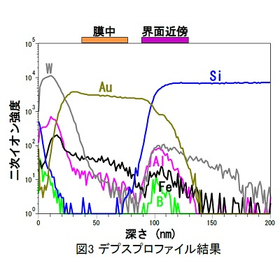
Impurities from components of the film formation device, target materials, and plating solutions can contaminate the device and have adverse effects, making the qualitative assessment of impurities on surfaces, within films, and at interfaces important. TOF-SIMS can sensitively evaluate unknown elements present on surfaces, within films, and at interfaces in a single measurement due to the following three characteristics: 1. For metallic elements, ions from m/z 1 to 800 can be detected simultaneously in one measurement. 2. Detection sensitivity of a few ppm can be achieved (varies depending on materials and ions). 3. The use of a sputter gun allows for the evaluation of depth distribution.

  • img_c0638_2.jpg
  • Wafer
  • Contract measurement
  • Other semiconductors
  • Analytical Equipment

Added to bookmarks

Bookmarks list

Bookmark has been removed

Bookmarks list

You can't add any more bookmarks

By registering as a member, you can increase the number of bookmarks you can save and organize them with labels.

Free membership registration

[Analysis Case] Qualitative Analysis of Fluorinated Gases

Qualitative analysis of specific freons (CFC/HCFC) and alternative freons (HFC) is possible.

Freon gases are utilized in various applications such as refrigerants, foaming agents, semiconductors, and cleaning agents for precision parts due to their chemically stable nature and minimal impact on human health. On the other hand, they are substances that contribute to ozone layer depletion and global warming, which is why they are regulated by law. In this case, Freon gases were analyzed using GC/MS, and the separation analysis of CF4, which has low polarity and is difficult to separate among PFCs, was conducted. By using GC/MS, it is possible to qualitatively analyze specific Freons such as CFCs, HCFCs, and alternative Freons like HFCs and PFCs.

  • img_c0641_2.jpg
  • img_c0641_3.jpg
  • Contract measurement
  • Environmental Analysis
  • Analytical Equipment

Added to bookmarks

Bookmarks list

Bookmark has been removed

Bookmarks list

You can't add any more bookmarks

By registering as a member, you can increase the number of bookmarks you can save and organize them with labels.

Free membership registration

[Analysis Case] Metal Contamination Analysis of Si Wafer Surface (B0233)

It is possible to obtain a large amount of metal element information at once through qualitative and semi-quantitative analysis!

We offer metal contamination analysis of Si wafers (B0233). The purpose of metal contamination analysis of Si wafer surfaces using ICP-MS includes not only the contamination assessment of the Si wafer itself but also the evaluation of contamination within semiconductor devices and the assessment of the working environment due to Si wafer exposure. Therefore, the analysis of Si wafer surfaces is conducted for various purposes. ICP-MS analysis allows for the highly sensitive measurement of metal contamination on Si wafer surfaces, and it is also possible to specify the evaluation area according to the purpose. [Measurement Method] ■ [ICP-MS] Inductively Coupled Plasma Mass Spectrometry *For more details, please download the PDF or feel free to contact us.

  • Contract Analysis
  • Analytical Equipment

Added to bookmarks

Bookmarks list

Bookmark has been removed

Bookmarks list

You can't add any more bookmarks

By registering as a member, you can increase the number of bookmarks you can save and organize them with labels.

Free membership registration