We have compiled a list of manufacturers, distributors, product information, reference prices, and rankings for Coating Technology.
ipros is IPROS GMS IPROS One of the largest technical database sites in Japan that collects information on.

Coating Technology Product List and Ranking from 35 Manufacturers, Suppliers and Companies | IPROS GMS

Last Updated: Aggregation Period:Feb 18, 2026~Mar 17, 2026
This ranking is based on the number of page views on our site.

Coating Technology Manufacturer, Suppliers and Company Rankings

Last Updated: Aggregation Period:Feb 18, 2026~Mar 17, 2026
This ranking is based on the number of page views on our site.

  1. 吉田SKT Aichi//Manufacturing and processing contract
  2. 第百通信工業 Tokyo//IT/Telecommunications
  3. サクラ工業 Shizuoka//Automobiles and Transportation Equipment
  4. 4 シミズ Osaka//Manufacturing and processing contract
  5. 5 ジェイネット Saitama//Manufacturing and processing contract

Coating Technology Product ranking

Last Updated: Aggregation Period:Feb 18, 2026~Mar 17, 2026
This ranking is based on the number of page views on our site.

  1. What is stainless steel surface treatment and coating technology? 吉田SKT
  2. What is aluminum surface treatment and coating technology? 吉田SKT
  3. Coating technology to improve mold release properties. 吉田SKT
  4. 4 PFAS-free patented technology "Silica Nano Coating" 第百通信工業
  5. 5 Nano film coating technology "SixONy" サクラ工業

Coating Technology Product List

31~60 item / All 62 items

Displayed results

Coating technology

Coating in a suitable manner! Functional films can be formed according to the application on various plastic films.

Our company utilizes the coating technology developed through the coating of base films for transfer foils to work on the formation of various functional films. We possess two types of coating technologies: the "kiss reverse gravure method for thin films" and the "die method for thick films." The choice of method depends on the thickness and viscosity of the ink being coated, allowing for diverse coating applications. 【Features】 ■ Kiss Reverse Gravure Method - Suitable for thinly coating low-viscosity coating liquids - No back roll, so there is no wrapping around the back ■ Die Method - Suitable for coating medium to high-viscosity coating liquids - The die is in a sealed state, preventing contamination from foreign substances *For more details, please refer to the related links or feel free to contact us.

  • Contract manufacturing
  • Processing Contract
  • Coating Agent
  • Coating Technology

Added to bookmarks

Bookmarks list

Bookmark has been removed

Bookmarks list

You can't add any more bookmarks

By registering as a member, you can increase the number of bookmarks you can save and organize them with labels.

Free membership registration

Coating technology

We can broadly accommodate precision fields such as electronic materials! We have installed printing machines and can respond to various orders.

Coating technology is primarily a technique for coating organic film on substrates, serving as the foundation for thin film processing technology. There are various coating methods, including gravure coating, reverse coating, comma coating, die coating, and bar coating. Additionally, it can not only provide designs such as coloring on metal vapor deposition films and various plastic films but also impart various functions such as physical and chemical resistance, adhesion, and release properties. 【Features】 ■ Technology for coating organic films on substrates ■ Formulation technology that creates functions and characteristics according to applications ■ Composite technology that integrates coating techniques ■ Equipped with a coater of cleanliness class 100 ■ Installation of printing machines to accommodate various orders *For more details, please refer to the external link page or feel free to contact us.

  • Coating Agent
  • Coating Technology

Added to bookmarks

Bookmarks list

Bookmark has been removed

Bookmarks list

You can't add any more bookmarks

By registering as a member, you can increase the number of bookmarks you can save and organize them with labels.

Free membership registration

Development case of coating technology with electrical insulation, corrosion resistance, and low work function (functional enhancement).

Active in medical X-rays, non-destructive testing equipment, mass spectrometry devices, and more.

■Background of Development For many years, we have been commercializing various shapes of filaments using tungsten. However, in recent years, with advancements in science and technology, customer needs have diversified, making it increasingly difficult to meet their demands with tungsten alone. ■Overview of Development With the aim of enhancing the functionality of filaments, examples of customer requests included "insulation," "corrosion resistance," and "low work function." In response, we have incorporated the following into our filaments: ● Aluminum oxide (alumina) for [insulation] (Coating alumina onto tungsten coils) ● Yttrium oxide (yttria) to provide [corrosion resistance] and [low work function], successfully enhancing functionality. (Coating yttria (Y203) onto the filaments) ■Details of Development In developing the coating technology, we adopted a certain method. While it is a common approach, it is based on [our unique equipment and manufacturing process]. We optimize factors such as particle size, mixing ratio, and film thickness through experimental investigation, but this is not easy. Ultimately, the number of experiments has reached into the thousands, and we continue to work on quality improvement.

  • Processing Contract
  • Coating Technology

Added to bookmarks

Bookmarks list

Bookmark has been removed

Bookmarks list

You can't add any more bookmarks

By registering as a member, you can increase the number of bookmarks you can save and organize them with labels.

Free membership registration

Silicone Coating Technology "Clear Sky Method"

Restoring transparency with the Clear Sky Method! A proposal for reducing lifecycle costs while enhancing the landscape!

The "Clear Sky Method" is a silicone coating technology that restores the transparency of polycarbonate sheets and other materials degraded by sunlight and ultraviolet rays, thereby improving maintenance. By penetrating a special solution into the degraded surface and reducing irregularities, light can pass through more easily, improving the parallel light transmittance (total light transmittance). Applying this to degraded sound barriers enhances safety for drivers and reduces lifecycle costs. Additionally, applying it to new materials (preventive maintenance) can further extend their lifespan. 【Features】 ■ Restores transparency ■ Improves parallel light transmittance (total light transmittance) ■ Less susceptible to sunlight ■ Reduces lifecycle costs ■ Enhances maintainability For more details, please refer to the catalog or feel free to contact us.

  • others
  • Coating Technology

Added to bookmarks

Bookmarks list

Bookmark has been removed

Bookmarks list

You can't add any more bookmarks

By registering as a member, you can increase the number of bookmarks you can save and organize them with labels.

Free membership registration

Nano film coating technology "SixONy"

Expresses high heat resistance and colorlessness. By controlling the refractive index and film thickness, a variety of colors can be achieved.

"SixONy" is a nano-coating technology that gives products a unique depth. As the name suggests, the nano-coating has a thickness of 20 to 150 nanometers. This ultra-thin film, approximately one ten-thousandth of a millimeter, excels in heat resistance and corrosion resistance. By adjusting the molecular distribution during the manufacturing process, it can express various colors with depth. 【Features】 ■ Heat resistance: Up to 600℃ (no change at 500℃ for 24 hours) ■ Corrosion resistance: Enhances the corrosion resistance of the substrate ■ Productivity: Processing temperature is below 50℃ ■ Expresses highly heat-resistant colorless transparency ■ Allows for diverse coloration by controlling refractive index and film thickness *For more details, please refer to the PDF document or feel free to contact us.

  • others
  • Coating Technology

Added to bookmarks

Bookmarks list

Bookmark has been removed

Bookmarks list

You can't add any more bookmarks

By registering as a member, you can increase the number of bookmarks you can save and organize them with labels.

Free membership registration

Coating technology "Fluid Immersion Method"

A resin coating technology that enhances the rust prevention effect of products! Effective for outdoor product processing.

The "Fluid Immersion Method" is a coating technique that involves heating the substrate and immersing it in a powder of resin. Since it immerses in powdered resin, compared to solvent-based or powder coatings, the rust prevention effect of the product is enhanced. It is suitable for products used outdoors due to its excellent weather resistance, flexibility, and temperature change resistance. Additionally, it does not use volatile organic compounds in the manufacturing process, making it an environmentally friendly method used for various product processing. 【Features】 ■ Immersion in powdered resin ■ Adhesion amount of resin film is 10 to 20 times greater ■ Improved rust prevention effect of the product ■ Excellent weather resistance, flexibility, and temperature change resistance ■ Environmentally friendly method *For more details, please refer to the PDF document or feel free to contact us.

  • Other contract services
  • Coating Agent
  • Coating Technology

Added to bookmarks

Bookmarks list

Bookmark has been removed

Bookmarks list

You can't add any more bookmarks

By registering as a member, you can increase the number of bookmarks you can save and organize them with labels.

Free membership registration

New coating technology "UBM"

Achieving corrosion resistance, wear resistance, and release resistance.

"UBM" is a coating technology that improves the pinhole problem that could not be solved by conventional AIP, enhancing corrosion resistance, wear resistance, sliding properties, and resin release properties. It prevents resin adhesion and scorching on screws, three-point sets, and nozzles (adapters), improving the defect rate. With increased corrosion and wear resistance, it is possible to extend the lifespan of screws and three-point sets. 【Features】 ■ Improves the pinhole problem ■ Enhances corrosion resistance, wear resistance, sliding properties, and resin release properties ■ Prevents resin adhesion and scorching, improving the defect rate ■ Makes it possible to extend the lifespan of screws and three-point sets *For more details, please download the PDF or feel free to contact us.

  • Processing Contract
  • nozzle
  • Other machine elements
  • Coating Technology

Added to bookmarks

Bookmarks list

Bookmark has been removed

Bookmarks list

You can't add any more bookmarks

By registering as a member, you can increase the number of bookmarks you can save and organize them with labels.

Free membership registration

Special Coating Technology "FM Method"

The lifespan of molds and wear tools is over six times the average! You can reduce costs on the manufacturing line.

The "FM Method" is a processing technique that fuses and hardens the surface of a base material by bombarding it with special alloy molecules using an electron gun in a high vacuum furnace, and further forms a special coating layer. Since the coating penetrates into the interior of the base material, peeling or detachment does not occur. The workpiece after treatment achieves a surface hardness of over 2000 Hv, and reduces the friction coefficient to about 1/6 compared to chrome plating. 【Features】 ■ The coating penetrates into the interior of the base material, preventing peeling or detachment. ■ Prevents issues that occur when cutting or punching hard materials like copper and brass. ■ Achieves a surface hardness of over 2000 Hv (for treated workpieces). ■ Reduces the friction coefficient to about 1/6 compared to chrome plating (for treated workpieces). ■ Becomes less prone to dirt adhesion and further prevents rust (for treated workpieces). *For more details, please refer to the PDF document or feel free to contact us.

  • Contract manufacturing
  • Coating Technology

Added to bookmarks

Bookmarks list

Bookmark has been removed

Bookmarks list

You can't add any more bookmarks

By registering as a member, you can increase the number of bookmarks you can save and organize them with labels.

Free membership registration

[Technology and Achievements] Dry Fine Particle Coating Technology

Adding high added value in formulation design! It is applied to investigational drugs targeting compounds in the development stage.

The physical properties of active pharmaceutical ingredients often pose significant challenges in the formulation design of solid dosage forms. The "dry particle coating technology" masks the shortcomings of active pharmaceutical ingredients and adds high value in formulation design. It has various advantages over wet particle coating processes. Additionally, under solvent-free drying conditions, small particles are covered on the surfaces of larger particles by applying significant energy, such as impact and shear stress. By applying further force, the small particles fuse with the larger particles. We have successfully developed formulations using this technology and are applying it to investigational drugs targeting compounds in the development stage. 【Advantages】 ■ Cost-effective manufacturing ■ Formulation of active pharmaceutical ingredients that are unstable in water and heat ■ High-dose formulations/small tablets ■ Masking of odors/tastes *For more details, please refer to the PDF materials or feel free to contact us.

  • Other contract services
  • Technology Development
  • Coating Technology

Added to bookmarks

Bookmarks list

Bookmark has been removed

Bookmarks list

You can't add any more bookmarks

By registering as a member, you can increase the number of bookmarks you can save and organize them with labels.

Free membership registration

Coating technology "PBI Coating"

A technology for coating "PBI" resin, which boasts the highest heat resistance among plastics.

Polybenzimidazole (PBI) is a super engineering plastic co-developed by NASA and NFML. Among super engineering plastics, it has the highest heat resistance and is an ultra-super engineering plastic that excels in electrical insulation and other properties. At Yoshida SKT, we have developed a coating technology that applies PBI (polybenzimidazole) to the surfaces of metal products and other materials. This coating technology allows us to harness the excellent functions and properties of PBI while also gaining advantages in cost and durability that molded products do not offer. The outstanding heat resistance, plasma resistance, radiation resistance, and flame retardancy of polybenzimidazole are utilized in various applications, including high-temperature sliding applications, scratch prevention for products, and electrical insulation. *For more details, please refer to the PDF document or feel free to contact us.

  • Other surface treatment equipment
  • Coating Technology

Added to bookmarks

Bookmarks list

Bookmark has been removed

Bookmarks list

You can't add any more bookmarks

By registering as a member, you can increase the number of bookmarks you can save and organize them with labels.

Free membership registration

Coating Technology: "Blast Treatment Required for Coating"

Teflon coating is a coating that excels in non-stick properties. Special techniques are required to firmly apply the coating to the substrate.

■What is Blast Treatment? Blast treatment is a surface treatment method that involves spraying blast materials (various types of abrasives) onto the surface of a product using compressed air, to remove rust and dirt from the substrate surface. ■Surface Preparation for Coating Surface preparation by blasting not only cleans the surface but also increases the surface area through roughening, which enhances the anchoring effect and significantly improves adhesion during coating processes. Therefore, it is suitable for preparing surfaces for many coatings and is commonly used in pre-treatment. Additionally, blasting can improve the wettability of paints, making it optimal for surface preparation for painting as well. To fully realize the performance of coatings, surface preparation is a crucial step. At Yoshida SKT, we select blast materials and treatment methods suitable for coatings and substrates, and we process Teflon coatings and fluororesin coatings. *For more details, please click the link below or feel free to contact us.

  • Surface treatment contract service
  • Coating Technology

Added to bookmarks

Bookmarks list

Bookmark has been removed

Bookmarks list

You can't add any more bookmarks

By registering as a member, you can increase the number of bookmarks you can save and organize them with labels.

Free membership registration

Coating technology: "Corrosion-resistant coating that can be processed at room temperature."

Coating technology that can be processed at room temperature / Corrosion-resistant coating materials

The fluororesin coating/lining known for its anti-corrosion coating requires baking paint. "Cerashield" offers two types: room temperature processing type and heat processing type, and it is an anti-corrosion coating material that prevents corrosion and permeation, reducing the frequency of updates for industrial equipment such as tanks. It is a hardened type paint with excellent corrosion prevention effects, forming a high cross-link density coating. It can be applied to a wide range of substrates including metal, plastic, wood, concrete, and ceramics, demonstrating excellent adhesion. 【Product Lineup】 Room temperature curing type: "Cerashield CST-1108" Heat curing type: "Cerashield CST-1508" 【Features】 ■ Reliable corrosion resistance ■ All-around chemical resistance (heat curing type) ■ Room temperature processing available (room temperature curing type) ■ Excellent hardness ■ Electrical insulation ■ Advantageous for aftercare *For more details, please refer to the PDF document or feel free to contact us.

  • Coating Agent
  • Coating Technology

Added to bookmarks

Bookmarks list

Bookmark has been removed

Bookmarks list

You can't add any more bookmarks

By registering as a member, you can increase the number of bookmarks you can save and organize them with labels.

Free membership registration

Coating technology: "Coating with excellent wear resistance, sliding properties, and release characteristics."

Coating technology "Bicoat" suitable for applications with mechanical loads.

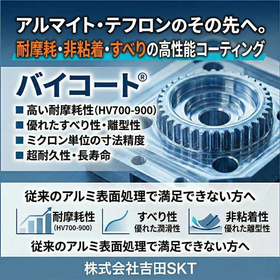
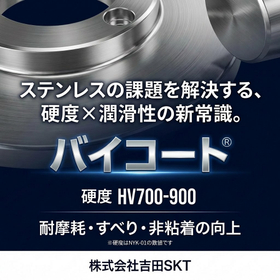
"Bycoat" is a coating technology that combines inorganic material coating techniques to achieve the ideal functions of "sliding property + release property + wear resistance." It withstands harsh usage areas such as molds and parts made of resin/rubber, as well as chutes and guides in packaging machines, providing reliable release properties, sliding properties, and durability. Due to its excellent dimensional accuracy, it is also suitable for areas requiring micron-level dimensional precision. 【Features】 ■ Amazing durability ■ High hardness and resistant to scratches ■ Excellent wear resistance ■ Outstanding non-stick and release properties ■ Safe for use in molds requiring micron-level dimensional precision *For more details, please refer to the PDF document or feel free to contact us.

  • TYS-03K_edited.jpg
  • NYF-11-S 1_edited.jpg
  • 2021-05-22 (4)_edited.jpg
  • IMG_8528_edited_edited.jpg
  • IMG_0957edit_edited.jpg
  • Other surface treatment equipment
  • Coating Technology

Added to bookmarks

Bookmarks list

Bookmark has been removed

Bookmarks list

You can't add any more bookmarks

By registering as a member, you can increase the number of bookmarks you can save and organize them with labels.

Free membership registration

What is aluminum surface treatment and coating technology?

Aluminum is lightweight and easy to process, making it suitable for various components. We will introduce surface treatments and coatings that can add properties to the aluminum surface.

■What is the reason for needing a surface on aluminum? Aluminum is lightweight, resistant to rust, has high conductivity for electricity and heat, and can be easily shaped. It reflects light and heat, is not affected by magnetic fields, and its surface has a characteristic that makes it less prone to rust due to an oxide film. However, in certain environments, it can corrode, and when used as machine parts, properties such as slip resistance and wear resistance are required. 【Types of Aluminum Surface Treatment and Coating】 - Anodizing - Sandblasting / Bead blasting - Plating - Teflon coating There are methods like the above to modify the surface of aluminum. Generally, they perform adequately, but if you want to further enhance durability, slip resistance, and non-stick properties, we will introduce a coating that can meet such demands. 'Bicoat,' with a coating hardness of HV700-900 and the lubricating properties of fluororesin, combines wear resistance, slip resistance, and non-stick properties, making it recommended for those who are not satisfied with conventional aluminum surface treatments and coatings. *You can download product information for 'Bicoat(R)' in PDF format.

  • 2021-05-22 (4)_edited.jpg
  • NYK-01 (4)_edited.jpg
  • Other surface treatment equipment
  • Coating Technology

Added to bookmarks

Bookmarks list

Bookmark has been removed

Bookmarks list

You can't add any more bookmarks

By registering as a member, you can increase the number of bookmarks you can save and organize them with labels.

Free membership registration

Coating technology "Fluororesin Coating"

Adjustable from thin films to thick films! Wide-ranging support for various types, small lots, and items from small to large!

"Fluororesin coating" is characterized by its excellent non-stick properties, making it difficult for substances to adhere. Additionally, it is resistant to chemicals and maintains its physical properties even in high-temperature and high-pressure water. We accommodate individual items and prototypes starting from one piece, with sizes ranging from a minimum of 5mm to a maximum of 4000mm. We have a proven track record in various industries. We provide suitable coatings tailored to our customers' needs. [Features] - Excellent non-stick properties, making it difficult for substances to adhere - Good slip properties and resistant to wear - Resistant to chemicals and maintains physical properties even in high-temperature and high-pressure water - Excellent electrical insulation properties - Excellent heat resistance, accommodating temperatures from -240 to 260°C - Difficult to wet and resistant to dirt *For more details, please refer to the PDF document or feel free to contact us.

  • Surface treatment contract service
  • Coating Technology

Added to bookmarks

Bookmarks list

Bookmark has been removed

Bookmarks list

You can't add any more bookmarks

By registering as a member, you can increase the number of bookmarks you can save and organize them with labels.

Free membership registration

Coating technology "PEEK Coating"

Excellent wear resistance! Can be adjusted from thin films to thick films, forming a smooth and uniform surface coating!

"PEEK coating" features non-stick properties that surpass traditional fluoropolymer coatings. Scratch resistance is improved under various conditions. It exhibits excellent wear resistance even against hard materials like steel and ceramics. We accommodate single items and prototypes starting from 1 piece, with sizes ranging from a minimum of 5mm to a maximum of 4000mm. We have a proven track record in various industries. [Features] - Non-stick properties that surpass traditional fluoropolymer coatings - Improved scratch resistance under various conditions; excellent wear resistance - Outstanding chemical resistance to acids, bases, hydrocarbons, salts, and steam - Excellent mechanical properties in high-temperature environments, demonstrating high durability - Superior heat resistance, accommodating up to 260°C - Forms a smooth and uniform surface coating *For more details, please refer to the PDF document or feel free to contact us.

  • Processing Contract
  • Surface treatment contract service
  • Coating Agent
  • Coating Technology

Added to bookmarks

Bookmarks list

Bookmark has been removed

Bookmarks list

You can't add any more bookmarks

By registering as a member, you can increase the number of bookmarks you can save and organize them with labels.

Free membership registration

[Research Material] Global Market for CVD Coating Technology

World Market for CVD Coating Technology: APCVD (Atmospheric Pressure Chemical Vapor Deposition), LPCVD (Low Pressure Chemical Vapor Deposition), MOCVD (Metal Organic Chemical Vapor Deposition) ...

This research report (Global CVD Coating Technology Market) investigates and analyzes the current state and future outlook of the global market for CVD coating technology over the next five years. It includes information on the overview of the global CVD coating technology market, trends of major companies (sales, selling prices, market share), market size by segment, market size by major regions, and distribution channel analysis. The segments by type in the CVD coating technology market include APCVD (Atmospheric Pressure Chemical Vapor Deposition), LPCVD (Low Pressure Chemical Vapor Deposition), MOCVD (Metal Organic Chemical Vapor Deposition), PACVD (Plasma Assisted Chemical Vapor Deposition), LCVD (Laser Chemical Vapor Deposition), PCVD (Photo-Chemical Vapor Deposition), CVI (Chemical Vapor Infiltration), and CBE (Chemical Beam Epitaxy). The segments by application focus on automotive, home appliances, metal cutting tools, decoration, and aerospace. The regional segments are divided into North America, the United States, Europe, Asia-Pacific, Japan, China, India, South Korea, Southeast Asia, South America, the Middle East, and Africa, to calculate the market size for CVD coating technology.

  • Other services
  • Coating Technology

Added to bookmarks

Bookmarks list

Bookmark has been removed

Bookmarks list

You can't add any more bookmarks

By registering as a member, you can increase the number of bookmarks you can save and organize them with labels.

Free membership registration

Surface treatment technology Ultra-thin film nano-coating technology 'TC-10S'

TC-10S is a super-thin film fluorine-based nano-coating technology. It excels in precision, visible light transmittance, water repellency, and oil repellency. We are currently providing materials.

The "Nano Process TC-10S" enables nano-coating with ultra-thin film surface treatment technology of less than 100μm, excelling in precision, visible light transmittance, water repellency, and oil repellency. It causes almost no dimensional changes and can maintain optical properties, making it possible to apply water-repellent and release processing to "precision parts" where fluororesin coating was difficult, as well as in fields that require high dimensional and surface accuracy. <Examples of Applications> - Sealing and water-repellent treatment for electronic devices and components - Water repellency for optical lenses - Prevention of oil diffusion in bearing components - Prevention of oil sludge in sealing components - Prevention of adhesion of flux and other substances - Measures against liquid drainage for resist liquids, etc. - Improvement of water repellency for scientific instruments Additionally, Nano Process has been renewed with three other new functions, each with different features and applications. Currently, we are offering technical documents summarizing the details of each series. *If you are interested in more details or are facing challenges with surface treatment in precision fields, please download the documents or contact us directly.

  • Other semiconductors
  • Coating Technology

Added to bookmarks

Bookmarks list

Bookmark has been removed

Bookmarks list

You can't add any more bookmarks

By registering as a member, you can increase the number of bookmarks you can save and organize them with labels.

Free membership registration

Coating Technology: "Innovative Silicone Coating"

Solve release agent issues with innovative silicone coating technology!

■What are the issues with release agents? Release agents are known to be applied in industrial fields to improve the separation of molded products from molds. In addition to facilitating mold release, release agents also need to have properties that make them resistant to degradation from heat during molding and minimize contamination of the mold. Silicone is often used as a release agent because it has high heat resistance, does not easily degrade with repeated heating during molding, has low surface tension which provides good wettability to the mold, and can reach every corner of the shape. While silicone release agents have excellent effects, they can also impose a burden on the working environment, increase the effort required for mold cleaning, and lead to variations in the amount applied by workers, which may negatively impact the final product. ■Silicone Coating Technology Silicone coating technology balances release properties and maintenance, leading to solutions for release agent issues. ▼For more details about the coating, please click the URL below or contact us.

  • Injection Molding Machine
  • Coating Technology

Added to bookmarks

Bookmarks list

Bookmark has been removed

Bookmarks list

You can't add any more bookmarks

By registering as a member, you can increase the number of bookmarks you can save and organize them with labels.

Free membership registration

Coating technology "Thick Film Fluororesin Coating"

Thick film fluoropolymer coating technology imparts excellent corrosion resistance and purity to the substrate, protects metals, and prevents the leaching of metal ions.

■What is Thick Film Fluororesin Coating Technology? Fluororesin, which has excellent chemical resistance, is chemically stable and is not affected by most acids, alkalis, or other chemical agents, nor do ions dissolve and leak out. On the other hand, if the coating film is thin or if there are pinholes, it can negatively impact the protection of the substrate from chemical solutions and the leaching of impurities. With thick film coating technology, it is now possible to achieve pinhole-free thick film processing on can bodies and substrates where lining and molding are not feasible, providing protection from corrosive liquids and gases such as acids and alkalis, as well as preventing the leaching of metal ions. *For more detailed information on thick film processing of fluororesin coatings and corrosion resistance, please refer to the link below.

  • s-00718Nedit.gif
  • 0055H2_edited.jpg
  • DSC_4981_edited.jpg
  • s-0078ZL_edited.jpg
  • Processing Contract
  • Coating Technology

Added to bookmarks

Bookmarks list

Bookmark has been removed

Bookmarks list

You can't add any more bookmarks

By registering as a member, you can increase the number of bookmarks you can save and organize them with labels.

Free membership registration

Coating technology: "Coating suitable for cutting tools"

Solving adhesive problems with cutting tools using thin film release coating technology! Reduces maintenance for cutting blades.

■Coating Technology Suitable for Blades When it comes to coating blades, a technology that imparts coating functionality while maintaining the sharpness of the blade is necessary. Mold release silicone (coating) demonstrates excellent release properties against sticky substances and adhesive tapes, achieving top-level solvent resistance, film hardness, and heat resistance. In the cutting process of labels and tapes, it reduces the occurrence of sticking when cutting adhesive materials, and many customers have adopted it for their blades. Coating technology suitable for blades enhances the efficiency and productivity of cutting operations while also improving maintainability. The effects last a long time. <Points for Choosing This Product> - Reduces sticking when cutting adhesive materials - Expected to improve productivity in cutting processes - Release effect remains strong even with solvents and lasts long *Effects may vary depending on the product. *For more details, please download the materials or feel free to contact us.

  • IMG_1881_edited.jpg
  • IMG_1884_edited.jpg
  • 2021_2キャンペーンLP構成0512_edited_edited.jpg
  • Surface treatment contract service
  • Coating Technology

Added to bookmarks

Bookmarks list

Bookmark has been removed

Bookmarks list

You can't add any more bookmarks

By registering as a member, you can increase the number of bookmarks you can save and organize them with labels.

Free membership registration

Coating technology CHC (Ceramic Hard Coat)

It is a coating technology that maximizes "non-stick and release properties" by combining ceramics and fluororesins.

CHC (Ceramic Hard Coat) is a new type of fluoropolymer coating that combines the non-stick properties of conventional fluoropolymer coatings with high film hardness at elevated temperatures. ■Features - Non-stick properties equivalent to PTFE and PFA - High film hardness at temperatures above 200°C (compared to PTFE) *Based on internal testing ■Applications - Resin welding plates - Resin molding molds - Heater plates - Heat sealers *For product details, please see the link below.

  • FireShot Capture 492 - 【新開発】表面処理CHC(セラミックハードコート)のご紹介 - コーティングマガジン - 吉田SKT - www.y-skt.co.jp.png
  • Resin mold
  • Coating Technology

Added to bookmarks

Bookmarks list

Bookmark has been removed

Bookmarks list

You can't add any more bookmarks

By registering as a member, you can increase the number of bookmarks you can save and organize them with labels.

Free membership registration

Coating technology "Teflon/fluororesin"

I will provide a detailed explanation of "Teflon / fluororesin coating," which is classified as resin coating within coating technology.

**Types and Characteristics of Coatings** ■ PTFE Coating The continuous use temperature is the highest at 260°C, and it excels not only in heat resistance but also in non-stick and low friction properties. ■ PFA Coating It has the same continuous use temperature of 260°C as PTFE. It has a low thermal melt viscosity and is used as an anti-corrosion coating and non-stick coating. ■ FEP Coating Its heat resistance is lower at 200°C compared to PTFE. It provides a smooth surface with fewer pinholes in the coating. **Characteristics of Coatings** ■ Non-Stick Property It has the property of not adhering or being difficult to adhere to strongly adhesive substances. ■ Water and Oil Repellency It repels water and oil well even when they come into contact with the surface. ■ Heat and Cold Resistance Among resins, it has high heat resistance and can withstand high temperatures (260°C). ■ Low Friction Property It is very slippery and has excellent lubricating properties. ■ Chemical Resistance It is rarely affected or corroded by chemical substances such as acids and alkalis. ■ Electrical Properties It has high insulation strength (resistance to electrical breakdown), volume resistivity, and surface resistivity, making it excellent in electrical insulation. *For more details, please download the PDF or contact us.*

  • 熱板edit2.png
  • s-0068ZGedit.jpg
  • 01576Uedit.png
  • s-0045RL_edited.jpg
  • s-0078ZLedit.gif
  • s-01549P.gif
  • others
  • Coating Technology

Added to bookmarks

Bookmarks list

Bookmark has been removed

Bookmarks list

You can't add any more bookmarks

By registering as a member, you can increase the number of bookmarks you can save and organize them with labels.

Free membership registration

Coating Technology: "What is the Corrosion Resistance of Coatings?"

【Presentation of Materials】What is corrosion-resistant coating? This explains the fluororesin used for corrosion-resistant lining.

■What is corrosion-resistant coating? It is a coating that can protect the substrate, mainly metal tanks and pipes, from chemicals. Corrosion resistance refers to the property of being less prone to corrosion reactions and oxidation. By coating materials that excel in chemical resistance, corrosion resistance can be imparted to the substrate. Coatings that are relatively thick are referred to as "lining," and they are also called corrosion-resistant linings or anti-corrosion linings. Lining materials include resins, rubber, and glass, and in environments that are relatively corrosive or reactive, fluororesins, which excel in chemical resistance and heat resistance, are often chosen. Fluororesins can provide high corrosion resistance by utilizing excellent coating technology to create a pinhole-free finish. ▼ "Protecting the substrate from chemicals!" An explanation of the corrosion resistance of Teflon fluororesin coating ▼

  • Surface treatment contract service
  • Coating Technology

Added to bookmarks

Bookmarks list

Bookmark has been removed

Bookmarks list

You can't add any more bookmarks

By registering as a member, you can increase the number of bookmarks you can save and organize them with labels.

Free membership registration

What is stainless steel surface treatment and coating technology?

Stainless steel is resistant to rust and is used for various applications. We will introduce surface treatments and coatings that can add properties to stainless steel surfaces.

■What about the surface of stainless steel? Among stainless steels, the surface of austenitic stainless steel (SUS304) is covered with a passive film, making it resistant to rust in normal environments and maintaining a beautiful luster. However, in specific environments, it may corrode, and when used as machine parts, properties such as slip resistance and wear resistance are required. 【Types of Surface Treatment and Coating for SUS304】 - Electrolytic polishing - Sandblasting / bead blasting - Plating - Teflon coating There are methods like the above to modify the surface of stainless steel. Generally, these methods provide sufficient functionality, but if you want to further enhance durability, slip resistance, and non-stick properties, we introduce coatings that can meet such demands. 'Bicoat,' with its hard film of HV700-900 and the lubricating properties of fluororesin, combines wear resistance, slip resistance, and non-stick properties, making it recommended for those who are not satisfied with conventional surface treatments and coatings. For more detailed product information on 'Bicoat(R),' please download the PDF materials and take a look.

  • 2021-05-22 (4)_edited.jpg
  • NYK-01 (4)_edited.jpg
  • Other surface treatment equipment
  • Coating Technology

Added to bookmarks

Bookmarks list

Bookmark has been removed

Bookmarks list

You can't add any more bookmarks

By registering as a member, you can increase the number of bookmarks you can save and organize them with labels.

Free membership registration

Coating technology: "A technology that provides non-stick and release properties to contact surfaces."

We will introduce coating technology that achieves non-stick and release properties on contact surfaces.

"Non-stick" refers to a property that makes it easy to release from strongly adhesive substances, meaning it either does not adhere or adheres poorly. Materials that excel in non-stick properties include fluororesins and silicones, which are excellent in water and oil repellency, have a large contact angle, and possess a structure that makes them difficult to wet. Coating technologies that leverage these properties are effective for release applications and for situations where adhesion needs to be minimized. 【Selected Coatings (Partial)】 ■ Non-stick, heat-resistant, chemical-resistant, low-friction - Fluororesin coating ■ Release properties, high hardness, dimensional stability (durable parts, molds) - Bi-Coat ■ Non-stick, heat-resistant, low-friction - Super TP coating ■ Resin release at high temperatures - FSR coating ■ Prevention of adhesion of high-adhesion substances - MRS coating (silicone coating) *For more details, please refer to the PDF document or feel free to contact us.

  • IMG_8557_edited_edited.jpg
  • ホットメルト_edited.jpg
  • Processing Contract
  • Coating Technology

Added to bookmarks

Bookmarks list

Bookmark has been removed

Bookmarks list

You can't add any more bookmarks

By registering as a member, you can increase the number of bookmarks you can save and organize them with labels.

Free membership registration

Fluororesin coating technology suitable for semiconductor processing tools.

We will introduce a coating that can provide the necessary functions for semiconductor processing tools.

Semiconductor tooling and fluororesin coatings are closely related in semiconductor manufacturing. Fluororesin coatings are used to impart the following functions to semiconductor tooling: ■ Corrosion Resistance In the semiconductor manufacturing process, tools are used in environments involving chemicals and high temperatures, so highly corrosion-resistant fluororesin coatings are applied. ■ Release Properties In the semiconductor manufacturing process, release properties are required when removing semiconductor wafers or components from the tooling. Fluororesin coatings have excellent release properties. ■ Antistatic Properties In the semiconductor manufacturing process, highly antistatic fluororesin coatings are necessary to prevent damage to semiconductor chips caused by static electricity. Thus, fluororesin coatings play an important role in enhancing the performance of semiconductor tooling. It is expected that the demand for fluororesin coatings will continue to grow alongside advancements in semiconductor manufacturing technology. Yoshida SKT has numerous achievements in fluororesin coatings suitable for semiconductor tooling. Please download the materials for more details or contact us.

  • Surface treatment contract service
  • Coating Technology

Added to bookmarks

Bookmarks list

Bookmark has been removed

Bookmarks list

You can't add any more bookmarks

By registering as a member, you can increase the number of bookmarks you can save and organize them with labels.

Free membership registration

Coating technology to improve mold release properties.

We will introduce coatings and release surface treatments that improve the release of rubber, resin, and elastomer products that are prone to sticking.

Releaseability of a mold refers to the property that allows a product to be smoothly released from the mold. Poor releaseability can lead to issues such as prolonged release time or damage to the product. One effective method to improve releaseability is coating. Coating enhances non-stick properties and improves releaseability by forming a film on the surface of the mold. Depending on the type of coating, the characteristics such as the types of materials with excellent releaseability, durability, and wear resistance vary. Additionally, the appropriate coating differs based on the material and shape of the mold, as well as the type of resin being molded. "Bycoat" is a system that achieves the ideal function of "release + wear resistance" by combining "inorganic surface treatment technology" and "organic surface treatment technology." It withstands harsh usage areas such as injection molds, providing reliable lubrication and releaseability. Furthermore, due to its excellent dimensional accuracy, it is suitable for areas requiring micron-level precision. By processing with Bycoat, releaseability can be improved, reducing product defects and enhancing productivity. *Product materials and case studies are available for PDF download.*

  • 2021-05-22 (4)_edited.jpg
  • IMG_8528_edited_edited.jpg
  • s-0186XT.jpg
  • Surface treatment contract service
  • Coating Technology

Added to bookmarks

Bookmarks list

Bookmark has been removed

Bookmarks list

You can't add any more bookmarks

By registering as a member, you can increase the number of bookmarks you can save and organize them with labels.

Free membership registration

Lab Coating Technology Slot Die Method

The coating technologies that support the lab are the "microgravure(R) method for thin films" and the "slot die method for thick films."

The slot die method is a technique for coating a substrate by extruding the coating liquid from the die head.

  • others
  • Coating Technology

Added to bookmarks

Bookmarks list

Bookmark has been removed

Bookmarks list

You can't add any more bookmarks

By registering as a member, you can increase the number of bookmarks you can save and organize them with labels.

Free membership registration

[Book] Preparation, Stabilization, and Coating Technology of Coating Liquids (No. 2261)

[Available for preview] ◎ Development examples of coatings utilizing particle dispersion, emulsion synthesis, and sol-gel methods.

What are the design guidelines for coating films that ensure uniformity, wettability, and adhesion, as well as the challenges associated with coating and drying technologies? ---------------------------- ■ This document contains the following information: - Development of particle dispersion coating films - Development of emulsion-based paints - Preparation of sol-gel coating solutions - Design techniques for pigments and particle dispersion in coating films - Coating and application technologies

  • IPROS3391385136135994447_220x220.png
  • others
  • Coating Technology

Added to bookmarks

Bookmarks list

Bookmark has been removed

Bookmarks list

You can't add any more bookmarks

By registering as a member, you can increase the number of bookmarks you can save and organize them with labels.

Free membership registration