We have compiled a list of manufacturers, distributors, product information, reference prices, and rankings for Educational Videos.
ipros is IPROS GMS IPROS One of the largest technical database sites in Japan that collects information on.

Educational Videos - List of Manufacturers, Suppliers, Companies and Products

Educational Videos Product List

46~60 item / All 223 items

Displayed results

How to Determine Quotation Prices for the Manufacturing Industry 1

Explanation of how to calculate estimated prices!

In the manufacturing industry, accurate estimation of prices is crucial for improving yield. Understanding the method of calculating labor rates, in particular, forms the foundation of cost management. If labor rates are not calculated correctly, it can pressure profits and negatively impact management. This video explains the basic concepts of labor rates and suggests ways to enhance the transparency of estimation prices. 【Usage Scenarios】 - When creating estimates for new products - When aiming for cost reduction - When wanting to review the method of calculating labor rates 【Effects of Implementation】 - Accurate estimation of prices - Improved cost management capabilities - Enhanced profit margins

Added to bookmarks

Bookmarks list

Bookmark has been removed

Bookmarks list

You can't add any more bookmarks

By registering as a member, you can increase the number of bookmarks you can save and organize them with labels.

Free membership registration

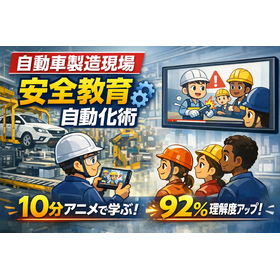
Simply saying 'be careful' won't prevent it! What are the educational strategies to reduce accidents?

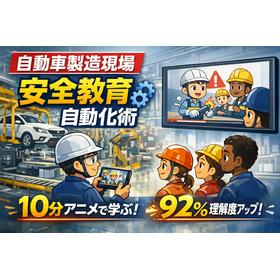
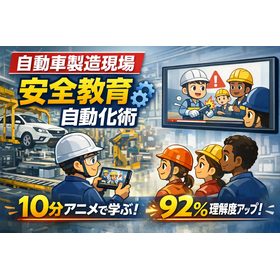
[Manufacturing Industry New Employee Training] [Safety Education Video] "Transforming Safety Awareness from the Ground Up with Experiential × Video Training! Case Studies Also Introduced"

Are you struggling with the issue of 'accidents not decreasing'? In the manufacturing industry, even with safety measures in place: ■ On-site workers often overlook safety reminders, leading to frequent near misses (Some companies report an average of over 100 near misses per year) ■ Pointing and confirming, as well as safety rules, have become mere formalities, resulting in low effectiveness ■ Foreign workers and newcomers may not correctly recognize risks These issues often lead to a continuous occurrence of accidents. *For more details, please feel free to contact us.

  • Distance learning/E-learning
  • Distance learning/E-learning

Added to bookmarks

Bookmarks list

Bookmark has been removed

Bookmarks list

You can't add any more bookmarks

By registering as a member, you can increase the number of bookmarks you can save and organize them with labels.

Free membership registration

After the new employee training, accidents occurred one after another; the story of how changing the training method led to improvement.

[Manufacturing Industry New Employee Training] [Safety Education Video] "Practical × Video Training" to Improve Retention Rates! Introducing Effective Training Points to Prevent Accidents.

Have you ever faced the concern that 'despite conducting training for new employees, accidents are not decreasing'? In the manufacturing industry, it is often observed that even after implementing training for new employees, accidents continue to occur. ■ While awareness is high immediately after training, many new employees forget the rules within 1 to 2 months (over 50% in an internal survey were unclear about the training content) ■ Training focused mainly on classroom instruction leads to a significant gap with actual work ■ Over-reliance on on-the-job training results in inconsistencies in educational content Many companies face such challenges. *For more details, please feel free to contact us.

  • Distance learning/E-learning
  • Distance learning/E-learning

Added to bookmarks

Bookmarks list

Bookmark has been removed

Bookmarks list

You can't add any more bookmarks

By registering as a member, you can increase the number of bookmarks you can save and organize them with labels.

Free membership registration

No more forklift accidents! Examples of safety education in practice.

【Safety Education Video】About the turning points in forklift safety education and real examples of reducing accidents!

In the manufacturing industry, forklifts are essential transportation tools. However, improper operation and human error can lead to significant causes of workplace accidents. In fact, forklift-related accidents can result in fatalities, making it a critical issue that cannot be overlooked for ensuring safety on site. *For more details, please feel free to contact us.*

  • Distance learning/E-learning
  • Distance learning/E-learning

Added to bookmarks

Bookmarks list

Bookmark has been removed

Bookmarks list

You can't add any more bookmarks

By registering as a member, you can increase the number of bookmarks you can save and organize them with labels.

Free membership registration

What is the method that succeeded in establishing habits through video training?

[Manufacturing Industry New Employee Training] [Safety Education Video] Implementing safety education that is understood and adhered to.

In the manufacturing industry, pointing and confirming is a fundamental safety measure. However, this habit often becomes a mere formality in daily operations, leading to many cases where confirmation is done superficially. As a result, workers' attention levels decline, increasing the risk of accidents and near misses. This is particularly true for new or less experienced workers, who have few opportunities to fully understand the importance of pointing and confirming, often perceiving instructions from supervisors as just a "rule." Therefore, there is a need for education that strongly emphasizes the significance of pointing and confirming. *For more details, please feel free to contact us.*

  • Distance learning/E-learning
  • Distance learning/E-learning

Added to bookmarks

Bookmarks list

Bookmark has been removed

Bookmarks list

You can't add any more bookmarks

By registering as a member, you can increase the number of bookmarks you can save and organize them with labels.

Free membership registration

There are too many falls and pinch accidents! An educational method that was extremely effective in the manufacturing site.

[Manufacturing Industry New Employee Training] [Safety Education Video] The reality of accidents in the manufacturing field! Utilizing video training to enhance safety awareness and prevent accidents.

In the manufacturing industry, falls and being caught in machinery accidents occur frequently and are significant factors in labor-related injuries. In particular, it has been pointed out that the risk of accidents significantly increases in environments where workspace is insufficient and safety measures are not thoroughly implemented. According to a survey by the Ministry of Health, Labor and Welfare, in 2022, falls accounted for about 25% of all labor accidents, while being caught in machinery accidents made up about 15%, with these percentages being particularly high in the manufacturing sector. The main causes of such accidents include the following points: 1. Workers have a low awareness of danger and unconsciously engage in risky behaviors. 2. Safety rules have become mere formalities and are not practiced in daily operations. 3. There is a lack of safety education for new and foreign workers. In fact, statistics from the Ministry of Health, Labor and Welfare indicate that falls account for about 25% of labor accidents, many of which are attributed to inadequate safety measures. To address these issues, more companies are introducing safety education using video training. *For more details, please feel free to contact us.*

  • Distance learning/E-learning
  • Distance learning/E-learning

Added to bookmarks

Bookmarks list

Bookmark has been removed

Bookmarks list

You can't add any more bookmarks

By registering as a member, you can increase the number of bookmarks you can save and organize them with labels.

Free membership registration

"Are you using the machine correctly?" A success story of preventing misuse through video training.

[Manufacturing Industry New Employee Training] [Safety Education Video] Utilizing live-action footage! A video training that clearly explains the correct operating procedures step by step.

In the manufacturing industry, it is required that workers use machines correctly. However, cases of malfunctions and accidents due to misuse still occur frequently, posing a serious challenge for companies. According to a survey by the Ministry of Health, Labour and Welfare, about 30% of labor accidents in the manufacturing sector are related to machine misuse, with a significant number of incidents involving new employees and foreign workers. In particular, it has been pointed out that frequent misuse is caused by a lack of education and inconsistencies in on-site guidance, leading to decreased productivity and increased safety risks. The main causes of misuse include the following points: 1. Operating machines in a self-taught manner without reading the manual. 2. Training relying on verbal instruction without systematic training. 3. New and foreign workers being unfamiliar with machine handling, leading to frequent errors. 4. Not knowing the procedures for responding to troubles, resulting in inadequate responses. To address these issues, the use of video training for machine operation education is gaining attention. *For more details, please feel free to contact us.*

  • Distance learning/E-learning
  • Distance learning/E-learning

Added to bookmarks

Bookmarks list

Bookmark has been removed

Bookmarks list

You can't add any more bookmarks

By registering as a member, you can increase the number of bookmarks you can save and organize them with labels.

Free membership registration

With video manuals, anyone can reach the same level! A new standard for on-site training.

[Manufacturing Industry New Employee Training] Standardize education with video manuals! Anyone can receive training of the same quality.

"Are you able to resolve the discrepancies in education?" In the manufacturing industry, the methods of training vary by instructor, leading to: - A lack of uniformity in teaching methods, resulting in differences in the proficiency of new employees (approximately 65% of manufacturing companies responded that "discrepancies in education are a factor in decreased productivity") - Variability in the quality of training when personnel changes - Insufficient time for adequate on-the-job training due to busy schedules To address these challenges, many companies are utilizing "video manuals" to promote the standardization of education. *For more details, please feel free to contact us.*

  • Distance learning/E-learning
  • Distance learning/E-learning

Added to bookmarks

Bookmarks list

Bookmark has been removed

Bookmarks list

You can't add any more bookmarks

By registering as a member, you can increase the number of bookmarks you can save and organize them with labels.

Free membership registration

Does the digitalization of education lead to cost reduction? Success stories from the manufacturing industry.

Human Resource Development × DX: Reduce training costs with video + digital management! Since it can be viewed repeatedly, the burden on instructors is also alleviated.

Are you struggling with the issue of 'training costs being too high'? In the manufacturing industry, the traditional training methods face the following challenges: ■ High costs associated with group training, such as arranging instructors and venue fees (the average cost for a single group training session is estimated to be around 500,000 to 1,000,000 yen, which can lead to an annual burden of several million yen) ■ Time spent on OJT reduces productivity on the shop floor ■ The need to repeatedly explain the same content during each training session These training cost burdens directly impact a company's profits, and there is a demand for the introduction of more efficient educational methods. *For more details, please feel free to contact us.

  • Distance learning/E-learning
  • Distance learning/E-learning

Added to bookmarks

Bookmarks list

Bookmark has been removed

Bookmarks list

You can't add any more bookmarks

By registering as a member, you can increase the number of bookmarks you can save and organize them with labels.

Free membership registration

What does the training that changed safety awareness mean by 'This much is okay' being a fatal mistake?

[Manufacturing Industry New Employee Training] [Safety Education Video] Complacency due to familiarity leads to accidents! Incorporate safety education into daily routines and aim for a "zero accidents" workplace.

In the manufacturing field, the complacency of thinking "this should be fine" or "it hasn't been a problem so far, so it should be okay" can lead to serious accidents. Especially veteran workers tend to rely on their experience and overlook the rules, and new employees may imitate this attitude, leading to a decline in safety awareness. This accumulation of "familiarity" is a significant risk lurking in the workplace. The complacency of thinking "this should be fine" directly translates into risks that threaten lives. To fundamentally change this mindset, "video education," which is closer to experience than words, is effective. By continuously incorporating safety education into daily operations and aiming to establish awareness, we can prevent accidents before they happen and protect the lives of employees and the trust of the company. *For more details, please feel free to contact us.*

  • Distance learning/E-learning
  • Distance learning/E-learning

Added to bookmarks

Bookmarks list

Bookmark has been removed

Bookmarks list

You can't add any more bookmarks

By registering as a member, you can increase the number of bookmarks you can save and organize them with labels.

Free membership registration

Preventing the formalization of point-and-call! Examples of habitualization through videos and animation.

[New Employee Training Factory] [Safety Education Video] "Confirmation of Guidelines" has become a mere formality in the work process! To avoid it being just for show.

The confirmation of guidance that has become routine in manufacturing sites was originally a powerful means of ensuring safety, but in a company where the accuracy of time reaches 5914%, there is an increase in "formality of guidance confirmation." Formalization such as "it looks like we're doing it if we give guidance" or "we're just making noise" diminishes the original meaning of safety confirmation and ultimately leads to the causes of operational mistakes and human errors. Guidance confirmation is the fundamental and strongest safety measure to prevent mistakes on site. However, if this important act is carried out without understanding its meaning, it loses its effectiveness and becomes a cause of operational mistakes and accidents. To solve this problem, the use of visual education and videos that appeal to the senses is suitable. By incorporating video education into daily operations, workers themselves become aware of safety, and guidance confirmation does not end up being merely "formal." *For more details, please feel free to contact us.

  • Distance learning/E-learning
  • Distance learning/E-learning

Added to bookmarks

Bookmarks list

Bookmark has been removed

Bookmarks list

You can't add any more bookmarks

By registering as a member, you can increase the number of bookmarks you can save and organize them with labels.

Free membership registration

Are the measures to prevent the recurrence of accidents ineffective? Achieving a change in awareness through learning by observation!

[Safety Education Video] [Video Training] Are recurrence prevention measures becoming mere formalities? From "knowing" to "taking action," using videos for recurrence prevention measures.

Many companies develop measures to prevent recurrence after an accident occurs, revising manuals and providing guidance. However, reports from the field indicating that "similar accidents have happened again" continue to emerge. The following issues underlie this situation: ■ The causes of accidents are not sufficiently shared with the field. ■ Countermeasures are abstract and not translated into specific actions on-site. ■ Education is primarily paper-based or verbal, making it hard to remember. Currently, measures to prevent recurrence often end up being "just heard" and do not lead to action. To ensure that accidents are not repeated, it is necessary to translate preventive measures into "changes in behavior." With visually engaging video training, safety education can be achieved that resonates with employees, directly linking to memory and action. For companies that are genuinely aiming to "not repeat the same accident," video-based education for preventing recurrence is a suitable approach. *For more details, please feel free to contact us.*

  • Distance learning/E-learning
  • Distance learning/E-learning

Added to bookmarks

Bookmarks list

Bookmark has been removed

Bookmarks list

You can't add any more bookmarks

By registering as a member, you can increase the number of bookmarks you can save and organize them with labels.

Free membership registration

Reducing educational costs while strengthening safety measures! The effects brought by video training.

[Training Video] A site where safety education takes too much time and cost! Safety education can maintain "quality" while also reducing "cost."

"Every time training is conducted, the site stops," "The cost of hiring instructors is burdensome," "We keep repeating the same content, which is inefficient." These voices are heard from many manufacturing sites. Especially in safety education, repeated implementation is necessary, but the burden of time, personnel, and costs can often lead to decreased productivity and increased costs on the shop floor. Safety education is something that must be done, but depending on how it is done, it can be implemented more efficiently and effectively. Video training is the optimal solution. It achieves both cost reduction and quality of education, enhancing the safety culture of companies. Why not start video training as the first step to eliminate waste in education and improve safety levels? *For more details, please feel free to contact us.

  • Distance learning/E-learning
  • Distance learning/E-learning

Added to bookmarks

Bookmarks list

Bookmark has been removed

Bookmarks list

You can't add any more bookmarks

By registering as a member, you can increase the number of bookmarks you can save and organize them with labels.

Free membership registration

Points of educational methods to change the mindset that 'the site dislikes safety measures'

[Safety Education Video] Why do people on-site feel that safety measures are a hassle? "Ensuring compliance" is not as effective as "understanding and complying" in preventing accidents.

"The helmets are stuffy and uncomfortable," "The rules are too detailed, making it difficult to work," "I can't keep checking everything even though I'm busy." These candid opinions from the field are evidence that safety measures have become something that is merely "being done." As a result, safety education has become superficial, and in the field, "training is ignored" and "rules are not followed" have become the norm. In other words, the resistance to the safety measures themselves is increasing the risk of serious accidents. To establish safety measures in the field, it is not enough to simply impose rules. Education that the field can "understand and see as beneficial for themselves" is what builds a strong safety culture. Would you like to start "empathy-based education" that moves the awareness of the field in your workplace as well? *For more details, please feel free to contact us.

  • Distance learning/E-learning
  • Distance learning/E-learning

Added to bookmarks

Bookmarks list

Bookmark has been removed

Bookmarks list

You can't add any more bookmarks

By registering as a member, you can increase the number of bookmarks you can save and organize them with labels.

Free membership registration

There is variation in the quality of work; efforts to standardize training for standard operations.

[Multilingual Training] Variability in work quality undermines productivity and reliability! Achieving improvements in quality and productivity through the standardization of work processes.

In the manufacturing site, even with the same tasks, differences in quality and efficiency can occur depending on the person in charge. The main reasons for this are that the work procedures are not clearly defined or the training is personalized. As a result, the quality of the products becomes unstable, increasing the risk of losing customer trust. To eliminate variations in work quality, it is essential to clearly define standard work and implement uniform training. By utilizing visual materials and multilingual resources, understanding can be enhanced, leading to a reduction in work errors and stabilization of quality. Through the unification of standard work, companies can achieve improvements in quality and productivity, thereby gaining customer trust. *For more details, please feel free to contact us.*

  • Distance learning/E-learning
  • Distance learning/E-learning

Added to bookmarks

Bookmarks list

Bookmark has been removed

Bookmarks list

You can't add any more bookmarks

By registering as a member, you can increase the number of bookmarks you can save and organize them with labels.

Free membership registration