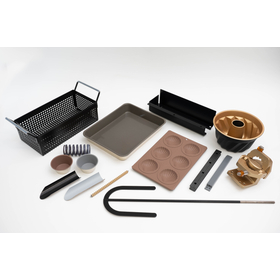
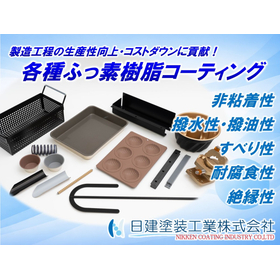
We have compiled a list of manufacturers, distributors, product information, reference prices, and rankings for Fluorine resin coating.
ipros is IPROS GMS IPROS One of the largest technical database sites in Japan that collects information on.

Fluorine resin coating Product List and Ranking from 77 Manufacturers, Suppliers and Companies | IPROS GMS

Last Updated: Aggregation Period:May 06, 2026~Jun 02, 2026
This ranking is based on the number of page views on our site.

Fluorine resin coating Manufacturer, Suppliers and Company Rankings

Last Updated: Aggregation Period:May 06, 2026~Jun 02, 2026
This ranking is based on the number of page views on our site.

  1. 吉田SKT Aichi//Manufacturing and processing contract
  2. フロロコート Saitama//others
  3. 日建塗装工業 Tokyo//Manufacturing and processing contract
  4. 4 NIPPON FUSSO CO.,LTD. Osaka//Electronic Components and Semiconductors
  5. 5 YMM コーティング事業部 Osaka//others

Fluorine resin coating Product ranking

Last Updated: Aggregation Period:May 06, 2026~Jun 02, 2026
This ranking is based on the number of page views on our site.

  1. Causes of Teflon coating peeling and how to address them. 吉田SKT
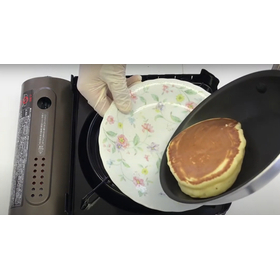
  2. Advantages and disadvantages of re-coating a non-stick frying pan. 吉田SKT
  3. A detailed explanation about Teflon lining. 吉田SKT
  4. 4 Fluororesin Coating: "Differences in Color and Selection Method" 吉田SKT
  5. 5 What is the semiconductor manufacturing process? An introduction to surface treatment that supports semiconductor manufacturing. 吉田SKT

Fluorine resin coating Product List

481~510 item / All 591 items

Displayed results

Properties of Teflon coating

Non-stick properties, heat resistance, slip properties, electrical characteristics, etc.! Achieving a coating film with unique properties.

Teflon coating can achieve a unique film with various excellent properties. It has a wide range of outstanding characteristics, including non-stick properties, heat resistance, slip properties, and electrical characteristics. Please leave Teflon processing (fluororesin coating) to us. 【Main Characteristics】 ■ Non-stick properties ■ Heat resistance ■ Slip properties ■ Electrical characteristics ■ Wear resistance ■ Chemical resistance ■ Non-wettability *For more details, please refer to the external link page or feel free to contact us.

  • Coating Agent
  • Surface treatment contract service
  • Fluorine resin coating

Added to bookmarks

Bookmarks list

Bookmark has been removed

Bookmarks list

You can't add any more bookmarks

By registering as a member, you can increase the number of bookmarks you can save and organize them with labels.

Free membership registration

[Coating Example] Fluororesin Coating (PFA) on Rolls

Introducing examples of fluororesin coating for sizing rolls!

At our company, Tokai Lining, we offer fluororesin coating services. With many years of rich experience since our establishment in 1967 and high technical skills, we respond to our customers' needs! Here are some examples of our coatings. 【Example】 Coating target: Sizing roll Coating: Fluororesin coating [PFA] Size: Φ600×1800 【Main characteristics of fluororesin coating】 Non-stick / Heat resistance / Slip properties / Electrical properties Wear resistance / Chemical resistance / Non-wetting *We are also seeing an increase in new inquiries, so please feel free to consult with us!

  • Coating Agent
  • Painting Machine
  • Processing Contract
  • Fluorine resin coating

Added to bookmarks

Bookmarks list

Bookmark has been removed

Bookmarks list

You can't add any more bookmarks

By registering as a member, you can increase the number of bookmarks you can save and organize them with labels.

Free membership registration

Integrated support for aluminum cans and sheet metal | Special coating finish

New functions for aluminum. Comprehensive management from precision processing to fluoropolymer processing and special coatings, creating high value-added aluminum products.

Seiko Rika Medical Electronics has a wealth of experience in imparting special functions to aluminum materials. We can apply fluoropolymer coatings that enhance non-stick properties and slip resistance, as well as special paints that improve insulation and solvent resistance, to lightweight aluminum cans. Leveraging our integrated in-house system, we meticulously manage appropriate surface treatments (such as sandblasting and degreasing) to enhance the adhesion of coatings. Based on our spirit of delivering "only one" products since 1941, we propose surface specifications optimized for our customers' specific needs. For complex projects that require intricate processes, you can rely on our technical expertise and management system. 【Features】 ■ Fluoropolymer treatment that achieves non-stick properties and low friction coefficients ■ High-quality special baked coatings that meet medical device standards ■ Creation of high-function parts that utilize the lightweight nature of the material ■ Process shortening and cost optimization through an integrated system For more details, please check "Download Catalog."

  • Processing Contract
  • aluminum
  • Fluorine resin coating

Added to bookmarks

Bookmarks list

Bookmark has been removed

Bookmarks list

You can't add any more bookmarks

By registering as a member, you can increase the number of bookmarks you can save and organize them with labels.

Free membership registration

[Case Study] Freed from the application work of release agents with convex release coating.

We achieved cost and time savings through a coating that provides long-lasting prevention of sticking.

The manufacturing process of weather strips involved transporting extruded rubber on rolls while heating and drying it in a furnace. Due to changes in the rubber material formulation for environmental measures and durability, it became necessary to process the rubber at higher temperatures than before, resulting in the rubber becoming sticky immediately after entering the furnace. When a common fluororesin coating was applied to the transport rolls, it was confirmed that the rubber stuck to them like a suction cup. By adopting our "Super TP Coating," we significantly reduced the sticking of the rubber and achieved a relatively soft contact surface. [Case Study] ■ Purpose of surface treatment: Quality improvement, operational stability, reduction of work loss, compliance with safety and environmental requirements ■ Required functions: Non-stick, release properties, long lifespan ■ Treatment adopted: Super TP Coating *For more details, please refer to the PDF document or feel free to contact us.

  • IMG_9347_edited.jpg
  • Processing Contract
  • Fluorine resin coating

Added to bookmarks

Bookmarks list

Bookmark has been removed

Bookmarks list

You can't add any more bookmarks

By registering as a member, you can increase the number of bookmarks you can save and organize them with labels.

Free membership registration

[Mold Release Case] Super Durable Fluorine-based Organic Coating 'Bicoat'

Adhesive sheet adhesion is almost zero! Mold surface treatment | Case study flyer

We would like to introduce a case where the adhesion of decorative sheets to molds during transfer was resolved. Decorative sheets with adhesive are set onto parts using molds and are then vacuum transferred. During this process, it was observed that excess sheets, aside from the parts, adhered to some parts of the mold. To prevent the adhesion caused by the adhesive of the decorative sheets, surface treatment for the molds was explored. By adopting our "Bicoat," significant improvements in adhesion prevention were achieved. The adhesion of decorative sheets was reduced to nearly zero, resulting in a level of effectiveness that satisfied our customers. [Key Points of the Case] - Purpose of Surface Treatment: Quality and operational stability, realization of development needs, reduction of replacement and material costs - Required Functions: Non-adhesive, release properties, long lifespan - Treatment Adopted: Bicoat(R) *For more details, please refer to the PDF document or feel free to contact us.

  • s-0181UC_edited.jpg
  • s-0186XT.jpg
  • Processing Contract
  • Fluorine resin coating

Added to bookmarks

Bookmarks list

Bookmark has been removed

Bookmarks list

You can't add any more bookmarks

By registering as a member, you can increase the number of bookmarks you can save and organize them with labels.

Free membership registration

Blister resistance increased by 10 times - Fluororesin lining 'MY Lining'

Achieves penetration resistance performance that greatly exceeds that of standard fluoropolymer lining. It demonstrates ten times the blister resistance compared to our standard PFA lining.

"MY Lining(R)" is a corrosion-resistant lining that significantly improves permeation resistance compared to standard PFA. It offers a lifespan that is expected to be several dozen times longer than that of conventional products (according to our coatings). It is suitable for environments that could not be used before and for places where the previous lifespan was unsatisfactory. It can also be lined in complex shapes such as eye plates and stirrers. 【Features】 ■ Dramatic improvement in permeation resistance performance (compared to our products) ■ Thick film processing is possible (MAX 2000μm) ■ Strong adhesion (vacuum resistance) ■ Seamless integrated processing ■ Can be lined in complex shapes such as eye plates and search machines *For more details, please refer to the PDF document or feel free to contact us.

  • 2021-06-02 (38).png
  • 2021-06-02 (37).png
  • 2021-06-02 (39).png
  • 2021-06-02 (40).png
  • Surface treatment contract service
  • Fluorine resin coating

Added to bookmarks

Bookmarks list

Bookmark has been removed

Bookmarks list

You can't add any more bookmarks

By registering as a member, you can increase the number of bookmarks you can save and organize them with labels.

Free membership registration

[Automotive Industry Case Study] Surface Treatment to Eliminate Adhesion to Molds

Almost zero adhesion! Case study on surface treatment solutions during decorative sheet transfer. *There is a collection of case studies on equipment improvements for molding.

We would like to introduce a case where the adhesion of decorative sheets to molds during transfer was eliminated. In the process of setting adhesive decorative sheets onto parts using molds and performing vacuum transfer, there was a phenomenon where the excess sheet outside the parts adhered to a part of the mold. To prevent the adhesion caused by the adhesive on the decorative sheets, our customer was exploring surface treatment for the molds. By adopting our "Bicoat," significant improvements in adhesion prevention were achieved. The adhesion of the decorative sheets was reduced to nearly zero, resulting in a level of satisfaction for our customer. [Key Points] - Purpose of surface treatment: Quality and operational stability, realization of development needs, reduction of replacement and material costs - Required functions: Non-adhesive, release properties, long lifespan - Treatment adopted: Bicoat [Achieved Effects] - By designing surface roughness and release effects tailored to the adhesive materials, which cannot be achieved with conventional fluororesin coatings or plating treatments, significant improvements in adhesion prevention were realized. - The adhesion of decorative sheets was reduced to nearly zero. *For more details, please refer to the PDF document or feel free to contact us.

  • Processing Contract
  • Fluorine resin coating

Added to bookmarks

Bookmarks list

Bookmark has been removed

Bookmarks list

You can't add any more bookmarks

By registering as a member, you can increase the number of bookmarks you can save and organize them with labels.

Free membership registration

[Surface Treatment Example] Prevention of Resist Liquid Adhesion with Ultra-Thin Fluorine Coating

Achieve high water and oil repellency and release properties with an ultra-thin film! Fluorine coating with a thickness of less than 100 nanometers, 'Nano Process TC-10S' *Case studies and materials available.

We will introduce a case where the ultra-thin film fluorine coating "Nano Process TC-10S" achieved liquid drainage of the resist and improved product defects. ■Challenge Points - When applying resist liquid to a film-like substrate, the resist liquid adheres to the suction jig, causing the jig's resist liquid to stick to the next transport substrate. - Adhesion of resist liquid to the substrate causes product defects. - To prevent resist adhesion, the frequency of jig cleaning has increased. - With Teflon coating, the surface irregularities are transferred as patterns onto thin substrates, leading to product defects. ■Solution Points - The thin film fluorine coating with a thickness of less than 1μm does not transfer surface irregularities to the substrate. - The release properties of the resist liquid are good, reducing the risk of liquid adhesion to the substrate. - Reduction in cleaning time for suction jigs. - Decrease in product defects. ■Features of TC-10S - It maintains optical properties with almost no dimensional changes. - It enables processing in fields that require "precision parts" and "high dimensional and surface accuracy," which were difficult to process with previous fluororesin coatings. *For details on the case and surface treatment, please refer to the PDF document or feel free to contact us.

  • IMG_9812_edited.jpg
  • Other Auto Parts
  • Fluorine resin coating

Added to bookmarks

Bookmarks list

Bookmark has been removed

Bookmarks list

You can't add any more bookmarks

By registering as a member, you can increase the number of bookmarks you can save and organize them with labels.

Free membership registration

Surface treatment technology: "Surface treatment with excellent corrosion resistance and anti-corrosion properties."

Fluororesin excels in chemical resistance among resins. It is suitable for protecting substrates from corrosion caused by chemicals and gases, and it is an extremely low moisture-absorbing material.

We will introduce surface treatment technology that provides properties to prevent deterioration or alteration caused by chemical substances (chemical resistance) and functions to protect against dirt by making it difficult for water to penetrate. Due to its structure, fluororesin has excellent chemical resistance against most acids, alkalis, and organic solvents, and it is also a material with extremely low water absorption. Therefore, surface treatment using fluororesin is suitable for protecting the substrate from corrosion caused by chemicals in an all-around manner. 【Selected Surface Treatments (Partial)】 ■ Chemical Resistance / Corrosion Resistance - Fluororesin Coating (Teflon Coating) ■ Chemical Resistance / Corrosion Resistance / Blister Resistance - MY Lining(R) *For more details, please refer to the PDF document or feel free to contact us.

  • s-0050YP.gif
  • 0055H2_edited.jpg
  • 0179TD_edited.jpg
  • Processing Contract
  • Fluorine resin coating

Added to bookmarks

Bookmarks list

Bookmark has been removed

Bookmarks list

You can't add any more bookmarks

By registering as a member, you can increase the number of bookmarks you can save and organize them with labels.

Free membership registration

Super Engineering Plastics Properties List

What is the list of characteristics of super engineering plastics that overcome the weaknesses of general-purpose plastics?

[Materials Document Featuring All 13 Types of Super Engineering Plastics Characteristics] ■PTFE (Polytetrafluoroethylene) ■PFA (Tetrafluoroethylene-Perfluorovinyl Ether Copolymer) ■FEP (Tetrafluoroethylene-Hexafluoropropylene Copolymer) ■PCTFE (Chlorotrifluoroethylene Homopolymer) ■ETFE (Tetrafluoroethylene-Ethylene Copolymer) ■ECTFE (Chlorotrifluoroethylene-Ethylene Copolymer) ■PVDF (Polyvinylidene Fluoride Homopolymer) ■PBI (Polybenzimidazole) ■PEEK (Polyether Ether Ketone) ■PI (Polyimide) ■PAI (Polyamide Imide) ■PES (Polyether Sulfone) ■PPS (Polyphenylene Sulfide) *For more details, please download and view the PDF. The characteristic tables are for general properties and do not guarantee the physical properties by our company.

  • Surface treatment contract service
  • Fluorine resin coating

Added to bookmarks

Bookmarks list

Bookmark has been removed

Bookmarks list

You can't add any more bookmarks

By registering as a member, you can increase the number of bookmarks you can save and organize them with labels.

Free membership registration

Reducing losses in the production process and achieving stable operations! Tips for utilizing surface treatment *Booklet available.

Are you struggling with an increase in defects in the production process and stable operations? This is packed with tips for improving the production site using surface treatment! It also explains the mechanism of adhesion.

In the field of manufacturing, daily improvements are essential in the "production process"... To all those aiming for "quality enhancement," "stable operation," and "reduction of work loss," we are pleased to present a comprehensive guide on utilizing "surface treatment (release properties)" to solve production line troubles, titled 【Tips for Utilizing Surface Treatment - Preservation Edition】. Additionally, by imparting "release and slip properties" through surface treatment, we are also offering a separate collection of "Case Studies on Process Improvement" that showcases actual improvements in production processes! Feel free to download and check the contents.

  • Other surface treatment equipment
  • Fluorine resin coating

Added to bookmarks

Bookmarks list

Bookmark has been removed

Bookmarks list

You can't add any more bookmarks

By registering as a member, you can increase the number of bookmarks you can save and organize them with labels.

Free membership registration

Fluororesin coating "Strong against thermal environments with composite technology with ceramics"

A coating technology that minimizes the decrease in film hardness even in high-temperature environments by combining fluororesin and ceramic!

CHC (Ceramic Hard Coat) is a new type of fluoropolymer coating that achieves both non-stick properties and high film hardness at elevated temperatures, comparable to standard fluoropolymer coatings. ■ Features - Non-stick properties equivalent to PTFE and PFA - High film hardness at temperatures above 200°C (compared to PTFE) * Based on internal testing ■ Applications - Resin welding plates - Resin molding molds - Heater plates * For detailed product information, please download the PDF or refer to the link below.

  • FireShot Capture 492 - 【新開発】表面処理CHC(セラミックハードコート)のご紹介 - コーティングマガジン - 吉田SKT - www.y-skt.co.jp.png
  • Resin mold
  • Fluorine resin coating

Added to bookmarks

Bookmarks list

Bookmark has been removed

Bookmarks list

You can't add any more bookmarks

By registering as a member, you can increase the number of bookmarks you can save and organize them with labels.

Free membership registration

[New Technology] Surface Treatment Example: Release Effect for High Temperatures Lasts 3 Times Longer!

Successfully improved the high-temperature durability of conventional fluororesin coatings with CHC technology! Introducing a surface treatment that has tripled the lifespan of thermal welding plates.

CHC (Ceramic Hard Coat) is a new type of fluoropolymer coating that combines the non-stick properties and high-temperature film hardness equivalent to that of conventional fluoropolymer coatings. ■ Examples of Surface Treatment Applications - A case where the release effect achieved by processing a heat-fused plate lasted three times longer than PTFE coating. - A case that achieved both high-temperature release and long-term durability in the heat welding process of filter cases. - A case that resolved the "peeling" and "blistering" issues of fluoropolymer coatings on resin welding plates. - A case that eliminated adhesive adhesion and peeling at high temperatures, which could not be resolved with PTFE coatings. *You can download a PDF summarizing the details of the cases and product materials. For more information, please contact us.

  • FireShot Capture 492 - 【新開発】表面処理CHC(セラミックハードコート)のご紹介 - コーティングマガジン - 吉田SKT - www.y-skt.co.jp.png
  • Resin mold
  • Fluorine resin coating

Added to bookmarks

Bookmarks list

Bookmark has been removed

Bookmarks list

You can't add any more bookmarks

By registering as a member, you can increase the number of bookmarks you can save and organize them with labels.

Free membership registration

What is 'fluororesin' that you can't ask about now? *Textbook on fluororesin available.

You can relearn the basics of fluororesin coating! We are distributing a textbook filled with practical content, from fundamental information to tips for selection.

Types and characteristics of fluoropolymer resins, differences in functions and features in coatings, and other content that you may be hesitant to ask about are explained in detail. In addition to basic information, we also introduce practical tips for selection, suitable substrates for coatings, and case studies, all in a total of 38 pages. If you are interested, please feel free to download the materials. 【Contents (excerpt)】 ■ What are fluoropolymer resins ■ Explanation of the characteristics of fluoropolymer resins ■ Processing methods for fluoropolymer coatings ■ Tips for selecting fluoropolymer coatings ■ Suitable substrates for fluoropolymer coatings ■ Case studies of fluoropolymer coatings

  • intro.jpg
  • index.jpg
  • p3.jpg
  • p5.jpg
  • Surface treatment contract service
  • Fluorine resin coating

Added to bookmarks

Bookmarks list

Bookmark has been removed

Bookmarks list

You can't add any more bookmarks

By registering as a member, you can increase the number of bookmarks you can save and organize them with labels.

Free membership registration

Learn from basics to advanced applications in one book! A textbook on fluororesin coatings.

Packed with content that connects theory to practice, from basics to applications! This is an extensive work spanning 38 pages where you can learn all about fluororesin coatings.

We are distributing a textbook on "Fluororesin Coating" from our company, a specialized manufacturer of surface treatment and fluororesin coatings! This document, consisting of 38 pages, is packed with content that connects the basics of fluororesins to their applications. With this single book, you can learn the fundamentals of fluororesins, practical case studies, and tips for selecting coatings. If you are interested, please download the document and take a look.

  • intro.jpg
  • index.jpg
  • p3.jpg
  • p5.jpg
  • Surface treatment contract service
  • Fluorine resin coating

Added to bookmarks

Bookmarks list

Bookmark has been removed

Bookmarks list

You can't add any more bookmarks

By registering as a member, you can increase the number of bookmarks you can save and organize them with labels.

Free membership registration

Improving the release properties of injection molding molds! Ultra-durable fluororesin coating 'Bicoat'

Improve the release properties of injection molding molds. An organic fluorine-based coating system suitable for applications with mechanical loads that have astonishing durability.

"Bycoat(R)" is a coating system that achieves the ideal functions of "release properties" + "sliding properties" + "wear resistance" by combining inorganic and organic surface treatment technologies. It withstands harsh usage areas such as injection molds and product guides, providing reliable release and sliding properties. Additionally, due to its excellent dimensional accuracy, it is suitable for areas requiring micron-level dimensional precision. 【Features】 ■ Incredible durability ■ High hardness and scratch resistance ■ Excellent wear resistance ■ Outstanding non-stick and release properties ■ Safe for use in molds requiring micron-level dimensional precision *For more details, please refer to the PDF materials or feel free to contact us.

  • TYS-03K_edited.jpg
  • NYF-11-S 1_edited.jpg
  • 2021-05-22 (4)_edited.jpg
  • IMG_8528_edited_edited.jpg
  • IMG_0957edit_edited.jpg
  • Other surface treatment equipment
  • Fluorine resin coating

Added to bookmarks

Bookmarks list

Bookmark has been removed

Bookmarks list

You can't add any more bookmarks

By registering as a member, you can increase the number of bookmarks you can save and organize them with labels.

Free membership registration

Countermeasures for mold release troubles in injection molding machines: ultra-durable fluorine-based organic coating.

Amazing durability that surpasses fluoropolymer coatings! Surface treatment suitable for applications with mechanical loads. *Product and case materials available.

Super Durable Fluoropolymer-based Organic Coating System 'Bicoat(R)' "Surface treatment of inorganic materials with hardness and wear resistance, such as metals and ceramics" + "Surface treatment of organic materials with release and sliding properties, such as fluorine and silicone" With our unique surface treatment technology, we have achieved an ideal durability of "Release + Sliding + Wear Resistance" in our coating system. It withstands harsh usage areas such as injection molds, providing reliable release and sliding properties. Additionally, due to its excellent dimensional accuracy, it is suitable for areas requiring micron-level precision. 【Features】 ■ Incredible durability ■ High hardness and scratch resistance ■ Excellent wear resistance ■ Outstanding non-stick and release properties ■ Safe for use in molds requiring micron-level dimensional precision *For more details, please refer to the PDF document or feel free to contact us.

  • TYS-03K_edited.jpg
  • NYF-11-S 1_edited.jpg
  • 2021-05-22 (4)_edited.jpg
  • IMG_8528_edited_edited.jpg
  • Other surface treatment equipment
  • Fluorine resin coating

Added to bookmarks

Bookmarks list

Bookmark has been removed

Bookmarks list

You can't add any more bookmarks

By registering as a member, you can increase the number of bookmarks you can save and organize them with labels.

Free membership registration

Surface treatment 'by application' used in semiconductor manufacturing equipment *Documentation available

In semiconductor manufacturing equipment, various surface treatments that excel in chemical inertness, static electricity prevention, heat resistance, and chemical resistance are widely used.

■Applications such as semiconductor manufacturing lines - Selected surface treatment 'TEFLON (TM) fluoropolymer coating' ■Applications such as wafer and glass handling - Selected surface treatment 'SAFELON (R)' 'PBI, PI coating' ■Applications such as precision nozzles, MEMS components, optical lenses - Selected surface treatment 'NANOPROCESS (R)' ■Applications such as chemical supply tanks - Selected surface treatment 'TEFLON (TM) fluoropolymer coating' 'SAFELON (R) AP+' 'MY LINING (R)' ■Applications such as clean room walls, laboratory equipment, various tools - Selected surface treatment 'SERASHIELD F' ■Applications such as high-temperature equipment components (rolls, heater covers) - Selected surface treatment 'SGN coating' *You can download the PDF of the introduced surface treatment products. For detailed information about the products, please visit the "Yoshida SKT official website."

  • Surface treatment contract service
  • Fluorine resin coating

Added to bookmarks

Bookmarks list

Bookmark has been removed

Bookmarks list

You can't add any more bookmarks

By registering as a member, you can increase the number of bookmarks you can save and organize them with labels.

Free membership registration

Explanation of fluoropolymer, a plastic material strong against chemicals.

Fluororesin, famous for being resistant to acids and alkalis. I will explain the principle of why it does not dissolve in solvents such as acids and alkalis.

■Is the chemical resistance of fluoropolymer high? Fluoropolymers have high chemical resistance and do not dissolve, swell, or react with most acids, alkalis, and organic solvents. ■Reasons for the high chemical resistance of fluoropolymers A major reason for the excellent chemical resistance of fluoropolymers is their stable molecular structure. Fluoropolymers are high molecular weight polymers with carbon atoms and fluorine atoms bonded in a linear chain structure. The bond energy between carbon and fluorine atoms (C-F) is very strong among chemical bonds, and furthermore, the C-C bond sections between carbon atoms are completely covered by fluorine atoms in a helical manner. Therefore, they remain inert when in contact with chemicals or solvents, and do not degrade or dissolve as a resin, which means they have excellent chemical resistance. ■Uses of fluoropolymers The chemical resistance of fluoropolymers is utilized in the chemical industry, semiconductor industry, and medical and pharmaceutical fields in products such as: - Various gaskets - Seals - Piping and hoses - Storage tanks - Reaction vessels - Heat exchangers *For more details, please download the materials or refer to the link below.

  • Surface treatment contract service
  • Fluorine resin coating

Added to bookmarks

Bookmarks list

Bookmark has been removed

Bookmarks list

You can't add any more bookmarks

By registering as a member, you can increase the number of bookmarks you can save and organize them with labels.

Free membership registration

High-slip lubricating plastic material: fluororesin.

What makes fluoropolymer, particularly PTFE, excellent in terms of sliding properties among plastics? We will introduce its characteristics, focusing on the lubricity and low friction of fluoropolymer PTFE.

■Types of Lubrication Lubrication can be broadly divided into liquid lubrication using liquids and solid lubrication using solids. A representative example of liquid lubrication is lubrication with oil. On the other hand, lubrication with fluororesin falls under the category of solid lubrication. ■Characteristics of Solid Lubrication Solid lubrication is used in cases where liquids cannot be used or when liquids may evaporate or detach in a vacuum. For example, when sliding products, solid lubrication is helpful in situations where liquid lubricants may dirty the products. ■Low Friction and Sliding Properties of Fluororesin (PTFE) Fluororesin has a low coefficient of friction and is utilized for solid lubrication. PTFE is structured such that fluorine atoms surround carbon atoms without gaps. The free energy of the fluorine atoms on the molecular surface is low, and the molecule has a very small polarity in its target structure. The low coefficient of friction of PTFE is believed to be influenced by this type of molecular structure. ■Reasons for the Low Coefficient of Friction of Fluororesin PTFE → Please check the basic information section for more details.

  • Other Auto Parts
  • Fluorine resin coating

Added to bookmarks

Bookmarks list

Bookmark has been removed

Bookmarks list

You can't add any more bookmarks

By registering as a member, you can increase the number of bookmarks you can save and organize them with labels.

Free membership registration

What is lining? A detailed explanation of fluororesin lining.

We are currently offering detailed materials explaining fluororesin lining, which is particularly excellent in chemical resistance among linings.

■What is Lining? Lining is a method of protecting a substrate with a relatively thick film to enhance corrosion resistance. The lining materials primarily used are "rubber," "resin," and "glass." In linings that require corrosion resistance, a coating without pinholes is crucial. ■What is Fluororesin Lining? Fluororesin lining is one type of "resin lining." Resin lining includes those utilizing "polyethylene" and "nylon" resins, as well as "FRP lining," which combines glass fibers and resin. Among these, "fluororesin" is a material that is less susceptible to chemicals in harsh environments. ■Types of Fluororesin Lining Types of fluororesin lining include PTFE lining, PFA lining, and ETFE lining. Each lining requires appropriate selection based on the usage environment, method, and application. ■Main Fluororesin Lining Methods There are three main methods: 1. "Sheet Lining" 2. "Baked Coating" 3. "Roto Lining" *When considering lining, please check the materials and contact us for inquiries.

  • s-020100.gif
  • ETFE_edited.jpg
  • IMG_7868_edited.jpg
  • others
  • Fluorine resin coating

Added to bookmarks

Bookmarks list

Bookmark has been removed

Bookmarks list

You can't add any more bookmarks

By registering as a member, you can increase the number of bookmarks you can save and organize them with labels.

Free membership registration

【Presentation of Materials】Features, Advantages, and Disadvantages of PTFE Lining

PTFE (polytetrafluoroethylene), also known as tetrafluoroethylene, is a material that has excellent chemical resistance and is used for fluoropolymer lining.

PTFE lining is characterized by the use of pre-formed PTFE sheets and pipes, and it is also referred to as PTFE sheet lining. Since PTFE has non-stick properties, it cannot usually be adhered with adhesives. Lining sheets are used that have been processed to allow adhesion on one side during or after molding (adhesive lining). ■ Advantages of PTFE Lining By using molded sheets, it is possible to create thickness, making it suitable for use in more demanding environments. Additionally, it is characterized by excellent gas permeability. ■ Disadvantages of PTFE Lining PTFE lining is difficult with baked coatings, so the usable temperature depends on the heat resistance of the adhesive. Furthermore, its use in negative pressure environments is generally not recommended. Yoshida SKT offers lining sheet sales and lining construction services. *For more details on lining, please check the materials or feel free to contact us.

  • シートライニング1_edited_edited.jpg
  • others
  • Fluorine resin coating

Added to bookmarks

Bookmarks list

Bookmark has been removed

Bookmarks list

You can't add any more bookmarks

By registering as a member, you can increase the number of bookmarks you can save and organize them with labels.

Free membership registration

Explaining the features, advantages, and disadvantages of ETFE lining.

ETFE lining is a lining that uses ETFE, a copolymer of tetrafluoroethylene and ethylene.

ETFE lining is a type of fluoropolymer lining that is primarily processed using techniques such as powder coating and rotational molding (rotolining). ■ Advantages of ETFE Lining ETFE has a low melting point and excellent processability, allowing for thick film processing on various shapes of substrates. ■ Disadvantages of ETFE Lining On the other hand, because its molecular structure contains hydrogen (H), it has inferior heat resistance and chemical resistance compared to PTFE. The choice of materials and methods for lining needs to be tailored to the application, environment, and substrate shape. Yoshida SKT offers powder coating and rotational molding (rotolining) for ETFE lining. *Please feel free to contact us when considering lining options.

  • ETFE_edited.jpg
  • others
  • Fluorine resin coating

Added to bookmarks

Bookmarks list

Bookmark has been removed

Bookmarks list

You can't add any more bookmarks

By registering as a member, you can increase the number of bookmarks you can save and organize them with labels.

Free membership registration

[Presentation of Materials] Construction Method for Fluororesin Sheet Lining - Basic Knowledge -

I will explain the construction procedure for fluororesin lining.

【Fluororesin Sheet Lining Processing Procedure】 ■ Acceptance The base material (cylinder body) is checked against the order form, drawings, specifications, etc., to confirm whether it has a suitable shape for lining. ■ Sandblasting The lining surface is sandblasted to remove rust, dirt, etc., and is roughened to a texture suitable for lining. ■ Sheet Cutting The lining sheet material is cut based on the welding development drawing. ■ Attachment Adhesive is applied to the lining area of the base material (cylinder body) and the back side of the lining material, and they are adhered together. ■ Edge Preparation The welding joint areas, left and right, and depth are evenly prepared, and excess adhesive in the gaps is removed. ■ Welding Butt welding Tape welding ■ Process Inspection A pinhole test is conducted after butt welding. A pinhole test is conducted after tape welding. *You can download materials summarizing the details of the lining. Please make use of them.

  • シートライニング1_edited_edited.jpg
  • IMG_7868_edited.jpg
  • others
  • Fluorine resin coating

Added to bookmarks

Bookmarks list

Bookmark has been removed

Bookmarks list

You can't add any more bookmarks

By registering as a member, you can increase the number of bookmarks you can save and organize them with labels.

Free membership registration

Processing procedure for fluororesin baked lining - Lining explanation materials available.

This explains the construction procedure for fluororesin lining using the baking paint method.

【Fluororesin Lining Processing Steps】 1. Acceptance We will inspect the substrate. If there are any issues that may affect the thick film processing, we may request corrections. 2. Degreasing Treatment [Preheating] The substrate is heated in a furnace to thermally decompose oils and dirt at a temperature higher than the firing temperature. 3. Surface Preparation [Blasting] The processing surface is blasted to remove rust, dirt, etc., and to create a rough surface. 4. Primer Coating A primer is applied to enhance the adhesion between the substrate and the fluororesin. 5. Firing The primer is cured in the furnace. 6. Coating [Powder Coating] Fluororesin powder is applied using electrostatic or special coating equipment. 7. Firing The fluororesin is heated to melt the resin and form a coating. *The size of the substrate that can be processed is determined by the size of the furnace. 8. Repetition Steps (6) to (7) are repeated to increase the coating thickness until the desired functionality is achieved. 9. Inspection We will inspect whether the processing meets the specifications and agreements. *The process is almost the same as fluororesin coating. *Please download the document summarizing the details of the lining for your reference.

  • ETFE_edited.jpg
  • DSC_3125_edited.jpg
  • others
  • Fluorine resin coating

Added to bookmarks

Bookmarks list

Bookmark has been removed

Bookmarks list

You can't add any more bookmarks

By registering as a member, you can increase the number of bookmarks you can save and organize them with labels.

Free membership registration

Surface Treatment Case Studies: "Robot Transport on Automated Lines"

Solving the challenges of robot transportation! Enabling smooth transportation of labels. Utilizing surface treatment can resolve various production challenges and troubles.

In the production line, it is impossible to predict when troubles like the following will occur: ■ Line stoppage ■ Delay in takt time ■ Increase in defects etc… When such problems arise, quick responses and identifying the causes are important, but learning preventive measures in advance can help avoid emergencies. By imparting "release properties and slip properties" through surface treatment, we are currently offering free "Coating Sample Books" and "Process Improvement Case Collections" that have actually improved production processes. ■ The adhesive side of the label does not stick to the base, allowing for suction and transport by robots. For more details on the case studies, please download the "Process Improvement Case Collection" and check it out. You can apply for a free trial set of surface treatment samples from the "Related Links." Please take this opportunity to apply.

  • Other surface treatment equipment
  • Fluorine resin coating

Added to bookmarks

Bookmarks list

Bookmark has been removed

Bookmarks list

You can't add any more bookmarks

By registering as a member, you can increase the number of bookmarks you can save and organize them with labels.

Free membership registration

Surface Treatment Case Study Collection: "Reducing Clogging in Conveyance Guides"

Solve transportation issues of products that stick due to moisture! Utilizing surface treatment can resolve various production challenges and troubles. Sample and case study collection available.

In the production line, troubles such as the following can occur at any time: ■ Line stoppage ■ Delay in takt time ■ Increase in defects etc... When such problems arise, while prompt response and investigation of the causes are important, learning preventive measures in advance can help avert emergencies. By imparting "release properties and slip properties" through surface treatment, we are currently offering free 'Coating Sample Books' and 'Process Improvement Case Studies' that have actually improved production processes. ■ Creating a gap between transported items to reduce incidents of sticking due to moisture. For more details on the cases, please download the 'Process Improvement Case Studies' and check them out. You can apply for a free trial set of surface treatment samples from the "Related Links." We encourage you to take this opportunity to apply.

  • Other surface treatment equipment
  • Fluorine resin coating

Added to bookmarks

Bookmarks list

Bookmark has been removed

Bookmarks list

You can't add any more bookmarks

By registering as a member, you can increase the number of bookmarks you can save and organize them with labels.

Free membership registration

Collection of Surface Treatment Examples: "Enabling Continuous Operation with Continuous Cutting of Tool Blades"

Preventing blade adhesion is now a reality. Continuous operation of equipment is possible! Utilizing surface treatment can solve various production challenges and troubles. Samples are currently available.

In a production line, troubles such as the following can occur at any time: ■ Line stoppage ■ Delay in takt time ■ Increase in defects etc… When such problems arise, while prompt response and investigation of the causes are important, learning preventive measures in advance can help avert emergencies. By imparting "release properties and slip properties" through surface treatment, we are currently offering free "Coating Sample Books" and "Process Improvement Case Collections" that have actually improved production processes. ■ Achieved continuous cutting of products with adhesive packaging. Passed durability tests of the equipment, enabling continuous operation. For more details on the case studies, please download the "Process Improvement Case Collection" and check it out. You can apply for a free trial set of surface treatment samples from the "Related Links." We encourage you to apply during this opportunity.

  • Other surface treatment equipment
  • Fluorine resin coating

Added to bookmarks

Bookmarks list

Bookmark has been removed

Bookmarks list

You can't add any more bookmarks

By registering as a member, you can increase the number of bookmarks you can save and organize them with labels.

Free membership registration

Collection of Surface Treatment Examples: "Selection of Release Surface Treatment According to Types of Adhesives"

Solve mass production challenges by selecting surface treatments according to the type of adhesive, such as acrylic-based or silicone-based! Samples and case studies are available.

In the production line, troubles such as the following can occur at any time: ■ Line stoppage ■ Delay in takt time ■ Increase in defects ■ etc... When such issues arise, while prompt response and investigation of the causes are important, learning preventive measures in advance can help avert emergencies. By imparting "release properties and slip properties" through surface treatment, we are currently offering free "Coating Sample Books" and "Process Improvement Case Studies" that have actually improved production processes. ■ Solving the problem of adhesive adhesion without compromising the sharpness of cutting tools. For details on the cases, please download the "Process Improvement Case Studies" and check them out. You can apply for a free trial set of surface treatment samples from the "Related Links." We encourage you to apply during this opportunity.

  • Other surface treatment equipment
  • Fluorine resin coating

Added to bookmarks

Bookmarks list

Bookmark has been removed

Bookmarks list

You can't add any more bookmarks

By registering as a member, you can increase the number of bookmarks you can save and organize them with labels.

Free membership registration

Case Study Collection on Surface Treatment: "Preventing Adhesion of Sealers on Packaging Films"

Eliminate resin adhesion to the sealer and reduce the risk of film peeling. Surface treatment can solve various production challenges. Samples and case studies are available.

In the production line, we cannot predict when the following troubles will occur: ■ Line stoppage ■ Delay in takt time ■ Increase in defects etc… When such problems arise, while prompt response and investigation of the causes are important, learning preventive measures in advance can help avoid emergencies. By imparting "release properties and slip properties" through surface treatment, we are currently offering a free "trial set" of surface treatments that have actually improved production processes, as well as a "case study collection for process improvement." For more details on the cases, please download the "case study collection for process improvement" and check it out. You can apply for a free trial set of surface treatment samples from the "related links." We encourage you to take this opportunity to apply.

  • Other surface treatment equipment
  • Fluorine resin coating

Added to bookmarks

Bookmarks list

Bookmark has been removed

Bookmarks list

You can't add any more bookmarks

By registering as a member, you can increase the number of bookmarks you can save and organize them with labels.

Free membership registration