We have compiled a list of manufacturers, distributors, product information, reference prices, and rankings for Simulation Software.
ipros is IPROS GMS IPROS One of the largest technical database sites in Japan that collects information on.

Simulation Software(cae) - List of Manufacturers, Suppliers, Companies and Products | IPROS GMS

Last Updated: Aggregation Period:Jan 21, 2026~Feb 17, 2026
This ranking is based on the number of page views on our site.

Simulation Software Product List

31~60 item / All 73 items

Displayed results

Optimization of axial fans using TCFD and CAESES.

The goal of the optimization calculation is to maximize fan efficiency at specific flow rates and increase airflow!

In this case, we will introduce the automatic optimization workflow for axial fan rotor blades developed by CFDSupport, the creator of TCAE, and FRIENDSHIP SYSTEMS, the creator of CAESES. The project began in response to requests from designers and manufacturers who have basic designs for axial fans and wish to improve existing products into more optimal shapes. *For detailed content of the article, you can view it through the related links. For more information, please download the PDF or feel free to contact us.*

  • TCFDとCAESESを用いた軸流ファンの最適化2.png
  • TCFDとCAESESを用いた軸流ファンの最適化3.png
  • TCFDとCAESESを用いた軸流ファンの最適化4.png
  • TCFDとCAESESを用いた軸流ファンの最適化5.png
  • Structural Analysis
  • fan
  • Other analysis software
  • Simulation Software

Added to bookmarks

Bookmarks list

Bookmark has been removed

Bookmarks list

You can't add any more bookmarks

By registering as a member, you can increase the number of bookmarks you can save and organize them with labels.

Free membership registration

Optimization of drone propeller shape

Providing the right products to customers! Introducing the benefits and applications of CAESES at Parrot.

The French company Parrot, which specializes in the design and development of drones, uses CAESES for the design of drone propellers. The reason Parrot's engineers, who are experts in the drone market, adopted CAESES is to speed up the design process and provide customers with even more suitable products. Here, we will introduce the benefits and applications of CAESES at Parrot. *For detailed information, you can view the related links. For more details, please download the PDF or feel free to contact us.*

  • ドローンのプロペラ形状の最適化2.png
  • ドローンのプロペラ形状の最適化3.png
  • ドローンのプロペラ形状の最適化4.png
  • ドローンのプロペラ形状の最適化5.gif
  • Structural Analysis
  • Software (middle, driver, security, etc.)
  • Simulation Software

Added to bookmarks

Bookmarks list

Bookmark has been removed

Bookmarks list

You can't add any more bookmarks

By registering as a member, you can increase the number of bookmarks you can save and organize them with labels.

Free membership registration

Collaboration feature of CONVERGE and CAESES using the intake port.

Supporting development design operations! Introducing features that can be effectively utilized.

The optimization calculation software CAESES and the thermal fluid analysis software CONVERGE work together as a collaborative optimization system aimed at shape optimization and investigating the effects of design variables, providing support to engineers in the design and development field. In this article, we will introduce the functions that can be effectively utilized in CAESES when collaborating with CONVERGE, using intake port models and piston models. *For detailed content of the article, please refer to the related links. For more information, feel free to download the PDF or contact us.

  • 11-2.png
  • 11-3.png
  • 11-4.png
  • 11-5.png
  • 11-6.gif
  • Other analysis software
  • Simulation Software

Added to bookmarks

Bookmarks list

Bookmark has been removed

Bookmarks list

You can't add any more bookmarks

By registering as a member, you can increase the number of bookmarks you can save and organize them with labels.

Free membership registration

Optimization of Marine Propeller Blade Shape Using OpenFOAM

The blades used for calculations can be created using the "Generic Blade" feature of CAESES.

One of the advantages of CAESES is its optimization design through an automation system connected to CFD software. This article introduces the blade shape optimization of marine propellers using OpenFOAM and CAESES, which is currently in use. In CAESES, in addition to methods for designing parametric 2D and 3D models, it is also possible to connect with various external software. *For more details, you can view the related links. For further information, please download the PDF or feel free to contact us.*

  • 6377102696005262328629436.png
  • 6377102709000600286261130.png
  • 6377102733181822253651802.png
  • 6377102792644412105023850.png
  • 6377102940461506159267580.png
  • Software (middle, driver, security, etc.)
  • Other analyses
  • Simulation Software

Added to bookmarks

Bookmarks list

Bookmark has been removed

Bookmarks list

You can't add any more bookmarks

By registering as a member, you can increase the number of bookmarks you can save and organize them with labels.

Free membership registration

Dimensional reduction of hull shape using principal component analysis in CAESES.

Introducing the dimensional reduction function based on the drag optimization of KCS ships!

To optimize the hydrodynamic performance of the hull using the parametric modeling and optimization software CAESES, we first extract design variables related to the deformation of the hull's variable geometry. By increasing the number of design variables in this process, we can obtain a wider variety of deformation shapes, which in turn increases the likelihood of achieving better hull design proposals. However, the number of computational cases required for simulations (such as CFD analysis) increases exponentially (recommended number of cases S = 2^N, where N is the number of design variables), leading to significantly larger computational and time costs. To address this issue, CAESES5 offers a dimensionality reduction feature based on Principal Component Analysis (PCA) methods. *For more detailed information, please refer to the related links. For further details, feel free to download the PDF or contact us.*

  • 主成分分析による船体形状の次元圧縮2.png
  • 主成分分析による船体形状の次元圧縮3.png
  • 主成分分析による船体形状の次元圧縮4.png
  • 主成分分析による船体形状の次元圧縮5.png
  • 主成分分析による船体形状の次元圧縮6.png
  • 主成分分析による船体形状の次元圧縮7.png
  • 主成分分析による船体形状の次元圧縮8.png
  • Other analyses
  • Simulation Software

Added to bookmarks

Bookmarks list

Bookmark has been removed

Bookmarks list

You can't add any more bookmarks

By registering as a member, you can increase the number of bookmarks you can save and organize them with labels.

Free membership registration

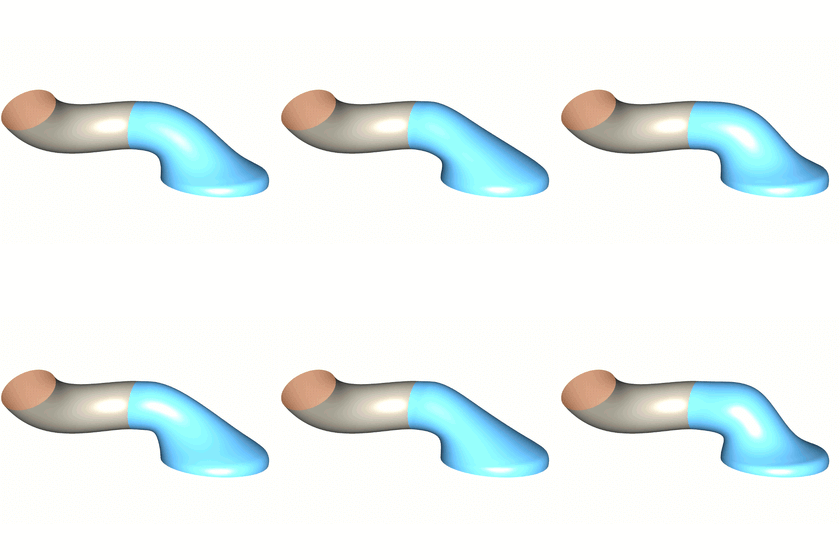
Optimization of catalytic converter performance using CAESES.

Optimization of the duct of the catalytic converter using CAESES!

Designing engine components for automobiles often involves considering many constraints, making it a challenging task within development design work. One example is the duct located just before the catalytic converter. Due to space constraints, this component is often designed to be bent quite sharply, which makes it difficult to ensure that the flow distribution is sufficiently uniform. In other words, if the flow characteristics of the catalytic converter are poor, there is a possibility that performance will decrease and emissions will increase. In this case, optimization of the duct for the catalytic converter will be performed using CAESES. *For more details, please refer to the related links. For further information, feel free to download the PDF or contact us.*

  • 6385803935833329694682380.gif
  • 9-2.png
  • 6385803976342704737924415.gif
  • 9.png
  • Other analysis software
  • Simulation Software

Added to bookmarks

Bookmarks list

Bookmark has been removed

Bookmarks list

You can't add any more bookmarks

By registering as a member, you can increase the number of bookmarks you can save and organize them with labels.

Free membership registration

Automatic Optimization using Adjoint Flow Solvers

It is possible to efficiently obtain optimal candidate geometry that can be directly supplied to the downstream CAD design process!

At FRIENDSHIP SYSTEMS, the developer of the CAD and optimization software CAESES, automatic optimization calculations were performed based on the shape sensitivity calculated by Adjoint Flow Solvers. The open-source optimization toolkit Dakota, integrated into CAESES, provides optimization methods that can directly accept gradient information obtained by combining shape sensitivity with CAD model parameters as input data. Based on this information, the algorithm selects parameters for design candidates created by CAESES, and calculations are performed using Adjoint Flow Solvers. *For more detailed information, please refer to the related links. For further details, you can download the PDF or feel free to contact us.*

  • 3-2.png
  • 3-3.png
  • 3-4.png
  • Other analysis software
  • Simulation Software

Added to bookmarks

Bookmarks list

Bookmark has been removed

Bookmarks list

You can't add any more bookmarks

By registering as a member, you can increase the number of bookmarks you can save and organize them with labels.

Free membership registration

Optimization of the shape of the volute and diffuser of a centrifugal compressor.

For shape creation, we use CAESES, and for mesh model creation and CFD analysis, we use products from NUMECA!

At the Technical University of Darmstadt in Germany (Institute of Gas Turbines and Aerospace Propulsion), research was conducted on the automatic optimization of the volute of centrifugal compressors and vane diffusers. This project was carried out in collaboration with NUMECA, a German company, and Kompressorenbau Bannewitz GmbH (KBB), a turbo machinery manufacturer. CAESES was used for shape creation, while NUMECA's products were utilized for mesh model creation and CFD analysis. In CAESES, a parametric model was created that allowed for variations in the cross-sectional shape and area distribution of the volute. For the diffuser, a non-axisymmetric design was implemented, enabling quick shape transformations by varying the misalignment angle, blade twist, chord length, pitch, and rotation through a parametric model. *For more detailed information, please refer to the related links. You can download the PDF for more details or feel free to contact us.*

  • 遠心圧縮機のボリュートとディフューザーの形状最適化2.png
  • Structural Analysis
  • Other analysis software
  • Simulation Software

Added to bookmarks

Bookmarks list

Bookmark has been removed

Bookmarks list

You can't add any more bookmarks

By registering as a member, you can increase the number of bookmarks you can save and organize them with labels.

Free membership registration

Optimization Case of Centrifugal Compressor Impeller Using CAESES

By constructing a parametric model, it is also possible to optimize the entire compressor model!

Centrifugal compressors are compact yet feature a high pressure ratio, and they are widely used in systems in the fields of aircraft and marine vessels. Impeller design is a crucial design aspect of centrifugal compressors and has a significant impact on compressor performance. In this case, we conducted automatic performance optimization using CAESES combined with CFD tools on an existing centrifugal compressor impeller model. *For more detailed information, please refer to the related links. For further details, you can download the PDF or feel free to contact us.*

  • CAESESによる遠心圧縮機インペラの最適化事例2.png
  • CAESESによる遠心圧縮機インペラの最適化事例3.png
  • CAESESによる遠心圧縮機インペラの最適化事例4.png
  • CAESESによる遠心圧縮機インペラの最適化事例7.gif
  • CAESESによる遠心圧縮機インペラの最適化事例8.gif
  • CAESESによる遠心圧縮機インペラの最適化事例9.gif
  • CAESESによる遠心圧縮機インペラの最適化事例10.gif
  • Centrifugal concentrator
  • Simulation Software

Added to bookmarks

Bookmarks list

Bookmark has been removed

Bookmarks list

You can't add any more bookmarks

By registering as a member, you can increase the number of bookmarks you can save and organize them with labels.

Free membership registration

Reduction of CO2 emissions through hull shape optimization.

Introducing how much the annual CO2 emissions have been reduced by utilizing CAESES!

FRIENDSHIP SYSTEMS, the developer of CAESES, has contributed to the reduction of energy consumption and CO2 emissions not only through support for the improvement of turbo machinery and engine-related parts but also for vessels. This article will introduce the experiences in design and improvement for CO2 emission reduction and how much annual CO2 emissions have been reduced by utilizing CAESES. *For detailed content of the article, please refer to the related link. For more information, feel free to download the PDF or contact us.

  • 船体形状最適化によるCO2排出量の削減2.png
  • 船体形状最適化によるCO2排出量の削減3.jpg
  • Other analyses
  • Modeler
  • Simulation Software

Added to bookmarks

Bookmarks list

Bookmark has been removed

Bookmarks list

You can't add any more bookmarks

By registering as a member, you can increase the number of bookmarks you can save and organize them with labels.

Free membership registration

[Example] Efficient Optimization through Morphing 'CAESES'

Only the modified parts of the existing shape are defined by parameters! Various shapes can be created.

We will introduce efficient optimization using morphing with "CAESES," which we provide. It is mainly used in the shipbuilding and maritime industry, but the majority of users focus on full parametric modeling. In morphing (partial parametric modeling), the deformation of imported existing geometry is performed. Therefore, only the modified parts of the existing shape are defined by parameters, allowing for the creation of various shapes. 【Previous Morphing Features】 ■ Shift transformations ■ Lackenby shift ■ Free-Foam deformation (FFD) ■ Cartesian shifts ■ Spot transformations *For more details, please download the PDF or feel free to contact us.

  • 1.PNG
  • 2.PNG
  • 3.PNG
  • 4.PNG
  • 5.PNG
  • 6.PNG
  • 7.PNG
  • 8.PNG
  • 9.PNG
  • Other analysis software
  • Simulation Software

Added to bookmarks

Bookmarks list

Bookmark has been removed

Bookmarks list

You can't add any more bookmarks

By registering as a member, you can increase the number of bookmarks you can save and organize them with labels.

Free membership registration

Design of a centrifugal water pump

Implementing the design process of a centrifugal water pump that maximally utilizes the capabilities of CAESES!

Centrifugal pumps are commonly used in industrial and household applications because their design, manufacturing, and maintenance are relatively simple. They also have the advantage of being efficient and easily adaptable to various sizes. Students from the Department of Transportation Systems at the Technical University of Berlin implemented the design process of a centrifugal water pump that maximizes the capabilities of CAESES as part of an internship project at FRIENDSHIP SYSTEMS, the developer of CAESES. *For more details, you can view the related links. For further information, please download the PDF or feel free to contact us.*

  • 遠心式ウォーターポンプの設計2.png
  • 遠心式ウォーターポンプの設計3.png
  • 遠心式ウォーターポンプの設計4.png
  • Structural Analysis
  • Other pumps
  • Simulation Software

Added to bookmarks

Bookmarks list

Bookmark has been removed

Bookmarks list

You can't add any more bookmarks

By registering as a member, you can increase the number of bookmarks you can save and organize them with labels.

Free membership registration

Optimization of the rear wing shape

Utilizing CAESES for the optimization of the rear wing shape attached to racing cars!

FRIENDSHIP SYSTEMS, the developer of CAESES, has actively supported student racing teams such as FaSTTUBe and the Ryerson Formula Racing Team. Among these, CAESES was utilized for the optimization of the rear wing shape of racing cars in the Formula Student Germany (FSG) contest, which gathers students from all over Germany. This case study will introduce the optimization of the rear wing and its results. *For more detailed information, please refer to the related links. For further inquiries, feel free to download the PDF or contact us.*

  • 9-2.png
  • 9-3.gif
  • 9-4.png
  • 9-5.png
  • 9-6.png
  • 9-7.png
  • Other analysis software
  • Simulation Software

Added to bookmarks

Bookmarks list

Bookmark has been removed

Bookmarks list

You can't add any more bookmarks

By registering as a member, you can increase the number of bookmarks you can save and organize them with labels.

Free membership registration

Aerodynamic optimization of vertical axis wind turbines

CAESES can perform optimization calculations and support users in their design tasks!

In this case, we will introduce the optimization calculations for vertical axis wind turbines. FRIENDSHIP SYSTEMS, the developer of the optimization design system CAESES, investigated the aerodynamic behavior of vertical axis wind turbines using the mesh generation software Pointwise. As a first initiative, FRIENDSHIP SYSTEMS connected the automatic mesh generation by Pointwise with CAESES and executed a method to optimize vertical axis wind turbines in 2D using various tools, including analysis software. *For more details, you can view the related links. For further information, please download the PDF or feel free to contact us.*

  • 垂直軸風力タービンの空力最適化2.png
  • 垂直軸風力タービンの空力最適化3.png
  • 垂直軸風力タービンの空力最適化4.png
  • Turbine
  • Simulation Software

Added to bookmarks

Bookmarks list

Bookmark has been removed

Bookmarks list

You can't add any more bookmarks

By registering as a member, you can increase the number of bookmarks you can save and organize them with labels.

Free membership registration

Propeller design of Caterpillar Propulsion

Execute tasks such as setting up the blade model and generating individual dynamic 2D drawings!

Caterpillar Propulsion has implemented CAESES for the design of propeller blades. When we started on a project basis, the overall idea was to implement it as a workbench that integrates and controls mesh generation and simulation software. At the same time, CAESES needs to provide a fully parametric 3D blade design that allows Caterpillar Propulsion's engineers to reconstruct the definitions of existing blades and profiles, while also requiring high flexibility to try out entirely new designs. *For more details, please refer to the related link. For further information, you can download the PDF or feel free to contact us.*

  • Caterpillar Propulsionのプロペラ設計2.png
  • Mechanical Design
  • Simulation Software

Added to bookmarks

Bookmarks list

Bookmark has been removed

Bookmarks list

You can't add any more bookmarks

By registering as a member, you can increase the number of bookmarks you can save and organize them with labels.

Free membership registration

Torque converter shape optimization

CAESES provides beneficial results across various fields, regardless of the products in question!

A torque converter for automobiles is a type of fluid coupling used in vehicles equipped with automatic transmissions to transmit rotational force from the engine to the drive shaft. Designers of torque converters work to minimize cavitation within the device and ensure good flow behavior of the transmission oil, aiming to maximize efficiency and torque ratio at high speeds. CAESES enables the modeling of such complex shapes and can build an optimization system that incorporates shape data into analysis software. By connecting CFD analysis software and proprietary CFD codes to CAESES, it analyzes flow behavior for each designed shape during optimization calculations and provides users with the optimal shape based on constraints. *For more detailed information, please refer to the related links. For further details, feel free to download the PDF or contact us.*

  • 13-2.png
  • Other analysis software
  • Simulation Software

Added to bookmarks

Bookmarks list

Bookmark has been removed

Bookmarks list

You can't add any more bookmarks

By registering as a member, you can increase the number of bookmarks you can save and organize them with labels.

Free membership registration

Optimization of globe valve shape

The purpose is to improve and investigate the performance of globe valves, connecting the cloud-based CFD solver SimScale with CAESES!

CAESES has been conducting optimization calculations for various types of valves and has implemented projects in collaboration with various companies. In this context, we would like to introduce one of the newly conducted projects, "Shape Optimization of a Globe Valve." This project was carried out in cooperation with GEMÜ Gebr. Müller Apparatebau, a German valve manufacturer and a global company specializing in aseptic valves, and SimScale, a leading engineering simulation company. *For more detailed information, please refer to the related links. You can download the PDF for more details or feel free to contact us.*

  • グローブバルブの形状最適化2.png
  • グローブバルブの形状最適化3.png
  • グローブバルブの形状最適化4.png
  • グローブバルブの形状最適化5.png
  • グローブバルブの形状最適化6.png
  • グローブバルブの形状最適化7.png
  • グローブバルブの形状最適化8.png
  • Structural Analysis
  • Other CAD
  • valve
  • Simulation Software

Added to bookmarks

Bookmarks list

Bookmark has been removed

Bookmarks list

You can't add any more bookmarks

By registering as a member, you can increase the number of bookmarks you can save and organize them with labels.

Free membership registration

Marine platform

The final structure reduced relative motion by 4% compared to the initial structure, resulting in material savings.

The support structure of the ocean platform must withstand the effects of waves over a long period and must have sufficient strength. By using CAESES, it is possible to optimize that structure and enhance its ability to withstand waves. This time, we conducted optimization of the ocean platform using CAESES. *For more detailed information, please refer to the related link. For further details, you can download the PDF or feel free to contact us.*

  • 6368763462076739021753337.gif
  • 6368763466640089517647976.gif
  • 6368763471879947459637115.jpg
  • Software (middle, driver, security, etc.)
  • Other analyses
  • Simulation Software

Added to bookmarks

Bookmarks list

Bookmark has been removed

Bookmarks list

You can't add any more bookmarks

By registering as a member, you can increase the number of bookmarks you can save and organize them with labels.

Free membership registration

Optimization design of assistive artificial hearts

Introducing the parametric model of the pump model and the evaluation of H-Q (Head-Flow) and T-Q (Torque-Flow)!

This article introduces the research and development of a ventricular assist device conducted by researchers at the Penn State College of Medicine using CAESES and CONVERGE. The goal of this research is to reduce the risk of adverse events such as hemolysis, degradation of von Willebrand factor, and thrombosis while minimizing the size of the pumps used in artificial hearts. To efficiently create a wide range of pump designs, CAESES has parameterized the flow path shape of the pump. *For more detailed information, you can view the related links. For further details, please download the PDF or feel free to contact us.*

  • 補助人工心臓の最適化設計2.png
  • 補助人工心臓の最適化設計3.png
  • 補助人工心臓の最適化設計4.png
  • Structural Analysis
  • Other analysis software
  • Other Pumps
  • Simulation Software

Added to bookmarks

Bookmarks list

Bookmark has been removed

Bookmarks list

You can't add any more bookmarks

By registering as a member, you can increase the number of bookmarks you can save and organize them with labels.

Free membership registration

Optimization of vessels

The total hull resistance obtained after parametric modeling, CFD analysis, and optimization processing was reduced by 2 to 3%.

CAESES's hull parametric modeling, when combined with CFD software, facilitates the study of hull shapes (reducing resistance) and enables the design to optimize hull performance. The hull shape, particularly the forward shape, has a significant impact on hull resistance, making shape optimization crucial. With CAESES, hulls can be easily parameterized, allowing for straightforward adjustments to the hull shape. By generating multiple shape patterns and combining them with analysis tools, designs can be optimized according to various optimization objectives. *For more detailed information, please refer to the related links. For further details, you can download the PDF or feel free to contact us.*

  • 6370199815693877095633449.gif
  • 6370199819867683684716010.jpg
  • Software (middle, driver, security, etc.)
  • Other analyses
  • Simulation Software

Added to bookmarks

Bookmarks list

Bookmark has been removed

Bookmarks list

You can't add any more bookmarks

By registering as a member, you can increase the number of bookmarks you can save and organize them with labels.

Free membership registration

CFD optimization through integration with AnsysCFD.

An appropriate CAD tool is needed to ensure the generation of various model variations to be analyzed in the automation process!

Ansys CFD tools such as Fluent and CFX receive strong support from engineers for evaluating fluid dynamic behavior in design, along with various options and tools used for mesh creation. These tools provide valuable information and insights regarding the performance to be evaluated. Moreover, they enable automated optimization and design exploration workflows that include CFD. In addition to improving design and shortening development time and design cycles, these tools significantly enhance the development process by increasing information about the impact of various design variables on performance (product behavior) during the initial design phase, where there is a high degree of freedom in decision-making. *For more details, you can view the related links. For more information, please download the PDF or feel free to contact us.*

  • 【CAESES】AnsysCFDとの連携によるCFD最適化2.png
  • 【CAESES】AnsysCFDとの連携によるCFD最適化3.png
  • 【CAESES】AnsysCFDとの連携によるCFD最適化4.png
  • 【CAESES】AnsysCFDとの連携によるCFD最適化5.png
  • 【CAESES】AnsysCFDとの連携によるCFD最適化6.png
  • 【CAESES】AnsysCFDとの連携によるCFD最適化7.png
  • 【CAESES】AnsysCFDとの連携によるCFD最適化8.png
  • 【CAESES】AnsysCFDとの連携によるCFD最適化9.png
  • Structural Analysis
  • Other CAD
  • Simulation Software

Added to bookmarks

Bookmarks list

Bookmark has been removed

Bookmarks list

You can't add any more bookmarks

By registering as a member, you can increase the number of bookmarks you can save and organize them with labels.

Free membership registration

Design and optimization of valves

The procedure explored using CAESES achieved a reduction in working time from several months to several days!

The optimization of valve design is one of many optimization targets, and by appropriately automating the design change process using CAESES and analyzing the number of implementation cases generated by the CFD solver, it is possible to significantly shorten the time to commercialization while exploring truly suitable designs under constraints. A valve is a device that opens, closes, or partially obstructs various passages to control, direct, or adjust the flow of fluid. In an open valve, fluid flows from high pressure to low pressure. Typically, the main objective of valve optimization is to adjust the flow rate passing through the valve at a specified pressure loss. This is often expressed as a flow coefficient, which serves as a relative measure of flow efficiency. *For more detailed information, please refer to the related links. For more details, you can download the PDF or feel free to contact us.*

  • バルブの設計と最適化2.jpg
  • バルブの設計と最適化3.gif
  • バルブの設計と最適化4.gif
  • バルブの設計と最適化5.gif
  • バルブの設計と最適化7.gif
  • バルブの設計と最適化8.gif
  • バルブの設計と最適化9.gif
  • バルブの設計と最適化10.gif
  • バルブの設計と最適化11.gif
  • valve
  • Simulation Software

Added to bookmarks

Bookmarks list

Bookmark has been removed

Bookmarks list

You can't add any more bookmarks

By registering as a member, you can increase the number of bookmarks you can save and organize them with labels.

Free membership registration

Optimization of the poppet valve

This article explains the design system based on the collaboration between the CFD solver SimericsMP and CAESES, based on actual research conducted!

The Italian company OMIQ SRL, which sells software, conducted research on an automatic design system using the poppet valve of high-pressure pumps developed by the Danish machinery manufacturer Danfoss. In this case, we will introduce the design system that integrates the CFD solver SimericsMP with CAESES based on the research that was actually conducted. The issue in this case is that the poppet valve exhibits unacceptable unstable behavior during operation. It was found that when the poppet valve attempts to open to its maximum displacement (27.5 mm), the instability of the flow increases, resulting in a decrease in pressure on the poppet valve, ultimately preventing the valve from fully opening (closing to about 6 mm remaining). This unstable phenomenon was verified through unsteady analysis using SimericsMP. *For more detailed information, please refer to the related link. For further details, you can download the PDF or feel free to contact us.*

  • ポペットバルブの最適化2.png
  • ポペットバルブの最適化3.gif
  • ポペットバルブの最適化4.gif
  • ポペットバルブの最適化5.gif
  • ポペットバルブの最適化6.gif
  • ポペットバルブの最適化7.png
  • ポペットバルブの最適化8.png
  • ポペットバルブの最適化9.png
  • ポペットバルブの最適化10.png
  • valve
  • Simulation Software

Added to bookmarks

Bookmarks list

Bookmark has been removed

Bookmarks list

You can't add any more bookmarks

By registering as a member, you can increase the number of bookmarks you can save and organize them with labels.

Free membership registration

Optimization of the turbine blade shape of the turbocharger.

Introduction to the combination of CFD and stress analysis, as well as scallop turbine wheels!

FRIENDSHIP SYSTEMS, the developer of CAESES, has collaborated with MTU and Darmstadt University of Technology to develop a robust and variable turbine wheel geometry for turbochargers. The research, called Project GAMMA ("Efficient Gas Engines for Maritime Applications of the Next Generation"), aims to develop and prepare new technologies and interactions within the system for LNG/natural gas, which serves as fuel for efficient ship propulsion systems. *For more detailed information, please refer to the related links. You can download the PDF for more details or feel free to contact us.*

  • ターボチャージャーのタービンブレード形状最適化2.png
  • ターボチャージャーのタービンブレード形状最適化3.png
  • ターボチャージャーのタービンブレード形状最適化4.png
  • ターボチャージャーのタービンブレード形状最適化5.png
  • ターボチャージャーのタービンブレード形状最適化6.png
  • ターボチャージャーのタービンブレード形状最適化7.png
  • ターボチャージャーのタービンブレード形状最適化8.png
  • Structural Analysis
  • Turbine
  • Simulation Software

Added to bookmarks

Bookmarks list

Bookmark has been removed

Bookmarks list

You can't add any more bookmarks

By registering as a member, you can increase the number of bookmarks you can save and organize them with labels.

Free membership registration

Optimization of bulk carrier shape

The objective function of the first stage of optimization was set for five combinations of draft and speed regarding power consumption and hull weight at sea.

This time, we will introduce a case of optimization for bulk carriers by DNV GL, a European classification society. This case involves the optimization calculations for the hull and propeller of a bulk carrier. The hull in question is an Ultramax-sized hull called "Diamond 2." The optimization includes wave reduction, propulsion at the stern, twisting at the stern, and propeller design, with the shapes created using the CAD features of CAESES. *For more detailed information, please refer to the related links. For further details, you can download the PDF or feel free to contact us.*

  • 6376317451117000702293720.png
  • 6376317457457505981388963.png
  • 6376194216919820486447540.png
  • Software (middle, driver, security, etc.)
  • Other analyses
  • Simulation Software

Added to bookmarks

Bookmarks list

Bookmark has been removed

Bookmarks list

You can't add any more bookmarks

By registering as a member, you can increase the number of bookmarks you can save and organize them with labels.

Free membership registration

Optimization of the air intake for AIPOD.

Introduction to parametric modeling using CAD and optimization software CAESES.

This article introduces the air intake optimization of ramjet engines using AIPOD, our self-developed optimization platform. Ramjet engines are designed for air intake at Mach numbers of 3 and above, where the mixture flows in and the exit becomes subsonic, making it a type of jet engine. To accommodate different flight Mach numbers, a center cone called a spike can be moved forward and backward, and when the maximum flight Mach number of 3.5 is reached, the Mach line formed at the tapered vertex intersects exactly with the lip. *For more detailed information, please refer to the related links. For further details, you can download the PDF or feel free to contact us.

  • 6381759902813614445822789.png
  • 6381759981474546185610338.png
  • 6381759992713570191512476.png
  • 6381760054527663661365892.png
  • 6381760086352692063301304.png
  • 6381760100908887057236142.png
  • 6381760116855762934017998 (1).png
  • 6381760116855762934017998.png
  • 6381760135552657312363288.png
  • Other analyses
  • Simulation Software

Added to bookmarks

Bookmarks list

Bookmark has been removed

Bookmarks list

You can't add any more bookmarks

By registering as a member, you can increase the number of bookmarks you can save and organize them with labels.

Free membership registration

3D simulation software for package design 'iC3D'

3D simulation software that consolidates the functions necessary for package design.

"iC3D" is a 3D designing application developed for all package printing. While creating 3D models within the software, you can freely import and map artwork created in other design applications. It visualizes in real-time and accurately how design ideas are transformed into three dimensions, from creating 3D models and applying artwork to displaying and creating store display images. [Features] - Consolidates the necessary functions for package design - Creates bottle shapes by importing dxf data exported from AI - Maps AI artwork to specified areas to create labels - Capable of creating models with complex shapes - Can execute complex shrink simulations accurately and quickly *For more details, please refer to the PDF materials or feel free to contact us.

  • Image Processing Software
  • Simulation Software

Added to bookmarks

Bookmarks list

Bookmark has been removed

Bookmarks list

You can't add any more bookmarks

By registering as a member, you can increase the number of bookmarks you can save and organize them with labels.

Free membership registration

Aiming for the realization of a society with zero traffic accidents where everyone can move safely and securely.

Evaluation results obtained from simulations and challenges for improving technology!

At Toyota Motor Corporation, we continue to work on improving the performance of technologies that support safe driving in order to realize our wish for zero traffic accident fatalities and injuries. This time, we spoke about the efforts related to predicting the effectiveness of Autonomous Emergency Braking (AEB) using CarMaker in the Advanced Mobility System Development Department, as well as our outlook for future improvements in simulation technology. *For more detailed information, please refer to the attached PDF. Feel free to contact us for further inquiries.

  • Development support tools (ICE, emulators, debuggers, etc.)
  • Simulation Software

Added to bookmarks

Bookmarks list

Bookmark has been removed

Bookmarks list

You can't add any more bookmarks

By registering as a member, you can increase the number of bookmarks you can save and organize them with labels.

Free membership registration

Optimization of turbine blade shape

Enabling optimization calculations of parametric models through automated processes!

In this case, we will introduce the shape optimization of gas turbine fixed blades, including end wall contouring, which is a joint project with SIEMENS. An efficient workflow using CAESES can provide significant support for design development. The gas turbine, which is the application in this instance, is a type of internal combustion engine used for driving generators, among other purposes. *For more detailed information, you can view it through the related links. For more details, please download the PDF or feel free to contact us.

  • タービンブレードの形状最適化2.gif
  • Turbine
  • Simulation Software

Added to bookmarks

Bookmarks list

Bookmark has been removed

Bookmarks list

You can't add any more bookmarks

By registering as a member, you can increase the number of bookmarks you can save and organize them with labels.

Free membership registration

Optimization of the Leading Edge for Boundary Layer Experiments on a Flat Plate

When the minimum curvature radius is approximately 2.5mm, it is possible to prevent plastic deformation of the steel belt!

Predicting transitional boundary layers under arbitrary conditions in fluid mechanics is a very challenging task. A research group at Karlsruhe Institute of Technology conducted tests for predicting transitional boundary layers considering the effects of pressure gradients, mainstream turbulence, and surface roughness, using CAESES and the open-source OpenFOAM for suitable leading-edge shape optimization. *For more details, you can view the related links. For further information, please download the PDF or feel free to contact us.*

  • 平板境界層実験のためのリーディングエッジの最適化2.png
  • 平板境界層実験のためのリーディングエッジの最適化3.png
  • 平板境界層実験のためのリーディングエッジの最適化4.png
  • 平板境界層実験のためのリーディングエッジの最適化5.png
  • 平板境界層実験のためのリーディングエッジの最適化6.png
  • 平板境界層実験のためのリーディングエッジの最適化7.png
  • 平板境界層実験のためのリーディングエッジの最適化8.png
  • others
  • Simulation Software

Added to bookmarks

Bookmarks list

Bookmark has been removed

Bookmarks list

You can't add any more bookmarks

By registering as a member, you can increase the number of bookmarks you can save and organize them with labels.

Free membership registration