We have compiled a list of manufacturers, distributors, product information, reference prices, and rankings for Simulation software.
ipros is IPROS GMS IPROS One of the largest technical database sites in Japan that collects information on.

Simulation software Product List and Ranking from 175 Manufacturers, Suppliers and Companies

Last Updated: Aggregation Period:Dec 31, 2025~Jan 27, 2026
This ranking is based on the number of page views on our site.

Simulation software Manufacturer, Suppliers and Company Rankings

Last Updated: Aggregation Period:Dec 31, 2025~Jan 27, 2026
This ranking is based on the number of page views on our site.

  1. FsTech Kanagawa//software
  2. アスペンテックジャパン/AspenTech Tokyo//software
  3. CGTech Tokyo//software
  4. 4 シュレーディンガー Tokyo//software
  5. 5 null/null

Simulation software Product ranking

Last Updated: Aggregation Period:Dec 31, 2025~Jan 27, 2026
This ranking is based on the number of page views on our site.

  1. Design and Optimization of VOITH Linear Jet FsTech
  2. Aspen Plus process simulation software アスペンテックジャパン/AspenTech
  3. [Research and Development] Mixing Simulation Software 'TEX-FAN'
  4. 4 Engine simulation software "GT-POWER" IDAJ
  5. 5 CNC simulation software『Vericut 9.6』 CGTech

Simulation software Product List

616~630 item / All 727 items

Displayed results

Optimization design of assistive artificial hearts

Introducing the parametric model of the pump model and the evaluation of H-Q (Head-Flow) and T-Q (Torque-Flow)!

This article introduces the research and development of a ventricular assist device conducted by researchers at the Penn State College of Medicine using CAESES and CONVERGE. The goal of this research is to reduce the risk of adverse events such as hemolysis, degradation of von Willebrand factor, and thrombosis while minimizing the size of the pumps used in artificial hearts. To efficiently create a wide range of pump designs, CAESES has parameterized the flow path shape of the pump. *For more detailed information, you can view the related links. For further details, please download the PDF or feel free to contact us.*

  • 補助人工心臓の最適化設計2.png
  • 補助人工心臓の最適化設計3.png
  • 補助人工心臓の最適化設計4.png
  • Structural Analysis
  • Other analysis software
  • Other Pumps
  • Simulation software

Added to bookmarks

Bookmarks list

Bookmark has been removed

Bookmarks list

You can't add any more bookmarks

By registering as a member, you can increase the number of bookmarks you can save and organize them with labels.

Free membership registration

Optimization of turbine blade shape

Enabling optimization calculations of parametric models through automated processes!

In this case, we will introduce the shape optimization of gas turbine fixed blades, including end wall contouring, which is a joint project with SIEMENS. An efficient workflow using CAESES can provide significant support for design development. The gas turbine, which is the application in this instance, is a type of internal combustion engine used for driving generators, among other purposes. *For more detailed information, you can view it through the related links. For more details, please download the PDF or feel free to contact us.

  • タービンブレードの形状最適化2.gif
  • Turbine
  • Simulation software

Added to bookmarks

Bookmarks list

Bookmark has been removed

Bookmarks list

You can't add any more bookmarks

By registering as a member, you can increase the number of bookmarks you can save and organize them with labels.

Free membership registration

Aerodynamic optimization of vertical axis wind turbines

CAESES can perform optimization calculations and support users in their design tasks!

In this case, we will introduce the optimization calculations for vertical axis wind turbines. FRIENDSHIP SYSTEMS, the developer of the optimization design system CAESES, investigated the aerodynamic behavior of vertical axis wind turbines using the mesh generation software Pointwise. As a first initiative, FRIENDSHIP SYSTEMS connected the automatic mesh generation by Pointwise with CAESES and executed a method to optimize vertical axis wind turbines in 2D using various tools, including analysis software. *For more details, you can view the related links. For further information, please download the PDF or feel free to contact us.*

  • 垂直軸風力タービンの空力最適化2.png
  • 垂直軸風力タービンの空力最適化3.png
  • 垂直軸風力タービンの空力最適化4.png
  • Turbine
  • Simulation software

Added to bookmarks

Bookmarks list

Bookmark has been removed

Bookmarks list

You can't add any more bookmarks

By registering as a member, you can increase the number of bookmarks you can save and organize them with labels.

Free membership registration

Optimization of the poppet valve

This article explains the design system based on the collaboration between the CFD solver SimericsMP and CAESES, based on actual research conducted!

The Italian company OMIQ SRL, which sells software, conducted research on an automatic design system using the poppet valve of high-pressure pumps developed by the Danish machinery manufacturer Danfoss. In this case, we will introduce the design system that integrates the CFD solver SimericsMP with CAESES based on the research that was actually conducted. The issue in this case is that the poppet valve exhibits unacceptable unstable behavior during operation. It was found that when the poppet valve attempts to open to its maximum displacement (27.5 mm), the instability of the flow increases, resulting in a decrease in pressure on the poppet valve, ultimately preventing the valve from fully opening (closing to about 6 mm remaining). This unstable phenomenon was verified through unsteady analysis using SimericsMP. *For more detailed information, please refer to the related link. For further details, you can download the PDF or feel free to contact us.*

  • ポペットバルブの最適化2.png
  • ポペットバルブの最適化3.gif
  • ポペットバルブの最適化4.gif
  • ポペットバルブの最適化5.gif
  • ポペットバルブの最適化6.gif
  • ポペットバルブの最適化7.png
  • ポペットバルブの最適化8.png
  • ポペットバルブの最適化9.png
  • ポペットバルブの最適化10.png
  • valve
  • Simulation software

Added to bookmarks

Bookmarks list

Bookmark has been removed

Bookmarks list

You can't add any more bookmarks

By registering as a member, you can increase the number of bookmarks you can save and organize them with labels.

Free membership registration

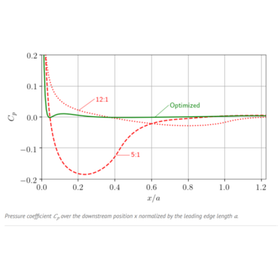
Optimization of the Leading Edge for Boundary Layer Experiments on a Flat Plate

When the minimum curvature radius is approximately 2.5mm, it is possible to prevent plastic deformation of the steel belt!

Predicting transitional boundary layers under arbitrary conditions in fluid mechanics is a very challenging task. A research group at Karlsruhe Institute of Technology conducted tests for predicting transitional boundary layers considering the effects of pressure gradients, mainstream turbulence, and surface roughness, using CAESES and the open-source OpenFOAM for suitable leading-edge shape optimization. *For more details, you can view the related links. For further information, please download the PDF or feel free to contact us.*

  • 平板境界層実験のためのリーディングエッジの最適化2.png
  • 平板境界層実験のためのリーディングエッジの最適化3.png
  • 平板境界層実験のためのリーディングエッジの最適化4.png
  • 平板境界層実験のためのリーディングエッジの最適化5.png
  • 平板境界層実験のためのリーディングエッジの最適化6.png
  • 平板境界層実験のためのリーディングエッジの最適化7.png
  • 平板境界層実験のためのリーディングエッジの最適化8.png
  • others
  • Simulation software

Added to bookmarks

Bookmarks list

Bookmark has been removed

Bookmarks list

You can't add any more bookmarks

By registering as a member, you can increase the number of bookmarks you can save and organize them with labels.

Free membership registration

A New Approach to the Design of sCO2 Axial Flow Turbines

Introducing a design case of a supercritical carbon dioxide axial flow turbine for waste heat recovery (WHR) in a 10MW class power plant!

In conventional thermal and nuclear power plants, steam and combustion gases are used as working fluids to drive turbines and generate electricity. In this case, we will introduce a design method for axial flow turbines using supercritical carbon dioxide (sCO2) as the working fluid, which reaches a supercritical state under relatively mild conditions using CAESES. The supercritical state exhibits properties that are intermediate between gas and liquid, and due to its high density and heat capacity, it has the potential to improve cycle efficiency compared to using gases below the critical point. *For more detailed information, please refer to the related links. For further details, you can download the PDF or feel free to contact us.*

  • sCO2軸流タービン設計のための新しいアプローチ2.png
  • sCO2軸流タービン設計のための新しいアプローチ3.png
  • sCO2軸流タービン設計のための新しいアプローチ4.png
  • sCO2軸流タービン設計のための新しいアプローチ5.png
  • sCO2軸流タービン設計のための新しいアプローチ6.png
  • Turbine
  • Simulation software

Added to bookmarks

Bookmarks list

Bookmark has been removed

Bookmarks list

You can't add any more bookmarks

By registering as a member, you can increase the number of bookmarks you can save and organize them with labels.

Free membership registration

Design and optimization of valves

The procedure explored using CAESES achieved a reduction in working time from several months to several days!

The optimization of valve design is one of many optimization targets, and by appropriately automating the design change process using CAESES and analyzing the number of implementation cases generated by the CFD solver, it is possible to significantly shorten the time to commercialization while exploring truly suitable designs under constraints. A valve is a device that opens, closes, or partially obstructs various passages to control, direct, or adjust the flow of fluid. In an open valve, fluid flows from high pressure to low pressure. Typically, the main objective of valve optimization is to adjust the flow rate passing through the valve at a specified pressure loss. This is often expressed as a flow coefficient, which serves as a relative measure of flow efficiency. *For more detailed information, please refer to the related links. For more details, you can download the PDF or feel free to contact us.*

  • バルブの設計と最適化2.jpg
  • バルブの設計と最適化3.gif
  • バルブの設計と最適化4.gif
  • バルブの設計と最適化5.gif
  • バルブの設計と最適化7.gif
  • バルブの設計と最適化8.gif
  • バルブの設計と最適化9.gif
  • バルブの設計と最適化10.gif
  • バルブの設計と最適化11.gif
  • valve
  • Simulation software

Added to bookmarks

Bookmarks list

Bookmark has been removed

Bookmarks list

You can't add any more bookmarks

By registering as a member, you can increase the number of bookmarks you can save and organize them with labels.

Free membership registration

Optimization Case of Centrifugal Compressor Impeller Using CAESES

By constructing a parametric model, it is also possible to optimize the entire compressor model!

Centrifugal compressors are compact yet feature a high pressure ratio, and they are widely used in systems in the fields of aircraft and marine vessels. Impeller design is a crucial design aspect of centrifugal compressors and has a significant impact on compressor performance. In this case, we conducted automatic performance optimization using CAESES combined with CFD tools on an existing centrifugal compressor impeller model. *For more detailed information, please refer to the related links. For further details, you can download the PDF or feel free to contact us.*

  • CAESESによる遠心圧縮機インペラの最適化事例2.png
  • CAESESによる遠心圧縮機インペラの最適化事例3.png
  • CAESESによる遠心圧縮機インペラの最適化事例4.png
  • CAESESによる遠心圧縮機インペラの最適化事例7.gif
  • CAESESによる遠心圧縮機インペラの最適化事例8.gif
  • CAESESによる遠心圧縮機インペラの最適化事例9.gif
  • CAESESによる遠心圧縮機インペラの最適化事例10.gif
  • Centrifugal concentrator
  • Simulation software

Added to bookmarks

Bookmarks list

Bookmark has been removed

Bookmarks list

You can't add any more bookmarks

By registering as a member, you can increase the number of bookmarks you can save and organize them with labels.

Free membership registration

Optimization of battery pack structure

The optimization calculation based on AIPOD resulted in a 4.69% reduction in mass!

In this analysis, we will build an automated simulation process for the battery pack and perform optimization with the goal of mass minimization. The software interface provided by AIPOD makes the process setup very simple. For the optimization, the thickness of 36 plates in the battery pack was given as design variables. The optimization goal is mass minimization, but the model's frequency, maximum plastic strain, and maximum RMS stress will be set as constraints. *For more detailed information, please refer to the related links. Feel free to contact us for more details.*

  • Other analysis software
  • Simulation software

Added to bookmarks

Bookmarks list

Bookmark has been removed

Bookmarks list

You can't add any more bookmarks

By registering as a member, you can increase the number of bookmarks you can save and organize them with labels.

Free membership registration

Optimization of the rear wing shape

Utilizing CAESES for the optimization of the rear wing shape attached to racing cars!

FRIENDSHIP SYSTEMS, the developer of CAESES, has actively supported student racing teams such as FaSTTUBe and the Ryerson Formula Racing Team. Among these, CAESES was utilized for the optimization of the rear wing shape of racing cars in the Formula Student Germany (FSG) contest, which gathers students from all over Germany. This case study will introduce the optimization of the rear wing and its results. *For more detailed information, please refer to the related links. For further inquiries, feel free to download the PDF or contact us.*

  • 9-2.png
  • 9-3.gif
  • 9-4.png
  • 9-5.png
  • 9-6.png
  • 9-7.png
  • Other analysis software
  • Simulation software

Added to bookmarks

Bookmarks list

Bookmark has been removed

Bookmarks list

You can't add any more bookmarks

By registering as a member, you can increase the number of bookmarks you can save and organize them with labels.

Free membership registration

Collaboration feature of CONVERGE and CAESES using the intake port.

Supporting development design operations! Introducing features that can be effectively utilized.

The optimization calculation software CAESES and the thermal fluid analysis software CONVERGE work together as a collaborative optimization system aimed at shape optimization and investigating the effects of design variables, providing support to engineers in the design and development field. In this article, we will introduce the functions that can be effectively utilized in CAESES when collaborating with CONVERGE, using intake port models and piston models. *For detailed content of the article, please refer to the related links. For more information, feel free to download the PDF or contact us.

  • 11-2.png
  • 11-3.png
  • 11-4.png
  • 11-5.png
  • 11-6.gif
  • Other analysis software
  • Simulation software

Added to bookmarks

Bookmarks list

Bookmark has been removed

Bookmarks list

You can't add any more bookmarks

By registering as a member, you can increase the number of bookmarks you can save and organize them with labels.

Free membership registration

Optimization of Motor Thermal Design for Electric Vehicles

Optimization aimed at minimizing the maximum temperature based on a flexible parametric model has been implemented!

In electric vehicles, the motor is a crucial power component responsible for driving the vehicle, and appropriate thermal management is essential to maintain its performance and durability. In particular, the cooling system plays an important role in efficiently dissipating heat from inside the motor and ensuring stable operation. In optimizing the thermal design of the motor, it is necessary to study appropriate cooling effects through various design patterns to maximize cooling performance. During the optimization process, design parameters such as the number and diameter of flow paths, the inclination angle and arrangement of end windings become important factors. Furthermore, to enhance cooling efficiency, careful attention must also be paid to flow control and temperature management of the end windings. In this case study, optimization aimed at minimizing the maximum temperature was conducted based on a flexible parametric model. The motor, composed of a stator and rotor, defines design variables that allow for various shape changes, leading to the derivation of appropriate flow path patterns. *For more detailed information, please refer to the related link. For further details, you can download the PDF or feel free to contact us.*

  • 16-2.gif
  • 16-3.gif
  • 16-4.gif
  • Other analysis software
  • Simulation software

Added to bookmarks

Bookmarks list

Bookmark has been removed

Bookmarks list

You can't add any more bookmarks

By registering as a member, you can increase the number of bookmarks you can save and organize them with labels.

Free membership registration

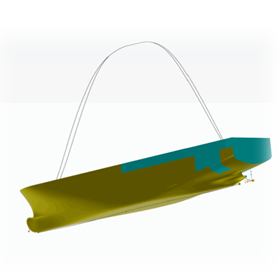
Dimensional reduction of hull shape using principal component analysis in CAESES.

Introducing the dimensional reduction function based on the drag optimization of KCS ships!

To optimize the hydrodynamic performance of the hull using the parametric modeling and optimization software CAESES, we first extract design variables related to the deformation of the hull's variable geometry. By increasing the number of design variables in this process, we can obtain a wider variety of deformation shapes, which in turn increases the likelihood of achieving better hull design proposals. However, the number of computational cases required for simulations (such as CFD analysis) increases exponentially (recommended number of cases S = 2^N, where N is the number of design variables), leading to significantly larger computational and time costs. To address this issue, CAESES5 offers a dimensionality reduction feature based on Principal Component Analysis (PCA) methods. *For more detailed information, please refer to the related links. For further details, feel free to download the PDF or contact us.*

  • 主成分分析による船体形状の次元圧縮2.png
  • 主成分分析による船体形状の次元圧縮3.png
  • 主成分分析による船体形状の次元圧縮4.png
  • 主成分分析による船体形状の次元圧縮5.png
  • 主成分分析による船体形状の次元圧縮6.png
  • 主成分分析による船体形状の次元圧縮7.png
  • 主成分分析による船体形状の次元圧縮8.png
  • Other analyses
  • Simulation software

Added to bookmarks

Bookmarks list

Bookmark has been removed

Bookmarks list

You can't add any more bookmarks

By registering as a member, you can increase the number of bookmarks you can save and organize them with labels.

Free membership registration

AIPOD: Optimization of Ship Performance

The selection of a rational optimization strategy is particularly important! The model in question is the KCS hull form.

In ship shape optimization, considering the analysis time and computational resource costs for a single case, engineers need to find an optimal design solution with as few computational cases as possible. Therefore, the selection of a rational optimization strategy becomes particularly important. This article introduces ship optimization using the general-purpose optimization platform AIPOD. *For more details, you can view the related links. For further information, please download the PDF or feel free to contact us.*

  • 船舶の性能最適化3.png
  • Thermo-fluid analysis
  • 3D CAD
  • Other analyses
  • Simulation software

Added to bookmarks

Bookmarks list

Bookmark has been removed

Bookmarks list

You can't add any more bookmarks

By registering as a member, you can increase the number of bookmarks you can save and organize them with labels.

Free membership registration

Propeller design for efoil using CAESES

Here is a brief introduction to the design of the propeller included with the foil board!

Do you all know about "efoil"? An efoil is an electric foil board that allows you to experience the sensation of flying above the water. Here, we will introduce some aspects of the propeller design that comes with the foil board, as discussed by a CAESES user with FRIENDSHIP SYSTEMS, the developer of CAESES. *You can view the detailed content of the article through the related links. For more information, please download the PDF or feel free to contact us.*

  • efoilのプロペラ設計2.png
  • Other analyses
  • 3D Printer
  • Simulation software

Added to bookmarks

Bookmarks list

Bookmark has been removed

Bookmarks list

You can't add any more bookmarks

By registering as a member, you can increase the number of bookmarks you can save and organize them with labels.

Free membership registration