46~55 item / All 55 items
Displayed results

Added to bookmarks
Bookmarks listBookmark has been removed
Bookmarks listYou can't add any more bookmarks
By registering as a member, you can increase the number of bookmarks you can save and organize them with labels.
Free membership registration
Contact this company
Inquiry Form46~55 item / All 55 items

We will introduce a case study of the analysis of metallic foreign objects present in a tube. The foreign object was collected, and morphological observation was conducted using SEM, followed by elemental analysis using the SEM-EPMA method, and semi-quantitative analysis of the detected elements was performed. ■ Information received from the customer regarding the occurrence of foreign objects - Situation of foreign object occurrence ⇒ Tube manufacturing - Material, size, and color of the foreign object ⇒ Metal, slightly less than 1 mm, rod-shaped, metallic luster - Expected content of the foreign object ⇒ Metal fragment - Other information ⇒ None in particular ■ Results Based on the elemental analysis results, the foreign object was determined to be stainless steel (SUS) of the Fe-Cr-Ni system. Furthermore, from the semi-quantitative analysis results, it was inferred to be austenitic SUS316 stainless steel. Stainless steel is widely used in various metal materials and components due to its excellent corrosion resistance.
Added to bookmarks
Bookmarks listBookmark has been removed
Bookmarks listYou can't add any more bookmarks
By registering as a member, you can increase the number of bookmarks you can save and organize them with labels.
Free membership registration
One of the important components among the nutrients in food is lipids, and over 90% of the lipids contained in edible oils are composed of triglycerides (TG). TG has a structure where three molecules of fatty acids are esterified to glycerol. In recent years, due to increasing health awareness, omega-3 fatty acids (such as alpha-linolenic acid) and medium-chain fatty acids have also gained attention as components of TG. However, to clarify the structure of TG, structural analysis through mass spectrometry and analysis of the constituent fatty acids are necessary. Liquid chromatography-time-of-flight mass spectrometry (LC-TOFMS) is effective for the analysis of these TGs, and the structure and constituent fatty acids of TG can be estimated from the MS spectrum and MS/MS spectrum. Here, we present examples of analyses of commercially available edible oils. ■ Analysis Samples Five types of commercially available edible oils (rapeseed oil, sesame oil, olive oil, flaxseed oil, MCT oil) ■ Analysis Equipment SCIEX Triple TOF6600 (LC-TOFMS) ■ Analysis Method After dissolving the sample in tetrahydrofuran (THF), it was appropriately diluted with methanol for LC-TOFMS analysis. ■ Analysis Results For details, please refer to the PDF document.
Added to bookmarks
Bookmarks listBookmark has been removed
Bookmarks listYou can't add any more bookmarks
By registering as a member, you can increase the number of bookmarks you can save and organize them with labels.
Free membership registration
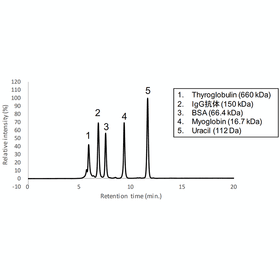
Quality control of proteins, including biopharmaceuticals, is important, particularly regarding aggregates such as dimers and oligomers, as well as degradation products (low molecular weight species), which have gained attention in recent years due to their relationship with immunogenicity. Size exclusion chromatography (SEC) is widely used as a simple method for analyzing these. Here, we present examples of analyses conducted on commercially available protein mixtures, IgG antibodies, and IgG antibodies that were aggregated through pH stress testing. *For more details, please refer to the PDF document or feel free to contact us.
Added to bookmarks
Bookmarks listBookmark has been removed
Bookmarks listYou can't add any more bookmarks
By registering as a member, you can increase the number of bookmarks you can save and organize them with labels.
Free membership registration
Amino acids related to the taste and umami of food are widely known. Additionally, "dipeptides," which consist of two amino acids, possess different physical and functional properties compared to amino acids and have recently attracted attention as functional components in fermented foods such as soy sauce and miso. At Kaneka Techno Research, we can conduct highly accurate analysis and evaluation using liquid chromatography-time-of-flight mass spectrometry (LC-TOFMS) and a library of amino acids and dipeptides (approximately 400 types). Here, we present an analysis case of amino acids and dipeptides in commercially available miso. [Case Overview] ■ Analysis Samples: Commercially available miso (3 types of soybean miso, 5 types of barley miso, 3 types of rice miso, totaling 11 types) ■ Analysis Equipment: SCIEX Triple TOF6600 (LC-TOFMS) *For more details, please refer to the PDF document or feel free to contact us.
Added to bookmarks
Bookmarks listBookmark has been removed
Bookmarks listYou can't add any more bookmarks
By registering as a member, you can increase the number of bookmarks you can save and organize them with labels.
Free membership registration
We would like to introduce a case of elemental impurity analysis of pharmaceuticals (active ingredients, intermediates, formulations) using ICP/MS under the quality control system required by GMP. In this analysis, since the components differ for each pharmaceutical, selecting the appropriate pretreatment method and choosing the internal standard are key to optimizing the ICP/MS conditions. We conduct the analysis by finding suitable analytical conditions with reliable analytical techniques. We also perform validation tests for each pharmaceutical, simultaneous screening analysis (70 elements from Li to U), and analysis using the ICP/AES method, so please feel free to consult us. 【Validation Plan】 ■ Using commercially available oral formulations, we conduct validation in accordance with USP <233> using microwave digestion-ICP/MS method. ■ Based on the PDE value, we convert the maximum daily intake of the formulation to 10g and calculate the concentration limit value J for the target elements. ■ We set 1/10 of the concentration limit value as the target quantification limit and conduct validation for 9 items. *For more details, please refer to the PDF document or feel free to contact us.
Added to bookmarks
Bookmarks listBookmark has been removed
Bookmarks listYou can't add any more bookmarks
By registering as a member, you can increase the number of bookmarks you can save and organize them with labels.
Free membership registration
The ultraviolet absorption of sugars (monosaccharides to oligosaccharides) can only be obtained around 190 to 195 nm, making detection difficult. Therefore, methods such as derivatization or using a refractive index detector (RID) or an evaporative light scattering detector (ELSD) are effective for measurement by HPLC. Here, we will introduce a case study analyzing sugars in soft drinks using RID and ELSD. For more details, please refer to the PDF download below. [Case Summary] ■ Analysis Samples - Commercial grape juice (20% juice, 100%) ■ Analysis Methods - HPLC-RID method, HPLC-ELSD method *For more details, please refer to the PDF document or feel free to contact us.
Added to bookmarks
Bookmarks listBookmark has been removed
Bookmarks listYou can't add any more bookmarks
By registering as a member, you can increase the number of bookmarks you can save and organize them with labels.
Free membership registration
The 13C-13C INADEQUATE measurement is a method that directly observes the correlation between 13C atoms, providing the advantage of revealing connections between carbon atoms that are not bonded to hydrogen. However, due to the natural abundance of 13C being approximately 1%, the probability of one 13C atom being bonded to another 13C atom is about 0.01%, which presents the drawback of requiring many samples and a long measurement time. Here, we present an example of measuring the natural product andrographolide using a 700MHz NMR with a cryoprobe. 【Case Overview】 ■ Analysis Sample - Andrographolide (heavy dimethyl sulfoxide solution, concentration 100mM) ■ Analysis Equipment - 700MHz NMR with cryoprobe (Bruker AVANCE NEO 700, integration time 24 hours) *For more details, please refer to the PDF document or feel free to contact us.
Added to bookmarks
Bookmarks listBookmark has been removed
Bookmarks listYou can't add any more bookmarks
By registering as a member, you can increase the number of bookmarks you can save and organize them with labels.
Free membership registration
Due to the increasing focus on environmental issues, silica is widely used as a filler to achieve both low fuel consumption performance and improved grip performance in tires. However, enhancing tire performance requires control over the dispersion state of silica and the bound rubber phase. We present a case study using SPM (Scanning Probe Microscopy) for mechanical property mapping (PeakForce QNM) of commercial tires (silica-filled rubber), visualizing the dispersion state of silica particles and the bound rubber phase within the tire. [Case Overview] ■ Analysis Sample: Commercial Tire ■ Analysis Method: PeakForce QNM (Bruker Dimension Icon) *For more details, please refer to the PDF document or feel free to contact us.
Added to bookmarks
Bookmarks listBookmark has been removed
Bookmarks listYou can't add any more bookmarks
By registering as a member, you can increase the number of bookmarks you can save and organize them with labels.
Free membership registration
In the fields of automobiles and aircraft, lightweight organic/inorganic composite materials with strength and rigidity are widely used. The size and dispersion state of inorganic fillers contained in organic/inorganic composite materials significantly affect mechanical properties, making it necessary to understand the distribution and orientation of inorganic fillers. This document presents a case study where fillers within a resin were evaluated in three dimensions using FIB-SEM. [Case Summary] ■ Analysis Sample - Automotive resin containing inorganic fillers ■ Analysis Results - It was found that the resin contains approximately 10Vol% of fillers. *For more details, please refer to the PDF document or feel free to contact us.
Added to bookmarks
Bookmarks listBookmark has been removed
Bookmarks listYou can't add any more bookmarks
By registering as a member, you can increase the number of bookmarks you can save and organize them with labels.
Free membership registration
Our Strengths - Accumulated expertise in resin composition analysis technology over many years - Sample preparation techniques for electron microscopy observation (sectioning, staining, replica film production) - Technology for analyzing odors and fragrances from both sensory evaluation and instrumental analysis perspectives - Development of analytical evaluation techniques through various academic presentations, paper submissions, and collaborative research with universities - Technical services provided directly by our sales and technical teams based on consultations to understand customer situations We respond to our customers' needs through the accumulation of years of refined expertise, the development of analytical evaluation techniques, and the proficient use of advanced analytical instruments. *For more details, please refer to our catalog or feel free to contact us.
Added to bookmarks
Bookmarks listBookmark has been removed
Bookmarks listYou can't add any more bookmarks
By registering as a member, you can increase the number of bookmarks you can save and organize them with labels.
Free membership registration