三菱ケミカル コンポジットパーツ本部 Asia事業部

Contact this company
Inquiry Form
三菱ケミカル Company Overview
Carbon fiber and composite materials change lives and create evolution! They can be processed into various shapes.
Mitsubishi Chemical is one of the world's leading manufacturers of carbon fiber composites, producing both PAN-based and pitch-based carbon fibers. PAN-based carbon fibers are made from acrylic fibers, while pitch-based carbon fibers are derived from coal. Our company handles everything from carbon fibers to intermediate materials such as prepregs and fabrics, as well as finished products. CFRP (Carbon Fiber Reinforced Plastics), which solidifies carbon fibers with resin, is expanding its applications in industries such as sports and leisure, aerospace, and construction due to its excellent properties that are not found in traditional metal materials or ceramics. We possess a diverse range of technologies and extensive knowledge related to carbon fiber composites, enabling us to propose materials and optimal designs that match our customers' needs. Additionally, by considering the volume and quality/price targets during mass production, we can offer the best solutions.
Business Activities
■Estimation, examination, prototyping, and mass production of CFRP for existing components ■Support for new product development using CFRP ■Support for lightweight and high rigidity considerations of materials (from room temperature environments to high-temperature environments)
Recommended information
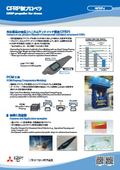
Introduction of Pitch Type CFRP "Semiconductor Wafer Transport Hand"
The pitch-type CFRP "semiconductor wafer transport hand" is lightweight, has low deflection, quick vibration damping, and high conductivity!
"Pitch-based CFRP" features lightweight and high rigidity, enabling the reduction of weight in wafer transport hands and minimizing load deflection. Additionally, wafer transport hands made from pitch-based CFRP exhibit rapid vibration damping, contributing to shorter equipment cycle times. **Benefits of Using CFRP in Wafer Transport Hands** - High specific modulus (modulus of elasticity ÷ weight) allows for lightweight, thin designs and reduced deflection. - Excellent vibration damping properties enable high-speed operation and reduced cycle times. - Enhanced conductivity allows for static electricity prevention. **Common Needs** - Due to limited space within the equipment, there is a desire to reduce the thickness of the hands and minimize deflection. - As the weight of the workpieces increases, there is a need to adopt materials with high Young's modulus. - Lightweight hands are necessary for high-speed operation. - There is a need to quickly suppress vibrations in the hands to shorten cycle times. **What Mitsubishi Chemical Can Offer** We can manufacture and sell carbon fibers and prepregs, as well as design products using these materials. Furthermore, we can provide comprehensive support from molding, processing, assembly, coating, to inspection. *For more details, please refer to the PDF materials or feel free to contact us.*
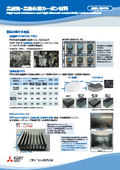
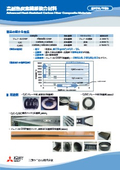
High heat-resistant carbon fiber composite materials! Comparison of physical properties of C/C and C/SiC.
Materials such as "C/C" and "C/SiC" can be used to reduce weight, decrease deflection, and improve vibration damping in components used in high-temperature environments above 800℃!
C/C composites are composite materials made of carbon fibers and carbon, while C/SiC composites are made of carbon fibers and SiC. Many carbon fibers are used as composite materials (CFRP) with resin as the matrix, but the heat resistance of resin has its limits. By using high-temperature treated materials (carbon and SiC) as the matrix, it has become possible to use them in high-temperature environments (800°C). 【Advantages】 ■ High heat resistance (800°C), enabling use in high-temperature environments ■ High specific modulus (modulus of elasticity ÷ weight), allowing for lightweight components, thin-walled designs, and reduced deflection ■ High thermal conductivity, enabling lightweight heat dissipation components 【Common Needs】 ■ Want to reduce the weight of parts made from heat-resistant materials (ceramics, isotropic graphite) ■ Want to minimize deflection due to limited space ■ Want to use materials with high Young's modulus 【Main Applications】 Parts for FPD manufacturing equipment, semiconductor manufacturing equipment, brake components, etc. 【What Mitsubishi Chemical Can Do】 In addition to manufacturing and selling carbon fibers and prepregs, we can also perform shaping, processing, assembly, coating, and inspection of these materials, and deliver them. *For more details, please refer to the PDF document or feel free to contact us.
Products/Services (24)
catalog(31)
Survey responses are required to view e-book details. Click to view the e-book.
news(15)
Detailed information
| Company name | 三菱ケミカル コンポジットパーツ本部 Asia事業部 |
|---|---|
| number of employees | 41591 |
| Contact address | postalcode 100-8251 Tokyo/ Chiyoda-ku/ 1-1-1 Marunouchi, Palace BuildingView on map TEL:- |
| Business Locations | Click here for the list |
| Industry | Resin/Plastic |