1~45 item / All 92 items
Displayed results
Filter by category

Added to bookmarks
Bookmarks listBookmark has been removed
Bookmarks listYou can't add any more bookmarks
By registering as a member, you can increase the number of bookmarks you can save and organize them with labels.
Free membership registrationContact this company
Contact Us OnlineBefore making an inquiry
Download PDF1~45 item / All 92 items
Filter by category

In small and medium-sized enterprises, particularly in the molding processing industry, there are many cases where companies face the challenge of "needing capital investment for productivity improvement and high precision, but the financial hurdles are high, making it difficult to take the plunge." We have also received feedback from manufacturers' sales representatives stating, "While we appreciate the performance aspect, we cannot reach an investment decision." Proposals utilizing subsidies are an effective means to advance the decision-making of such companies. This time, we will introduce a case study of an electric injection molding machine manufacturer that has adopted our services. 【Case Study Introduction】 ■ Products introduced using subsidies - Ultra wear-resistant electric injection molding machine - Dryer with loader ■ Background and Effects of Introduction The company was only producing with used hydraulic molding machines, but a significant issue was the decline in yield rate. Although they understood the need for capital investment, they could not proceed with concrete considerations due to high costs. However, after receiving a proposal utilizing subsidies, they decided to invest in equipment. The number of units they could produce increased from about 600 to over 1,500, achieving a 2.5-fold improvement and enabling stable production through 24-hour operation. *We are currently offering a free document summarizing the advantages and disadvantages of product introduction proposals using subsidies!
Added to bookmarks
Bookmarks listBookmark has been removed
Bookmarks listYou can't add any more bookmarks
By registering as a member, you can increase the number of bookmarks you can save and organize them with labels.
Free membership registration
In small and medium-sized enterprises, particularly in the food manufacturing industry, there are often challenges such as, "While capital investment for new product development and adding high value is necessary, the financial hurdles are high, making it difficult to take the plunge." We have also received feedback from manufacturers' sales representatives stating, "Although the concepts and possibilities are appreciated, we cannot reach an investment decision." Proposals utilizing subsidies are an effective means to advance the decision-making of such companies. This time, we would like to introduce a case study from a chocolate and sweets manufacturing equipment manufacturer that has implemented our services. 【Case Study Introduction】 ■ Products introduced using subsidies - Tempering machine ■ Background and Effects of Implementation While they understood the need for capital investment to establish the development and manufacturing processes for gelato and baked goods utilizing coffee, they were unable to proceed with concrete considerations due to high costs. However, after receiving a proposal utilizing subsidies, they decided to invest in equipment. This led to an increase in sales and employee recruitment, resulting in an approximately 40% increase in added value. *We are currently offering a free document summarizing the advantages and disadvantages of product introduction proposals using subsidies!
Added to bookmarks
Bookmarks listBookmark has been removed
Bookmarks listYou can't add any more bookmarks
By registering as a member, you can increase the number of bookmarks you can save and organize them with labels.
Free membership registration
In small and medium-sized enterprises, including those in the packaging materials manufacturing industry, there are often cases where they face the challenge of needing to invest in equipment to respond to the advanced and diversified customer needs, but the financial hurdles are high, making it difficult to take the plunge. We have also received feedback from manufacturers' sales representatives that while they are interested in the proposals, the investment decisions often come to a halt. Proposals that utilize subsidies are an effective means to advance the decision-making of such companies. This time, we would like to introduce a case study of an automatic high-speed reciprocating cutter manufacturer that has implemented our services. 【Case Study】 ■ Products introduced using subsidies - Automatic high-speed reciprocating cutter - Dedicated CAD system ■ Background and Effects of Implementation They were unable to internalize the prototype process for cardboard boxes, leading to prolonged lead times as a challenge. Although they understood that equipment investment was necessary for new customer development, they were hesitant due to cost concerns. After receiving a proposal that utilized subsidies, they decided to proceed with the implementation. After the introduction, a system capable of consistent response was established, and the prototype lead time was reduced from an average of 10 days to half. *We are currently offering a free document summarizing the advantages and disadvantages of product introduction proposals using subsidies!
Added to bookmarks
Bookmarks listBookmark has been removed
Bookmarks listYou can't add any more bookmarks
By registering as a member, you can increase the number of bookmarks you can save and organize them with labels.
Free membership registration
In small and medium-sized enterprises, including the cardboard manufacturing industry, there are many cases where companies face the challenge of "automation is necessary for improving productivity and labor conditions, but the burden of capital investment is significant, making it difficult to proceed with implementation." We have also received feedback from manufacturers' sales representatives that "while the benefits of automation are understood, they do not reach a decision on investment." Proposals utilizing subsidies are an effective means to advance the decision-making of such companies. This time, we would like to introduce a case study from a robot palletizer manufacturer that has adopted our services. 【Case Study】 ■ Products introduced using subsidies - Robot palletizer for cardboard ■ Background and effects of implementation In the manufacturing line of cardboard boxes, the final process was entirely manual, leading to decreased productivity. Although they had received proposals for capital investment to alleviate the increased workload and high turnover rates, they were hesitant due to cost concerns. However, after receiving a proposal utilizing subsidies, they decided to implement the solution. The income increase rate related to rising labor costs has risen by 7.4% over three years, achieving significant results in both employee retention and improvement of treatment. *We are currently offering a free document summarizing the advantages and disadvantages of product introduction proposals using subsidies!
Added to bookmarks
Bookmarks listBookmark has been removed
Bookmarks listYou can't add any more bookmarks
By registering as a member, you can increase the number of bookmarks you can save and organize them with labels.
Free membership registration
In small and medium-sized enterprises related to measurement and construction, there are often cases where they face the challenge of "while there is a demand for improved added value through precise measurement and data utilization, the burden of capital investment is significant, making it difficult to proceed with implementation." We have also received feedback from sales representatives of manufacturers stating, "The technical superiority is conveyed, but the investment decision gets stalled." Proposals utilizing subsidies are an effective means to advance the decision-making of such companies. This time, we will introduce a case study from a company that implemented our services for a 3D measurement system. 【Case Study】 ■ Products introduced using subsidies - Mobile 3D scanner - Drone ■ Background and Effects of Implementation In photo measurement using drones, there was a challenge of accurately surveying terrain in sites with many obstacles. Various proposals were received to resolve the constraints on the measurement range, but due to high costs, they were unable to proceed with capital investment. They decided to implement a proposal utilizing subsidies. After implementation, they were able to conduct accurate terrain surveys without being affected by obstacles, thereby enhancing their proposal capabilities to customers. *We are currently offering a free document summarizing the advantages and disadvantages of product introduction proposals using subsidies!
Added to bookmarks
Bookmarks listBookmark has been removed
Bookmarks listYou can't add any more bookmarks
By registering as a member, you can increase the number of bookmarks you can save and organize them with labels.
Free membership registration
In small and medium-sized enterprises, particularly in the precision machining industry, there are many cases where they face the challenge of "as machining accuracy and technical levels become more advanced year by year, the financial hurdles for capital investment are high, making it difficult to take the plunge." We have also received feedback from manufacturers' sales representatives stating, "Even if the proposals meet the technical requirements, they get stuck at the investment decision stage." Proposals that utilize subsidies are an effective means to advance the decision-making process for such companies. This time, we will introduce a case study of a high-precision machining center manufacturer that has implemented our services. 【Case Study】 ■ Products introduced using subsidies - Surface grinding machine - High-precision vertical machining center ■ Background and Effects of Implementation The customer, a semiconductor manufacturing equipment manufacturer, required a very high level of technical responsiveness. However, the existing equipment had limitations in ensuring stable accuracy and productivity, making equipment updates urgent. Therefore, by utilizing subsidies, they introduced the latest surface grinding machine and high-precision vertical machining center in a coordinated manner. After implementation, they achieved a reduction in processing time, increased productivity, and reduced the workload on on-site operators. *We are currently offering a free document summarizing the advantages and disadvantages of product introduction proposals using subsidies!
Added to bookmarks
Bookmarks listBookmark has been removed
Bookmarks listYou can't add any more bookmarks
By registering as a member, you can increase the number of bookmarks you can save and organize them with labels.
Free membership registration
In small and medium-sized enterprises, particularly in the machining industry, there are many cases where companies face the challenge of needing to invest in equipment to respond to the increasing sophistication and scale of customer needs, but find the financial hurdles too high to take the plunge. We have also received feedback from manufacturers' sales representatives stating, "While our technical superiority is recognized, it does not lead to investment decisions." Proposals utilizing subsidies are an effective means to advance the decision-making of such companies. This time, we will introduce a case study of a horizontal 5-axis machining center manufacturer that has adopted our services. 【Case Study Introduction】 ■ Products introduced using subsidies - Horizontal 5-axis machining center for large parts processing - Fully automatic system band saw ■ Background and Effects of Introduction Due to the trends in orders, it became essential to introduce machine tools capable of processing large workpieces with high precision. Although various proposals were received, the significant investment required made it difficult to proceed. However, after receiving a proposal utilizing subsidies, the decision to invest in equipment was made. After the introduction, the processing system for large parts was significantly strengthened, leading to improvements in quality, cost, and delivery (QCD). *We are currently offering a free document summarizing the advantages and disadvantages of product introduction proposals using subsidies!
Added to bookmarks
Bookmarks listBookmark has been removed
Bookmarks listYou can't add any more bookmarks
By registering as a member, you can increase the number of bookmarks you can save and organize them with labels.
Free membership registration
In small and medium-sized enterprises, including the blade manufacturing industry, there are often cases where they face the challenge of needing capital investment to expand production capacity, but the financial hurdles are high, making it difficult to take the plunge. We have also received feedback from manufacturers' sales representatives that while they understand the necessity of automation, they are not able to reach an investment decision. Proposals utilizing subsidies are an effective means to advance the decision-making of such companies. This time, we would like to introduce a case study from a company that proposed a robot system utilizing our services. 【Case Study】 ■ Products introduced using subsidies - Robot system for grinding and polishing operations ■ Background and Effects of Introduction Handling the grinding and polishing of knife handles manually had become a significant bottleneck in the process. While considerations for automation equipment were stalled due to cost concerns, a proposal utilizing subsidies was received, leading to a decision on capital investment. After the introduction, automation of the work progressed, freeing the site from operations that had become habitual overtime. Veteran skilled workers were able to spend time mentoring younger employees, which has also contributed to the promotion of skill transfer. *We are currently offering a free document summarizing the advantages and disadvantages of product introduction proposals using subsidies!
Added to bookmarks
Bookmarks listBookmark has been removed
Bookmarks listYou can't add any more bookmarks
By registering as a member, you can increase the number of bookmarks you can save and organize them with labels.
Free membership registration
In small and medium-sized enterprises, including the printing industry, there are often challenges such as, "While investment in equipment is necessary for enhancing quality demands and improving production efficiency, the financial hurdles are high, making it difficult to take the plunge." We have also received feedback from manufacturers' sales representatives stating, "Although the advantages of the equipment are recognized, we cannot reach an investment decision." Proposals utilizing subsidies are an effective means to advance the decision-making of such companies. This time, we will introduce a case study of a printing machine manufacturer that has adopted our services. [Case Study] ■ Products introduced using subsidies - State-of-the-art 4-color printing machine - Printed material inspection machine ■ Background and Effects of Implementation The inspection and checking processes for printed materials were taking a lot of time and effort, becoming a significant bottleneck in the workflow. While they recognized the need for capital investment to accommodate multi-color printing, the high costs made it difficult to proceed. After receiving a proposal utilizing subsidies, they decided to invest in the equipment. Following the implementation, their ability to handle multi-color printing improved, leading to an expansion in orders and an increase in sales. *We are currently offering a free document summarizing the advantages and disadvantages of proposals for product introduction using subsidies!
Added to bookmarks
Bookmarks listBookmark has been removed
Bookmarks listYou can't add any more bookmarks
By registering as a member, you can increase the number of bookmarks you can save and organize them with labels.
Free membership registration
In small and medium-sized enterprises, particularly in the food manufacturing industry, there are often challenges such as "while capital investment is necessary for improving productivity and reducing labor, the financial hurdles are high, and discussions do not progress." We have also received feedback from manufacturers' sales representatives stating, "Although we make proposals, we often do not reach a contract." Proposals utilizing subsidies are an effective means to advance decision-making for such companies. This time, we would like to introduce a case study of a baked goods manufacturing equipment manufacturer that has implemented our services. 【Case Study Introduction】 ■ Products introduced using subsidies Baked goods manufacturing equipment (filling machines, packaging machines) ■ Background and Effects of Implementation The packaging of popular products was done manually, and overtime became the norm during large orders. Although they were considering the introduction of machinery, the cost was a barrier, and they had not reached a concrete discussion. In this context, they decided to implement the equipment after receiving a proposal to utilize subsidies triggered by a new product. As a result, production volume significantly increased, and the workload was reduced. They successfully achieved stable production with a small number of staff. *We are currently offering a free document summarizing the advantages and disadvantages of product introduction proposals using subsidies!
Added to bookmarks
Bookmarks listBookmark has been removed
Bookmarks listYou can't add any more bookmarks
By registering as a member, you can increase the number of bookmarks you can save and organize them with labels.
Free membership registrationIn the design industry, there is a constant demand for improved operational efficiency and cost reduction. Especially in an increasingly competitive environment, acquiring new customers and providing value to existing customers is crucial. This document is a proposal aimed at supporting your clients in applying for subsidies to achieve business transformation, which will lead to the sale of your products. 【Usage Scenarios】 * Acquiring new customers in design production * Providing new value to existing customers * Cost reduction through operational efficiency 【Effects of Implementation】 * Reducing the financial burden on customers through the use of subsidies * Promoting the sale of your products * Building long-term relationships with customers
Added to bookmarks
Bookmarks listBookmark has been removed
Bookmarks listYou can't add any more bookmarks
By registering as a member, you can increase the number of bookmarks you can save and organize them with labels.
Free membership registrationIn the hospitality industry, especially for facilities aiming to recover inbound demand, strengthening customer attraction and improving customer satisfaction are urgent tasks. Inbound tourists have diverse needs and seek multilingual support and special experiences. To meet these needs, renovations of facilities and the introduction of new services may be necessary. However, the challenge is that these investments can incur significant costs. Our document titled "Subsidies as the Strongest Weapon for Business" is a proposal aimed at supporting your customers in applying for subsidies to achieve business transformation and connecting it to the sale of your products. 【Usage Scenarios】 * Strengthening multilingual support * Multilingual website development * Promotions targeting inbound tourists * Making facilities barrier-free * Improving Wi-Fi environments 【Effects of Implementation】 * Reduction of initial costs through subsidies * Attraction of inbound tourists * Improvement in customer satisfaction * Increase in sales * Strengthening of competitiveness
Added to bookmarks
Bookmarks listBookmark has been removed
Bookmarks listYou can't add any more bookmarks
By registering as a member, you can increase the number of bookmarks you can save and organize them with labels.
Free membership registrationIn the transportation industry, automation is essential for improving operational efficiency and safety. Particularly, as labor shortages become more severe, the automation of self-driving technology and warehouse operations is crucial for sustainable business operations. However, the high costs associated with these implementations lead many companies to hesitate. Our materials are proposal documents aimed at supporting your company in applying for subsidies to achieve automation and connecting it to the sales of your products. 【Usage Scenarios】 * Introduction of self-driving technology * Automation of warehouse operations * Implementation of operational management systems 【Effects of Implementation】 * Significant improvement in operational efficiency * Reduction in labor costs * Enhanced safety
Added to bookmarks
Bookmarks listBookmark has been removed
Bookmarks listYou can't add any more bookmarks
By registering as a member, you can increase the number of bookmarks you can save and organize them with labels.
Free membership registrationIn the field of smart agriculture, the introduction of precise data analysis and automation technologies is required. These technologies contribute to increased productivity, cost reduction, and enhanced quality management, but there may be initial costs associated with their implementation. By utilizing subsidies, these challenges can be addressed, facilitating a smooth transition to smart agriculture. 【Usage Scenarios】 * Agricultural corporations considering the introduction of smart agriculture technologies * Companies planning to introduce the latest agricultural equipment and systems * Businesses interested in utilizing subsidies to achieve labor-saving and efficiency improvements 【Effects of Implementation】 * Reduction of initial cost burden through the use of subsidies * Increased productivity through the introduction of the latest technologies * Strengthening of competitiveness and realization of sustainable agricultural management
Added to bookmarks
Bookmarks listBookmark has been removed
Bookmarks listYou can't add any more bookmarks
By registering as a member, you can increase the number of bookmarks you can save and organize them with labels.
Free membership registrationIn fisheries resource management, accurate understanding and appropriate management of resource quantities are required to achieve sustainable fishing. In particular, to respond to fluctuations in catch volumes and environmental changes, the latest technology and funding are necessary. Our materials are proposal documents aimed at supporting your clients in applying for grants to realize business transformation and connecting to the sale of your products. 【Usage Scenarios】 * Catch volume surveys * Fishing ground management * Resource protection 【Effects of Implementation】 * Fundraising through grant acquisition * Support for the introduction of the latest technology * Contribution to sustainable fishing
Added to bookmarks
Bookmarks listBookmark has been removed
Bookmarks listYou can't add any more bookmarks
By registering as a member, you can increase the number of bookmarks you can save and organize them with labels.
Free membership registrationIn the beauty industry reservation services, acquiring new customers and increasing repeat customers are crucial. Investing in customer attraction measures is essential, but cost-effectiveness often becomes a challenge. By utilizing subsidies, it becomes possible to reduce the costs associated with attracting customers and approach a larger number of clients. Our materials aim to support your customers in applying for subsidies to achieve business transformation and to connect this with the sales of your products. 【Usage Scenarios】 * Advertising for acquiring new customers * Implementation and renovation of reservation systems * Introduction of customer management systems 【Effects of Implementation】 * Cost reduction through subsidies * Improved customer attraction * Increased sales
Added to bookmarks
Bookmarks listBookmark has been removed
Bookmarks listYou can't add any more bookmarks
By registering as a member, you can increase the number of bookmarks you can save and organize them with labels.
Free membership registrationIn the introduction of monitoring systems in the nursing care industry, ensuring the safety of residents and reducing the burden on care staff are important issues. Particularly, with the increasing severity of nighttime monitoring and staff shortages, the implementation of efficient systems is required. This document is a proposal aimed at supporting your customers in applying for subsidies to achieve business transformation and linking it to the sale of your products. 【Usage Scenarios】 - Introduction of resident monitoring systems in nursing care facilities - Strengthening monitoring systems during nighttime - Reducing staff burden 【Effects of Implementation】 - Reduction of implementation costs through the use of subsidies - Improvement of resident safety - Increased operational efficiency for staff
Added to bookmarks
Bookmarks listBookmark has been removed
Bookmarks listYou can't add any more bookmarks
By registering as a member, you can increase the number of bookmarks you can save and organize them with labels.
Free membership registrationThe introduction of ICT in educational institutions is essential for improving the quality and efficiency of education. However, the cost of implementation often poses a challenge. This document supports your company in applying for subsidies when introducing ICT, facilitating a smooth implementation. 【Usage Scenarios】 * Implementation of classes utilizing ICT * Introduction of educational software * Introduction of administrative systems 【Effects of Implementation】 * Reduction of ICT implementation costs * Establishment of a modern educational environment * Increased operational efficiency for faculty and staff
Added to bookmarks
Bookmarks listBookmark has been removed
Bookmarks listYou can't add any more bookmarks
By registering as a member, you can increase the number of bookmarks you can save and organize them with labels.
Free membership registrationIn the e-commerce industry, acquiring new customers and retaining existing ones have become challenges amid intensifying competition. In particular, there is a demand for addressing rising advertising costs and diversifying customer needs. This document is a proposal aimed at supporting e-commerce operators in applying for subsidies to achieve business transformation and connect it to the sales of your products. 【Usage Scenarios】 * New construction of e-commerce sites * Review of marketing strategies * Implementation of customer management systems * Optimization of logistics systems * Overseas expansion 【Effects of Implementation】 * Fundraising through subsidies * Reduction of advertising costs * Increase in sales * Improvement in customer satisfaction * Acceleration of business growth
Added to bookmarks
Bookmarks listBookmark has been removed
Bookmarks listYou can't add any more bookmarks
By registering as a member, you can increase the number of bookmarks you can save and organize them with labels.
Free membership registrationIn the promotion of DX (Digital Transformation) in the food and beverage industry, improving operational efficiency and enhancing customer experience are essential. In particular, addressing labor shortages and strengthening marketing strategies through the utilization of customer data are crucial. This document is a proposal aimed at supporting your customers in applying for subsidies to achieve business transformation and connecting it to the sales of your products. 【Usage Scenarios】 - Introduction of POS systems - Introduction of mobile ordering systems - Introduction of customer management systems - Introduction of reservation management systems - Introduction of online menus 【Effects of Implementation】 - Cost reduction through operational efficiency - Increased customer satisfaction - Increase in sales - Maximization of marketing effectiveness - Strengthening of competitiveness
Added to bookmarks
Bookmarks listBookmark has been removed
Bookmarks listYou can't add any more bookmarks
By registering as a member, you can increase the number of bookmarks you can save and organize them with labels.
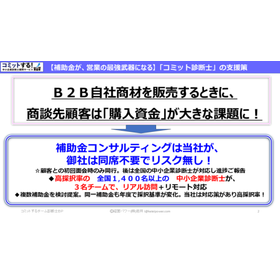
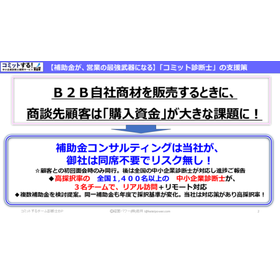
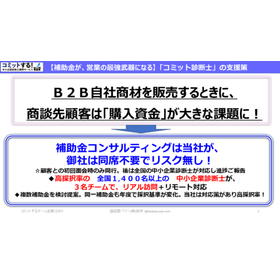
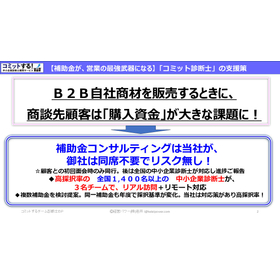
Free membership registrationAs the demand for automation in the manufacturing industry increases, this document supports your customers' business transformation and aims to lead to product sales. Since the introduction of automation equipment requires significant costs, utilizing subsidies is crucial. This document introduces support measures from small and medium enterprise consultants and showcases achievements in performance improvement for B2B system product sales companies facing challenges. 【Usage Scenarios】 * Companies considering automation of their manufacturing lines * Companies aiming for labor reduction and efficiency * Companies contemplating the introduction of the latest equipment 【Effects of Implementation】 * Reduction of initial cost burden through subsidy utilization * Increased willingness of customers to invest in equipment * Promotion of sales for your company's products
Added to bookmarks
Bookmarks listBookmark has been removed
Bookmarks listYou can't add any more bookmarks
By registering as a member, you can increase the number of bookmarks you can save and organize them with labels.
Free membership registrationIn the construction industry, energy conservation is an important issue aimed at achieving both cost reduction and environmental impact reduction. Particularly in construction sites and the renovation of existing buildings, investment in equipment to enhance energy-saving performance is required. However, initial costs can be high, and there are not infrequent cases where companies hesitate to implement such measures. Our materials are proposal documents aimed at supporting your customers in applying for subsidies to achieve energy conservation and linking it to the sales of your products. 【Usage Scenarios】 * Introduction of energy-saving equipment at construction sites * Energy-saving renovations of existing buildings * Construction of new properties with high energy-saving performance 【Effects of Implementation】 * Significant reduction in initial costs using subsidies * Reduction in running costs through the introduction of energy-saving equipment * Improved image as a company with high environmental performance
Added to bookmarks
Bookmarks listBookmark has been removed
Bookmarks listYou can't add any more bookmarks
By registering as a member, you can increase the number of bookmarks you can save and organize them with labels.
Free membership registrationIn the agricultural sector, labor shortages and the need for increased productivity have become urgent issues. Smart agriculture is an effective means to address these challenges, but implementation can sometimes be costly. Therefore, by utilizing subsidies, we can reduce initial costs and enable a smooth introduction. Our materials aim to support your company in applying for subsidies to implement smart agriculture and achieve business transformation, ultimately leading to the sale of your products. 【Usage Scenarios】 * Introduction of smart agriculture technology * Practice of precision agriculture * Utilization of agricultural data 【Effects of Implementation】 * Reduction of initial costs * Increased productivity * Management improvement
Added to bookmarks
Bookmarks listBookmark has been removed
Bookmarks listYou can't add any more bookmarks
By registering as a member, you can increase the number of bookmarks you can save and organize them with labels.
Free membership registrationIn the field of telemedicine, there is a demand for improving patient convenience and efficiently utilizing medical resources. Particularly in areas where there is a shortage of local medical institutions and specialists, the introduction of telemedicine systems is urgent. However, initial costs and operational expenses often pose challenges. Our materials aim to support your company in applying for subsidies to implement a telemedicine system and enhance service delivery to patients, ultimately leading to the sale of your products. 【Usage Scenarios】 - Introduction of telemedicine systems - Expansion of online medical services - Strengthening of information provision services for patients 【Effects of Implementation】 - Reduction of initial costs and operational expenses through subsidies - Improvement in the quality of telemedicine services - Increase in patient satisfaction
Added to bookmarks
Bookmarks listBookmark has been removed
Bookmarks listYou can't add any more bookmarks
By registering as a member, you can increase the number of bookmarks you can save and organize them with labels.
Free membership registrationIn the IT industry, particularly in the field of security, the latest security measures are essential to respond to the increasing sophistication and cunning of cyber attacks. However, the high costs can often be a challenge. Our materials explain the subsidies that your company can utilize when implementing security measures, with the aim of connecting this to the sales of your products. 【Usage Scenarios】 - Introduction of the latest security systems - Utilization of security consulting services - Development of security personnel 【Effects of Implementation】 - Reducing cost burdens while introducing the latest security measures - Lowering security risks and improving business continuity - Strengthening competitiveness
Added to bookmarks
Bookmarks listBookmark has been removed
Bookmarks listYou can't add any more bookmarks
By registering as a member, you can increase the number of bookmarks you can save and organize them with labels.
Free membership registration
In the beauty industry, reservation systems are crucial for customer acquisition and improving repeat rates. Specifically, acquiring new customers and enhancing the satisfaction of existing customers significantly impact sales. This document is a proposal aimed at supporting your clients in applying for subsidies to achieve business transformation and connecting it to the sales of your products. 【Usage Scenarios】 * Streamlining operations through the introduction of a reservation system * Implementing a customer management system * Marketing strategies for attracting customers 【Effects of Implementation】 * Reducing initial costs through the use of subsidies * Increasing sales and improving profit margins * Strengthening competitiveness
Added to bookmarks
Bookmarks listBookmark has been removed
Bookmarks listYou can't add any more bookmarks
By registering as a member, you can increase the number of bookmarks you can save and organize them with labels.
Free membership registration
In the field of telemedicine, there is a demand for improved convenience for patients and increased efficiency for medical institutions. In particular, the introduction of telemedicine systems can pose challenges related to initial costs and operational expenses. This document is a proposal aimed at supporting your customers in applying for subsidies to achieve business transformation and linking it to the sale of your products. [Usage Scenarios] * Introduction of telemedicine systems * Expansion of online medical services * Purchase of medical equipment [Effects of Implementation] * Reduction of initial cost burden for customers * Lowering the barriers to implementation and promoting sales * Improvement in customer satisfaction
Added to bookmarks
Bookmarks listBookmark has been removed
Bookmarks listYou can't add any more bookmarks
By registering as a member, you can increase the number of bookmarks you can save and organize them with labels.
Free membership registration
In the online education industry, there is a growing demand for new customer acquisition and improvement in service quality amid intensifying competition. In particular, building online platforms and developing the latest educational content can incur significant costs. This document is a proposal aimed at supporting your company in applying for grants to achieve business transformation and to connect it to the sales of your products. 【Usage Scenarios】 - Building an online education platform - Developing educational content - Strengthening marketing strategies 【Effects of Implementation】 - Fundraising through grants - Accelerating customer acquisition - Improving service quality
Added to bookmarks
Bookmarks listBookmark has been removed
Bookmarks listYou can't add any more bookmarks
By registering as a member, you can increase the number of bookmarks you can save and organize them with labels.
Free membership registration
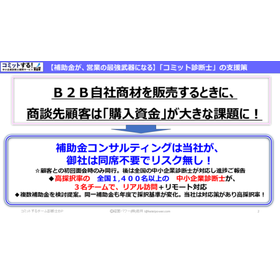
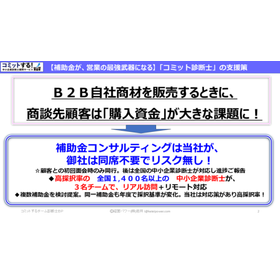
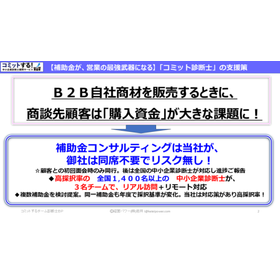
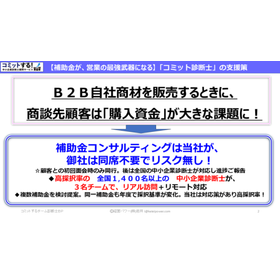
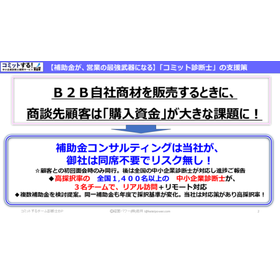
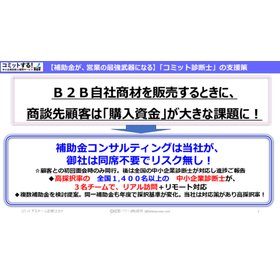
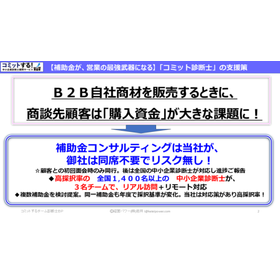
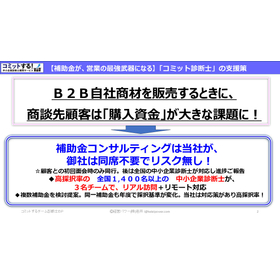
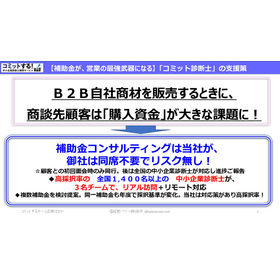
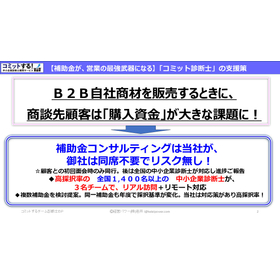
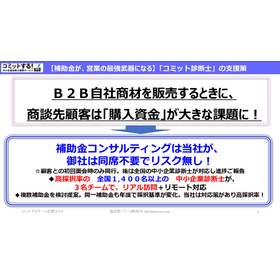
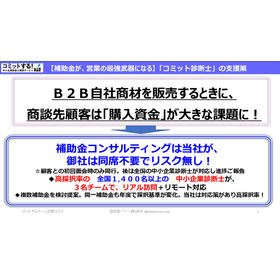
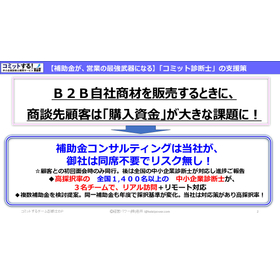
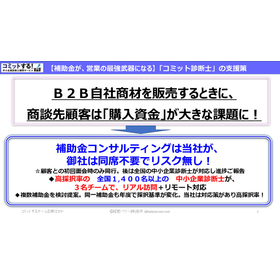
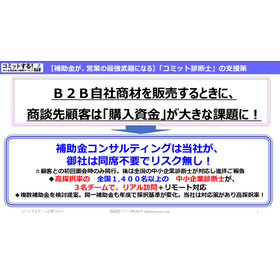
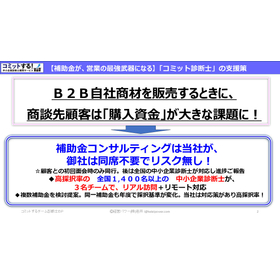
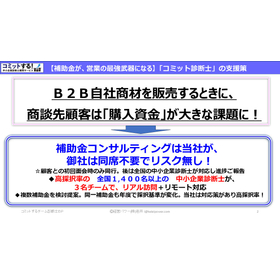
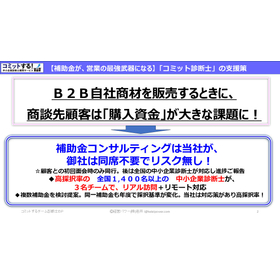
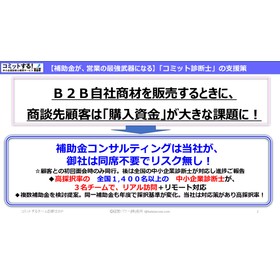
In the hospitality industry, multilingual support is essential due to the increase in foreign tourists. Providing information in multiple languages leads to improved customer satisfaction and strengthens the ability to attract customers. However, multilingualization incurs costs, and there are challenges in knowing where to start. Our materials are proposal documents aimed at supporting your customers in applying for subsidies to achieve business transformation and linking it to the sale of your products. They include the challenges currently faced by B2B system product sales companies, support measures from "commitment diagnosticians," and our track record in "performance improvement." Please download and make use of it. 【Usage Scenarios】 - Multilingualization of accommodation facility websites and reservation systems - Multilingualization of in-house signage and guidance displays - Implementation of customer management systems capable of multilingual support 【Effects of Implementation】 - Enhanced information provision to foreign tourists - Improved customer satisfaction - Strengthened customer attraction - Cost reduction through subsidies
Added to bookmarks
Bookmarks listBookmark has been removed
Bookmarks listYou can't add any more bookmarks
By registering as a member, you can increase the number of bookmarks you can save and organize them with labels.
Free membership registration
In the e-commerce industry, acquiring new customers and retaining existing ones have become challenges amid intensifying competition. In particular, investments necessary for business growth vary widely, including the construction and renovation of e-commerce sites, strengthening marketing strategies, and developing new sales channels. Utilizing subsidies is an effective means to promote these investments. This document is a proposal aimed at supporting e-commerce operators in applying for subsidies to achieve business transformation and connect it to the sales of your products. 【Usage Scenarios】 - Construction and renovation of e-commerce sites - Strengthening marketing strategies - Developing new sales channels 【Effects of Implementation】 - Fundraising through the use of subsidies - New proposals to customers - Potential for sales expansion
Added to bookmarks
Bookmarks listBookmark has been removed
Bookmarks listYou can't add any more bookmarks
By registering as a member, you can increase the number of bookmarks you can save and organize them with labels.
Free membership registration
In the field of agriculture, the smartification process demands improved efficiency and productivity. Particularly in agriculture, which is susceptible to labor shortages and the impacts of climate change, the introduction of the latest technologies is essential. However, the initial costs can be high, and securing funding can pose challenges. This document is a proposal aimed at supporting your company in applying for subsidies when introducing smart agricultural technologies and linking it to the sales of your products. 【Usage Scenarios】 * Agricultural corporations considering the introduction of smart agricultural technologies * Agricultural workers aiming for labor-saving and efficiency improvements * Companies looking to expand their business by utilizing subsidies 【Effects of Implementation】 * Reduction of initial cost burden through the use of subsidies * Increased productivity through the introduction of the latest technologies * Promotion of sales through the use of sales tools
Added to bookmarks
Bookmarks listBookmark has been removed
Bookmarks listYou can't add any more bookmarks
By registering as a member, you can increase the number of bookmarks you can save and organize them with labels.
Free membership registration
In the caregiving and monitoring industry, high-quality service provision is required to ensure the safety and peace of mind of users. Especially as the labor shortage becomes more severe, building an efficient monitoring system is crucial. By utilizing subsidies, it becomes possible to introduce the latest monitoring systems and improve the quality of services. This document is a proposal aimed at supporting your clients in applying for subsidies to achieve business transformation and connecting it to the sales of your products. 【Usage Scenarios】 - Introduction of monitoring systems - Improvement of caregiving service quality - Resolution of labor shortages 【Effects of Implementation】 - Cost reduction through subsidies - Introduction of the latest technology - Improvement of service quality
Added to bookmarks
Bookmarks listBookmark has been removed
Bookmarks listYou can't add any more bookmarks
By registering as a member, you can increase the number of bookmarks you can save and organize them with labels.
Free membership registration
In the food and beverage industry, improving customer attraction is an urgent issue amid intensifying competition. In particular, acquiring new customers and increasing repeat customers are crucial factors that influence sales. However, effective customer attraction measures can be costly, and due to financial constraints, there are often cases where sufficient measures cannot be implemented. This document proposes specific methods for your company to utilize subsidies to enhance customer attraction. 【Usage Scenarios】 * Advertising and promotion for acquiring new customers * Implementation of customer management systems to increase repeat customers * Expansion of takeout and delivery services 【Effects of Implementation】 * By utilizing subsidies, implement customer attraction measures while keeping costs down * Increase in sales due to improved customer attraction * Enhanced customer satisfaction and acquisition of repeat customers
Added to bookmarks
Bookmarks listBookmark has been removed
Bookmarks listYou can't add any more bookmarks
By registering as a member, you can increase the number of bookmarks you can save and organize them with labels.
Free membership registration
In the IT and DX promotion industry, the introduction of the latest technologies and the streamlining of operations are required. Especially in a rapidly changing market environment, transitioning to new business models and strengthening competitiveness are crucial. However, challenges such as implementation costs and a shortage of skilled personnel often lead to stagnation in DX promotion. This document is a proposal aimed at supporting subsidy applications to assist your customers in their DX promotion efforts and to connect it to the sales of your products. 【Usage Scenarios】 * IT companies considering DX promotion * Companies wanting to introduce the latest technologies * Companies aiming for operational efficiency 【Effects of Implementation】 * Support for customers' DX promotion * Promotion of product sales * Achievement of revenue expansion
Added to bookmarks
Bookmarks listBookmark has been removed
Bookmarks listYou can't add any more bookmarks
By registering as a member, you can increase the number of bookmarks you can save and organize them with labels.
Free membership registration
For manufacturers, improving productivity and reducing costs are important challenges. Automation can contribute to solving these issues, but the initial investment can be a significant burden. This document is a proposal aimed at supporting your company in applying for subsidies and promoting the introduction of automation equipment. 【Usage Scenarios】 * Automation of production lines * Labor reduction through robot implementation * Process management utilizing IoT 【Effects of Implementation】 * Reduction of initial investment costs * Improvement in productivity * Strengthening of competitiveness
Added to bookmarks
Bookmarks listBookmark has been removed
Bookmarks listYou can't add any more bookmarks
By registering as a member, you can increase the number of bookmarks you can save and organize them with labels.
Free membership registration
In the construction industry, labor shortages and the need for operational efficiency are urgent issues. The introduction of systems and services that achieve labor-saving is essential for improving productivity. However, the cost of implementation often poses a barrier. This document is a proposal aimed at supporting your clients in applying for subsidies to realize business transformation and linking it to the sale of your products. 【Usage Scenarios】 * Introduction of labor-saving systems at construction sites * Implementation of software that achieves operational efficiency * Introduction of labor-reducing equipment utilizing the latest technology 【Effects of Implementation】 * Reducing the initial cost burden on clients * Promoting the sale of products * Supporting the business growth of clients
Added to bookmarks
Bookmarks listBookmark has been removed
Bookmarks listYou can't add any more bookmarks
By registering as a member, you can increase the number of bookmarks you can save and organize them with labels.
Free membership registration
In the transportation industry, rising fuel costs and increasing labor expenses have made cost reduction and operational efficiency urgent issues. In particular, the implementation of vehicle management systems and the optimization of operating routes have the potential to significantly contribute to cost savings. However, the costs associated with these system implementations often lead companies to hesitate in adopting them. This document is a proposal aimed at supporting your customers in applying for subsidies to achieve business transformation, thereby linking it to the sale of your products. 【Usage Scenarios】 - Implementation of vehicle management systems - Implementation of route optimization systems - Implementation of warehouse management systems 【Effects of Implementation】 - Reducing initial costs to promote system adoption - Cost savings through improved operational efficiency - Potential for increased sales
Added to bookmarks
Bookmarks listBookmark has been removed
Bookmarks listYou can't add any more bookmarks
By registering as a member, you can increase the number of bookmarks you can save and organize them with labels.
Free membership registration
In the automotive industry, a stable supply of high-quality parts is required. In particular, the occurrence of defective products during the manufacturing process not only leads to increased costs but also has the potential to undermine product reliability. The introduction of the new MC contributes to quality improvement by enhancing processing accuracy and suppressing the occurrence of defects. Additionally, improvements in setup time and work efficiency are expected to lead to increased productivity. 【Usage Scenarios】 - Small-batch production of various automotive parts - Strengthening quality control systems - Cost reduction 【Effects of Implementation】 - Reduction of scrap costs - Improvement in quality - Increase in productivity
Added to bookmarks
Bookmarks listBookmark has been removed
Bookmarks listYou can't add any more bookmarks
By registering as a member, you can increase the number of bookmarks you can save and organize them with labels.
Free membership registration
We would like to introduce a case where a "wheel loader with a skit fork" for raw material processing was introduced, utilizing the manufacturing subsidy to carry out tasks such as transporting logs, crushing, sifting wood chips, storing, and feeding. The introduction was prompted by challenges such as the existing equipment for raw material processing being unsanitary, poor workability and safety, difficulties in arranging crushing, and challenges in expanding production scale. As a result of the introduction, sales increased by 120%, and the workforce was expanded by 5 employees. This opened the way to ensure stable raw material processing and enabled the expansion of production volume to 2,000 tons per year. 【Case Overview】 ■ Background of Introduction - Existing equipment for raw material processing was unsanitary, had poor workability and safety, faced difficulties in arranging crushing, and had challenges in expanding production scale. ■ Results of Introduction - Sales increased by 120%, and the workforce was expanded by 5 employees. - Progress made towards expanding production volume to 2,000 tons per year. *For more details, please download the PDF or feel free to contact us.
Added to bookmarks
Bookmarks listBookmark has been removed
Bookmarks listYou can't add any more bookmarks
By registering as a member, you can increase the number of bookmarks you can save and organize them with labels.
Free membership registration
We would like to introduce a case study of the "Auto Shampoo System (automatic shampooing machine)" that utilizes the manufacturing subsidy to reduce staff working hours through automatic shampooing, make use of dormant hairdressers, and provide gray hair dyeing services at a lower price than traditional hair salons. The introduction was prompted by challenges such as excessive competition in the hairdressing industry, a shortage of hairdressers, and a shrinking market, as well as the potential found in the business model of "gray hair dyeing specialty stores" that can utilize dormant hairdressers. As a result of the introduction, the staff's shampooing time was reduced from 20 minutes to 5 minutes. Additionally, a system was established where hourly wages are determined by productivity at each store, enabling staff to operate autonomously. 【Case Overview】 ■ Background of Introduction - Excessive competition in the hairdressing industry, shortage of hairdressers, shrinking market - Found potential in the business model of "gray hair dyeing specialty stores" ■ Results of Introduction - Shampooing time reduced from 20 minutes to 5 minutes - Established a system where hourly wages are determined by productivity at each store - No issues attracting customers even during the COVID-19 pandemic *For more details, please download the PDF or feel free to contact us.
Added to bookmarks
Bookmarks listBookmark has been removed
Bookmarks listYou can't add any more bookmarks
By registering as a member, you can increase the number of bookmarks you can save and organize them with labels.
Free membership registration
We would like to introduce a case where a "vacuum distillation unit for waste treatment" was implemented to utilize the manufacturing subsidy for creating biodiesel fuel from waste cooking oil, achieving a purity of 99.9% and high quality. In existing manufacturing methods, there were limitations on purity, leading to frequent troubles when used in the latest DPF-equipped vehicles. The cost of wastewater treatment was also a challenge, which led to the implementation of this solution. As a result of the implementation, the cleaning process for waste cooking oil became unnecessary, reducing the manufacturing time by 60%. Wastewater treatment costs were reduced, and all residues became recyclable as fertilizer material. [Case Overview] ■ Background of Implementation - There were limitations on purity, leading to frequent troubles when used in the latest DPF-equipped vehicles. - Costs of wastewater treatment. ■ Results of Implementation - Manufacturing time was reduced by 60%. - Wastewater treatment costs were reduced, and all residues became recyclable as fertilizer material. - High-quality fuel led to a decision for implementation by major general contractors. *For more details, please download the PDF or feel free to contact us.
Added to bookmarks
Bookmarks listBookmark has been removed
Bookmarks listYou can't add any more bookmarks
By registering as a member, you can increase the number of bookmarks you can save and organize them with labels.
Free membership registration
We would like to introduce a case where we utilized the manufacturing subsidy to mechanize the manual taping process of one-touch case production, achieving improvements in productivity and labor-saving with the introduction of a "medium-sized gluers (gluing machines) for cardboard." The demand for easily assembled one-touch cases has increased, and the manual taping process became a bottleneck, making improvements in productivity and labor-saving urgent, which led to the introduction. What used to require 8 people to operate can now be done by 3, resulting in a dramatic reduction in overtime hours. Additionally, the sales department became more proactive in receiving orders for one-touch cases. [Case Overview] ■ Background of Introduction - The manual taping process became a bottleneck, making improvements in productivity and labor-saving urgent. ■ Results of Introduction - What used to require 8 people to operate can now be done by 3, resulting in a dramatic reduction in overtime hours. *For more details, please download the PDF or feel free to contact us.
Added to bookmarks
Bookmarks listBookmark has been removed
Bookmarks listYou can't add any more bookmarks
By registering as a member, you can increase the number of bookmarks you can save and organize them with labels.
Free membership registration
We would like to introduce a case where the high-speed micro-vibration type shifter "FS High Shifter" was implemented to utilize the manufacturing subsidy, micro-pulverizing by-products generated during the barley milling process to address wheat allergy issues and enhance the value of metal processing materials. Previously, the by-products had coarse particles and could only be used for low-priced applications (livestock feed), and the storage costs were higher than those of the main product, which pressured profitability, leading to the implementation. As a result of the implementation, the average unit price of the by-products increased from 10 yen/kg to more than 2.5 times (over 25 yen/kg). The sales revenue from high-priced by-products amounted to 5.2 million yen annually, generating profit. [Case Overview] ■ Background of Implementation - The by-products had coarse particles and could only be used for low-priced applications (livestock feed). - Storage costs were higher than those of the main product, pressuring profitability. ■ Results of Implementation - The average unit price of the by-products increased from 10 yen/kg to more than 2.5 times (over 25 yen/kg). - Sales revenue from high-priced by-products amounted to 5.2 million yen annually. *For more details, please download the PDF or feel free to contact us.
Added to bookmarks
Bookmarks listBookmark has been removed
Bookmarks listYou can't add any more bookmarks
By registering as a member, you can increase the number of bookmarks you can save and organize them with labels.
Free membership registration
We would like to introduce a case study of the implementation of "network-compatible processing equipment" that utilizes the Monozukuri subsidy to establish a thorough monitoring system linked with IoT technology and robotics, enabling a production system capable of long hours of operation. The introduction was prompted by the low operating rate of existing processing equipment (sometimes only 2 hours of operation out of 8), and the time it took for young employees to become proficient, as well as the effort and space required to search for data on tools and materials. As a result of the implementation, the defect rate drastically decreased from 40% to below 1%, and operating hours improved. Additionally, the time it took for young employees to be able to operate the equipment was reduced from six months to one year down to just one week. 【Case Overview】 ■ Background of Implementation - The low operating rate of existing processing equipment and the time required for young employees to become proficient. - The effort and space needed to search for data on tools and materials. ■ Results of Implementation - The defect rate drastically decreased from 40% to below 1%, and operating hours improved. - The time for young employees to be able to operate the equipment was shortened to one week. *For more details, please download the PDF or feel free to contact us.
Added to bookmarks
Bookmarks listBookmark has been removed
Bookmarks listYou can't add any more bookmarks
By registering as a member, you can increase the number of bookmarks you can save and organize them with labels.
Free membership registration
We will introduce a case where we utilized the manufacturing subsidy to sew together the toe knitting stitch by stitch, achieving a flat and beautiful finish along with a soft opening, by introducing an Italian "knitting machine" that allows for the expansion of development variations. The decision to implement this was due to the challenges of increasing product prices and the strong customer demand for comfort. As a result of the implementation, the toe knitting stitches were finished flat and beautifully, reducing resistance. The ribbed knit rubber was also achieved with a single cylinder, resulting in a soft opening. [Case Overview] ■ Background of Implementation - Need for quality improvement and cost management ■ Results of Implementation - Direct sales through e-commerce expanded by over 20% *For more details, please download the PDF or feel free to contact us.
Added to bookmarks
Bookmarks listBookmark has been removed
Bookmarks listYou can't add any more bookmarks
By registering as a member, you can increase the number of bookmarks you can save and organize them with labels.
Free membership registration