46~55 item / All 55 items
Displayed results
Filter by category

Added to bookmarks
Bookmarks listBookmark has been removed
Bookmarks listYou can't add any more bookmarks
By registering as a member, you can increase the number of bookmarks you can save and organize them with labels.
Free membership registrationContact this company
Contact Us Online46~55 item / All 55 items
Filter by category
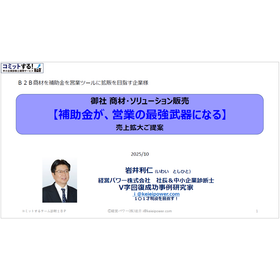
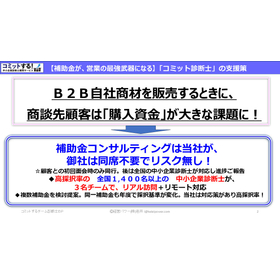
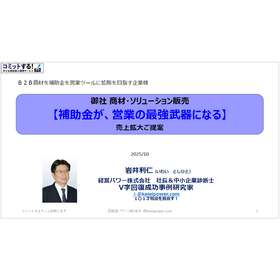
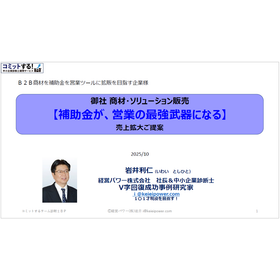
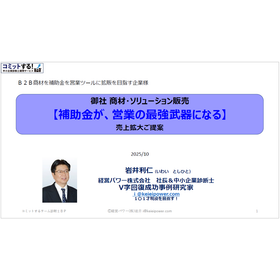
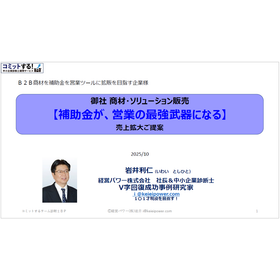
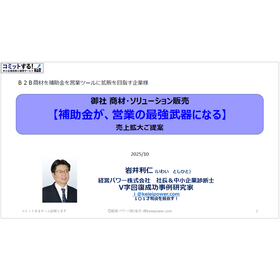
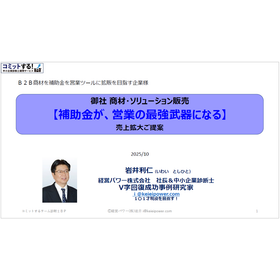
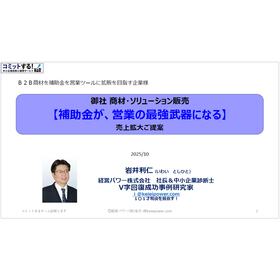
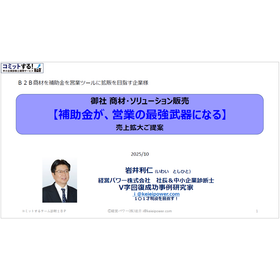
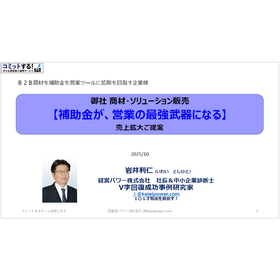
The key to the success of proposals using subsidies lies in collaboration with "committed team consultants," who are experts in the system. This allows sales representatives to focus on proposals while customers receive support with high expertise. Small and medium-sized enterprise consultants will lecture sales representatives on the key points, such as the basic structure of major subsidies and phrases for explaining during negotiations, that they need to grasp. Additionally, during the application phase, they provide support for creating application forms and business plans, organizing and checking necessary documents, and reporting results after approval, offering specialized assistance with documentation. The collaboration with over 1,300 small and medium-sized enterprise consultants enables support across regions, forming a nationwide network. *Please check the materials for a comprehensive overview of the expert support that will enhance your sales team's proposal capabilities.
Added to bookmarks
Bookmarks listBookmark has been removed
Bookmarks listYou can't add any more bookmarks
By registering as a member, you can increase the number of bookmarks you can save and organize them with labels.
Free membership registration
The main concerns of customers regarding subsidies are the "risk of non-acceptance" and the "burden of the application process." By having clear answers prepared by sales representatives, reliability can be maintained. Even in the case of non-acceptance, it is important to communicate that "switching to another subsidy or reapplying in the next public offering is possible." However, since there is a risk of delays in the schedule, it is recommended to consider both scenarios of "with subsidy and without subsidy." Regarding the burden of the application process, while consultants cannot act as representatives for the application, it is important to convey that they will provide comprehensive support to ensure companies do not feel lost, such as "organizing necessary documents, guidance on writing, and structuring plans." *The complete version of frequently asked questions and their example answers commonly encountered in sales settings can be obtained by downloading the materials.
Added to bookmarks
Bookmarks listBookmark has been removed
Bookmarks listYou can't add any more bookmarks
By registering as a member, you can increase the number of bookmarks you can save and organize them with labels.
Free membership registration
In the sales field, addressing customers' concerns about their budget and the reliability of their applications is key to advancing negotiations. Prepare effective talking points to lower the psychological barriers for customers. For customers who are hesitant about price, suggest that "if they qualify for subsidies, they may be able to reduce their actual burden," providing a reason to continue considering the proposal. When discussing investment effectiveness, encourage specific quantification by saying, "Let’s organize this together" regarding reductions in labor and man-hours, and summarize it as an introduction effect that can also be used for subsidy applications. Additionally, for customers worried about the reliability of their applications, emphasize that "small business consultants who are knowledgeable about subsidies will assist with document preparation," providing reassurance through the involvement of experts. *The complete collection of sales talks that resolve customer doubts and enhance reliability is available for download in the materials.*
Added to bookmarks
Bookmarks listBookmark has been removed
Bookmarks listYou can't add any more bookmarks
By registering as a member, you can increase the number of bookmarks you can save and organize them with labels.
Free membership registration
To incorporate subsidies into product introduction proposals, a series of steps is necessary to deeply explore the customer's challenges and accurately determine compatibility with the system. By systematizing this process, the accuracy of the proposals improves. In STEP 1, conduct "customer challenge hearings" to identify bottleneck processes and labor shortages, and in STEP 2, organize the "effects of product introduction" such as labor cost reduction and productivity improvement. Next, in STEP 3, perform the "subsidy compatibility assessment," and in STEP 4, reflect the subsidy rate and self-burden amount in the "proposal document." Subsequently, in STEP 5, provide "application support" such as assistance with document preparation, and in STEP 6, connect to "post-approval follow-up" such as delivery schedule adjustments and support for creating performance reports. *For examples of talks and practical points at each step that sales representatives can immediately implement, please download the materials for confirmation.
Added to bookmarks
Bookmarks listBookmark has been removed
Bookmarks listYou can't add any more bookmarks
By registering as a member, you can increase the number of bookmarks you can save and organize them with labels.
Free membership registration
Proposals utilizing subsidies are powerful, but they also include several disadvantages and risk factors, such as the complexity and uncertainty of the system. It is important to communicate these appropriately to customers to prevent misunderstandings. One of the biggest risk factors is the "uncertainty of adoption." Since subsidies are subject to review, there is a possibility that they may not be approved. It is necessary to consider switching to another subsidy or reapplying in the next round. Furthermore, the eligibility requirements and schedules vary by system, and incorrect explanations can lead to misunderstandings or excessive expectations from customers. Additionally, there may be a mismatch with the need for "immediate implementation," requiring proposals that take into account the timing of public offerings and the duration of project implementation. *We provide detailed explanations of how to describe subsidies and measures to minimize sales risks in our materials.
Added to bookmarks
Bookmarks listBookmark has been removed
Bookmarks listYou can't add any more bookmarks
By registering as a member, you can increase the number of bookmarks you can save and organize them with labels.
Free membership registration
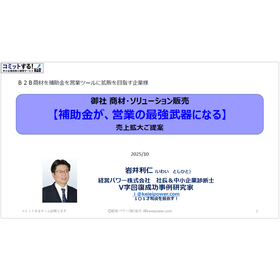
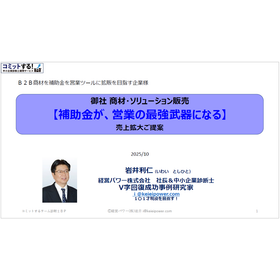
Proposals that include subsidies not only significantly enhance the value of your sales team but also benefit the customer. This enables the realization of high-level sales activities and helps differentiate from competitors. One of the advantages is that utilizing subsidies reduces the actual burden on customers. This shifts the perception from "too expensive to consider" to "possible depending on the conditions," increasing the feasibility of implementation. Furthermore, by proposing a method to lower the actual burden through subsidies rather than discounts, you can avoid price competition and create a situation where products are chosen based on their "value." Salespeople who can make this proposal are seen by customers as "salespeople who understand management challenges," which also leads to trust-building. *Please check the materials for specific successful examples of subsidy proposals that can advance your sales strategy.
Added to bookmarks
Bookmarks listBookmark has been removed
Bookmarks listYou can't add any more bookmarks
By registering as a member, you can increase the number of bookmarks you can save and organize them with labels.
Free membership registration
In facing numerous challenges such as rising material costs and a shortage of skilled labor, a powerful strategy for encouraging manufacturing customers to adopt your products is the "utilization of subsidies." Many excellent facilities are being postponed due to the barrier of "budget constraints." However, if you can propose a way to reduce the actual burden by utilizing subsidies, customers will have an opportunity to reconsider. This is not merely price negotiation; it promotes customers' investment decisions, elevating postponements to "consideration" and moving considerations to a "positive" stance. If explained appropriately, it can facilitate customers' investment decisions. *For an overview of proposals utilizing subsidies that manufacturers' sales representatives should master, please refer to the materials.
Added to bookmarks
Bookmarks listBookmark has been removed
Bookmarks listYou can't add any more bookmarks
By registering as a member, you can increase the number of bookmarks you can save and organize them with labels.
Free membership registration
We would like to introduce a case where a machinery trading company implemented a CAD system linked with an automatic high-speed reciprocating cutter, supported by a subsidy creation consulting service. In the company's traditional packaging, there was a mix of other companies' expanded polystyrene and their own corrugated boxes. To address this, they developed a prototype to convert everything to corrugated boxes. They decided to implement the system, believing that if they could reduce the lead time for design and measures by half, it would strengthen their proposal capabilities and increase sales. After the implementation, during the COVID outbreak, they were able to quickly develop and sell "value-added products," such as partitions, not just as packaging materials, but as part of a new business area, thus establishing a new business axis. Recently, they have also started developing and selling disaster prevention products. [Reasons for Implementation] - The traditional packaging mixed other companies' expanded polystyrene with their own corrugated boxes, so they developed a prototype to convert everything to corrugated boxes. - They believed that if they could reduce the lead time for design and measures by half, it would strengthen their proposal capabilities and increase sales. *For more details, please download the PDF or feel free to contact us.*
Added to bookmarks
Bookmarks listBookmark has been removed
Bookmarks listYou can't add any more bookmarks
By registering as a member, you can increase the number of bookmarks you can save and organize them with labels.
Free membership registration
We would like to introduce a case of the introduction of the remote-controlled felling work vehicle "Shin Raptor." The logging industry often involves steep forested areas and is a life-threatening job, where the safety of workers has not been adequately addressed. Additionally, due to the recent extreme heat, consideration for workers has become urgent, yet manual labor and human power remain the industry norm. Therefore, we introduced the "Shin Raptor." While subcontracting and further subcontracting are common in the industry, the adoption of this machine has allowed us to secure inquiries and business negotiations from major companies. [Reasons for Introduction] - We can request support for mid-term strategy planning rather than just one-time subsidy application assistance. - By consulting with a small business consultant known for high adoption rates, we felt we could obtain the "monozukuri subsidy," which has become difficult to secure. - Since they understand our business plan, they can efficiently provide subsidy application support without needing extensive explanations. - They also assist with billing processes to ensure a 100% payment rate after adoption (the amount is the preliminary amount). *For more details, please download the PDF or feel free to contact us.
Added to bookmarks
Bookmarks listBookmark has been removed
Bookmarks listYou can't add any more bookmarks
By registering as a member, you can increase the number of bookmarks you can save and organize them with labels.
Free membership registration
Our company offers a "Small and Medium Enterprise Consultant Advisory Service," where the president, employees, and three or more certified small and medium enterprise consultants work as one team to strive towards achieving goals. We conduct a free preliminary consultation proposal meeting three times, where action plans are proposed by three or more advisors, allowing for a confident selection of consultants. In addition to holding the small and medium enterprise consultant qualification, many of our members also possess multiple licenses, such as labor and social security attorneys, tax accountants, and lawyers. The synergy between practical experience and small and medium enterprise consultant theory enables us to commit to improving your company's performance. 【Features】 ■ Commitment to numerical goals and striving for performance improvement ■ Clear and affordable monthly pricing ■ Team-based approach for broad and in-depth support ■ Choose your consultant after three free preliminary consultation proposal meetings before signing a contract ■ All consultants hold the small and medium enterprise consultant qualification certified by the Minister of Economy, Trade and Industry ■ Active industry professionals, "in-house consultants," also participate as team members *For more details, please refer to the related links or feel free to contact us.



Added to bookmarks
Bookmarks listBookmark has been removed
Bookmarks listYou can't add any more bookmarks
By registering as a member, you can increase the number of bookmarks you can save and organize them with labels.
Free membership registration