1~6 item / All 6 items
Displayed results

Added to bookmarks
Bookmarks listBookmark has been removed
Bookmarks listYou can't add any more bookmarks
By registering as a member, you can increase the number of bookmarks you can save and organize them with labels.
Free membership registrationContact this company
Inquiry Form1~6 item / All 6 items
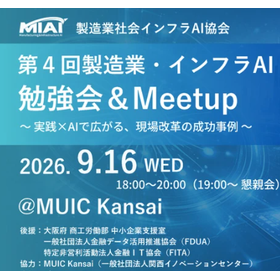
On September 16, 2026 (Wednesday), we will hold the "4th Manufacturing and Infrastructure AI Study Group & Meetup: Expanding Field Reforms through Practical AI Success Stories" on-site. On that day, we will welcome special guests and conduct various lectures themed around the current state of AI utilization in the manufacturing and infrastructure industries. Additionally, after the event, we plan to hold a Meetup (networking event) for all participants. We look forward to your enthusiastic participation. *For more details, please feel free to contact us.
Added to bookmarks
Bookmarks listBookmark has been removed
Bookmarks listYou can't add any more bookmarks
By registering as a member, you can increase the number of bookmarks you can save and organize them with labels.
Free membership registration
【If a major earthquake stops the factory, the damage could amount to hundreds of millions of yen!?】 Revealing successful examples of "DX × Earthquake Countermeasures" to protect the future of manufacturing! A major earthquake that is not "going to happen someday" but "can happen at any time." If a major earthquake were to occur now and halt the production line in a factory... You would face critical risks to business continuity (losses ranging from several million to several billion yen) not only from damage to buildings and equipment but also from delays in delivery and loss of business partners. This document presents real examples of "actual losses and reconstruction costs" that occur in factories during an earthquake, based on data from the Great East Japan Earthquake and the Kumamoto Earthquake. ▼ What you will learn in this seminar Actual damages during an earthquake: Real data on sales losses and reconstruction costs associated with factory shutdowns On-site action guide: A chronological action plan and checklist to move without hesitation from initial response to recovery Safety measures utilizing DX and AI: The mechanism and estimated costs of systems that detect shaking and automatically stop equipment and enable remote recovery Keys to successful business continuity: How to effectively use earthquake insurance to expedite recovery and examples from advanced companies ▼ Event Overview Date: September 11, 2026 (Friday) 13:30 - 14:30 Format: Online (Teams Webinar) Participation Fee: Free
Added to bookmarks
Bookmarks listBookmark has been removed
Bookmarks listYou can't add any more bookmarks
By registering as a member, you can increase the number of bookmarks you can save and organize them with labels.
Free membership registration
[Reforming Manufacturing Sites] Solving "Invisible Inventory" and "Manual Errors" with AI! The Cutting Edge of DX in Inventory Management and Logistics Text: "Searching for where everything is takes time..." "Ordering based on experience and intuition leads to overstock and stockouts..." Do you face such issues in your manufacturing site? This document introduces cases where automation of inbound and outbound processing and real-time visualization of inventory data have been achieved by utilizing cameras, barcodes, QR codes, and AI! ▼ Three Key Points Explained in the Document Instant reading with batch photography! Automating inbound processing and data updates significantly reduces work time. AI automatically determines the optimal storage location! Eliminating waste in searching and moving maximizes storage efficiency. [Case Study] A unified management model from procurement to the reuse of processed scrap in a plastic product processing factory. Comprehensive DX that can be immediately applied in the field, including data linkage with WMS and production management systems. Please download and read it! ▼ Event Overview Date: October 9, 2026 (Friday) 13:30 - 14:30 Format: Online (Teams Webinar) Participation Fee: Free *For more details, please feel free to contact us.
Added to bookmarks
Bookmarks listBookmark has been removed
Bookmarks listYou can't add any more bookmarks
By registering as a member, you can increase the number of bookmarks you can save and organize them with labels.
Free membership registration
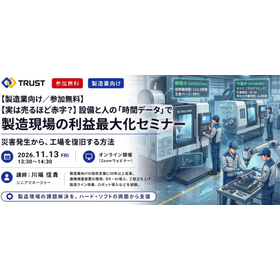
"Even though the processing costs in the catalog are the same, there are products that somehow do not generate profit..." "We are unable to grasp the reasons for machine stoppages (short and long stops) or the speed differences among operators..." The "invisible losses" lurking in the workplace may actually be significantly squeezing the factory's profits. This document explains a method to dramatically enhance the profitability and competitiveness of the site by automatically acquiring the "operating time" of processing machines and the "working time" of operators, and cross-analyzing them on the same time axis! ▼ What you will learn in this seminar 【Reducing equipment stagnation】 Identify priority measures for short and long stops to significantly reduce machine downtime 【Highlighting unprofitable products】 Calculate the "net actual cost" from equipment and personnel data for evidence-based price negotiations 【Technology transfer and leveling】 Visualize the work differences (such as screw tightening) between skilled workers and newcomers to eliminate bottlenecks in the process 【Case study of a press processing factory】 A practical model from daily report automation to data collection using RFID ▼ Event Overview Date: November 13, 2026 (Friday) 13:30 - 14:30 Format: Online (Teams Webinar) Participation Fee: Free *For more details, please feel free to contact us.
Added to bookmarks
Bookmarks listBookmark has been removed
Bookmarks listYou can't add any more bookmarks
By registering as a member, you can increase the number of bookmarks you can save and organize them with labels.
Free membership registration
The retirement of veteran engineers (the 2025 problem) is causing control programs to become black boxes... There is no time to teach ladder diagrams to younger or new employees, nor are there learning opportunities in educational institutions... The 'personalization of programs and development burden' lurking in the field may actually be significantly hindering the promotion of DX in factories and productivity. This document explains a new method and practical model for accelerating and streamlining program generation, comprehension, and standardization in PLC program development in manufacturing using generative AI! ▼ What you will learn in this seminar 【Reducing the burden of control development】 Trends in automatic generation of PLC code and ladder diagrams using general-purpose LLMs, specialized LLMs, and manufacturer-specific Copilots 【Knowledge transfer and eliminating black boxes】 Analyzing and visualizing personalized legacy code and past assets with AI to achieve standardization of veteran know-how and reduce education costs 【Compliance with language standards (IEC 61131-3 4th edition)】 Understanding the compatibility of ST language and ladder diagrams with AI, and presenting a practical workflow that can be used immediately in the field 【Comparison of major vendors and case studies】 Introducing new AI features from Mitsubishi Electric, Siemens, Rockwell, and examples of Copilot integration.
Added to bookmarks
Bookmarks listBookmark has been removed
Bookmarks listYou can't add any more bookmarks
By registering as a member, you can increase the number of bookmarks you can save and organize them with labels.
Free membership registration
[Free Participation for Manufacturing Industry] AI Visual Inspection is Not Just "Detect and Done" A Method to Identify Defective Factors from Inspection Data and Improve Processes In manufacturing sites, there are various challenges in the inspection process, such as labor shortages, skill transfer, and variability in visual inspections. While the use of AI visual inspection is advancing to address these challenges, simply determining good and defective products with AI does not lead to process improvement. What is important is to accumulate and analyze inspection data to clarify "when, where, and why defects are occurring." In this seminar, we will introduce the basics of AI visual inspection, analyze the causes of defects using inspection data, and provide methods for improving upstream processes and preventing recurrence, along with specific examples. *For more details, please feel free to contact us.
Added to bookmarks
Bookmarks listBookmark has been removed
Bookmarks listYou can't add any more bookmarks
By registering as a member, you can increase the number of bookmarks you can save and organize them with labels.
Free membership registration