1~45 item / All 67 items
Displayed results
Added to bookmarks
Bookmarks listBookmark has been removed
Bookmarks listYou can't add any more bookmarks
By registering as a member, you can increase the number of bookmarks you can save and organize them with labels.
Free membership registration
Contact this company
Contact Us Online1~45 item / All 67 items

The advantages of the cutting-edge manufacturing method of metal 3D printing, "Digital Sintering," are as follows: ✅ Overwhelming Speed The lead time is about one week (with the shortest record being two days), making it very advantageous for prototype and small-scale production that require urgent responses. ✅ Strong in Producing Complex Shapes and Small Parts The maximum size it can accommodate is 80mm square, but it excels in manufacturing small and complex-shaped parts. It is ideal for small components in medical devices and electronic equipment, as well as for very small quantities of development parts. ✅ Specific Steel Type Compatibility The available materials are limited to SINTER T (SUS316L) and SINTER D (pure copper, SUS316L, SUS630), but this allows for the rapid provision of complex-shaped items. *This is a guideline for the maximum size and steel types based on our metal 3D printing service technology. We provide the optimal manufacturing method along with VE proposals according to the purpose of parts procurement (QCD) and specification conditions, so please feel free to contact us.
Added to bookmarks
Bookmarks listBookmark has been removed
Bookmarks listYou can't add any more bookmarks
By registering as a member, you can increase the number of bookmarks you can save and organize them with labels.
Free membership registration
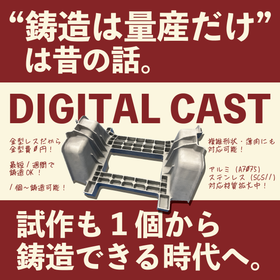
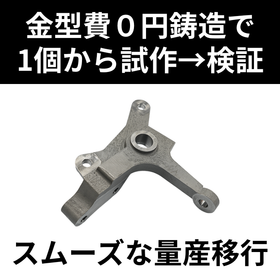
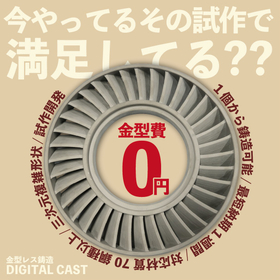
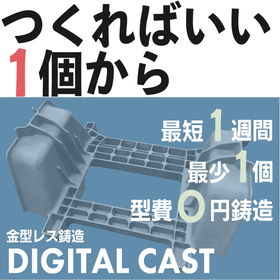
▶ Mold cost reduced to 0 yen ▶ Complex shapes are also acceptable ▶ Castable from just one piece ▶ Short delivery time of as little as one week "Digital Cast" is a new form of "prototype casting" that balances development speed and cost. Masters are produced using a 3D printer, allowing for complex three-dimensional shapes that are difficult to achieve with machining. You can choose from over 70 materials, including Inconel and A7075. We have received over 1,000 inquiries to date. Please give the option of "casting for prototypes" a try at least once. ■ Examples of achievements Industrial machine parts Semiconductor parts Aerospace parts Golf club heads Strength verification of cast products Prototype verification of complex shapes Original parts manufacturing
Added to bookmarks
Bookmarks listBookmark has been removed
Bookmarks listYou can't add any more bookmarks
By registering as a member, you can increase the number of bookmarks you can save and organize them with labels.
Free membership registration
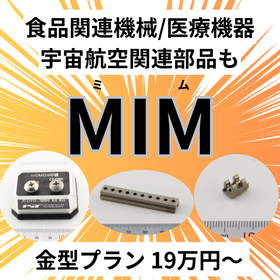
Castem's MIM (Metal Injection Molding) allows for fine, thin-walled, and complex three-dimensional shapes. It is widely adopted in fields that require precision, such as food factory machinery, medical device parts, and aerospace components. Manufacturing in the million-order range is possible. We specialize in producing small parts that emphasize beauty (surface roughness Rmax 12) and precision (sharp edges and thin-walled shapes). The initial mold costs for injection-molded products can also be reduced according to the plan (starting from 190,000 yen). *Please download the materials for information on mold plans. For more details, feel free to contact us through our website. 【Supported Steel Types】 Cr-Mo Steel Ni-Cr-Mo Steel Tool Steel High-Speed Steel Stainless Alloys (Austenitic, Martensitic, Precipitation Hardening) Heat-Resistant Steel Cemented Carbide Magnetic and Low Thermal Expansion Alloys Titanium *Please feel free to consult us about materials not listed. 【Size Guidelines】 Size: Approximately up to 30mm on each side Minimum (one side): Approximately 1mm Maximum (one side): Approximately 200mm Minimum wall thickness: Approximately 0.1mm Minimum weight: Approximately a few mg Maximum weight: Approximately 100g *Please consult us as the range of support may vary depending on the product shape.
Added to bookmarks
Bookmarks listBookmark has been removed
Bookmarks listYou can't add any more bookmarks
By registering as a member, you can increase the number of bookmarks you can save and organize them with labels.
Free membership registration
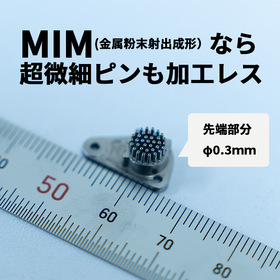
The photo shows a nozzle of a fiber manufacturing equipment part produced by MIM. The hole diameter at the tip is φ0.3mm, and the length of the protrusion is 2.8mm, making it extremely fine. By mixing metal powder and resin, then using injection molding with a mold and debinding sintering, we can mass-produce highly precise machine parts like this. In mass production, significant reductions in lead time and costs can be expected compared to machining. Castem has researched MIM, a technology born from NASA, and has independently obtained a U.S. patent. We have over 30 years of manufacturing experience. We have produced medical device parts and aerospace components that require high precision. For more details, please feel free to contact us through our website or other means. 【Product Overview】 Fiber manufacturing equipment part 【Material】 Stainless steel (SUS630) 【Dimensions】 Hole diameter at the tip: φ0.3±0.05mm Hole depth: 2.8mm
Added to bookmarks
Bookmarks listBookmark has been removed
Bookmarks listYou can't add any more bookmarks
By registering as a member, you can increase the number of bookmarks you can save and organize them with labels.
Free membership registration
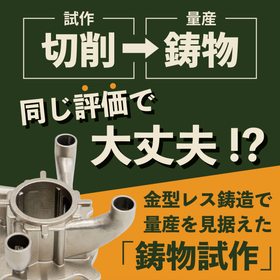
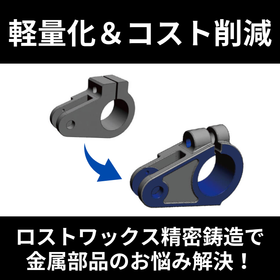
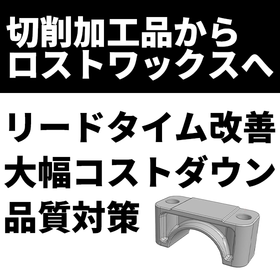
"Switching from Machined Products to Lost Wax Casting!" ✅ Improved Lead Time ✅ Cost Reduction ✅ Comprehensive Quality Measures Previously, we used machined products, but by switching to lost wax precision casting, we have improved mass production capabilities and achieved lead time improvements. Additionally, by reducing material weight by over 100g through thinning, we have made cost reductions possible. Quality measures are also thorough, including countermeasures against voids by ensuring uniform wall thickness and addressing burrs by creating recesses. We have received many inquiries from customers considering the switch from machining to lost wax precision casting due to cost factors. Depending on the desired size and application of the parts, we can also propose other methods such as MIM (Metal Injection Molding) and digital casting (mold-less casting using 3D printed models). For any inquiries regarding metal parts, please feel free to consult with Castem.
Added to bookmarks
Bookmarks listBookmark has been removed
Bookmarks listYou can't add any more bookmarks
By registering as a member, you can increase the number of bookmarks you can save and organize them with labels.
Free membership registration
The image is a complex-shaped metal artwork installed by the waterside. To accommodate the ultra-complex shapes based on the artist's sensibility, we adopted moldless casting "Digital Cast" based on 3D data. For installation in an outdoor waterside environment, we used a corrosion-resistant duplex stainless steel casting "SCS11." ■ Features of Moldless Casting Digital Cast - The shortest delivery time is one week. Enables speedy production, perfect for prototyping and development. - More than 70 types of materials to choose from, including iron, stainless steel, and copper. Also compatible with special steels and high-strength aluminum materials like "A7075." - Can be manufactured from a single piece. - No mold costs. - Ideal for prototyping and strength verification with multiple materials. - Smooth transition from prototyping to mass production through casting. ■ Features of SCS11 - Superior corrosion resistance in chloride environments compared to general austenitic stainless steels. - High corrosion resistance suitable for use in underwater, marine, and offshore environments. - Proven track record in a wide range of fields, including offshore/marine equipment, medical devices, food equipment, and outdoor installations. - Slightly higher cost compared to general stainless steel, but contributes to total cost reduction through increased longevity. Based on the application and installation location, we will propose the optimal manufacturing method, material, and shape. Please feel free to consult with us.
Added to bookmarks
Bookmarks listBookmark has been removed
Bookmarks listYou can't add any more bookmarks
By registering as a member, you can increase the number of bookmarks you can save and organize them with labels.
Free membership registration
We can quickly prepare parts that have suddenly become necessary using "Digital Cast," which does not require molds. The key points of Digital Cast are as follows: ✅ Fastest delivery time is 1 week ✅ More than 70 types of materials (casting materials) available ✅ Can be manufactured from a single piece ✅ No mold costs We also welcome inquiries for prototypes and small-lot production with an eye on mass production! We will respond flexibly to your requests, so if you have parts under consideration for weight reduction or shape changes, please feel free to contact us. 【What is Digital Cast?】 A method of producing metal products by creating a resin model with a 3D printer and then following a process similar to lost-wax precision casting using that model as a prototype. We can handle castings in as little as 1 week and from a single piece. We will provide proposals that offer benefits even in development and prototyping. If you have parts under consideration for weight reduction or shape changes, please feel free to consult with us.
Added to bookmarks
Bookmarks listBookmark has been removed
Bookmarks listYou can't add any more bookmarks
By registering as a member, you can increase the number of bookmarks you can save and organize them with labels.
Free membership registration
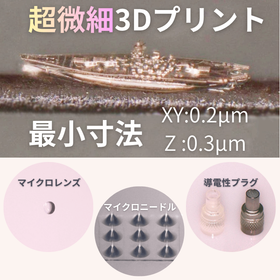
"Prototyping of ultra-fine parts using the world's highest precision 3D light sculpting technology" This is a manufacturing contract service for micro lenses, diffractive optical elements, micro needles, MEMS, etc., using the world's highest precision 3D light sculpting technology, the "Nanoscribe System." It is being advanced in collaboration with Kyoto University of Advanced Science. By utilizing 3D printing technology based on two-photon polymerization and IP resin with sub-micron resolution, this system enables the production of shapes and precision that are impossible with conventional methods. The image at the top shows a battleship Yamato-sized object that can rest on a strand of hair. No molds or cutting are required, and we can accommodate prototyping from a single piece. By applying dry plating (gold, platinum), it is also possible to impart conductivity. We can meet delivery times within three weeks. We can also create designs if 3D data is not available. The applicable sizes vary by material, but the minimum shape dimensions are XY: 0.2μm, Z: 0.3μm. The maximum build height is 8mm. This technology is utilized in research and industrial fields such as mechatronics, biotechnology, microelectronics, optics, medicine, and materials engineering. If you are considering prototyping ultra-fine parts, please feel free to contact us.
Added to bookmarks
Bookmarks listBookmark has been removed
Bookmarks listYou can't add any more bookmarks
By registering as a member, you can increase the number of bookmarks you can save and organize them with labels.
Free membership registration
Castem's MIM (Metal Injection Molding) method has a proven track record in medical device components and aerospace parts. However, do you have the impression that MIM, which specializes in complex shapes and small parts, is not suitable for small lots due to "high mold costs for prototypes" or "limited material options"? The MIM method offers three mold plans tailored to your required quantities. 1. "Mass Production Type" for large lots and repeats - Price: From 980,000 yen - Quantity: Up to 100,000 pieces 2. "Simple Type" for small lots and repeats - Price: From 490,000 yen - Quantity: Up to 10,000 pieces 3. "Try and Make Type" for prototypes and ultra-small lots - Price: From 190,000 yen - Quantity: Up to 50 pieces *Conditions apply. Please feel free to contact us for details. 【Features of Castem's MIM】 ✅ Capable of producing fine, complex shapes with a minimum wall thickness of 0.1mm and sharp edge reproduction ✅ Molding of screws and ultra-fine pins without machining ✅ Proven track record in medical devices, dental, food, and aerospace-related components ✅ In-house integrated production system from mold making to processing such as plating ✅ Both domestic and overseas factories have obtained ISO 9001 certification, ensuring reliable quality control.
Added to bookmarks
Bookmarks listBookmark has been removed
Bookmarks listYou can't add any more bookmarks
By registering as a member, you can increase the number of bookmarks you can save and organize them with labels.
Free membership registration
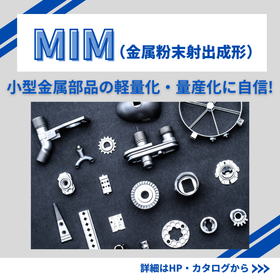
"I want to make it lighter." "The costs and delivery times don't match with machining." ―― We solve such "big challenges of small parts" with MIM. 【Strengths of Castem MIM】 ✅ Expertise in fine, thin, and three-dimensional shapes High-precision metal powder injection molding allows for the integral shaping of complex three-dimensional forms that are difficult to achieve with machining. Achieves high mechanical strength despite being a sintered product. ✅ Cost optimization through machining-free design Numerous achievements in high-precision shapes that require no secondary processing, such as screws, medical devices, and orthodontic parts. With a "non-cutting" approach from the design stage, bold thinning and weight reduction are possible. ✅ Comprehensive support from mold design to mass production Molds are designed and manufactured in-house. Stable mass production is achieved at our ISO9001 certified overseas factory, pursuing a balance between quality and cost. Shortening processes, improving quality, and reducing weight―― Castem proposes the "optimal shape" tailored to our customers' challenges. If you're looking to lighten and mass-produce small metal parts, please consult us. ☞ For more details, please contact us through the official Castem website.
Added to bookmarks
Bookmarks listBookmark has been removed
Bookmarks listYou can't add any more bookmarks
By registering as a member, you can increase the number of bookmarks you can save and organize them with labels.
Free membership registration
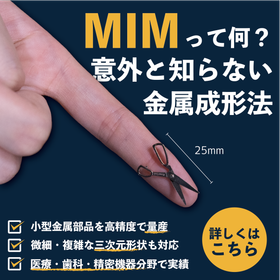
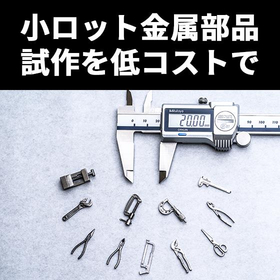
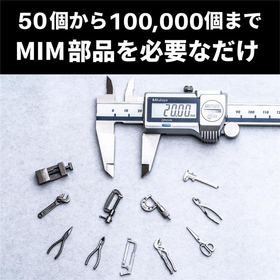
MIM (Metal Injection Molding) is a technology for manufacturing metal parts by mixing metal powder and binder, injecting them into a mold, and finally sintering them. ✅ Capable of producing fine, complex shapes and sharp edges with a minimum wall thickness of 0.1mm. ✅ Can mold screws and ultra-fine pins without machining. ✅ Proven track record in medical devices, dental, food, and aerospace-related components. ✅ Integrated production system from mold manufacturing to processing such as plating in-house. ✅ Both domestic and overseas factories have obtained ISO9001 certification, ensuring reliable quality control. With ultra-fine molding technology, we can also create miniature tools that move like the real thing, measuring 25mm in length (such as scissors, calipers, and cutters). From limited small lot products to repeat mass production, we can propose mold cost plans tailored to your needs. We have successfully achieved cost reductions through bold design changes from the design stage, with in-house integrated production from mold manufacturing. Please feel free to contact us through our website.
Added to bookmarks
Bookmarks listBookmark has been removed
Bookmarks listYou can't add any more bookmarks
By registering as a member, you can increase the number of bookmarks you can save and organize them with labels.
Free membership registration
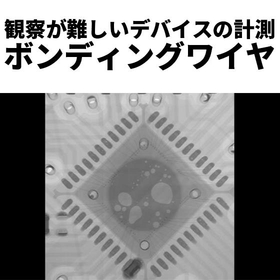
Material: Printed Circuit Board Observation Range: 5 x 5 (mm) The image shows the observation of bonding wires. Bonding wires are thin metal wires used as connection materials in semiconductors. We have visualized issues such as joint defects and flow rate calculations, which are considered difficult to evaluate with standard measuring instruments. At Castem, we offer CT scan services using the Nikon MCT225. You can either leave your samples with us or have our staff accompany you while you perform the scan. By conducting a CT scan, it becomes possible to analyze internal defects, create 3D data, and measure internal dimensions. If you are interested, please feel free to contact us.
Added to bookmarks
Bookmarks listBookmark has been removed
Bookmarks listYou can't add any more bookmarks
By registering as a member, you can increase the number of bookmarks you can save and organize them with labels.
Free membership registration
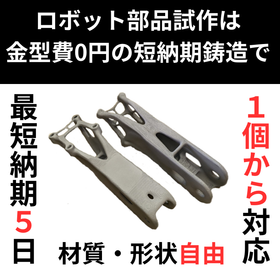
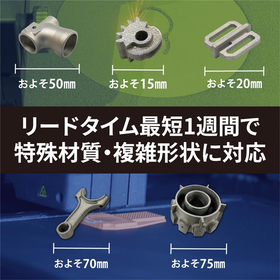
Features of "Digital Cast," a mold-less casting that combines precision casting and 3D printing technology ✅ Low-cost casting possible from a single piece without molds ✅ Shortest delivery time of 5 days! Providing metal parts in a short timeframe ✅ Excels in complex three-dimensional shapes and hollow structures ✅ Compatible with a variety of steel types, including ultra-high-strength aluminum alloy A7075 A new casting technology that takes the best of both worlds: the speed of 3D printing and the precision casting that accommodates complex shapes and diverse steel types! There are over 2,000 implementation cases across various industries, including next-generation mobility, rockets, and robot parts. When considering repeat mass production in casting, prototype production using the same material in the casting method is possible. This is ideal for evaluating and verifying mechanical properties! Additionally, it allows for comparative testing of the same shape with various metal materials and can quickly respond to shape changes. A new approach to prototype development of metal parts. For more details, please feel free to contact us through our website or other means.
Added to bookmarks
Bookmarks listBookmark has been removed
Bookmarks listYou can't add any more bookmarks
By registering as a member, you can increase the number of bookmarks you can save and organize them with labels.
Free membership registration
【Current Situation】 1. Concerns about the strength of the welded parts 2. Inability to completely eliminate the risk of corrosion ↓ 【Improvement Points】 1. Changed the welded parts to an integrated shape, increasing strength! 2. Tested and adopted a rust-resistant material [SCS11] for mass production! In this way, we were able to resolve the concerns that existed with the conventional products all at once. The key points of Digital Cast are as follows: ☑ Shortest delivery time is 1 week ☑ More than 70 types of materials (casting materials) available for selection ☑ Can be produced from a single piece ☑ No mold cost With the casting method [Digital Cast] that allows for production from a single piece without the need for molds, let's casually try out various prototypes! We also welcome inquiries for prototypes aimed at mass production or small-lot production! We will respond flexibly to your requests, so if you have any parts under consideration for weight reduction or shape changes, please feel free to contact us first. 【What is Digital Cast?】 A method that creates resin models using a 3D printer and then produces metal products in a process similar to lost-wax precision casting using those models as prototypes. We can accommodate castings in as little as 1 week, starting from a single piece. We will provide proposals that offer advantages even in development and prototyping.
Added to bookmarks
Bookmarks listBookmark has been removed
Bookmarks listYou can't add any more bookmarks
By registering as a member, you can increase the number of bookmarks you can save and organize them with labels.
Free membership registration
Would you like to try manufacturing parts currently made through cutting and welding at a lower cost and with a shorter delivery time? The parts in the image were originally produced by machining two separate components and then welding them together. Due to the special material known as Inconel 625, sourcing from overseas manufacturers was necessary, which increased costs. Additionally, this material is prone to work hardening, making machining very difficult. However, all these issues can be resolved with the mold-free, multi-material casting method called Digital Cast! The key points of Digital Cast are as follows: ✅ The shortest delivery time is one week ✅ More than 70 types of materials (casting materials) can be selected ✅ Production is possible from just one piece ✅ No mold costs We also welcome inquiries for prototypes and small-lot mass production with an eye on mass production! We will flexibly respond to your needs, so if you have parts under consideration for weight reduction or shape changes, please feel free to contact us. What is Digital Cast? It is a method of producing metal products by creating a resin model with a 3D printer and then following a process similar to lost-wax precision casting. Castings can be handled in as little as one week, starting from just one piece. We will provide proposals that offer benefits even in development and prototyping.
Added to bookmarks
Bookmarks listBookmark has been removed
Bookmarks listYou can't add any more bookmarks
By registering as a member, you can increase the number of bookmarks you can save and organize them with labels.
Free membership registration
✅Strength increase due to integrated shape ✅Product cost reduced by 40% ✅Elimination of hassle in arranging and managing by process 【What is Digital Cast?】 A method of producing metal products by creating resin models with a 3D printer and using them as prototypes in a process similar to lost-wax precision casting. Castings can be handled in as little as one week, starting from just one piece. We offer proposals that are beneficial even for development and prototyping. If you have parts under consideration for weight reduction or shape changes, please feel free to consult with us. 【Three Features of Digital Cast】 - Shortest delivery time of one week - Zero mold cost - Manufacturing possible from just one piece
Added to bookmarks
Bookmarks listBookmark has been removed
Bookmarks listYou can't add any more bookmarks
By registering as a member, you can increase the number of bookmarks you can save and organize them with labels.
Free membership registration
Castem's MIM (Metal Injection Molding) has a proven track record in medical device components and aerospace parts. The photo shows a screw part related to aerospace (material 64Ti, Φ12). The example product is a molded part without any machining on the screw section, which helps reduce costs. "Want to prototype but mold costs are high and it's not suitable for small lots" or "There are few compatible materials"—do you have such impressions? With Castem's "Try and Make Mold" for up to 50 shots, you can prototype MIM products starting from a mold cost of 190,000 yen. *Conditions apply; please inquire for details. **Features of Castem's MIM:** - Proposals for mold cost plans that cater to requests for limited small lots and mass production repeat items. - A system where the entire process from mold creation to processing is done in-house. - Expertise in achieving fine, complex shapes and sharp edge reproduction with a minimum wall thickness of 0.1mm. - All processes including precision machining, heat treatment, and plating are integrated for consistent production.
Added to bookmarks
Bookmarks listBookmark has been removed
Bookmarks listYou can't add any more bookmarks
By registering as a member, you can increase the number of bookmarks you can save and organize them with labels.
Free membership registration
To engineers who have only prototyped through cutting. That shape might be easier, faster, and cheaper to produce with casting. ✅ Mold cost: 0 yen ✅ Support from just one piece ✅ Difficult-to-machine materials like Inconel and A7075 are also OK ✅ Over 1,000 successful implementations Changing the common belief that "prototyping = cutting," 【Digital Cast】 will be your next option. 【What is Digital Cast?】 A method of producing metal products using a 3D printer to create a resin model, which is then used as a prototype in a process similar to lost-wax precision casting. Castings can be produced in as little as one week, starting from just one piece. We offer proposals that provide benefits even in development and prototyping. If you have parts under consideration for weight reduction or shape changes, please feel free to consult with us.
Added to bookmarks
Bookmarks listBookmark has been removed
Bookmarks listYou can't add any more bookmarks
By registering as a member, you can increase the number of bookmarks you can save and organize them with labels.
Free membership registration
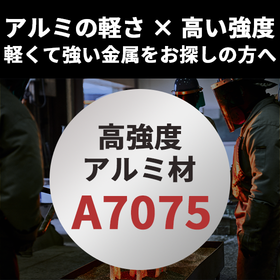
The ultra-high-strength aluminum material, super duralumin "A7075 (cast)", is now part of our original casting material standards! It can be used in lost-wax precision casting and mold-less casting "Digital Cast". "Wanting lightness and strength, but titanium is expensive. I want to keep costs down..." We solve such concerns. While possessing the unique lightness of aluminum, its tensile strength is close to that of stainless steel "SCS13 (equivalent to SUS304)". It is suitable for aerospace components and robotic parts where lightness and strength are required. With lost-wax precision casting, which excels in hollow and complex three-dimensional shapes, we contribute to cost reduction through optimal shape proposals. ★ For a detailed description of A7075, please see the attached image. ★ For compatible materials, click here: https://www.castem.co.jp/technology/lostwax/
Added to bookmarks
Bookmarks listBookmark has been removed
Bookmarks listYou can't add any more bookmarks
By registering as a member, you can increase the number of bookmarks you can save and organize them with labels.
Free membership registration
【Manufacturing Method】 Digital Cast 【Content】 This is an example of prototype verification conducted in preparation for mass production after changing the procurement source. We proposed testing for lost-wax casting using mold-less digital casting. Additionally, the parts that were originally printed with a laser marker were reproduced with cast lettering, and the finish was confirmed in advance using digital casting. 【What is Digital Cast?】 A manufacturing method that creates resin models with a 3D printer and then produces metal products following a process similar to lost-wax precision casting. Castings can be produced in as little as one week, starting from just one piece. We offer proposals that are beneficial for development and prototyping. If you have parts under consideration for weight reduction or shape changes, please feel free to consult with us. 【Three Features of Digital Cast】 - Shortest delivery time of one week - Zero mold cost - Production possible from just one piece
Added to bookmarks
Bookmarks listBookmark has been removed
Bookmarks listYou can't add any more bookmarks
By registering as a member, you can increase the number of bookmarks you can save and organize them with labels.
Free membership registration
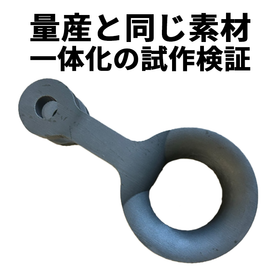
【Conventional Method】 Welding 【Method】 Digital Cast 【Content】 The image shows a railway component that reinforces overhead wires. When integrating what were originally two parts, there was a request to conduct prototype verification using the same material as for mass production. Therefore, we proposed Digital Cast, which allows for manufacturing from a single part without the need for a mold. As requested, we conducted prototype verification using the same material as for mass production, leading to mass production using lost wax casting. 【What is Digital Cast?】 A method that involves creating a resin model with a 3D printer, which is then used as a prototype to produce metal products through a process similar to lost wax precision casting. Castings can be produced in as little as one week, starting from just one piece. We offer proposals that are beneficial even for development and prototyping. If you have parts under consideration for weight reduction or shape changes, please feel free to consult with us. 【Three Features of Digital Cast】 - Shortest delivery time of one week - Mold cost of zero - Capable of manufacturing from just one piece
Added to bookmarks
Bookmarks listBookmark has been removed
Bookmarks listYou can't add any more bookmarks
By registering as a member, you can increase the number of bookmarks you can save and organize them with labels.
Free membership registration
☑ Increased costs due to parts replacement ☑ Decreased machine performance due to rust ☑ Decreased customer trust due to quality defects Concerns about the deterioration of machine parts in marine, underwater, and outdoor environments. Since these parts are necessary for the production of food and pharmaceuticals, materials that are resistant to chemicals are desired. The solution to these challenges is Castem's dual-phase stainless steel casting "SCS11," provided through lost-wax precision casting. ■ Features of SCS11 - Excellent corrosion resistance in chloride environments compared to general austenitic stainless steel - High corrosion resistance suitable for use in seawater and marine environments - Stable corrosion resistance in many acidic and alkaline environments - Proven track record in a wide range of fields, including offshore/underwater equipment, medical devices, food machinery, and outdoor equipment - Slightly higher cost compared to general stainless steel, but contributes to total cost reduction through longer lifespan ■ Summary of Benefits With SCS11, which combines "rust resistance" and "high strength," there is potential to reduce the frequency of parts replacement and contribute to long-term stable performance. *According to Castem's research (for more details, please see the attached image). For more information, please feel free to contact us through our website.
Added to bookmarks
Bookmarks listBookmark has been removed
Bookmarks listYou can't add any more bookmarks
By registering as a member, you can increase the number of bookmarks you can save and organize them with labels.
Free membership registration
This is a request for the prototype development of parts that originally took a long time to produce due to the many processes involved in welding. We want to shorten the process by using lost-wax casting, but suddenly creating a mold is risky and concerning... Therefore, we conducted prototype verification using a digital casting method that allows for mold-less casting. 【What is Digital Casting?】 A method of producing metal products using a 3D printer to create a resin model, which serves as a prototype, and then following a process similar to lost-wax precision casting. Castings can be produced in as little as one week, starting from just one piece. We offer proposals that provide benefits even in development and prototyping. If you have parts under consideration for weight reduction or shape changes, please feel free to consult with us. 【Three Features of Digital Casting】 - Shortest delivery time of one week - Mold cost of zero - Production possible from just one piece
Added to bookmarks
Bookmarks listBookmark has been removed
Bookmarks listYou can't add any more bookmarks
By registering as a member, you can increase the number of bookmarks you can save and organize them with labels.
Free membership registration
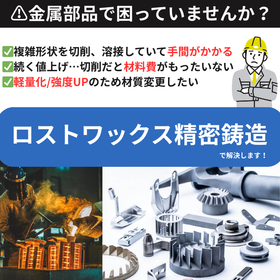
The lost wax precision casting method involves injecting wax into a mold to create a product model, coating it with ceramic to form a casting mold, and then casting to produce metal parts. Its strengths are as follows: ✅ Hollow and complex three-dimensional shapes ✅ A diverse selection of over 70 steel types (including iron, stainless steel, copper, aluminum, and special materials such as super duralumin) ✅ Cost reduction achieved through gradual material removal considering productivity ✅ Time savings through a reduction in the number of processes ✅ Small lot production of various types (from dozens to thousands per lot) ✅ Affordable aluminum molds that can be used semi-permanently ✅ Capable of handling items from a few grams to 30 kg (with a specialty size range of 30 to φ300 mm) "If you want to integrate multiple parts," "if you want to increase strength," "if you want to reduce costs compared to machining," "if multiple processes are required for a single part, leading to increased costs and time"… We propose the optimal materials, shapes, and methods tailored to your concerns and requests. *For a list of materials and tolerance tables, click here* → https://www.castem.co.jp/technology/lostwax/ Please feel free to consult us through our website.
Added to bookmarks
Bookmarks listBookmark has been removed
Bookmarks listYou can't add any more bookmarks
By registering as a member, you can increase the number of bookmarks you can save and organize them with labels.
Free membership registration
【Conventional Method】 Machining 【Method】 Digital Casting 【Content】 This is an example of a case where shape proposals were implemented with an eye on mass production. Digital casting, which allows for the creation of cast products from a single piece without molds, enables such shape modifications and prototypes to be done with low risk, providing peace of mind. We were able to produce test parts using the same method as mass production. 【What is Digital Casting?】 A method that involves creating a resin model with a 3D printer and then manufacturing metal products following a process similar to lost-wax precision casting using that model as a prototype. Castings can be produced in as little as one week, starting from just one piece. We offer proposals that are beneficial even for development and prototyping. If you have parts under consideration for weight reduction or shape changes, please feel free to consult with us. 【Three Features of Digital Casting】 - Shortest delivery time of one week - Mold cost of zero yen - Production possible from a minimum of one piece ~~~~~~~~~~~~~~~~~~~~ Industry: Semiconductor Material: SCS13
Added to bookmarks
Bookmarks listBookmark has been removed
Bookmarks listYou can't add any more bookmarks
By registering as a member, you can increase the number of bookmarks you can save and organize them with labels.
Free membership registration
Prototyping = Breaking the Common Sense of Machining With mold-less casting "Digital Cast", ✅ Supports complex three-dimensional shapes ✅ Delivery in as fast as one week ✅ No mold costs, starting from one piece "When it comes to this shape, machining is impossible..." "The costs are too high to produce in quantity..." In such cases, consider the option of "casting." Digital Cast is a new prototyping method that creates a master using a 3D printer and then casts it. No molds are needed, and we can respond quickly even for just one piece. Over 1,000 successful implementations. Many companies have already broken free from the assumption that "prototyping = machining." Feel free to consult with us first. Your "manufacturing speed" will change.
Added to bookmarks
Bookmarks listBookmark has been removed
Bookmarks listYou can't add any more bookmarks
By registering as a member, you can increase the number of bookmarks you can save and organize them with labels.
Free membership registration
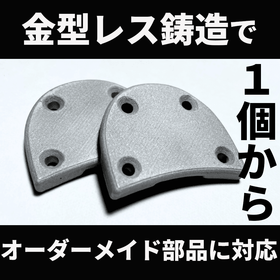
The image is a custom example of heel tips used in tap dancing. Castem's mold-less casting digital cast creates molds based on 3D printed models and then manufactures them using the same process as conventional lost-wax precision casting. The absence of molds leads to a reduced lead time, with the shortest delivery record being 5 days (usually 2 weeks). We can accommodate not only iron, stainless steel, and aluminum but also over 70 types of steel, allowing us to create precise metal parts with complex three-dimensional shapes. Do you want a custom-made, one-of-a-kind commemorative item...? Is a machine part broken, but there are no drawings for an old machine...? Has the necessary part been discontinued...? Do you need just one metal part for a prototype, but machining is too costly...? Digital cast can solve such requests and concerns! 【Part Overview】 Material: A6061 Usage: Heel tips used in tap dancing (Custom-made)
Added to bookmarks
Bookmarks listBookmark has been removed
Bookmarks listYou can't add any more bookmarks
By registering as a member, you can increase the number of bookmarks you can save and organize them with labels.
Free membership registration
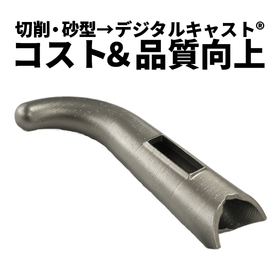
The image shows an example of a part used in the manufacturing of an elephant trunk (the handle and tip of a rickshaw). The previous material was brass, and it was manufactured through cutting, but it seems the processing company went out of business. After that, it was produced once using sand casting, but it was more expensive and had many defects compared to cutting, which was a problem. Therefore, we proposed digital casting, which can accommodate small lots, and we were able to improve both cost and quality. 【What is Digital Casting?】 A method of producing metal products by creating a resin model with a 3D printer and using it as a prototype, following a process similar to lost-wax precision casting. Castings can be produced in as little as one week, starting from just one piece. We offer proposals that are beneficial even for development and prototyping. If you have parts under consideration for weight reduction or shape changes, please feel free to consult with us. 【Three Features of Digital Casting】 - Shortest delivery time of one week (usually two weeks) - No mold cost - Production possible from a minimum of one piece
Added to bookmarks
Bookmarks listBookmark has been removed
Bookmarks listYou can't add any more bookmarks
By registering as a member, you can increase the number of bookmarks you can save and organize them with labels.
Free membership registration
The image shows an example of parts that were originally manufactured through cutting and welding, now integrated using lost-wax precision casting. Furthermore, the shape has been optimized, and a sample was produced using a 3D printer. You were able to see the full-scale sample in person and confirm its situation with the object. Material: SCS13 Size: 70×40×35 【Castem's Lost-Wax Method】 Castem's core technology, "lost-wax precision casting," excels in producing complex three-dimensional shapes. Since our founding, we have continued to respond to customer inquiries for manufacturing from simple shapes to challenging ones, with over 35,000 molds produced. In response to various requests for metal materials, we now handle more than 70 types of steel, including stainless steel, copper, and aluminum. We also accommodate special steels and unique ultra-high-strength aluminum materials (A7075 optimized for original casting), and we continue to challenge ourselves with new materials. In addition to cost reduction, we consider flow of molten metal and production efficiency, proposing shapes and methods tailored to specific applications. For precision metal parts, please feel free to consult with Castem.
Added to bookmarks
Bookmarks listBookmark has been removed
Bookmarks listYou can't add any more bookmarks
By registering as a member, you can increase the number of bookmarks you can save and organize them with labels.
Free membership registration
**Manufacturing Method** Digital Cast **Content** Verification of whether precision in robot control can be achieved by reducing weight. Additionally, there is interest in prototyping with topology shapes, so we propose digital casting without molds, which can accommodate from one piece. **What is Digital Cast?** A manufacturing method that creates resin models using a 3D printer, which are then used as prototypes to produce metal products through a process similar to lost-wax precision casting. Castings can be produced in as little as one week and can be made from a single piece. We offer proposals that provide benefits for development and prototyping. If you have parts under consideration for weight reduction or shape changes, please feel free to consult with us. ↓ Insert link to related page ↓ https://castem-digitalcast.com/ ~~~~~~~~~~~~~~~~~~~~ Industry: Industrial Robots Material: AC4C
Added to bookmarks
Bookmarks listBookmark has been removed
Bookmarks listYou can't add any more bookmarks
By registering as a member, you can increase the number of bookmarks you can save and organize them with labels.
Free membership registration
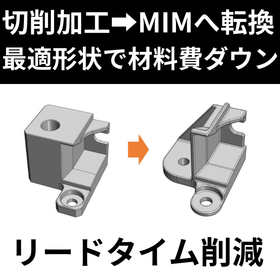
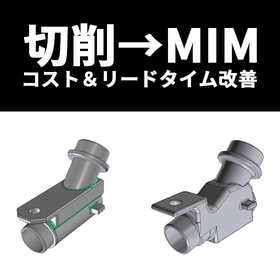
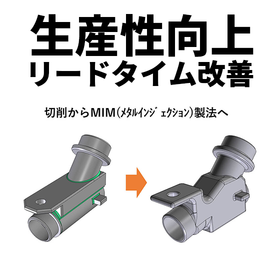
The image shows a case where the mass production capability was improved and lead time was reduced by switching parts that were traditionally machined to the MIM (Metal Injection Molding) method. Additionally, by reducing the material weight by nearly 90g through a process called "de-bulking," cost reduction was also achieved. ◎Product Overview - Material: SUS304L - Size: 40×35×35 - In the case of MIM, the product weight significantly affects the cost, so de-bulking is done as much as possible. 【Castem's MIM Method】 The MIM (Metal Injection Molding) method is a processing technique that mixes metal powder with an organic binder (resin) and injects it into a mold to produce metal parts in the desired shape. It excels in producing fine three-dimensional complex shapes with a wall thickness of up to 5mm and achieves a density of over 95%. It can accommodate orders in the millions and has superior mechanical strength compared to conventional sintered products. We are also advancing the in-house development of compounds made by mixing metal powder and binder, and obtained a U.S. patent in 1991. If you have any inquiries regarding the manufacturing of small metal parts, please feel free to contact us.
Added to bookmarks
Bookmarks listBookmark has been removed
Bookmarks listYou can't add any more bookmarks
By registering as a member, you can increase the number of bookmarks you can save and organize them with labels.
Free membership registration
The image shows an example of parts made using the lost wax casting method. Traditionally, these were machined parts, but by switching to precision casting using lost wax, we have improved mass production capabilities and achieved lead time reductions. Additionally, by reducing the material weight by over 100g, we have also made cost reductions possible. We are implementing quality measures such as addressing voids by ensuring uniform wall thickness and preventing burrs by creating recesses. ■ Case Details - Transition from SS440 machined parts to SCS14 lost wax products - Size: 84×36×36 - Reduction of over 100g in weight. Cost reduction through material cost savings - Measures against voids and burrs - Preventing burr formation in holes by ensuring that paper does not touch during gate finishing, while maintaining the seating surface of bolts Due to cost considerations, we have received many inquiries from customers considering switching from machining to precision lost wax casting. Depending on the desired size and application of the parts, we can also propose other methods such as MIM (Metal Injection Molding) and digital casting (moldless casting using 3D printed models). For any inquiries regarding metal parts, please feel free to consult with Castem. Please refer to the link below for our comprehensive company brochure.↓↓↓ https://saas.actibookone.com/content/detail?param=eyJjb250ZW50TnVtIjo0MTc4ODZ9&detailFlg=1&pNo=1
Added to bookmarks
Bookmarks listBookmark has been removed
Bookmarks listYou can't add any more bookmarks
By registering as a member, you can increase the number of bookmarks you can save and organize them with labels.
Free membership registration
The image is an illustration of the point where the wire has been cut. By visualizing the components and circuits used inside electronic devices, you can identify key points for wiring arrangements. It is possible to gain insights when enhancing the functionality, miniaturization, and lightweight design of devices. Castem offers CT scanning services using the Nikon MCT225. We can either hold your samples or allow you to scan them with our staff accompanying you. 【Transmittance Capability】 There are limitations on transmittance capability depending on the material. Resin: 170mm Aluminum: 70mm Titanium: 45mm Iron: 15mm Heavy Metals: Not possible to capture By performing a CT scan, it becomes possible to analyze internal defects, create 3D data, and measure internal dimensions. If you are interested, please feel free to contact us.
Added to bookmarks
Bookmarks listBookmark has been removed
Bookmarks listYou can't add any more bookmarks
By registering as a member, you can increase the number of bookmarks you can save and organize them with labels.
Free membership registration
【Manufacturing Method】 Digital Cast (Moldless Casting) 【Content】 This is an example used for vehicle development prototypes. In the process of new development, prototype verification is conducted before mass production! By using Digital Cast, not only can the initial costs associated with mold production be reduced, but quality concerns after mold creation can also be alleviated. 【What is Digital Cast?】 It is a manufacturing method that involves creating a resin model with a 3D printer and then producing metal products through a process similar to lost-wax precision casting using that model as a prototype. Castings can be handled in as little as one week, starting from just one piece. We offer proposals that provide benefits even in development and prototyping. We also accommodate custom orders from individual customers.
Added to bookmarks
Bookmarks listBookmark has been removed
Bookmarks listYou can't add any more bookmarks
By registering as a member, you can increase the number of bookmarks you can save and organize them with labels.
Free membership registration
A contemporary artist created a glass art piece about 10 centimeters tall, which was 3D scanned and then a 3D printed model was made, enlarged to about five times its original size. The super complex shape, which was accidentally created like candy art, was reproduced through casting. Since the installation location was near water, a highly corrosion-resistant duplex stainless steel "SCS11" was used. The final product was buffed to create a mystical form that blends into the space. 【What is Digital Casting?】 When prototype parts are needed during design changes in development, when there is no stock of parts and urgent replacements are necessary, or when original jigs are needed for on-site work… In such cases, creating metal products through traditional casting methods, considering cost and delivery time, is not a viable option. Therefore, if needed, we offer mold-less casting with the catchphrase "Just make it from one piece!" With no need for molds and zero mold costs, we have a delivery record of as short as one week, and we can custom-make cast products starting from just one piece. Since the original form is a 3D printed item, we can accommodate complex shapes and hollow products that cannot be manufactured with molds. This service is utilized across numerous industries, including aerospace, shipping, automotive, precision machinery, industrial equipment, medical, and construction, catering to requests for metal parts from both corporations and individual customers.
Added to bookmarks
Bookmarks listBookmark has been removed
Bookmarks listYou can't add any more bookmarks
By registering as a member, you can increase the number of bookmarks you can save and organize them with labels.
Free membership registration
■Information on CT Scan Contract Services■ At Castem, we offer CT scan services using the Nikon MCT225. By conducting CT scans, it is possible to analyze internal defects, create 3D data, and measure internal dimensions. We can either hold your samples or allow you to perform the scan with our staff accompanying you. 【Equipment Overview】 Nikon Solutions MCT225 Imaging Method: Cone Beam CT X-ray Source: 225kV Microfocus Tube Maximum Tube Output: 225W Maximum Focus Diameter: 3μm Magnification: 1.6× to 150× Resolution: 1.33 to 125μm X-ray Detector: 16bit 4M Pixel Flat Panel Detector (FPD) Maximum Sample Weight: 50kg (maximum 5kg for dimensional evaluation) 【Penetration Capability】 There are limitations to penetration capability depending on the material. Resin: 170mm Aluminum: 70mm Titanium: 45mm Iron: 15mm Heavy Metals: Not possible to scan
Added to bookmarks
Bookmarks listBookmark has been removed
Bookmarks listYou can't add any more bookmarks
By registering as a member, you can increase the number of bookmarks you can save and organize them with labels.
Free membership registration
A small-diameter hole shaped like a conical tube, with a tip diameter of φ0.3±0.05 and a length of 2.8 mm, has been achieved without machining. Additionally, there are no burrs inside, and it possesses the necessary strength to prevent chipping or breaking. When dealing with multiple pieces of this shape on a pin cushion through machining, the cost and time are significantly high. With our MIM technology, which allows for ultra-small precision molding, high-precision parts under 1 mm can be mass-produced without machining. 【What is MIM (Metal Injection Molding)?】 It is a method also known as metal powder injection molding. A mixture of metal fine powder and a binder is injected into a mold to create a shaped product, which is then subjected to debinding and high-temperature sintering in a vacuum furnace to produce metal products. We excel at obtaining ultra-small metal parts with high precision, complex shapes, and three-dimensional geometries that are difficult to machine. Our company is the only one in Japan that develops the raw materials used for MIM in-house. We will provide the best proposals for our customers using various technologies. Please feel free to contact us through our website for any inquiries regarding metal parts.
Added to bookmarks
Bookmarks listBookmark has been removed
Bookmarks listYou can't add any more bookmarks
By registering as a member, you can increase the number of bookmarks you can save and organize them with labels.
Free membership registration
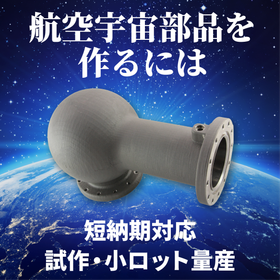
In the growing aerospace industry, we have numerous achievements in parts manufacturing. From over 70 types of steel in the top class of lost wax companies, we propose steel types and manufacturing methods that possess the necessary performance such as strength, heat resistance, and lightness! 【Castem's Lost Wax Developed Since Our Founding】 ■ Capable of mass production of complex shapes and three-dimensional curves at low cost ■ Pursue strength freely from two aspects: shape and material ■ Choose from over 70 types of special steel, stainless steel, copper alloys, aluminum alloys, etc. ■ Higher precision compared to other casting methods, reducing the number of processing steps 【Utilizing 3D Printed Models - Moldless Casting Digital Cast】 ■ Lead time for delivery is approximately 2 weeks (with the shortest record being 5 days) ■ A wide variety of steel types similar to lost wax ■ Moldless casting allows for production from one piece, ideal for prototypes ■ Capable of manufacturing small to medium and large parts ■ Rational prototype verification aimed at mass production casting 【Micro Mechanical Parts in Millions of Orders - MIM (Metal Injection Molding)】 ■ Small lot products under 3000 pieces are handled with low-cost dedicated molds for small lots ■ Wide-ranging support beyond standard MIM materials ■ All processes including precision machining, heat treatment, and plating are done in-house ■ Quick response to low cost, short delivery times, and design changes or corrections
Added to bookmarks
Bookmarks listBookmark has been removed
Bookmarks listYou can't add any more bookmarks
By registering as a member, you can increase the number of bookmarks you can save and organize them with labels.
Free membership registration
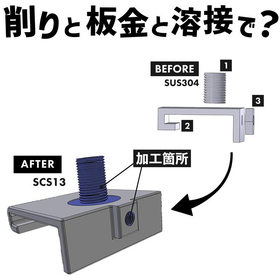
We need precision parts, but machining is costly... Multiple processes such as machining and welding are required, making it labor-intensive... We want to integrate multiple parts... Why not solve these concerns with 【Lost Wax Precision Casting】? 【Castem's Lost Wax Method】 "Lost Wax Precision Casting" specializes in complex three-dimensional shapes. Since our founding, we have continuously responded to customer inquiries for production, achieving over 35,000 types from simple to complex items. In response to various material requests, we have started handling over 70 types of steel, including stainless steel, copper, and aluminum. We also accommodate special steels and ultra-high-strength aluminum alloys (optimizing original casting for A7075). 【Cost Reduction Examples】 The thumbnail shows a cost reduction case achieved by changing the manufacturing method to lost wax casting, resulting in shape modification and integration. In conventional products, we manufactured through multiple processes including laser cutting, bending, machining, and welding, but we proposed integration using the lost wax method. This eliminates the hassle of managing processes between steps, reduces machining, and increases strength. By confirming the contact surface with the object and making that part convex, we reduced the dimensional management range, making quality control easier.
Added to bookmarks
Bookmarks listBookmark has been removed
Bookmarks listYou can't add any more bookmarks
By registering as a member, you can increase the number of bookmarks you can save and organize them with labels.
Free membership registration
By switching the manufacturing of metal parts, which were traditionally produced through cutting processes, to the MIM (Metal Injection Molding) method, we have improved mass production capabilities and reduced lead times. Additionally, by reducing the weight of the material, we have achieved cost reductions. Material: SUS304L Size: 17×13×8 ーーーーーーーCastem's MIM Methodーーーーーーーー 【Features】 We excel at producing fine, complex three-dimensional shapes and have superior mechanical strength compared to conventional sintered products. The surface is smooth, and the dimensional accuracy of the metal molded products is high. 【Cost Performance】 Over 90% of production is carried out at our wholly-owned overseas factories. We manufacture molds in-house, and depending on the lot size and shape, we offer multiple patterns for mold production, enabling proposals for reducing initial mold costs. 【High-Quality System】 Both domestic and overseas factories are ISO 9001 certified, ensuring a robust management system for quality control. With domestic staff stationed on-site, we have extensive experience in educating local staff and managing factory operations over many years. 【Risk Management】 We have multiple base factories in Japan, Thailand, the Philippines, and Colombia, which reduces dependency on a single factory. This broadens our options for response in emergency situations and contributes to stable supply.
Added to bookmarks
Bookmarks listBookmark has been removed
Bookmarks listYou can't add any more bookmarks
By registering as a member, you can increase the number of bookmarks you can save and organize them with labels.
Free membership registration
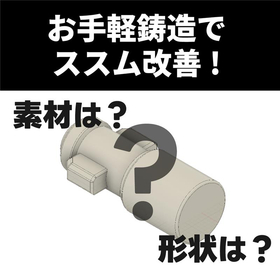
"Castings are not suitable for prototyping or small lot production." —Don't you think so? With Castem's "Digital Cast," you can produce casting parts from just one piece without molds by utilizing 3D printing. It offers high freedom of shape and can significantly reduce lead time, costs, and labor. 【Cost Reduction Example】 The part in the thumbnail is a CG manifold that was previously made by machining two parts and then welding them together. Additionally, due to the special material Inconel 625, it was sourced from overseas processing companies, making it a quite high-cost part in the past. However, by creating it as a single molded piece, we achieved a cost reduction of up to 80% and improved strength. "I want to verify shapes that cannot be achieved through machining" and "I want to test with the same material as the final product." We can solve these development challenges with our next-generation precision casting technology, Digital Cast. If you have 3D data, just leave the rest to us. We will provide precision cast products quickly!
Added to bookmarks
Bookmarks listBookmark has been removed
Bookmarks listYou can't add any more bookmarks
By registering as a member, you can increase the number of bookmarks you can save and organize them with labels.
Free membership registration
★Comparison of the Differences and Advantages between Moldless Casting "Digital Cast" and Metal 3D Printing "Digital Sinter"! In recent years, manufacturing technology for metal parts has evolved dramatically. Moldless casting methods and metal 3D printing are particularly attracting attention in our technology category. 【Advantages of Metal 3D Printing: Digital Sinter】 ■ Overwhelming Speed Digital Sinter has a lead time of about one week (with the shortest record being two days), making it very advantageous for prototypes and small-scale production that require urgent responses. ■ Strong in Producing Complex Shapes and Small Parts The maximum size it can accommodate is 80mm on each side, but it excels in manufacturing small and complex-shaped parts. It is ideal for small components in medical devices and electronic devices, as well as for developing very small quantities of parts. ■ Specific Steel Type Compatibility The materials that can be used are limited to SINTER T (SUS316L) and SINTER D (pure copper, SUS316L, SUS630). This allows for the rapid provision of difficult-shaped items. *This is a guideline for the maximum size and steel types based on our metal 3D printing service. 【What is the Best Metal Forming for Your Needs?】 We provide the optimal manufacturing method for your project, along with VE proposals, based on the purpose of part procurement (QCD) and specification conditions.
Added to bookmarks
Bookmarks listBookmark has been removed
Bookmarks listYou can't add any more bookmarks
By registering as a member, you can increase the number of bookmarks you can save and organize them with labels.
Free membership registration
★Comparison of the Differences and Advantages between Moldless Casting "Digital Cast" and Metal 3D Printing "Digital Sinter"! In recent years, manufacturing technologies for metal parts have evolved dramatically. Moldless casting methods and metal 3D printing are particularly attracting attention in our technology category. 【Advantages of Moldless Casting: Digital Cast】 ■Short Lead Time The lead time is only 2 weeks (with the shortest turnaround time being just 5 days). This helps shorten development periods and construction times. ■Wide Range of Metal Materials Available Digital Cast allows for the selection of over 70 types of materials (casting materials). It can accommodate a wide range of needs, including iron, stainless steel, aluminum, copper (including pure copper), special alloys (such as duralumin A7075 and Inconel), heat-resistant steel, tool steel, and high-speed steel. This provides designers with more flexible options. ■Manufacturing Capable from Small to Medium to Large Parts It can accommodate sizes up to 500 mm square. It is ideal for manufacturing small to medium and large parts. ■Rational Prototype Verification with an Eye on Mass Production Casting During mass production repeats, products are formed using the lost-wax precision casting method (our core technology), and it is a rational verification method to prototype and verify similar cast products before manufacturing, especially in terms of evaluating mechanical properties (such as strength confirmation).
Added to bookmarks
Bookmarks listBookmark has been removed
Bookmarks listYou can't add any more bookmarks
By registering as a member, you can increase the number of bookmarks you can save and organize them with labels.
Free membership registration
【Cost Reduction Examples through Shape Modification and Integration】 In conventional products, manufacturing involved multiple processes such as laser cutting, bending, machining, and welding. However, we propose integration through the lost-wax method. Since it can be produced using a single method, it eliminates the hassle of managing between processes, reduces machining through integration, and increases strength. Additionally, by checking the contact surface with the object and making that part convex, we reduce the dimensional management range, making quality control easier. 【Castem's Lost-Wax Method】 As a lost-wax manufacturer, we have a cumulative track record of over 30,000 molds, excelling in both simple shapes and complex three-dimensional shapes such as hollow, undercut, and gear shapes. We can accommodate various materials, including iron-based, stainless steel, copper, aluminum, and some customer-specified materials.
Added to bookmarks
Bookmarks listBookmark has been removed
Bookmarks listYou can't add any more bookmarks
By registering as a member, you can increase the number of bookmarks you can save and organize them with labels.
Free membership registration
Traditionally, it was a machined product, but by switching to lost-wax manufacturing, we have improved mass production capabilities and reduced lead times. Additionally, by removing unnecessary material, we are achieving weight reduction and reducing material costs. Furthermore, we are also reducing processing surfaces to keep processing costs down while maintaining quality. Material: S45C (precision casting) Size: 90×70×31
Added to bookmarks
Bookmarks listBookmark has been removed
Bookmarks listYou can't add any more bookmarks
By registering as a member, you can increase the number of bookmarks you can save and organize them with labels.
Free membership registration