[Season 2 Core] Chapter 9: Winning in Practice with GSM — Troubleshooting and High-Difficulty Surface Strategies
T3Japan
"Magic that deforms space itself. While the concept is wonderful, can it truly be used in practical high-difficulty surfaces?" — Engineers who understand the limits of general-purpose kernels tend to harbor skepticism towards spatial deformation. In areas like three-way intersections and complex fillet regions, half-hearted deformations can lead to data corruption.
This article explains advanced surface control to "win" with GSM under the stringent demands of practical applications. The main points are as follows:
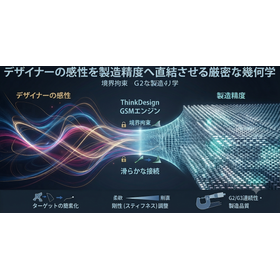
The science of "constraints": To prevent distortion during deformation, it is crucial to clearly lock the boundaries (neutral zones) of areas that should not be moved (such as partition surfaces and contact surfaces) and control the range of influence.
Techniques to navigate three-way intersections and fillet dense areas: Methods to achieve smooth connections that satisfy G2/G3 continuity while preventing local distortion through target simplification and stiffness adjustments.
Data reliability: The advantage of maintaining internal mathematical integrity even with complex deformations, allowing dynamically modified models to be directly linked to subsequent processes like mold design and NC data generation.
We will unveil a rigorous geometric approach that connects a designer's sensibility to manufacturing precision at the hundredth of a millimeter level.
Inquiry about this news
Contact Us OnlineMore Details & Registration
Details & Registration
Related Links
Nice to meet you, I'm Takachan, working in sales (which is more like a pre-sales role) at ThinkDesign. Usually, I listen to clients' desires for "the kind of service they want to create" and bridge the gap to turn those into a "concrete blueprint" that engineers and designers can follow without hesitation.
Distributors