- Publication year : 2026
1~24 item / All 24 items
Displayed results
Added to bookmarks
Bookmarks listBookmark has been removed
Bookmarks listYou can't add any more bookmarks
By registering as a member, you can increase the number of bookmarks you can save and organize them with labels.
Free membership registrationContact this company
Inquiry Form1~24 item / All 24 items
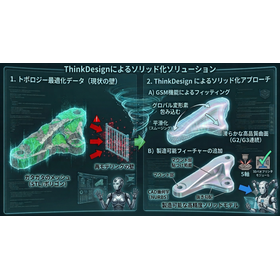
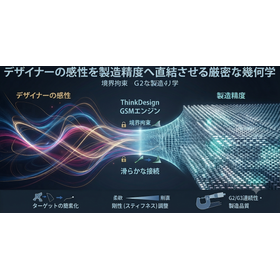
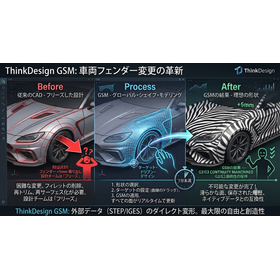
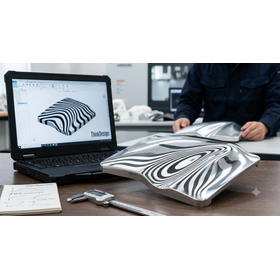
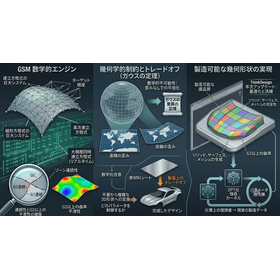
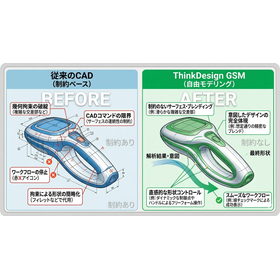
DPT Corporation's 3D CAD "ThinkDesign" achieves a high level of coexistence between the "beauty of surfaces (elegance)" pursued by Japanese manufacturing and manufacturing requirements through its unique "GSM (Global Shape Modeling)" technology. Typically, creating smooth surfaces such as "G2 (curvature continuous)" and "G3 (curvature change rate continuous)" required in automotive design and home appliances has been a complicated process in traditional CAD, involving cumbersome post-processing and the risk of data corruption, akin to "artisan skills." However, GSM simultaneously resolves "deformation" and "ensuring continuity" in real-time. By simply moving the constraints (targets) defined by the designer, the system automatically redefines beautiful surfaces that meet the boundary conditions. Furthermore, through the integration with "zone modeling," it is possible to make dynamic local changes while keeping existing design lines intact, all completed with just drag operations. This provides an environment where the intuition of veteran designers can be intuitively replicated by younger engineers. "Technical constraints must not stifle the designer's sensibility." DPT Corporation protects its self-developed kernel as a "sanctuary" and promotes the democratization of the design environment.
Added to bookmarks
Bookmarks listBookmark has been removed
Bookmarks listYou can't add any more bookmarks
By registering as a member, you can increase the number of bookmarks you can save and organize them with labels.
Free membership registration
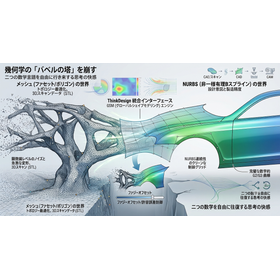
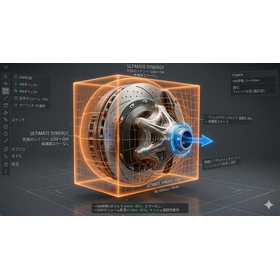
3D CAD "ThinkDesign" proposes an innovative modeling method that fundamentally resolves the challenges of "complex fillet processing" and "rebuild errors in past history modifications" that have troubled designers with traditional history-based CAD. The goal of this software is to create a world where the system follows the designer's intent, rather than the human adapting to the system's limitations. By utilizing "Target Driven Design," which derives smooth surfaces from the continuity with surrounding faces instead of numerical input, it achieves fillets without geometric breakdowns. Furthermore, with "ISM (Interactive Solid Modeling)," which goes beyond direct modeling, it allows for direct manipulation of surfaces and redefinitions even with data imported from other CAD systems that lack history. The fusion of ISM, which handles local operations, and "GSM," which excels at large-scale deformations, enables simultaneous execution of overall volume changes and specific location adjustments as mathematically correct solids, even after complex fillet processing. By 2026, fillets and shape modifications will evolve from being a "struggle" that hinders designers to a "joy of finishing" that materializes at the speed of thought.
Added to bookmarks
Bookmarks listBookmark has been removed
Bookmarks listYou can't add any more bookmarks
By registering as a member, you can increase the number of bookmarks you can save and organize them with labels.
Free membership registration
The reason ThinkDesign's "GSM" continues to be a solitary presence is not merely due to the superiority of its functions, but rather the fundamental difference in its design philosophy. While many CAD systems rely on "borrowed hearts" (general-purpose kernels) like Parasolid or ACIS, which face limitations such as rebuild errors due to their specifications and "the curse of history" when it comes to bold shape transformations, ThinkDesign adheres to its own "in-house developed kernel." This allows for direct deformation of the entire model in a dimension completely independent of the hierarchy of history, akin to tectonic shifts. Furthermore, unlike simple shape distortion in CG, it achieves both "surface quality suitable for molds" and "mathematical rigor" necessary for manufacturing through real-time high-order simultaneous equations. For modern designers constrained by general-purpose engines and rushed to create data tailored to CAD's convenience, GSM represents a philosophy to reclaim the "freedom to pursue the ideal shape," becoming an overwhelming advantage that others cannot easily penetrate.
Added to bookmarks
Bookmarks listBookmark has been removed
Bookmarks listYou can't add any more bookmarks
By registering as a member, you can increase the number of bookmarks you can save and organize them with labels.
Free membership registration
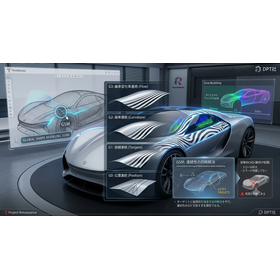
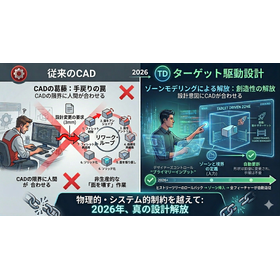
This is an overview of an article explaining the groundbreaking feature of the 3D CAD software "ThinkDesign," known as "Zone Modeling." In traditional 3D modeling, even minor design changes lead to unproductive "rework," such as the removal of fillets or the disassembly and reassembly of surfaces, placing a significant burden on designers. In contrast, "Zone Modeling" provided by ThinkDesign allows designers to define boundary lines that they do not want to deform as "constraints," enabling them to achieve reliable and bold shape changes solely within those boundaries. The strength of this feature lies in its ability to finely control constraints at boundary positions (G0/G1/G2 continuity) and smoothly blend the effects of deformation into surrounding surfaces through "disciplined fade-out." This is supported by an intelligent in-house developed kernel that solves complex simultaneous equations in real-time. Designers only need to define the "target" area they want to move and the "constraints" they want to protect, and subsequent features are automatically updated after changes to the model structure. This innovative modeling method frees designers from physical and systemic constraints, truly unleashing their creativity, and presents a practical roadmap for its implementation.
Added to bookmarks
Bookmarks listBookmark has been removed
Bookmarks listYou can't add any more bookmarks
By registering as a member, you can increase the number of bookmarks you can save and organize them with labels.
Free membership registration
This is an explanatory article discussing the technical advantages and design philosophy of GSM (Global Shape Modeling), which is a core feature of the 3D CAD software "ThinkDesign." The main characteristic is the liberation from the stresses of "dependency on history" and "rebuild errors" that traditional CAD systems have faced. The author compares the experience of using GSM to enveloping complex models in "transparent jelly," allowing them to be transformed flexibly in space. This method illustrates how shapes can be intuitively controlled while maintaining surface continuity and quality. Additionally, it introduces "Target Driven Design," which serves as the technical foundation. This approach allows users to define target points or curves, enabling the in-house developed kernel to instantaneously derive mathematically correct optimal solutions. The article provides specific examples, such as "improving aerodynamics while maintaining mounting holes" in racing car body design, highlighting how this tool evolves the designer's role from "simple tasks" to "pure decision-making."
Added to bookmarks
Bookmarks listBookmark has been removed
Bookmarks listYou can't add any more bookmarks
By registering as a member, you can increase the number of bookmarks you can save and organize them with labels.
Free membership registration
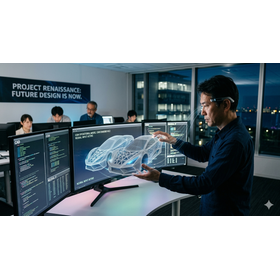
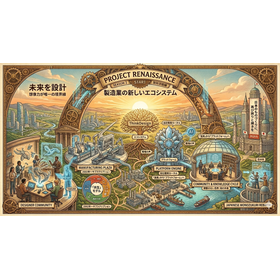
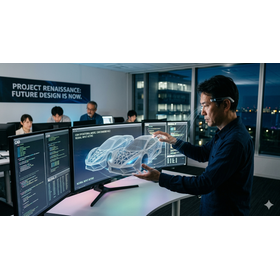
"Project Renaissance" is a challenge to evolve CAD from a mere "design tool" into a "new platform for manufacturing" where designers, manufacturers, and society are organically connected. The "barriers of craftsmanship" that were once debated regarding the introduction of CG software have been overcome through the evolution and proliferation of digital tools. Now, our goal is to eliminate the "barriers of business" that lie ahead. Currently, in Japan's manufacturing industry, while each department enhances its specialization, friction and rework between departments have become obstacles to projects. By utilizing ThinkDesign from the design stage and allowing designers themselves to evaluate and modify, we aim to build an ecosystem that ends this division. Through collaboration with AI and a community that fosters the circulation of knowledge, we will maximize designers' creativity and restore pride and brilliance to Japan's manufacturing. In Season 2, we will delve deeper into the technical superiority of the shape manipulation engine "GSM," which is at the core of this transformation.
Added to bookmarks
Bookmarks listBookmark has been removed
Bookmarks listYou can't add any more bookmarks
By registering as a member, you can increase the number of bookmarks you can save and organize them with labels.
Free membership registration
What is the true criterion for choosing 3D CAD? In many fields, it is often classified as "mid-range" or "high-end" based on price, but the essential optimal solution lies in the design's purpose: "What do we want to achieve and for what reason?" This article explains the advantages of ThinkDesign, which features a rare "in-house developed kernel" and enables freeform modeling through its unique Global Shape Modeling (GSM). It delves into the essence of "Project Renaissance," which aims to open up the highest-level design environment, previously monopolized by a few companies with vast capital, to a more accessible infrastructure through realistic investment. Regardless of the size of the company, independent designers and local workshops that focus on precision down to the millimeter can compete with major manufacturers on equal terms, presenting a "possibility of reversal." It breaks down the disparity in tools caused by capital power, allowing all engineers to compete purely based on creativity in manufacturing. This vision for a new design environment in 2026 is presented.
Added to bookmarks
Bookmarks listBookmark has been removed
Bookmarks listYou can't add any more bookmarks
By registering as a member, you can increase the number of bookmarks you can save and organize them with labels.
Free membership registration
As of 2026, the transition to software subscriptions is accelerating, but in fact, ThinkDesign has been a pioneer in paving the way for this in Japan since 2002. At that time, in the 3D CAD industry, which imposed high initial costs, our goal in fully implementing subscriptions was to free the design field from the shackles of "high initial investment" and to provide the necessary functions when needed. We believe that it is important to go beyond the binary debate of "high-end" versus "mid-range" and focus on the lineage and performance of the kernel. ThinkDesign maintains an environment where designers can always use the latest technology as "high-end CAD at an affordable price." This is not just a billing model; it is a form of "trustful coexistence" that supports designers' challenges and continues to evolve together.
Added to bookmarks
Bookmarks listBookmark has been removed
Bookmarks listYou can't add any more bookmarks
By registering as a member, you can increase the number of bookmarks you can save and organize them with labels.
Free membership registration
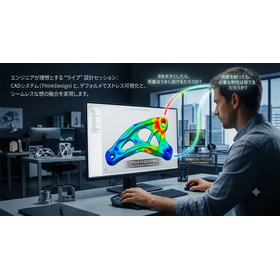
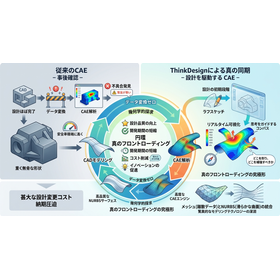
The transition from 2D to 3D in the early 1990s brought about reliable information transfer and efficiency in later processes. However, in today's world where 3D has become the norm, design environments are facing new challenges such as error handling in history corrections, the "communication divide" caused by discrepancies between designers' "sensibilities" and engineers' "numbers," and the inability to reproduce analysis results in CAD models. This article will explain approaches to overcome these challenges and lead design into the next dimension. Global Shape Modeling (GSM), which allows intuitive shape changes without being constrained by history, incorporates a fourth dimension of "time (Speed)" into the design process. Furthermore, ThinkDesign's "Open Architecture" collaborates with optimization tools, enabling CAD to automatically deform based on analysis results, thereby achieving a fifth dimension of "optimal solutions (Optimization)." We will unravel the full picture of a high-dimensional design environment that graduates from command operations and directly manipulates the "intent of the product" to simulate the future.
Added to bookmarks
Bookmarks listBookmark has been removed
Bookmarks listYou can't add any more bookmarks
By registering as a member, you can increase the number of bookmarks you can save and organize them with labels.
Free membership registration
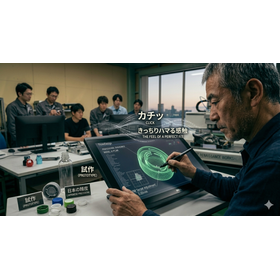
The "click" sensation that Japanese manufacturing proudly delivers at your fingertips. Its essence lies in the "obsession" of designers who meticulously focus on differences as small as 0.05mm. This article unravels the stories of four "ultimate tools" where designers are freed from the constraints of CAD and directly embody their obsession. - Honma Golf: Reproducing the "sensual curves" demanded by premium brands 100% digitally through GSM (Global Shape Modeling). - SHOEI: Achieving both extreme aerodynamic performance and beautiful surface quality akin to a work of art. Realizing high-precision surfaces that directly lead to mold production. - TOM'S: Responding to the development speed required in the racing world by quickly and accurately feeding back analysis (CFD) results into CAD models. - Mikasa Industries: In designs where aesthetic curves and precise fits coexist, a full hybrid environment directly contributes to shortening development time. What is common among these cases is the fact that designers are not conforming to the "convenience of CAD," but rather "CAD is following the will of the designer." Graduating from CAD as a "drafting tool" and returning to it as a "thinking tool" that accelerates designers' thoughts will lead Japanese manufacturing into the next generation.
Added to bookmarks
Bookmarks listBookmark has been removed
Bookmarks listYou can't add any more bookmarks
By registering as a member, you can increase the number of bookmarks you can save and organize them with labels.
Free membership registration
"Is that operation the limit of CAD? Or is it the limit of imagination?" To end the era of being worn out by the shackles of history and rebuild errors in the field of 3D design, ThinkDesign rises again. In the series "Project Renaissance," which started on Zenn, we thoroughly explain the "magical shape manipulation engine: GSM" that directly shapes engineers' intuition. Distinguished from mid-range CAD that operates using generic engines from other companies, our purebred "in-house developed kernel" brings overwhelming performance. At its core lies the philosophy of "Target Driven Design," which respects the designer's intent and balances complex designs with precise geometric calculations. This series is not just an introduction to tools; it is a record of the renaissance that allows designers to return from "tasks" to "decision-making" in the manufacturing industry of 2026. Experience a new design paradigm that unleashes your creativity.
Added to bookmarks
Bookmarks listBookmark has been removed
Bookmarks listYou can't add any more bookmarks
By registering as a member, you can increase the number of bookmarks you can save and organize them with labels.
Free membership registration
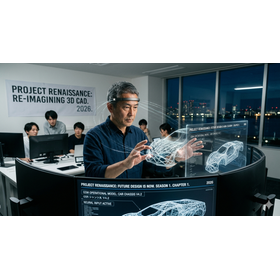
Chapter 1's theme is "The Reason to Reassess 3D CAD in 2026." Why is a new challenge necessary now in a CAD market that should be mature? It is because many engineers are misled to believe that "system constraints" are "their own limitations." In this series, we will thoroughly dissect the true value of the magical engine "GSM," which liberates designers from the shackles of history, and "Target Driven Design," which derives shapes from purposes, while unraveling the lineage of ThinkDesign, which possesses a rare "in-house developed kernel." We aim to eliminate the disparity in precision caused by capital power and move towards the "democratization of the design environment," where everyone can access top-tier tools. In 2026, a long journey begins now for Japanese manufacturing to regain its pride once again.
Added to bookmarks
Bookmarks listBookmark has been removed
Bookmarks listYou can't add any more bookmarks
By registering as a member, you can increase the number of bookmarks you can save and organize them with labels.
Free membership registration
In this chapter, we trace back to the "Eureka Gold" era, the origin of ThinkDesign, and delve into the core of the high-end modeling philosophy that has been cultivated. The technology created by Cad.Lab has always stood out in the history of 3D CAD. In particular, the operability that allows for the manipulation of freeform surfaces retains an overwhelming advantage that remains relevant in modern design environments. Unraveling how the ideal of a "tool that does not hinder the designer's thinking" pursued by the developers of that time was shaped is not merely nostalgia. It is an important process for rediscovering the "essence of shape creation" in the increasingly complex modern manufacturing landscape. In the latter half, we will explain the latest interfaces that inherit and elevate that DNA, as well as the advantages of the evolved GSM. What is the "true creativity" that emerges from not denying past excellent assets but rather integrating them with the latest technologies? This will be an extremely important episode that connects our origins and future at the beginning of a project that spans 80 chapters in total.
Added to bookmarks
Bookmarks listBookmark has been removed
Bookmarks listYou can't add any more bookmarks
By registering as a member, you can increase the number of bookmarks you can save and organize them with labels.
Free membership registration
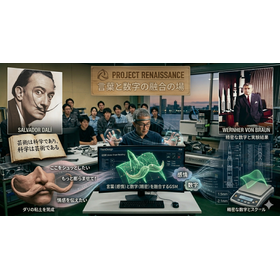
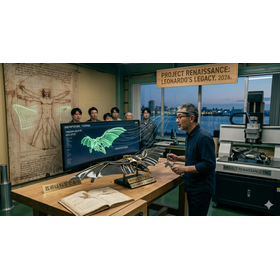
"Why CAD from Italy?" It is neither the rationality of America nor the discipline of Germany. What ThinkDesign has pursued is a unique history where the sensibility of Italy's "Motor Valley," known for its world-class aesthetic beauty, fuses with Japan's "artisan spirit," which allows for no compromise even in fractions of a millimeter. Once, a designer from Pininfarina spoke of the design truth embodied in the "wedge shape" of Ferrari. And the extreme demands posed by Japanese automakers to "manipulate surfaces with highlight lines." This article delves into how the Italian approach of "freely kneading virtual clay" has been sublimated into a "high-end tool" that convinces the rigorous manufacturing environment of Japan. The "harmony of art and science" preached by the Renaissance master Da Vinci is now applied to modern 3D design. Here lies the "true essence of design" that we are trying to reclaim through ThinkDesign. ▼ Read the full article here https://zenn.dev/t3japan/articles/da65cb32ba271e
Added to bookmarks
Bookmarks listBookmark has been removed
Bookmarks listYou can't add any more bookmarks
By registering as a member, you can increase the number of bookmarks you can save and organize them with labels.
Free membership registration
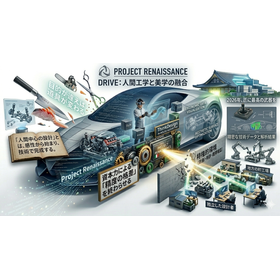
"I want to slightly expand this." Is the designer's intuition being dulled by the system constraints of managing history and constraints? Design is fundamentally "the process of thinking that shapes value," and CAD operations should be its output device. However, in many workplaces, designers have transformed into operators of "cleaning tools." Our Project Renaissance promotes the 3D CAD "ThinkDesign," which resolves this "disconnection between thought and operation." "GSM" allows you to directly grasp surfaces without worrying about history, materializing intuition with 1mm precision. "ISM" enables even data from other companies to be edited as freely as clay in your hands. Here, we provide an environment that evolves CAD from a "cleaning tool" to a "thinking tool," allowing designers to regain their original creativity. The days of trying to appease CAD are over. It's time to design that shapes your thoughts directly. ▼ Read the full article here https://zenn.dev/t3japan/articles/22a320cb458f35
Added to bookmarks
Bookmarks listBookmark has been removed
Bookmarks listYou can't add any more bookmarks
By registering as a member, you can increase the number of bookmarks you can save and organize them with labels.
Free membership registration
[Design Philosophy] Are you compromising with only "shapes that can be made"? In modern manufacturing, "efficiency" is the supreme proposition. However, in the pursuit of creating data in the shortest time possible, are we not discarding the "dignity of design" that should inherently exist? Many of you may have experienced being rejected by CAD while trying to pursue freeform surfaces, reluctantly compromising with combinations of straight lines. In essence, design is not about creating shapes that are easy to draw with CAD commands; it is about materializing the "thought" that engineers have embedded. In this technical column, we explained the concept of "GSM (Global Shape Modeling)" that we have been refining for many years, focusing on how to reclaim the "sovereignty of design" that designers have been on the verge of losing. If you are seeking a new way of design that breaks free from "design dominated by tools" and does not limit creativity, please take a moment to read this. ▼ Read the full article here https://zenn.dev/t3japan/articles/16cd23736d2868
Added to bookmarks
Bookmarks listBookmark has been removed
Bookmarks listYou can't add any more bookmarks
By registering as a member, you can increase the number of bookmarks you can save and organize them with labels.
Free membership registration
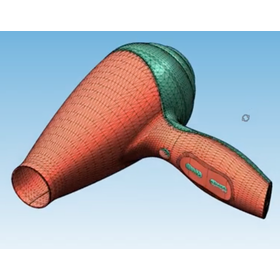
The process that was once given up on because "mesh data cannot be processed" may become a thing of the past. In the video we are introducing this time, the latest hybrid modeling technology is showcased using a model of a hairdryer with complex curves. What is noteworthy is that right after the mesh is divided and solidified, operations such as hollowing out through set operations and creating bosses with specified axes are carried out extremely smoothly. The process of meticulously building the inner structure while displaying cross-sections is accompanied by careful explanations, conveying a clear evolution of the technology. This demonstration holds the potential to dramatically streamline traditional workflows and is a must-see for engineers. (Search term: Search for "T3Japan Full Hybrid Solid" on YouTube)
Added to bookmarks
Bookmarks listBookmark has been removed
Bookmarks listYou can't add any more bookmarks
By registering as a member, you can increase the number of bookmarks you can save and organize them with labels.
Free membership registration
Introduction to the ThinkDesign Official YouTube Channel When learning to operate 3D CAD, the struggle with "understanding the details of movements" is common. This channel is an official knowledge base that condenses the know-how of the Italian-born design tool "ThinkDesign" into videos. [To ThinkDesign Users] We provide immediate solutions to practical questions like "How do I use this command?" By accessing each video through the QR code in the catalog, you can always check the demonstrations by dedicated instructors, dramatically enhancing the efficiency of self-learning and in-house training. [To Those Considering Implementation] You can check the highly flexible modeling and powerful support features specialized for the manufacturing industry (such as casting and forging) on the operation screen. By using the catalog and videos together, you can concretely envision the optimization of operations and design processes after implementation. From advanced techniques to the latest information, this channel is packed with tips to accelerate your design. We hope you take full advantage of it.
Added to bookmarks
Bookmarks listBookmark has been removed
Bookmarks listYou can't add any more bookmarks
By registering as a member, you can increase the number of bookmarks you can save and organize them with labels.
Free membership registration
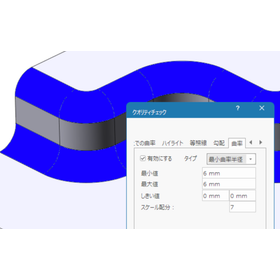
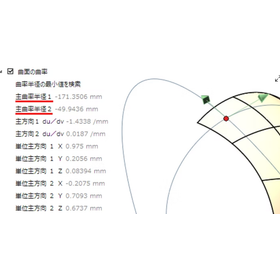
The "minimum curvature radius," which is essential for evaluating surface quality. However, the calculation logic varies depending on the shape. We compare and verify the adoption processes for cases where the principal curvature is zero, positive, and negative. We organized the nature of the intuitive discomfort from a mathematical perspective and condensed it into practical knowledge.
Added to bookmarks
Bookmarks listBookmark has been removed
Bookmarks listYou can't add any more bookmarks
By registering as a member, you can increase the number of bookmarks you can save and organize them with labels.
Free membership registration
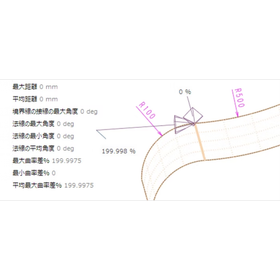
Are you using the ThinkDesign continuity check command without fully understanding it? In the "surface-to-surface" evaluation, the orientation of the surfaces (normals) greatly affects the numerical results. When an extreme value of 180 degrees appears, is it an error or just a display specification? In this seminar video, we will explain in three minutes the key points to avoid common mistakes that beginners tend to make and how to correctly interpret the results. By visually understanding the logic behind the calculations, you can achieve reliable surface evaluations without confusion. This is a must-watch for those who want to balance speed and accuracy in design!
Added to bookmarks
Bookmarks listBookmark has been removed
Bookmarks listYou can't add any more bookmarks
By registering as a member, you can increase the number of bookmarks you can save and organize them with labels.
Free membership registration
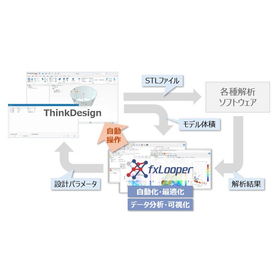
The general optimization software "fxLooper 3.4.0" developed by Anotherworker Co., Ltd. has added the 3D CAD software "ThinkDesign" to its lineup of supported CAD software. fxLooper is a Japan-origin general optimization and automation platform that collaborates with CAD and CAE software to derive the "correct answer" from a vast array of patterns. "ThinkDesign" is a next-generation 3D design platform that merges its unique "Global Shape Modeling (GSM)" with "Hybrid Modeling." ThinkDesign users will be able to utilize the design optimization workflow using fxLooper.
Added to bookmarks
Bookmarks listBookmark has been removed
Bookmarks listYou can't add any more bookmarks
By registering as a member, you can increase the number of bookmarks you can save and organize them with labels.
Free membership registration
Uncover the true nature of "that point" with numbers. ~Health check for curves, surfaces, and meshes, local information command~ No more guesswork! Attack with "points" of local information. Even if the connections between curves look nice, we want to avoid the tragedy of a bumpy interior. That's where this command comes in handy. By pinpointing and quantifying the desired location, what once felt "somehow good" transforms into "backed by evidence, it's a definite OK!" It's a slightly niche but incredibly useful feature that substantiates your preferences with numbers.
Added to bookmarks
Bookmarks listBookmark has been removed
Bookmarks listYou can't add any more bookmarks
By registering as a member, you can increase the number of bookmarks you can save and organize them with labels.
Free membership registration
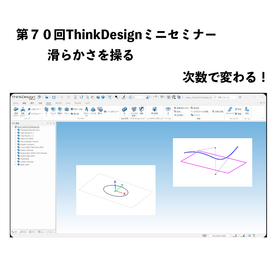
Welcome to the 70th ThinkDesign Mini Seminar! This time, we will thoroughly explain the essential concept of "degree," which is crucial for achieving high-quality modeling. In ThinkDesign, when creating curves and surfaces, there are many instances where you are required to specify "degree, continuity, and number of segments" within the commands. Are you setting these values based on a vague intuition? In fact, these numbers are the key determinants of the "beauty" and "usability" of the elements. In this video, we will particularly focus on "degree" and introduce it to you! - How does changing the degree affect the curve? - The relationship with control points and the underlying calculations - How to choose the appropriate degree that is useful in practice We will clearly explain these points again. By correctly understanding the meaning of degree, you will be able to create smooth surfaces without any bumps and develop smart data that is resilient to modifications. This content is a must-see for those who want to acquire a higher level of modeling skills. Please watch until the end and utilize it to improve the quality of your daily design workflow!
Added to bookmarks
Bookmarks listBookmark has been removed
Bookmarks listYou can't add any more bookmarks
By registering as a member, you can increase the number of bookmarks you can save and organize them with labels.
Free membership registration
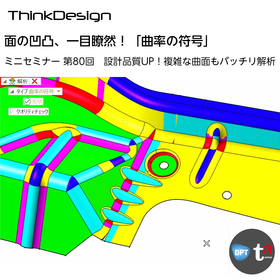
Points of the Curvature Sign Command This command calculates the product (Gaussian curvature) and sum (mean curvature) of the principal curvatures at each point on the surface and visualizes the state of the surface using color coding. Immediate Judgment of Convexity: It allows for instant identification of whether the surface corresponds to "convex (hill)," "concave (valley)," or "saddle shape (like a horse saddle)." Quality Check: It is ideal for confirming whether the curvature is not inverted at the seams of patches and whether unintended "gaps" or "waves" have occurred. Mold Consideration: It helps in understanding the properties of the surface before selecting tools during processing or considering draft angles.
Added to bookmarks
Bookmarks listBookmark has been removed
Bookmarks listYou can't add any more bookmarks
By registering as a member, you can increase the number of bookmarks you can save and organize them with labels.
Free membership registration