Season 3 [Fusion] Chapter 6: Into the Era of Fusion of Dissimilar Materials - The Ultimate "Curvature" Demanded by Multi-Materials and Composites
T3Japan
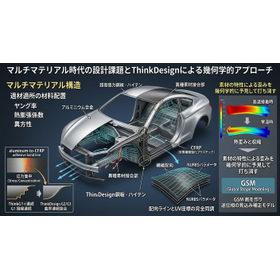
In the lightweighting of automobiles and the development of next-generation mobility, the "multi-material approach," which optimally arranges ultra-high-strength steel sheets, aluminum, CFRP, and other materials, has become essential. However, design challenges that are difficult to address with conventional CAD have emerged, such as stress concentration at joints of dissimilar materials, the utilization of the anisotropy of composite materials (fiber orientation), and warping and delamination due to differences in thermal expansion.
The 3D CAD "ThinkDesign" solves these challenges with advanced geometric processing technology.
G2/G3 continuity (curvature control): By eliminating curvature discontinuities at joint boundaries and creating geometric "stress relief," durability is significantly improved.
High-quality NURBS and GSM: Achieves shape optimization that fully synchronizes the surface UV parameters with the fiber orientation of CFRP, extracting 100% of material performance.
GSM prediction correction: Automatically generates high-precision prediction models that apply reverse phase vectors against thermal shrinkage and dissimilar material strain calculated by CAE.
Our unique technology, which "redirects forces through geometry and anticipates and cancels out distortions," maximizes the potential of materials and strongly supports the development of next-generation lightweight and high-rigidity bodies.
Inquiry about this news
Contact Us OnlineMore Details & Registration
Details & Registration
Related Links
Nice to meet you, I'm Takachan, working in sales (which is more like a pre-sales role) at ThinkDesign. Usually, I listen to clients' thoughts on "the kind of service they want to create" and bridge the gap to turn those ideas into a "concrete blueprint" that engineers and designers can execute without hesitation.
Distributors