Season 4 Chapter 3: A Method for Translating "Sensory Evaluation" of Appliance Design into 3D Data
T3Japan
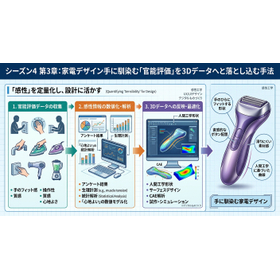
The "fitting sensation" that conforms to the human hand is an important quality that influences purchasing decisions and satisfaction with home appliances. However, there has been a challenge where the organic shapes refined by designers through prototypes like clay models lose their delicate nuances when converted to traditional 3D CAD data in exchange for "geometric correctness."
The unique feature GSM (Global Shape Modeling) of the 3D CAD "ThinkDesign" addresses this gap between sensibility and engineering.
* **Maintaining Surface Continuity**: The entire curved surface can be directly deformed while preserving smooth joints between surfaces (G2/G3 continuity).
* **Integration with 3D Scanning**: CAD surfaces can instantly adhere to scan data, enabling intuitive positional adjustments.
* **Real-Time Analysis**: Micron-level fine-tuning is possible while checking light reflections with zebra highlights and other tools.
* **Avoiding Internal Interference**: Even when there is interference with mechanical parts, the design surface can be flexibly corrected without compromising aesthetics.
By utilizing GSM, it is possible to elevate high-precision mass production CAD data without compromising the sensory evaluation of human perception, enabling the next generation of product design that merges sensibility and digital technology.
Inquiry about this news
Contact Us OnlineMore Details & Registration
Details & Registration
Related Links
Nice to meet you, I'm Takachan, working in sales (which is more like a pre-sales role) at ThinkDesign. Usually, I listen to clients' desires for "the kind of service they want to create" and act as a bridge to translate that into a "concrete blueprint" that engineers and designers can easily bring to life.
Distributors