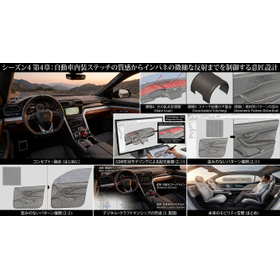
Season 4 Chapter 4: Design control from the texture of automotive interior stitching to the subtle reflections of the dashboard.
T3Japan
In automotive interior design, it is necessary to achieve a high-level balance between "safety engineering," such as driver visibility and light distribution control, and "sensory quality," which pursues textures and tactile sensations like genuine leather seats and grain patterns. However, in conventional CAD environments, technical barriers such as micron-level surface corrections to prevent dashboard reflections on the windshield, the vast placement of three-dimensional stitches on complex 3D curved surfaces, and distortion control of geometric patterns due to curvature changes have caused significant rework and data expansion.
The 3D CAD "ThinkDesign," through its unique surface control algorithm called GSM (Global Shape Modeling), enables surface deformation according to optical analysis results while maintaining high continuity (G2/G3) with surrounding surfaces. Furthermore, by utilizing a high-precision mapping function that considers surface stretching, "GSM Associative Projection," and a lightweight graphic engine, it can maintain responsiveness even with tens of thousands of stitch placements.
ThinkDesign achieves precise control of light and the expression of genuine leather texture at a fraction of a millimeter, enabling the transformation of high-quality engineering data that meets mass production and safety requirements without compromising the designer's aesthetic sensibility.
Inquiry about this news
Contact Us OnlineMore Details & Registration
Details & Registration
Related Links
Nice to meet you, I'm Takachan, working in sales (which is more like a pre-sales role) at ThinkDesign. Usually, I listen to clients' desires for "the kind of service they want to create" and act as a bridge to translate those into a "concrete blueprint" that engineers and designers can easily bring to life.
Distributors