Season 4 Chapter 7: The Creation of Ergonomic Curves that Fit the Organic Skeleton of Medical Device Humans
T3Japan
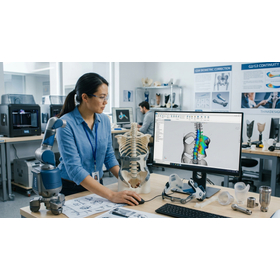
The biggest challenge in the design of medical devices and healthcare products is fitting CAD data into the "human body space," where straight lines do not exist. The large-volume polygon (STL) data obtained from CT/MRI, etc., is difficult to read and manipulate with conventional CAD, and there are limitations such as feature breakdown when deforming to match individual shapes for each patient.
ThinkDesign directly merges mesh data with solids/surfaces. With its unique GSM (Global Shape Modeling) technology, it accurately performs "morphing deformation" of the entire model into the contours of the skeleton without breaking the history. This enables the design of custom implants that fit precisely to each patient's skeleton and advanced ergonomic grips. Furthermore, it allows for real-time visualization and verification of the complete G2/G3 continuity required for sliding surfaces.
If you are struggling with the use of biological data or if you are a designer looking to significantly reduce the development time for personalized medical devices, please check out the article on note.
Inquiry about this news
Contact Us OnlineMore Details & Registration
Details & Registration
Related Links
Nice to meet you, I'm Takachan, working in sales (which is more like a pre-sales role) at ThinkDesign. Usually, I listen to clients' desires for "the kind of service they want to create" and bridge the gap to turn those into a "concrete blueprint" that engineers and designers can follow without hesitation.
Distributors