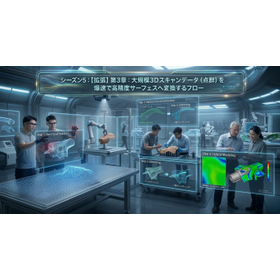
Season 5: [Expansion] Chapter 3: A Flow for Rapidly Converting Large-Scale 3D Scan Data (Point Clouds) into High-Precision Surfaces
T3Japan
With the evolution of 3D scanning, it has become easy to obtain tens of millions of point clouds and high-density meshes. However, in the field, converting meshes to surfaces can take days, and without a history, corrections must start from scratch. Reverse engineering faces three challenges: operational delays due to data bloat, manual noise filtering, and the inability to edit due to subdivision patches from automatic surfacing. This paper explains a four-step workflow to solve these issues. In Step 1, outlier removal and adaptive reduction reduce the point cloud to less than 1/10 of its original size. In Step 2, cross-section curves are extracted to construct a skeletal line that ensures continuity (G0 to G2). Step 3 involves Global Shape Modeling (GSM), where basic surfaces are fitted to the scanned data while maintaining mathematical continuity. In Step 4, hybrid modeling of solids and surfaces is completed, and accuracy is verified within ±0.05mm through deviation analysis. High-end CAD that can handle heavy meshes smoothly and integrate seamlessly is crucial, with examples showing that tasks taking three days can be completed in half a day. It concludes that with the right flow and tools, anyone can achieve high-precision B-Rep surfaces.
Inquiry about this news
Contact Us OnlineMore Details & Registration
Details & Registration
Related Links
Nice to meet you, I'm Takachan, working in sales (which is more like a pre-sales role) at ThinkDesign. Usually, I listen to clients' desires for "the kind of service they want to create" and act as a bridge to translate those into a "concrete blueprint" that engineers and designers can easily bring to life.
Distributors